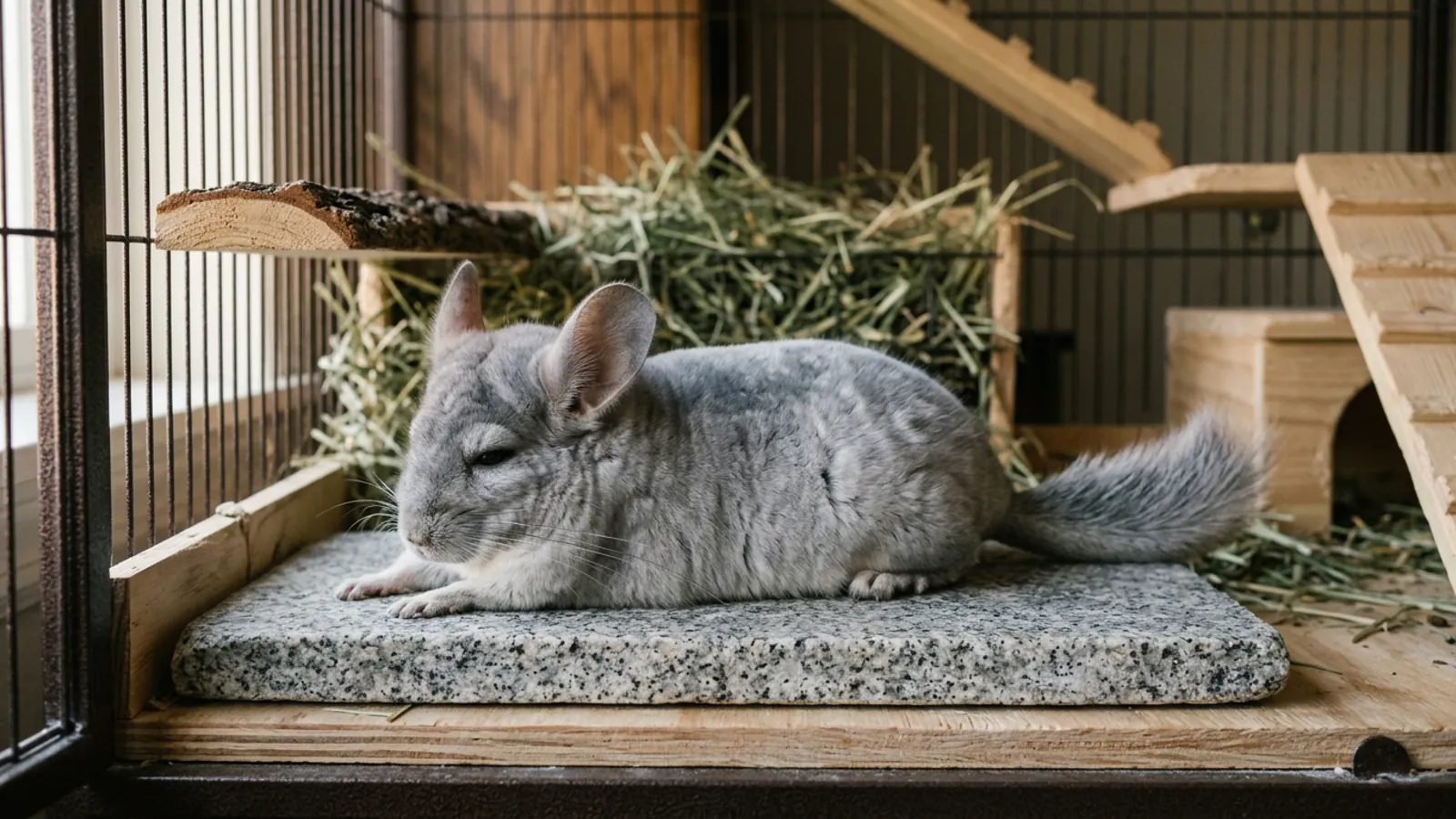
A chinchilla cooling stone is one of the cheapest useful things you can put in a cage, and one of the most misunderstood. It is a flat slab of granite or marble that sits on the cage floor so an animal can lie on it and dump heat into it. It does work. It also has a ceiling, and that ceiling is lower than most people selling them will tell you. I have kept stones in Pebble and Juniper's cage every summer for years, and I would still call an overheating room an emergency with three of them down there. What follows is what the stone does, what it cannot do, and how I use one.
What a cooling stone does
A chinchilla cannot sweat its way out of trouble. It has almost no functional sweat glands, and the coat that makes it so absurdly soft is the same coat that traps heat against the skin. Somewhere between 50 and 80 hairs grow out of a single follicle, depending on which source you read, and the practical result is a dense insulating blanket the animal cannot take off. That leaves two real routes for shedding heat: the large thin ears, which are full of blood vessels and act as radiators, and conduction, which means lying flat against something that carries heat away from the body faster than air does.
That second route is the whole reason a stone exists. Air is a poor conductor. Wood is not much better. Granite and marble are dense and conduct heat away from a warm belly far faster, so a chinchilla lying spread out on stone loses heat at a rate it cannot manage lying on a wooden ledge.
Here is the part that gets skipped. An unchilled stone is exactly the temperature of the room it is sitting in. It is not cold. It feels cold to your hand for the same reason it feels cold to a chinchilla: it is pulling heat out of you quickly. In a room at 68°F, that is a real and useful comfort. In a room at 82°F, the stone is also at 82°F, and 82°F stone cannot cool an animal below 82°F no matter how long it lies there. It does not change the temperature your chinchilla lives in.
Why a stone is never the whole plan
Pebble came to me from a rehome, out of an attic that got hot enough that I still think about it. Her first summer with me brought a heatwave and a night at the emergency vet, and every hard line I hold about chinchilla cooling traces back to that night. So I will be blunt: a chilling stone for chinchillas is a comfort item layered on top of a controlled room, and if you are relying on it to get an animal through a hot day, you do not have a heat plan.
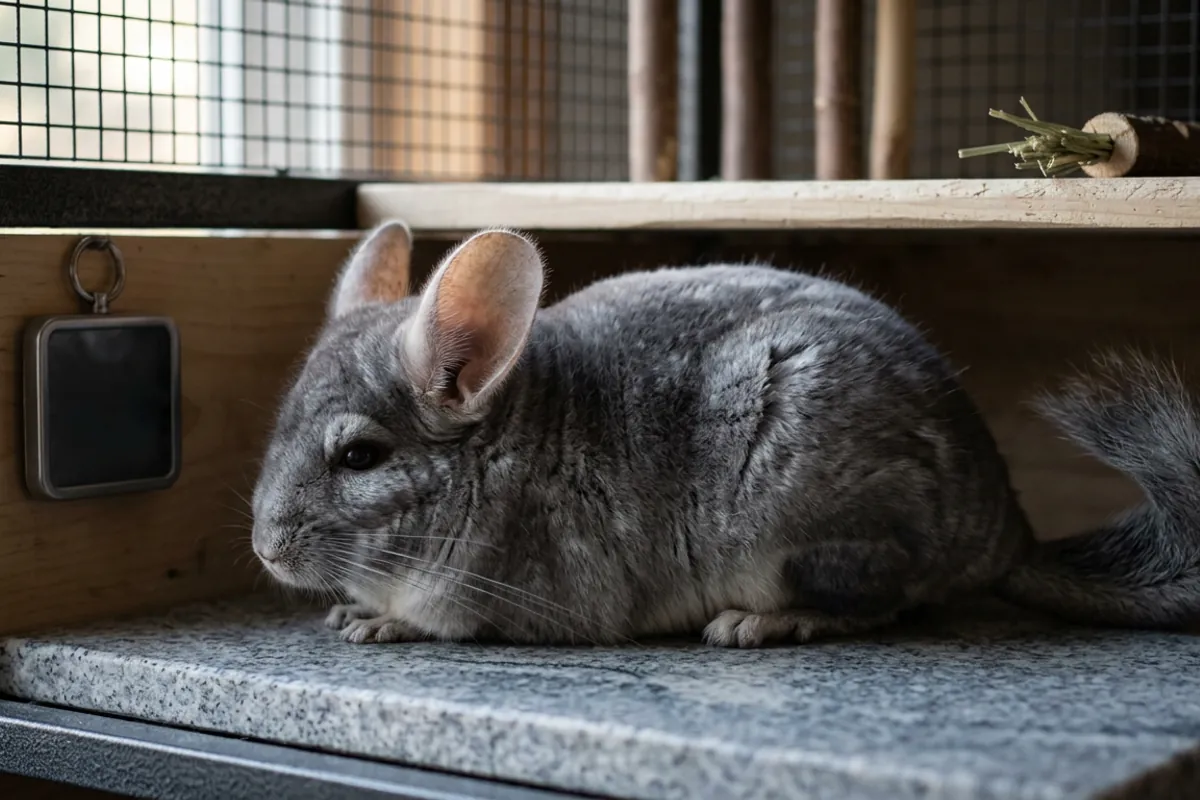
The numbers are not negotiable and they have not changed. Comfortable is 60 to 70°F (15 to 21°C). Above 75°F (24°C) is risky. At 80°F (27°C) and up you are in emergency territory, and it arrives faster in humid air, because humidity blocks what little evaporative cooling the animal has left. There is a rule you can do in your head that turns up in veterinary reference guidance as well as among keepers: add the temperature in Fahrenheit to the relative humidity percentage and keep the total under about 150. Use it, and still treat the ambient numbers above as the hard line, because a guideline cutoff is not a physiological constant. I have written the full picture up in the chinchilla heat safety guide and in more detail on chinchilla temperature, and there is a heat danger calculator if you want to check a specific temperature and humidity combination.
None of that works without measurement. A wall thermostat in the hallway is not telling you what the air is doing at cage height in the corner where the afternoon sun lands. Put a thermometer with a humidity readout on the cage itself and read it every day in summer. digital thermometer and humidity gauge with remote probes As an Amazon Associate I earn from qualifying purchases.
Air conditioning is the answer when the room runs hot. A fan helps the room, and moving air is better than still air, but a fan aimed at a chinchilla is doing far less than it does for you, because you sweat and the chinchilla does not. Cooling the air is what counts.
What to look for in a stone, and what to leave on the shelf
Material first. Granite and marble both work, and I lean granite because it is dense, hard, and does not flake the way slate can. What matters more than the rock is what has been done to it: it must be plain, unsealed, unglazed, unpainted, and free of any resin or polish coating. A chinchilla will test a new object with its teeth. Anything applied to the surface will end up inside the animal.
Size is where most people go wrong. A chinchilla dumping heat does not sit neatly on a coaster, it flattens out like a dropped sock, front legs forward, belly down, sometimes rolled onto one side. The stone has to be big enough for that whole posture. Roughly 8 by 10 inches (20 by 25 cm) is a sensible minimum for an adult, and bigger is better. Check the edges are eased rather than sharp, and that there are no chips.
A plain pet chinchilla granite stone does the job, and the widely sold Kaytee chinchilla chiller granite stone is the one most people meet first. It is fine stone. My reservation is size: the standard slab is small for a sprawled adult, so buy two and set them side by side, or go larger with a tile. Kaytee Chinchilla Chiller granite stone As an Amazon Associate I earn from qualifying purchases.
Two things to skip. First, a gel cooling pad for a chinchilla, the kind sold for dogs and cats, is a hard no from me. It is a plastic or vinyl envelope full of gel, sitting in a cage with an animal whose response to a new object is to chew it. A punctured chinchilla cooling pad means chewed plastic and swallowed gel, and that is a vet call, not a cleanup. Second, a chinchilla cooling house, meaning a ceramic or stone hide, is a reasonable extra in an already cool room, but it is not heat management. Enclosing an animal cuts airflow around its body, and a heavy stone house in a hot room is a box that holds heat. If I only had budget for one thing, it would be flat slabs, not a house.
How to use a chinchilla cooling stone, day to day
Placement comes first. Heat rises, so in a tall cage the lowest level is the coolest, usually by a degree or two. Put the stone flat on the cage floor or on a solid, stable low shelf, in the shadiest part of the cage, away from any wall that takes direct sun. Never wedge a heavy slab on a high ledge above a landing spot. Stone plus a bad jump is a real injury, and I have heard of it happening.
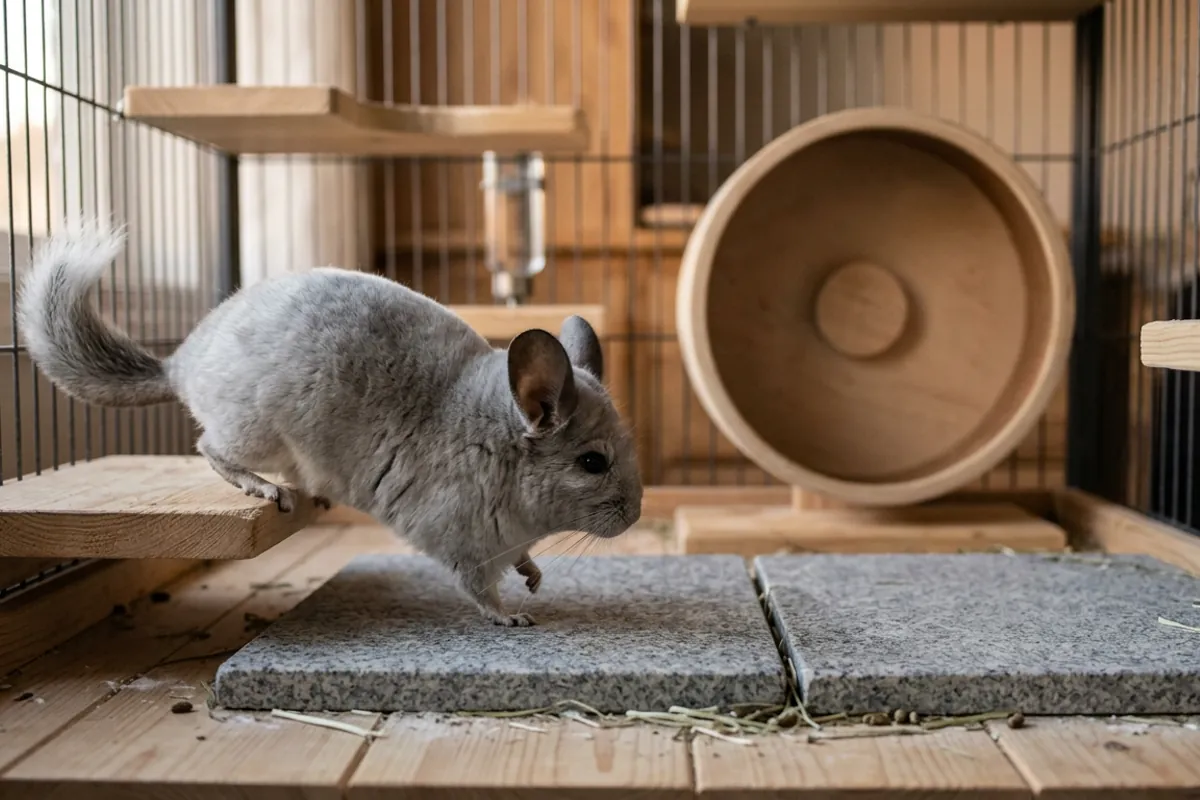
Give them more than one. Chinchillas regulate themselves by choosing where to sit, and that only works if there is a choice: a cool slab, a wooden ledge, a shaded corner. Two stones in different spots beats one big one in the middle.
On chilling, my rule is fridge, never freezer. A fridge-cold stone is plenty, and I run two or three in rotation on a hot afternoon, swapping them as they warm. The freezer causes two problems. A stone taken from a freezer into warm, humid air grows a film of condensation, and a damp chinchilla is a genuine problem: that coat holds water for hours and stays warm and wet against the skin, which is how fungal skin trouble starts. Chinchillas bathe in dust, never in water, and everything about their care follows from keeping that coat dry, which is the same reason I am fussy about the dust bath routine. The second problem is simply that freezer temperatures are harsh against thin footpads and a bare belly.
So: fridge, wipe the stone completely dry with a towel before it goes in, and put it back on the cage floor. If a stone ever comes out with beads of water on it, dry it and wait.
Do not put a towel or fleece over the stone. Fabric blocks the conduction that makes it work and gives them something to chew and swallow. Do not chase the animal onto it either. They will find it. And keep the stone out of the dust bath house, where it just gets caked.
Keeping the stone clean
Expect the stone to become a toilet. A flat cool surface in a corner is exactly what a chinchilla picks, and urine soaks into stone, marble more readily than granite. A neglected slab develops a chalky ring and a smell, and at that point it is no longer a nice place to lie.
I scrub mine with very hot water and a stiff brush, and use white vinegar on the mineral scale that urine leaves behind. If you use soap, make it plain and unscented, and rinse until you would happily drink the runoff. No bleach residue, no scented cleaners, no dishwasher tablets. Then the stone dries completely, outdoors or on a rack, before it goes back in the cage. Bone dry, not nearly dry.
While you have it in your hands, look it over. A chipped corner is a sharp corner, and a cracked slab will eventually break in two under an animal. Retire it when it gets there; a replacement granite offcut costs very little.
Weekly is about right in summer if it is being used as a bathroom, and whenever it looks grubby otherwise. It is a two minute job that is easy to let slide.
Making your own from a tile
The pet aisle version is convenient, but a hardware store or a stone yard will usually sell you a granite or marble offcut for pocket change, often twice the size. That is what I use most of the time. Ask for a plain, unsealed offcut, and ask them to ease the edges for you if they have the tools; otherwise a few minutes with wet sandpaper or a rubbing stone takes the bite off.
Unglazed quarry tile or plain terracotta also works, though neither is quite as dense as granite. What I avoid is anything with a factory sealant, a high gloss finish, a printed pattern, or a resin-filled surface, which rules out a lot of decorative stone. If the label says sealed, put it back. Slate I skip, because it can split into flakes along its layers.
Scrub a new offcut in hot water first to get the cutting dust off, dry it fully, and it is ready. The result is the same chinchilla chiller granite stone you would buy, just larger and cheaper.
Where the stone sits in a real heat plan
Think of it as the last layer, not the first. The order that keeps animals alive is: control the room temperature, then the airflow, then the cage, then the stone.
Control the room. Air conditioning in the room the cage lives in, blinds closed on the sunny side through the day, and the coolest room in the house chosen for the cage rather than the most convenient one. A ground floor room beats an upstairs one. Never an attic, ever, for reasons that are Pebble's whole story.
Then the cage itself. Metal and wood construction lets air move through and does not hold heat the way a solid plastic base does, which is one more reason plastic has no place in a chinchilla cage. Critter Nation double unit small animal cage As an Amazon Associate I earn from qualifying purchases.
Then the extras. Stones on the floor, rotated from the fridge on the worst afternoons. A frozen bottle of water wrapped in a towel and set against the outside of the bars, never inside, where the plastic would be chewed and the condensation would soak the bedding.
And then watch the animal, because the cage thermometer tells you about the air and the chinchilla tells you about the chinchilla. Ears that have gone bright red and feel hot are the early sign. Lying stretched flat out and staying there, dullness, a wet chin or chest from drooling, fast shallow breathing, and any wobbliness or disorientation mean you are past comfort and into danger. I have written the signs out properly in the piece on chinchilla heat stroke warning signs.
If you see the later signs, this is a vet problem, not a stone problem. Get the room cool, offer a cool surface, and go to an exotics vet straight away. Do not put a chinchilla in water and do not use ice baths; cooling too fast causes its own crisis, and a soaked coat is its own emergency. I am an experienced keeper, not a vet, and this is exactly the line where that distinction matters. Find your exotics vet before summer, not during it, which is the whole point of the piece on finding a chinchilla vet.
A chinchilla cooling stone is a good, cheap, honest piece of kit. It gives an animal somewhere to shed a little heat and something to choose, and mine use theirs daily from June onward. It just cannot rescue a room that is too hot, and pretending otherwise is how people lose chinchillas.