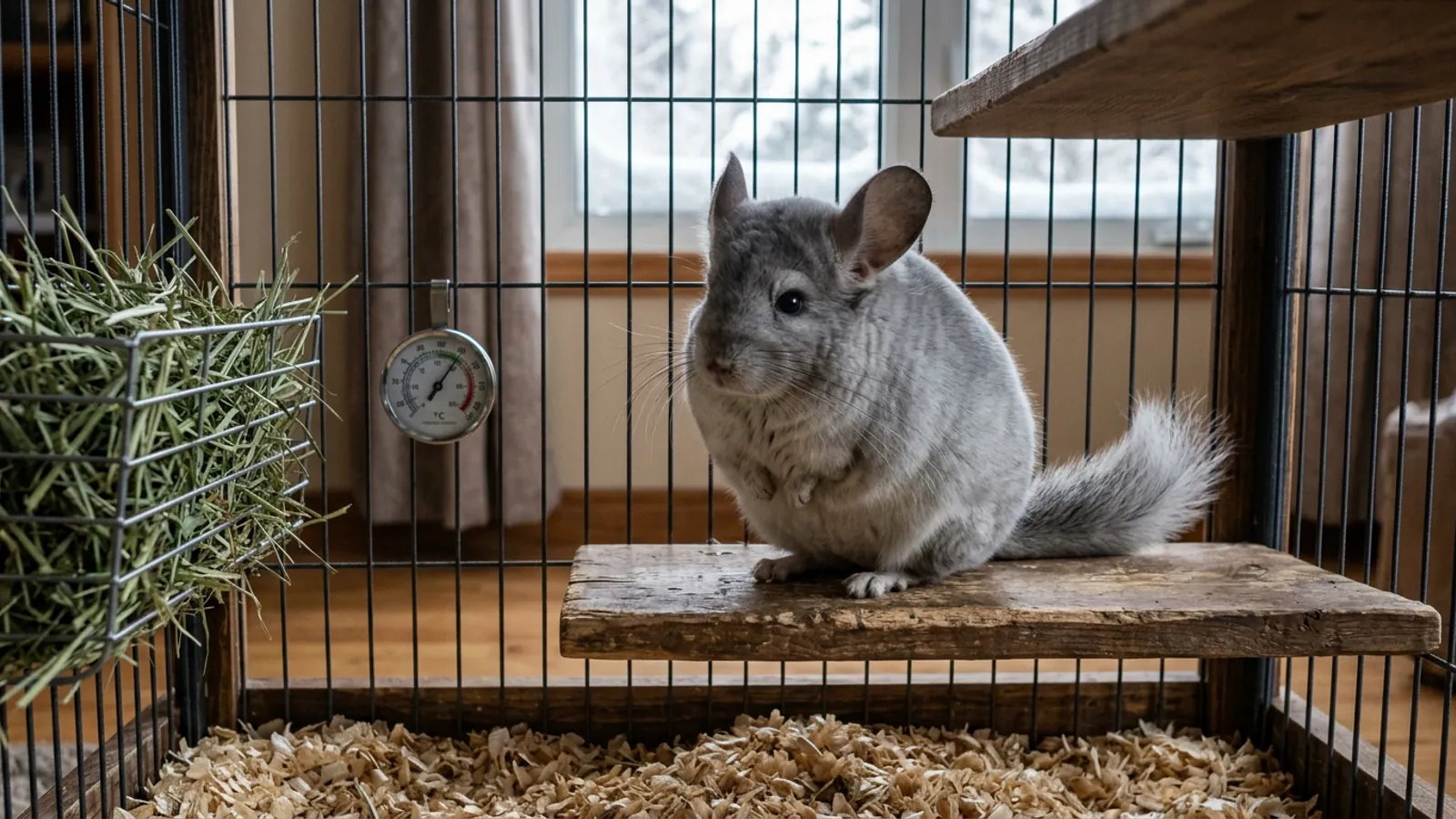
Autumn is when the question changes. All summer people ask me how hot is too hot, and then the first cold snap arrives and the same owners want to know how cold is too cold for a chinchilla. It is a fair question, and it usually comes from someone who has read the heat warnings on this site and assumed the danger runs both directions with equal force. It does not. Cold is a real risk and I will give you the numbers I use, but a chinchilla in a chilly room is in far less trouble than a chinchilla in a hot one, and the difference is not close.
The short answer on how cold is too cold
There is no single number where a chinchilla crosses from fine to dying, which is exactly why the question gets muddy answers. What I can give you is the ladder I use in my own home.
The comfortable band is 60 to 70°F (15 to 21°C). That is the target, summer and winter, and everything else on this page is about what happens when you drift off it.
From 50 to 60°F (10 to 15°C) a healthy adult chinchilla with dry fur, a draft free spot and somewhere to tuck into is fine. I do not panic at 55°F. I do check for a draft, because at that temperature a draft is the thing that will hurt.
From 40 to 50°F (4 to 10°C) I act. A healthy adult is not in immediate danger over an evening, but that is not a room to leave an animal in, and the margin for anything going wrong has mostly gone.
Below about 40°F (4°C) I treat it as a genuine problem for a pet chinchilla, and anywhere near freezing is not acceptable at all.
Here is the part I will not paper over: that lower boundary is where keepers disagree. Ranch and barn chinchillas that have acclimatized over weeks, in dry buildings with deep bedding and company, live through colder than that. Wild chinchillas in the Andes deal with temperatures a pet would never see. Your chinchilla, in a heated house, acclimatized to nothing, is not that animal. I would rather you use the cautious number than the record one.
Why chinchillas handle cold better than heat
The asymmetry is built into the animal. That coat is extraordinarily dense, with many hairs growing from each follicle rather than one, and it evolved for a cold, dry, high altitude life. It is insulation the animal cannot take off. A chinchilla cannot sweat the way we do, cannot pant usefully, and dumps excess heat mostly through those large thin ears and by lying flat on something cool.
So heat stacks against them and cold works with them. At 80°F (27°C) a chinchilla is in an emergency and can be dead within hours, faster if the air is humid, and I have watched how quickly that goes wrong. At 50°F a chinchilla is mildly inconvenienced. If you want the full version of the hot side, it is all in chinchilla temperature is the number that keeps yours alive and the heat safety hub.
Cold, when it does kill a chinchilla, almost never does it alone. It needs an accomplice: wet fur, a draft blowing directly on the cage, an animal that was already sick or very young or very old, or a temperature that crashed rather than drifted. A slow seasonal cooling is something a chinchilla adapts to. A window left open onto a 38°F night, blowing across a cage at floor level, is a different event entirely.
The numbers I use, and how I measure them
Guessing the temperature in a room is not a skill anyone has. The number that matters is the one at the cage, not the one on your hallway thermostat and not the forecast, so I keep a thermometer and hygrometer clipped at cage height where the animals live. digital thermometer and humidity gauge with remote probes As an Amazon Associate I earn from qualifying purchases. One that logs the daily high and low is worth the extra few pounds, because it tells you what happened at 4am while you were asleep, which is when a room gets cold.
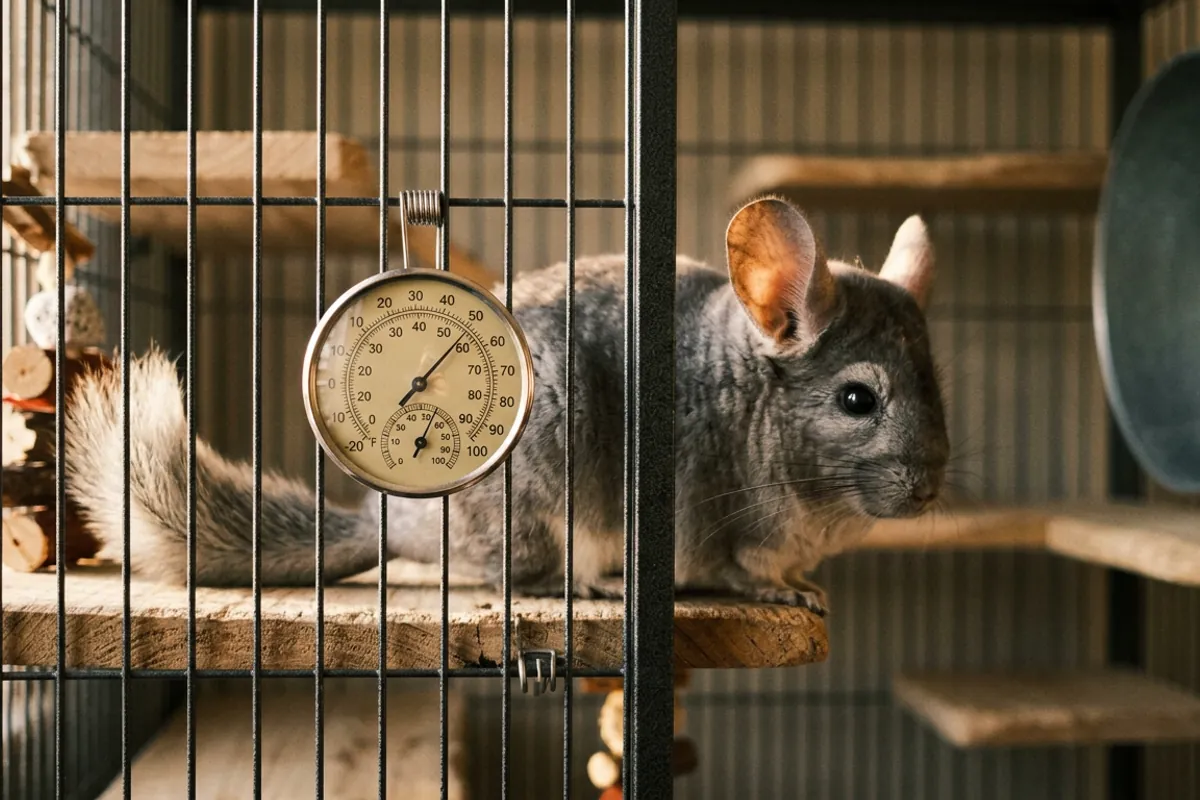
Humidity belongs on the same gauge. In summer humidity is what turns a risky 78°F into an emergency, and there is a heat danger calculator on this site that combines the two. In winter humidity matters for a different reason: damp air makes cold bite harder, and damp air in an under heated room is what gets into bedding and coats. Dry and cool beats mild and damp, every time.
Two other readings I take without a gadget. The ears, which should feel cool but not cold, and the hay rack, because an animal that is cold and unwell stops eating before it does anything dramatic.
Cold plus damp or draft is the thing that hurts
If you remember one line from this article, make it this one: a wet chinchilla in a cold room is an emergency, and a dry chinchilla in a cold room usually is not.
That coat is so dense that water does not run off it, it soaks in and sits against the skin, and it can take many hours to dry. Wet fur has almost no insulating value and it rots. This is one of several reasons chinchillas never bathe in water, only in dust. If your chinchilla somehow gets soaked, from a leaking water bottle, a spilled bowl or a well meaning bath, that is a same day problem in any weather and a serious one in winter. I have written up what a soaked coat and a wet chin each mean in chinchilla wet.
Drafts are the other accomplice. A steady moving airflow strips warmth off an animal far faster than still air at the same temperature, and cages sit exactly where drafts run: near external walls, under windows, beside doors, and at floor level where cold air pools. My rules are simple. Cage up off the floor, at least a meter from any window or exterior wall, never in the path of a door that opens outside, and never directly under an air conditioning vent, which in autumn is still cycling in some houses.
Check the leaky water bottle habitually in winter. A bottle that drips onto bedding gives you damp bedding, and damp bedding under a cold animal is the combination I keep away from.
What a chinchilla that is too cold looks like
Chinchillas are prey animals and they hide discomfort, so you are reading small things.
A cold chinchilla sits hunched and compact, feet tucked under, ears flattened back against the head, coat fluffed out to trap air. That is normal thermoregulation, not a crisis, but it tells you the animal is working at staying warm. If it stays like that all evening in a room you thought was fine, believe the animal over your own sense of the room.
Past that, what I watch for is a change in the ordinary. Ears that feel cold rather than cool. Less movement at the hours when yours is usually busiest, which for a crepuscular animal means dusk and dawn. Less hay eaten, and fewer, smaller or drier droppings, which is the earliest reliable signal something is off in a chinchilla. Visible shivering is uncommon and I treat it as serious. An animal that is limp, unresponsive or cold to the touch through the coat is past anything you can fix at home.
When it stops being a husbandry problem
Warm the room, offer hay, and give it an hour. If your chinchilla is not back to normal behavior, or if it is not eating, or if it seems weak, call an exotics vet. I am a keeper, not a vet, and hypothermia in a small animal is not something to manage by guesswork. The same goes for an animal that is already ill, very young or very old, since those are the ones with no margin at all. What a lethargic chinchilla is telling you covers the wider set of causes, because cold is rarely the only candidate.
How I warm a room without creating a new hazard
Warm the room, not the cage. That single principle rules out most of the equipment people ask me about.
Heat lamps and ceramic emitters near a chinchilla cage are a fire risk and a burn risk, and they create a hot spot that an animal in a cage cannot always get away from. Heat pads mean a cord, and a chinchilla will chew a cord. Fleece liners, blankets and snuggle sacks get eaten, and fabric in a chinchilla gut is a surgical problem, not a laundry problem. Plastic hides do not belong in the cage in any season.
What I use instead is boring and safe: central heating, or an oil filled radiator placed well away from the cage, set to hold the room in the 60 to 70°F band overnight. Then I let the animal make its own heat, which it is very good at.
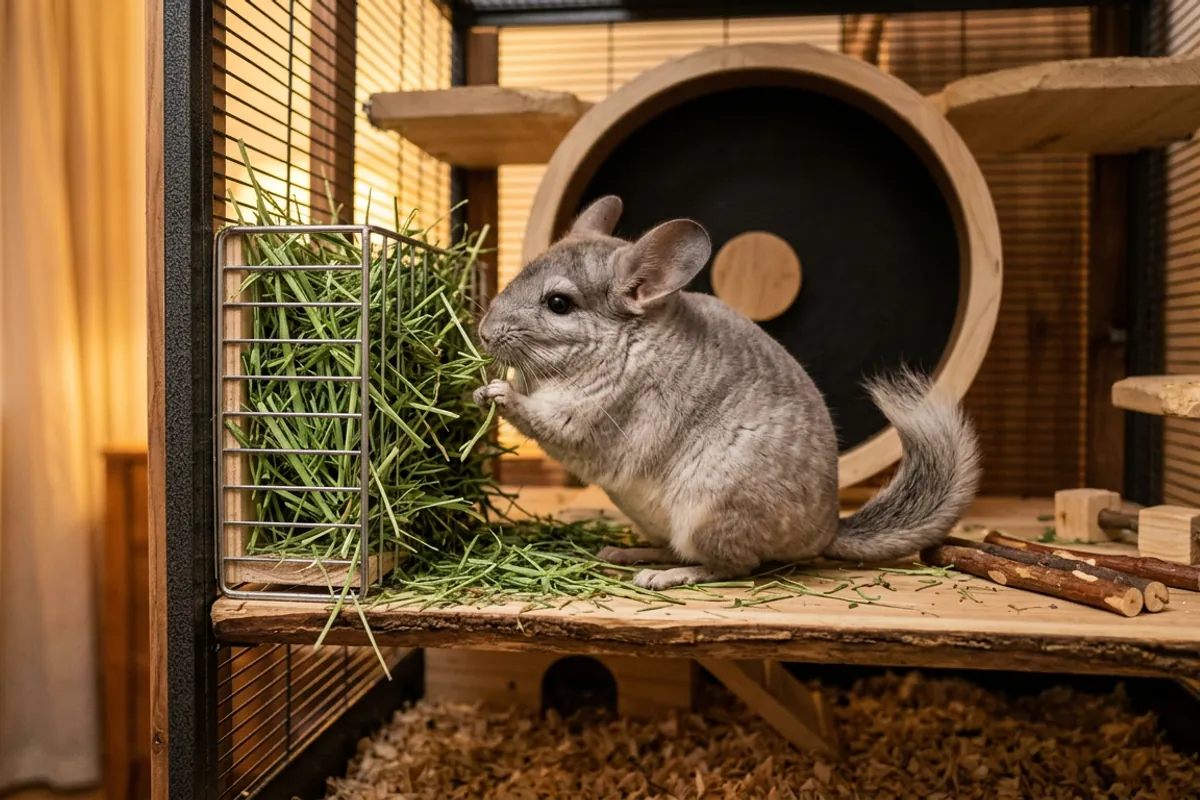
Unlimited grass hay is the engine. Fermenting fiber in the hindgut produces heat, and a chinchilla with a full hay rack is a chinchilla with the fuel to stay warm, so in a cold snap I make sure the rack never runs low. Oxbow Western Timothy Hay, 40 oz bag As an Amazon Associate I earn from qualifying purchases. Hay stays the whole meal, not a side dish, and the reasoning is in chinchilla hay. Do not compensate for cold weather by adding pellets or treats; pellets stay a measured supplement and the extra fat does nothing useful here.
Movement makes heat too, so a cold spell is a bad time for a boring cage. A solid running surface wheel, never a wire one, lets an animal warm itself up on its own schedule. 15 inch Chin Spin solid surface chinchilla wheel As an Amazon Associate I earn from qualifying purchases. A rotation of safe wood chews does the same job for a chinchilla that would rather gnaw than run, and it keeps teeth wearing down, which is the thing I never let slide. emours apple wood chew sticks, 40 count As an Amazon Associate I earn from qualifying purchases.
And give them somewhere to tuck into. A wooden house in the cage, with deep bedding around it, lets an animal choose to be warmer without you deciding for it. Choice is the whole point.
Chinchilla cold weather away from your thermostat
The thermostat only covers the room. Most winter cold incidents I hear about happen in the gaps.
Car journeys are the big one. A carrier crossing an unheated garage and sitting in a car that has been parked outside all night is a rapid temperature swing, which is worse than a steady cool room. I warm the car first, keep the carrier off the floor and out of the vent stream, and I never leave a chinchilla in a parked car in any weather, cold included.
Power cuts are the other. If the heating dies in midwinter, a chinchilla is far better off than in a summer outage, and that is worth knowing so you do not panic. Move the cage to the smallest interior room, close the door, add extra bedding, keep the hay coming, and check that the water bottle has not frozen or stuck. Bottles fail in cold before animals do.
As for taking them out into cold weather for fresh air: I do not. A chinchilla outdoors faces temperature swings, damp, predators and parasites it never meets indoors, and there is nothing outside it needs. I have laid out the whole case in can chinchillas go outside.
Winter care that has nothing to do with the number
A few seasonal adjustments that owners forget.
Take the cooling stone out, or at least know it is there. A granite or marble slab is useful in July, and in a 55°F room it is one more cold surface an animal may sit on without benefit. Kaytee Chinchilla Chiller granite stone As an Amazon Associate I earn from qualifying purchases. Mine come out when the heating goes on and go back when it goes off. What a cooling stone does explains where it helps and where it stops.
Keep dust baths on the same schedule. Cold weather changes nothing about the coat's need to be degreased, and a chinchilla that skips baths gets a greasy, matted coat that insulates worse, not better. The one thing I do change is storage: keep the dust somewhere warm and dry, because cold damp dust clumps and does a poor job. Lixit Blue Beauty chinchilla dust, 3 lb As an Amazon Associate I earn from qualifying purchases. Bathe earlier in the evening if your room runs cool, so the coat is fully fluffed back up before the overnight low. The full routine is in the chinchilla dust bath.
Watch the air drying out. Central heating pulls humidity down, and very dry air combined with heavy dust use can irritate eyes. If you see weeping or squinting, that is worth attention rather than waiting.
Finally, watch weight. Winter is when a slow decline hides under a fluffed coat, and a kitchen scale once a week catches what your eyes will not.
The plain summary is this. Aim for 60 to 70°F. Treat below 50°F as a signal to fix something, below 40°F as a real problem, and freezing as never. Keep the animal dry, keep drafts off the cage, keep the hay unlimited, and cold weather becomes the easy half of the year. The hot half is the one that will kill your chinchilla, and I will keep saying so for as long as people keep asking me about the cold.