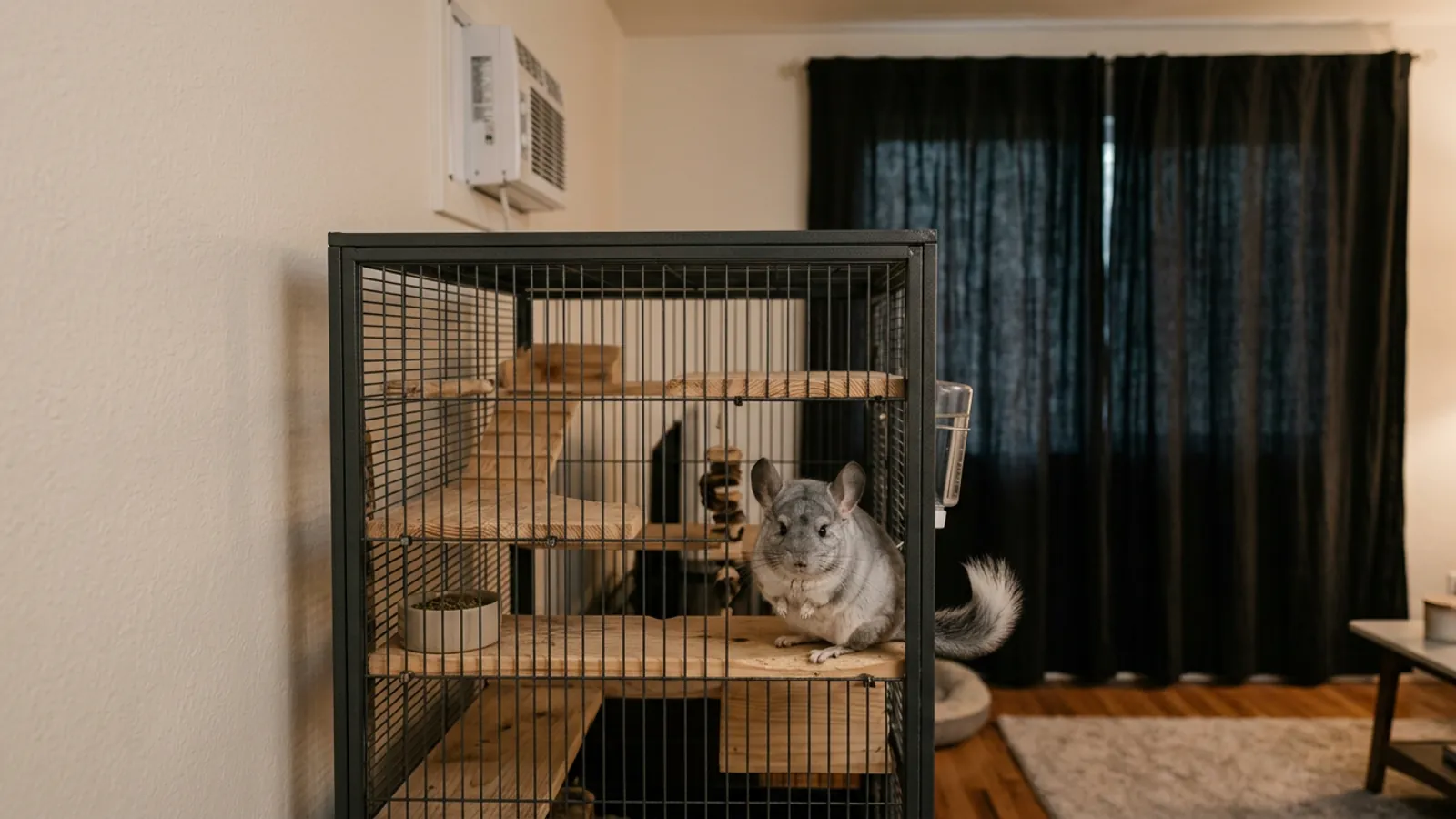
Pebble came to me from a rehome out of an overheated attic, and her first summer with me nearly ended in a heatwave. That night at the emergency vet is the reason I do not treat chinchilla air conditioning as an upgrade or a comfort feature. For an animal that evolved in the cold, thin air of the high Andes and carries fur dense enough that dozens of hairs grow from a single follicle, a working air conditioner is the one piece of equipment that decides whether a hot week is boring or fatal. Everything else in the cage matters. This is the thing that keeps the animal alive long enough to use the rest of it.
Why air conditioning is the only heat plan I trust
A chinchilla cannot get rid of heat the way you can. They do not sweat. That coat, which is so good at holding warmth in at 4,000 meters, is just as good at holding it in when your living room hits 78°F, and it works against them the entire time. The main radiator they have is a pair of large, thinly furred ears, plus stretching out flat to expose more surface, plus panting when things are already going badly. Panting in a chinchilla is not a mild sign. It means the easy options have already been used up.
Because the animal has so little ability to shed heat itself, you do not cool the chinchilla. You cool the room, and you keep it cool. That distinction is the whole article. Every gadget sold as a chinchilla cooling product works on the animal or a few inches around it, and the ambient temperature of the room overrides all of them. A granite slab in an 84°F room is a warm granite slab within the hour.
I have read plenty of advice suggesting a fan and a frozen bottle will see a chinchilla through summer. In a mild climate with a cool house, people get away with it, and getting away with something is not the same as it being safe. If the room your chinchilla lives in can reach 75°F on its worst day, you need mechanical cooling, and you need it before the forecast turns. There is no version of this where you improvise on the day.
The numbers your air conditioner has to hold
The comfortable range is 60 to 70°F, which is 15 to 21°C. Above 75°F (24°C) you are in risky territory. At 80°F (27°C) and up you are in an emergency, and that threshold arrives faster and hits harder in humid air.
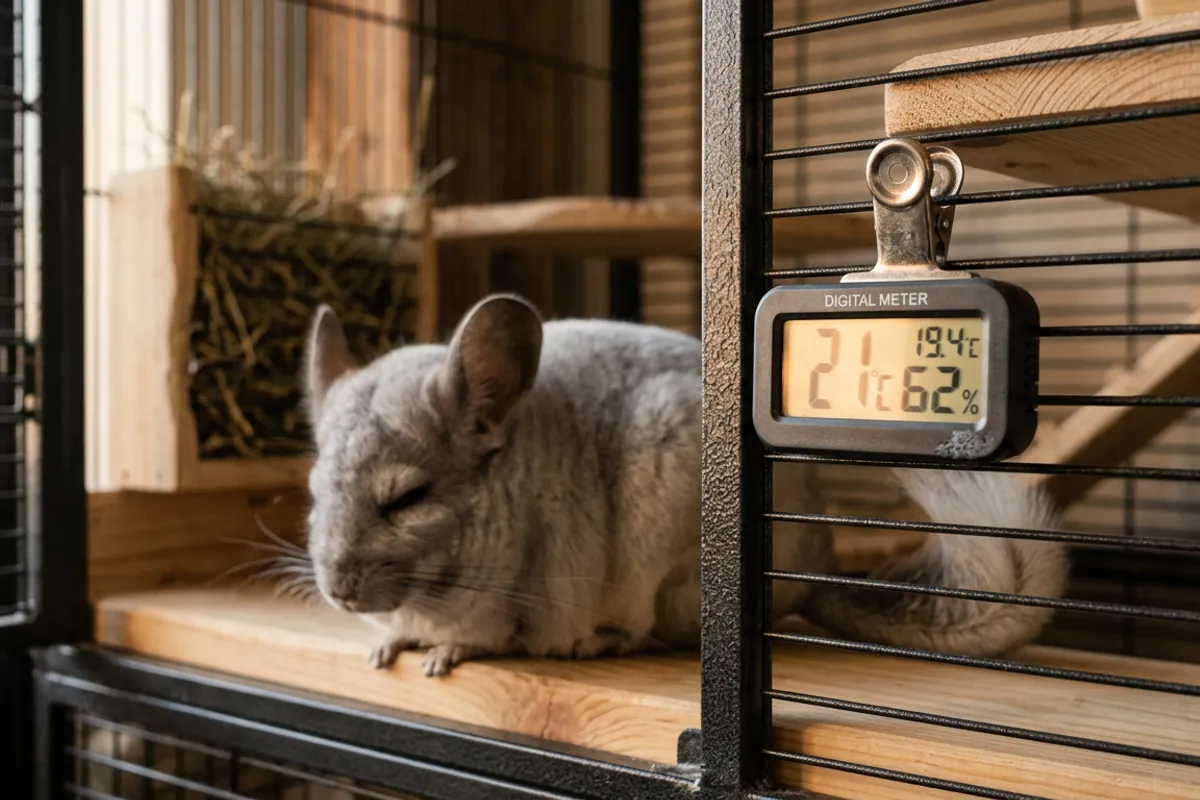
In practice I set the thermostat around 65°F (18°C) and I treat 72°F (22°C) as a fault condition rather than a warning. If the room has drifted to 72°F, something has changed: a filter is clogged, a door was left open, the sun has moved onto a window I forgot about, or the unit is losing the fight against the outdoor temperature. I want to know that on a mild day, not on the day it is 95°F outside. More on the underlying biology in chinchilla temperature is the number that keeps yours alive, and if you want to sanity check a specific combination of heat and damp, the chinchilla heat danger calculator does the arithmetic for you.
Here is the part people skip. Your thermostat reports the temperature at the thermostat, which is usually on an interior hallway wall at chest height, nowhere near the cage. It is not lying, it is just answering a different question. What you need is the temperature at the top ledge of the cage, because heat rises and because the top ledge is where a chinchilla chooses to sit. In my own room the top of a tall cage runs a few degrees above the thermostat reading on a hot afternoon, and a few degrees is the entire margin between fine and risky.
So buy a separate digital thermometer and hygrometer with a min and max memory, and cable tie it to the cage at the height your chinchilla uses. digital thermometer and humidity gauge with remote probes As an Amazon Associate I earn from qualifying purchases. The min and max function is the useful half. It tells you what happened at 3pm while you were at work, which is the only reading that matters. Check it in the evening, note the peak, reset it. That thirty second habit has caught more problems in my house than any alarm.
Chinchilla humidity, and why it changes the math
Chinchilla humidity gets treated as a footnote and it should not be. When an animal cannot sweat, the heat loss it has left runs largely through its breathing, and moist air blunts that. The same 76°F reading is a different situation at 35 percent relative humidity than it is at 75 percent. I aim to keep the room under 50 percent. The veterinary guidance I trust puts the target below 40 percent and treats 55 as a hard ceiling, so anything creeping into the high 50s is a problem to fix rather than a reading to accept.
There is a rule of thumb that turns up in veterinary reference guidance as well as among keepers: add the temperature in Fahrenheit to the relative humidity percentage, and keep the total under 150. So 70°F with 40 percent humidity gives 110, which is comfortable. Now watch where it fails you. 78°F with 70 percent humidity gives 148, under the line, and the chinchilla heat danger calculator on this site reads that same combination as an emergency, because it weights the damp instead of just adding it. Trust the tool and the ambient numbers over the arithmetic. I use the rule only as a quick sniff test, and I will be straight with you about what it is: a heuristic, not a validated clinical formula, and the exact cutoff is arguable. What is not arguable is the direction: damp air makes heat more dangerous, so treat a humid 76°F as if it were a dry 80°F and act accordingly.
Damp causes a second, slower problem. That coat has no way to dry quickly, so in a humid room it stays subtly damp at the skin, the dust bath stops lifting oils properly, and the fur starts to clump and mat. Persistent damp is also friendly to fungal skin infections, which is one route into chinchilla ringworm. If your dust is caking in the bath house instead of flowing, your room is too humid, and that is worth reading alongside the chinchilla dust bath, done right from dust to schedule.
Luckily, an air conditioner dehumidifies as a side effect of cooling, so a properly sized unit usually handles both jobs. If your room still sits above 55 percent, add a dehumidifier. What you must never add is an evaporative cooler, sometimes sold as a swamp cooler, or a humidifier anywhere near the cage. They lower the temperature by pushing moisture into the air, which is precisely the trade a chinchilla cannot afford.
Choosing an air conditioner for a chinchilla room
Any real air conditioner for a chinchilla beats no air conditioner. Beyond that, the options differ in ways worth knowing.
A ductless mini split is what I would install if I were choosing fresh. It is quiet, it runs on an inverter compressor so it holds a set point rather than swinging four degrees either side of it, and it is efficient enough that running it all summer does not make you flinch at the bill. The cost is installation.
A window unit is the plain workhorse. Cheap, powerful for its size, and easy to replace on short notice, which counts for a lot in July. Seal the gaps around it properly with foam and tape, because a leaky install lets hot outside air straight back in and the unit runs itself ragged for nothing.
A portable unit on wheels is the weakest of the three and I would only choose one if the window shape or the lease left me no option. Single hose models exhaust hot air out the window while quietly pulling replacement air in from the rest of the house, which drags some of the heat straight back. If you go portable, get a dual hose model and vent it properly.
Two practical points that matter more than the brand. First, size the unit to the room rather than buying the biggest one available. An oversized air conditioner cools the air fast, satisfies the thermostat, and shuts off before it has pulled much moisture out, so you end up with a clammy room that reads fine on the thermometer. Second, chinchilla dust is a filter killer. Bathing dust is superfine pumice and it goes everywhere, shed fur follows it, and both end up in the intake. Check the filter monthly through summer and wash it more often than the manual suggests. A choked filter is how an air conditioner "fails" in August when there is nothing wrong with it.
Service the unit in spring. During a regional heatwave every technician is booked for a week, and a week is not a timescale a chinchilla can wait on.
Where the cage goes once the aircon is running
A chinchilla aircon setup is half machine and half floor plan. Put the cage against an interior wall, away from windows, and away from any wall that backs onto a kitchen, a tumble dryer, or the side of the house that bakes all afternoon. Sunlight through glass falling directly on a cage will push the cage well above the room temperature even while the air conditioner is holding its number perfectly, and no thermostat anywhere in the house will notice. Blackout curtains or reflective film on the relevant windows cost very little and remove the problem completely.
Do not aim the cold air stream straight at the cage. A steady, even room temperature is the goal, not a draft blowing across a sleeping animal. The airflow should be moving the room's air, with the cage sitting inside that cooled volume rather than in the jet.
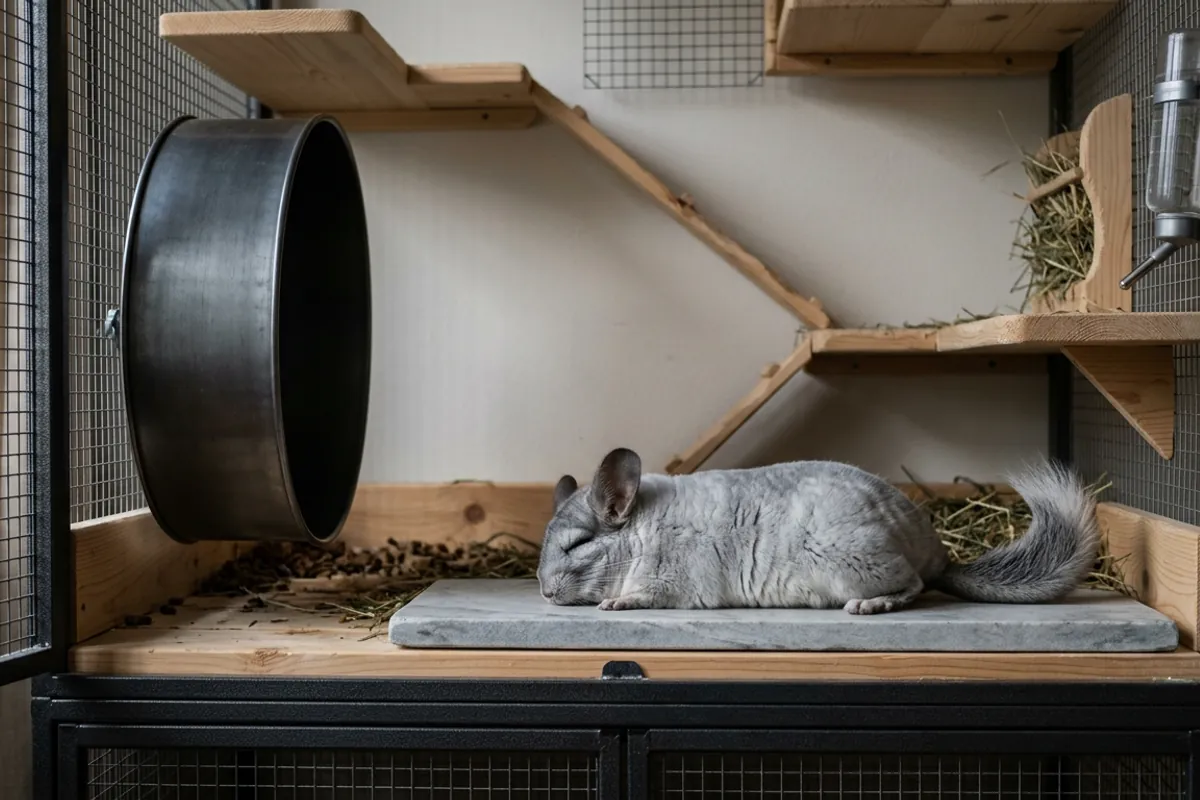
Think vertically too. A proper chinchilla cage is tall, and the top ledge is both the warmest spot and their favorite perch, which is an unhelpful combination. I keep a hard cool surface on a lower level so there is a cooler place to retreat to, and I keep the highest ledges free of enclosed hideouts in summer, because a wooden house at the top of a warm cage is a small oven. If you are still assembling the cage itself, why a chinchilla cage has to be metal, and how to fit it out covers the structure.
Finally, keep the door of that room shut so the unit is cooling one space rather than fighting the whole house. It is the cheapest way to buy yourself several degrees.
When the air conditioning fails
It will, eventually. Power cuts during the exact heatwave that strains the grid, a compressor that gives up, a breaker that trips, a housemate who turns the unit off to save money. Write the plan down now, while nothing is wrong, and put it somewhere visible.
My sequence is: close every blind, shut interior doors to trap the cool that is left, put the cage's cool surfaces in play, and start watching the thermometer minute by minute rather than daily. If the room climbs past 75°F with no sign of the unit coming back, I move the animal, either to the coolest room in the house, a friend's house, or the car with its air conditioning running before the carrier goes in.
Cool hard surfaces are worth having ready. A granite or marble slab pulls warmth out of a chinchilla lying on it, which helps. Kaytee Chinchilla Chiller granite stone As an Amazon Associate I earn from qualifying purchases. Keep two, rotate them through the fridge and never the freezer, and be realistic about the limits, which I go through in what a chinchilla cooling stone does, and where it stops helping. A stone saturates within the hour and then it is simply a rock at room temperature. It buys time. It does not replace cooling the air.
Frozen water bottles wrapped in a towel and placed against the outside of the cage bars do something similar, and ceramic tiles chilled in the fridge work as backup slabs. A fan is worth running because it helps a room shed heat, but understand what it is doing: an animal that does not sweat gets far less benefit from moving air than you do, so a fan alone is not a heat plan.
Never, under any circumstances, put a chinchilla in water or soak that coat to cool it down. It will not dry, and you trade a heat problem for a chilled, matted animal with a skin infection. Chinchilla wet: a soaked coat, a drooling chin, and what each one means explains why that coat and water do not mix.
The signs that mean stop improvising
Bright red, hot ears. Lying flat and stretched out rather than curled. Panting or open mouthed breathing. Drooling. Wobbling, or not responding to you normally. Those are heat stroke signs, covered in detail in chinchilla heat stroke warning signs every owner should know, and they are a veterinary emergency, not a home fix. I have kept chinchillas for about ten years and I am not a vet: my job at that point is to get the room cooler, keep the coat dry, and be in the car phoning ahead. Find your exotics vet before summer, not during it, using how to find a chinchilla vet before you need one, and keep the after hours number on the fridge.
Things that do not substitute for air conditioning, no matter how they are marketed: gel cooling pads, which are plastic and will be chewed and swallowed, ice cubes in the water bottle, trimming or shaving the coat, and the belief that a basement stays cool enough on its own. Basements also tend to run humid, which brings you straight back to the previous section.
The routine that keeps the room cool
None of this works as a one time purchase. It works as a habit, and the habit is small.
Look at the min and max reading every evening and reset it. Once a week, glance at the humidity trend rather than just the number. Once a month in summer, pull and wash the filter. Once a year, in spring, get the unit serviced.
If you leave the house for more than a few hours during hot months, use a sensor that will alert your phone when the room crosses a threshold. Set that alert at 73°F rather than 78°F, because you want the warning while there is still time to phone someone. Which leads to the last piece: give a neighbor a key and show them where the thermostat is and what number it should read. A remote alert with nobody able to act on it is just an unpleasant notification.
This is not a low maintenance animal. It is not, and what keeping a chinchilla pet is really like, after ten years is honest about the rest of it. But the heat side specifically comes down to one machine, one thermometer at cage height, and a plan for the day the machine stops. Pebble is still here because I got the machine part right after nearly getting it wrong once, and that is all of what I know worth passing on. The rest of my heat guidance lives under chinchilla heat safety if you want to read it in one place.