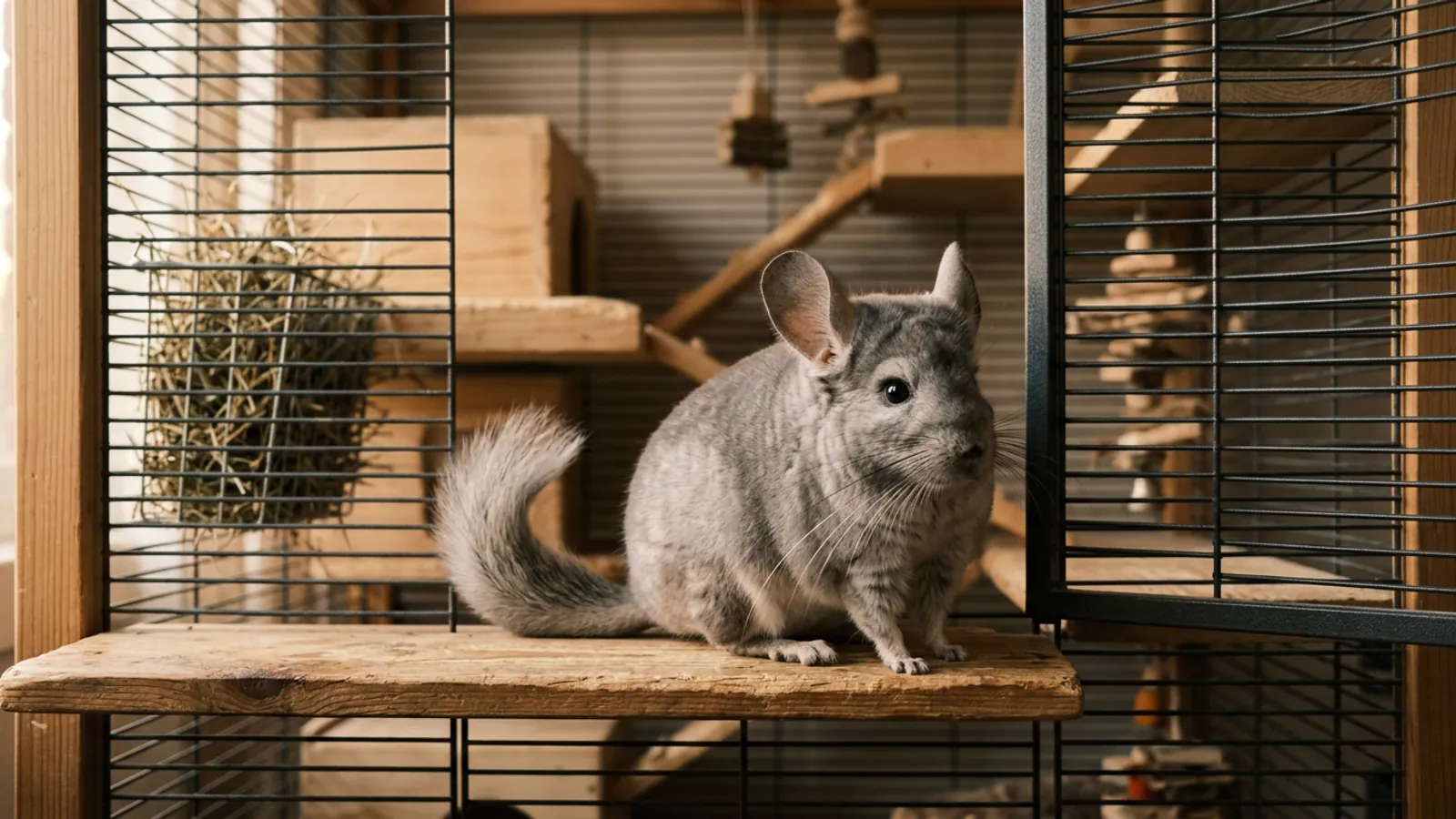
Is a chinchilla a good pet? That is the question I get asked more than any other, and it depends almost entirely on you. For the right person a chinchilla is a bright, funny, long lived companion. For a lot of well meaning people it is a mismatch that ends in guilt and vet bills. I have kept chinchillas for about ten years, and I still think they are wonderful, but I am not here to sell you one. A chinchilla can share your home for fifteen or twenty years if you can meet a short list of needs that do not bend. So rather than hand you a flat yes, let me walk you through what it takes, and you can decide for yourself.
What people picture, and what they get
People see the fur. Chinchillas have the densest fur of almost any land mammal, more than fifty hairs growing from a single follicle, and it makes them look like the softest, most cuddly thing you have ever seen. That picture is where most of the trouble starts. The fur is real, but the cuddly part usually is not.
A chinchilla is crepuscular, which means it comes alive at dawn and dusk and wants to sleep through the middle of your day. Mine start rattling their cage the moment the room goes dim, right when I am winding down. They are prey animals, fast and easily startled, and most of them do not want to be held. They will happily come to you, sit on you, take a treat from your fingers, and then bolt the second they have had enough. If you want a pet you can pick up and squeeze, a chinchilla is not it, and no amount of patience fully changes that wiring.
What you get instead is a small acrobat with real personality. Mine recognize me, beg at the bars, popcorn straight up in the air when they are pleased, and each one is different. Pebble is bold and nosy. Juniper is careful and watches everything first. That is the trade. You give up the cuddling and you get an intelligent, curious animal that lives a long time and shows you who it is over months, not minutes. Whether chinchillas make good pets really turns on whether that trade sounds good to you or disappointing.
The heat rule that decides everything
If you take one thing from me, take this. A chinchilla's fur is so dense that it cannot shed heat the way most animals do, and it did not evolve for warm rooms. Chinchillas are comfortable from 60 to 70°F (15 to 21°C). Above 75°F (24°C) they start to struggle, and 80°F (27°C) and up is a genuine emergency, faster still if the air is humid. This is not a comfort preference. Heatstroke kills chinchillas, and it kills them quickly.
I learned this the hard way. I adopted Pebble out of an overheated attic, and her first summer brought a heatwave that put us in the emergency vet overnight. That night is the reason I am relentless about temperature, and it is the reason This is not negotiable warning to sound friendlier. Before you decide a chinchilla is a good pet for you, look honestly at your home. Can you keep a room at or below 70°F (21°C) through the hottest week of your year? If your answer depends on air conditioning you might lose in a power cut, you need a backup plan.
That plan is not complicated, but it has to exist. A thermometer with a humidity reading lives on my cage so I am never guessing. digital thermometer and humidity gauge with remote probes As an Amazon Associate I earn from qualifying purchases. A chilled slab of stone gives an overheating chinchilla somewhere to dump heat. Kaytee Chinchilla Chiller granite stone As an Amazon Associate I earn from qualifying purchases. Neither of those replaces a cool room, they buy you margin inside one. I keep a fuller version of my heat routine on the chinchilla heat safety page and the warning signs on the heat stroke page, because this is the part that most often turns a good pet into a dead one.
Hay, teeth, and the diet you cannot shortcut
A chinchilla's teeth never stop growing, all of them, for its whole life. The only thing that keeps them worn down to a healthy length is chewing coarse grass hay for hours a day. This is the single most important fact about feeding them, and it is why I am uncompromising here. Juniper came to me as a neglected rescue with dental disease, and I manage that day to day. Watching up close what happens when teeth do not get worn down is why I will not let anyone treat hay as optional.
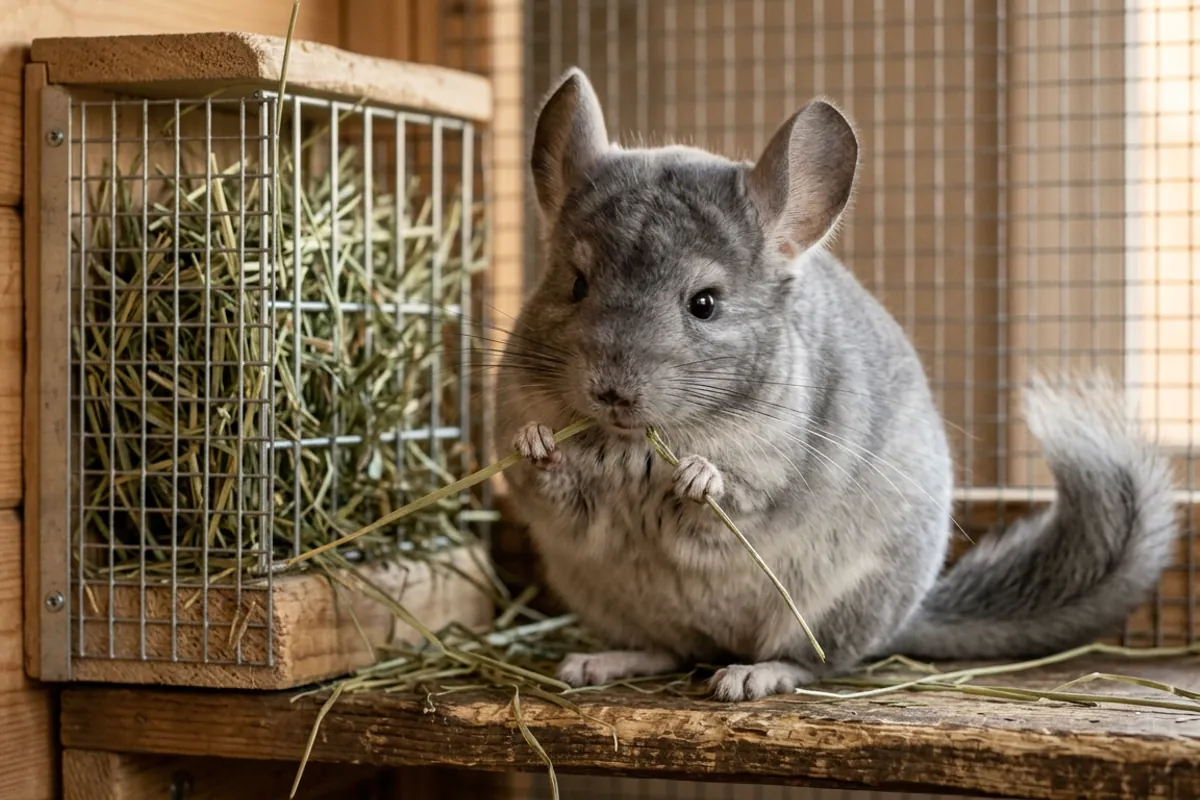
So the diet is simple and it is not negotiable. Unlimited grass hay, timothy or a similar coarse hay, available every hour of every day. Oxbow Western Timothy Hay, 9 lb box As an Amazon Associate I earn from qualifying purchases. On top of that a measured amount of plain chinchilla pellets, and that is close to the whole story. Treats are tiny and occasional. No fruit sugar, no seeds, no yogurt drops, no human snacks, none of the colorful mixes marketed at rodents. A chinchilla's gut is built for dry fiber, and rich food causes bloat and diarrhea that can turn serious fast.
Hay does double duty. It feeds the gut and it wears the teeth, which is why nothing replaces it. I back it up with plenty of safe wood to gnaw, because chewing is a need and not a hobby for this animal. A variety pack of apple wood and other safe woods keeps mine busy and their teeth working. emours apple wood chew sticks, 40 count As an Amazon Associate I earn from qualifying purchases. If you ever see drooling, a wet chin, weight loss, or a chinchilla that wants to eat but drops its food, that is a dental emergency and it needs an exotics vet, not a wait and see. My longer notes live on the chinchilla hay and chinchilla teeth pages.
The bath that uses dust, not water
Here is one that surprises new owners. A chinchilla never bathes in water. That incredibly dense fur soaks up water, holds it against the skin, takes ages to dry, and can grow fungus or chill the animal before it dries out. A wet chinchilla is a problem, not a clean one.
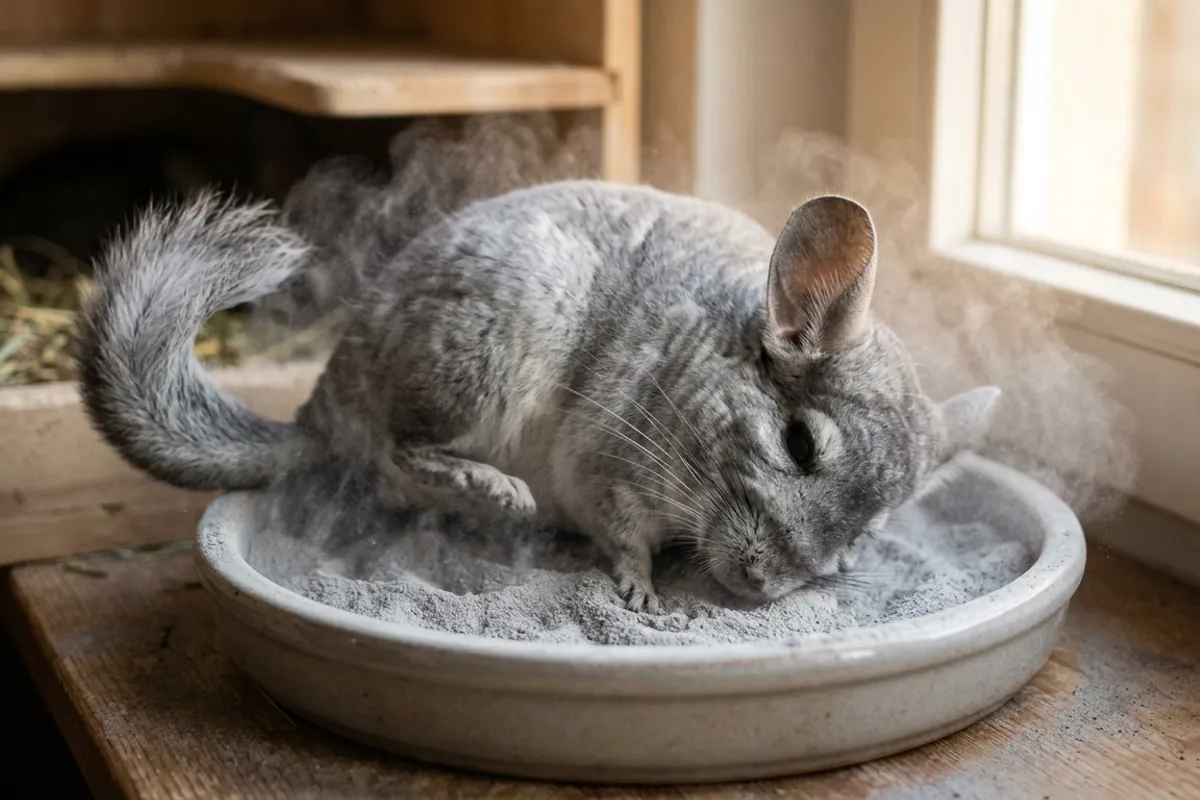
Instead they roll in fine volcanic dust, which lifts oil and moisture out of the coat and keeps it in that famous condition. You give them a container of the proper dust a few times a week, let them roll for a few minutes, and take it away again so they do not sit in it or use it as a toilet. Buy the real volcanic dust made for chinchillas, not sand and not a craft substitute. Lixit Blue Beauty chinchilla dust, 3 lb As an Amazon Associate I earn from qualifying purchases. It is a small, genuinely charming part of keeping them, and if you want the full method I wrote it up on the chinchilla dust bath page.
The cage is not optional, and it is not small
A chinchilla needs a large, tall, metal cage, and this is where a lot of budgets get a shock. These are athletic animals that jump and climb, and they need vertical space with solid wood ledges at different heights to bounce between. The cage has to be metal, wood, and the odd bit of ceramic. Plastic is not decoration here, a chinchilla will chew and swallow it, and that causes gut blockages that kill.
I would not go below a proper multi level cage built for the species. A metal and wood cage with wooden ledges is the baseline, not a luxury. Critter Nation double unit small animal cage As an Amazon Associate I earn from qualifying purchases. Inside it you want a hide, a hay feeder, a water bottle, the dust bath a few times a week, chews, and a wheel. If you buy a wheel, buy a solid running surface. 15 inch Chin Spin solid surface chinchilla wheel As an Amazon Associate I earn from qualifying purchases. Wire wheels and mesh floors catch feet and break legs, and I will name them as the hazards they are every time. Skip them.
Set against the fur and the price tag, the cage is often what tips someone from wanting a chinchilla to realizing they are not ready, and that is a fair place to stop. There is no small, cheap, humane version of this cage. If the plain budget is not there yet, the kind thing is to wait. My full setup is on the chinchilla cage page.
Who a chinchilla is not a good pet for
I would rather talk someone out of a chinchilla than watch the animal pay for a bad fit, so here is my blunt list. A chinchilla is a poor match for a young child who wants to hold and cuddle a pet, because chinchillas mostly do not want to be held and they startle and can nip when frightened. They are a poor match for a warm home you cannot reliably keep below 70°F (21°C). They are a poor match for someone who wants a short, low commitment pet, because these animals commonly live 10 to 20 years and that is a long time to plan for.
They are also a poor match for anyone who wants a quiet, hands off cage in the corner. Chinchillas are most active exactly when you want to relax in the evening, they need out of cage exercise in a chinchilla proofed room, and they need daily attention even if that attention is mostly on their terms. And they usually should not live alone. In much of the world it is considered kinder to keep them in same sex pairs or small groups, which means two of everything and double the cost. None of this is meant to scare you off. It is meant to make sure that when you say a chinchilla is a good pet, you are saying it about the animal you will have and not the plush toy in your head. My longer version is on the chinchilla as pets page.
About "free to good home" listings
A lot of people meet chinchillas through a chinchilla free to good home advert, and I want to be careful here because the animal in that listing is often the one that most needs a good owner. People give chinchillas up for real reasons, allergies, moving, life changes, and also because they got in over their heads for exactly the reasons above. That is not a red flag against the animal. It is a chance to give one a better second home.
But go in with your eyes open. Free is not cheap. The cage, the hay, the dust, the vet fund, and an exotics vet you have found before you need one all cost the same whether the animal came free or not, and a rehomed chinchilla can arrive with dental problems or heat damage from its old life. Ask how old it is, why it is being given up, what it eats, and whether it has ever seen a vet. Meet it if you can. A chinchilla that panics at every movement may just need time and patience, and it may be telling you something about how it was kept. If you have the room, the cool space, and the budget, taking one on is one of the better things you can do, and adoption is close to my heart. I wrote more about the process on the chinchilla adoption page.
So, back to the question. Is a chinchilla a good pet? Yes, if you can hold a room cool, feed unlimited hay, buy the big metal cage, commit for the better part of two decades, and enjoy an animal that shows affection on its own terms rather than in your lap. If any of those is a stretch, a chinchilla will not become a good pet by hoping. And if all of them fit your life, you are in for one of the most rewarding, characterful little animals I know.