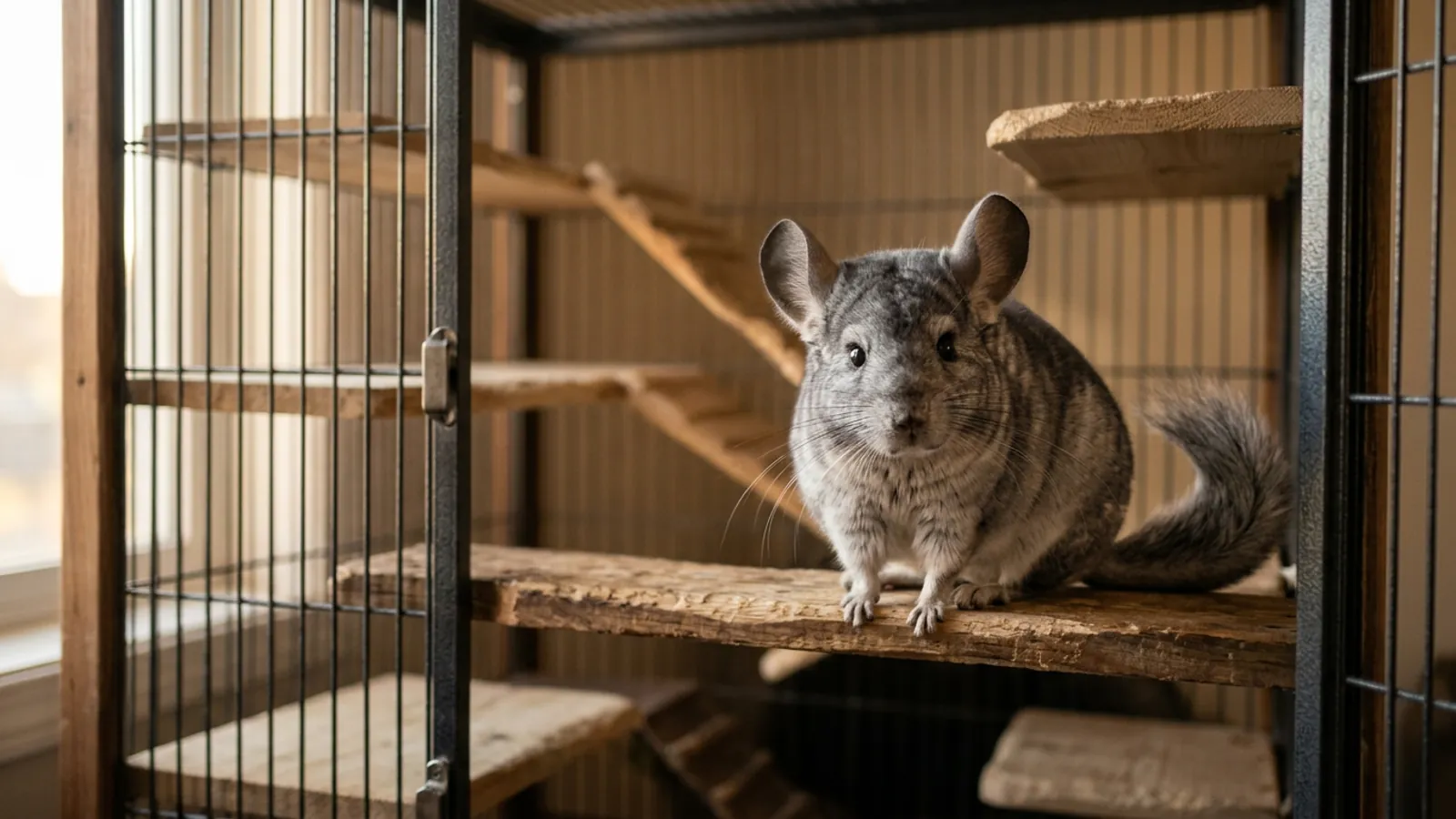
Most chinchilla facts get passed around like party trivia, and a good half of them are wrong or dressed up to sound cute. The ones worth knowing are the ones that tell you how to keep the animal alive, because with a chinchilla almost every odd thing about its body is also a care rule. I have kept them for about ten years, and I learned the hard way that a fact you skim past on a quiet Tuesday is the same fact an emergency vet explains back to you at midnight on a Saturday. So these are the chinchilla facts I use, each one tied to what it means for the animal sitting in your cage right now.
They come from the high Andes, and their body never left it
A chinchilla is a rodent from the Andes mountains of South America, and almost everything strange about it starts there. In the wild they live in cold, dry, rocky country, historically up to around 3,000 to 5,000 meters, which is roughly 10,000 to 16,000 feet. That is thin air, sharp swings between day and night, and next to no humidity. There are two species, the long-tailed chinchilla and the short-tailed chinchilla, and nearly every pet you meet descends from the long-tailed one. Both are endangered in the wild, hunted close to extinction for that famous coat, and the wild populations that remain are small and protected.
I keep dragging the conversation back to the mountains because they explain the animal in front of you. A body engineered for a cold, dry, high place is a body that handles heat and damp terribly, because it never had to. The heat rules on this site are not fussiness and they are not me being precious, they are the gap between a cool night and a dead animal, and they trace straight back to where these creatures evolved. If you want the fuller picture of what wild life still dictates at home, I wrote it up in what a chinchilla in the wild is really like. Hold that one image, cold and dry and high, while you read everything below.
Their fur is the densest of any land mammal
This is the fact everyone half-knows and almost nobody knows in the form that matters. A chinchilla has the densest fur of any land mammal. Where you grow a single hair from a follicle, a chinchilla grows dozens. Sources vary on the exact count, so no precise figure exists, but the numbers land in the tens of thousands of hairs per square centimeter, with many hairs sprouting from each follicle. That is why the coat feels like nothing else you have ever touched, and it is also why fleas cannot live on them, the fur is simply too thick for a parasite to move through.
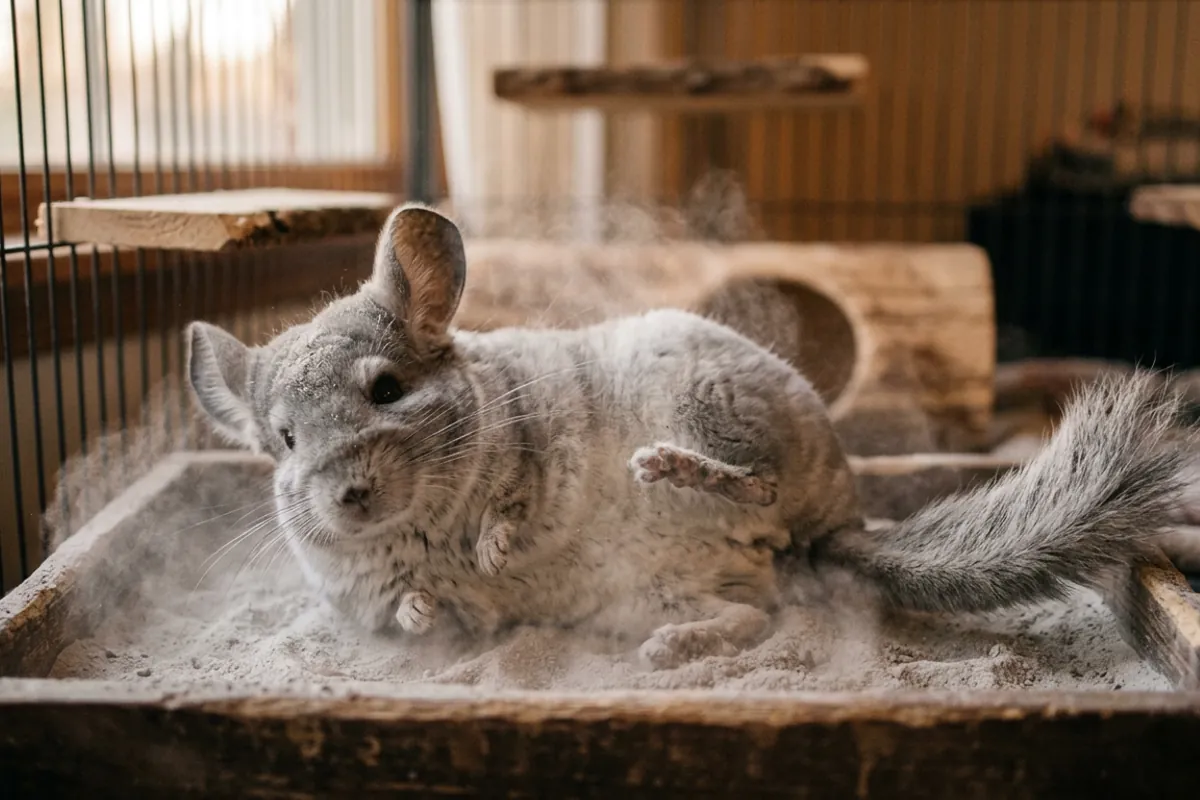
Here is the part that saves lives. Fur that dense does not dry. Get a chinchilla soaked and the water is trapped against the skin under an insulating blanket, and it sits there long enough to chill the animal and grow fungus. That is the entire reason they never, ever bathe in water. They roll in fine volcanic dust instead, which slips through the coat and carries oil and moisture back out. A dedicated dust bath house keeps the mess contained and the powder deep enough to work. Lixit Blue Beauty chinchilla dust, 3 lb As an Amazon Associate I earn from qualifying purchases. Use a proper pumice-based dust on a schedule, not play sand and not more often than the coat needs, or you dry the skin out. I broke down the how and the how-often in the chinchilla dust bath done right.
They cannot cool themselves the way you can
You sweat. A chinchilla effectively cannot. It has very few working sweat glands and it cannot pant its way out of trouble the way a dog does. The main tool it has for shedding heat is its ears, those big rounded ears are packed with blood vessels close to the surface, and the animal dumps warmth through them. When the ears go bright red and feel hot to the touch, the chinchilla is already in trouble. That is not a charming detail to photograph, it is a warning light on the dashboard.
This is Pebble's story turned into a rule. Her first summer brought a heatwave and a near miss that ended at the emergency vet, and it is the reason not one word about temperature is negotiable. Comfortable is 60 to 70°F, which is 15 to 21°C. Above 75°F, roughly 24°C, you are into risky ground, and 80°F, about 27°C, and up is a genuine emergency, faster still when the air is humid, because damp air strips away the little cooling they manage. Put a gauge that reads both temperature and humidity right at cage height, not across the room where it lies to you. digital thermometer and humidity gauge with remote probes As an Amazon Associate I earn from qualifying purchases. Give them a cool surface to press against on warm days, something that pulls heat out of the body. Kaytee Chinchilla Chiller granite stone As an Amazon Associate I earn from qualifying purchases. To see how heat and humidity stack into real danger, run your own room through the chinchilla heat danger calculator, and read the heat stroke warning signs before the day you need them, not during it.
Their teeth never stop growing
A chinchilla has 20 teeth, and every single one grows for the animal's whole life. They are open-rooted, which means there is no point where the tooth decides it is finished, it just keeps coming, and the only thing holding it in check is grinding, tooth against tooth and tooth against fibrous food. One more detail that catches people out: healthy chinchilla teeth are yellow to orange, not white. That color is normal, strong, well-mineralized enamel. Pale, chalky white teeth can be a sign that something is wrong.
This is the fact I live with every day. My Juniper came to me as a neglected rescue with dental disease, and I manage it up close, day in and day out. When teeth stop wearing down evenly they overgrow and can hook into the cheek or the tongue, and that is malocclusion, one of the most common and most miserable things that goes wrong in this species. The defense is relentless chewing on the right materials, unlimited hay first and then plenty of safe, untreated wood to gnaw. emours apple wood chew sticks, 40 count As an Amazon Associate I earn from qualifying purchases. A rotating mix of chews keeps a chinchilla interested instead of bored, and bored teeth are teeth that stop grinding. If yours drools, drops food, paws at its mouth, or quietly loses weight, that is not a wait-and-watch situation, that is an exotics vet, and I mean this week. I laid the warning signs out in spotting malocclusion before it turns serious.
They run on grass, not sugar
A chinchilla is built to wring a living out of poor, fibrous mountain grasses, and its gut is a fermenting system tuned for exactly that job. They are hindgut fermenters, and yes, they eat some of their own droppings on purpose, the soft ones, to run their food through a second time and pull out nutrients they missed on the first pass. It sounds grim, and it is completely normal and necessary, so do not try to stop it.
What that means for you is blunt and not up for debate: unlimited grass hay is the meal, not a garnish. Timothy hay should be in front of them all day, every day, and it does two jobs at once, it feeds that fermenting gut and it grinds those endless teeth. Oxbow Western Timothy Hay, 40 oz bag As an Amazon Associate I earn from qualifying purchases. Plain pellets sit on top as a small, measured supplement, never the main course, and buying hay in bulk is one of the cheapest good decisions you will make as an owner. Oxbow Western Timothy Hay, 9 lb box As an Amazon Associate I earn from qualifying purchases. What a chinchilla is not built for is sugar and fat. Fruit, nuts, seeds, yogurt drops, most of the treats marketed straight at them, their gut cannot process it and it does real harm. I keep extras to a pinch of plain dried herb or a sliver of safe forage and nothing richer. The full yes-and-never list lives in what can a chinchilla eat and the diet guide.
They live longer than almost any rodent you will meet
People buy a chinchilla thinking rodent, thinking two or three years like a hamster, and they are off by more than a decade. A well-kept chinchilla commonly lives 10 to 20 years, and some push past that. In the wild the number is far lower, because a wild animal faces cold, predators, and scarcity that a good cage quietly removes from the equation. Longevity in captivity is not luck, it is the payoff for getting the hay, the heat, and the vet care right for years on end.
I say this bluntly on purpose, because it is a fact that should change a decision before you make it. This is a fifteen-year-plus commitment, closer to a dog or a parrot than to a pocket pet you keep for a season. The animal you carry home from a listing counter will still be with you through house moves, job changes, and whole chapters of your life. Plan for the long vet relationship, the years of hay bills, and the reality that a chinchilla bonds and does not enjoy being passed along. I put honest numbers to the whole span in how long chinchillas really live.
They are crepuscular athletes, not lap ornaments
A chinchilla is neither nocturnal nor diurnal, it is crepuscular, most alive at dawn and at dusk. That is when yours will want to tear around the cage, and it is worth knowing before you site the thing next to your pillow and wonder why you never sleep. They are also astonishing jumpers. A healthy chinchilla can launch itself about six feet, roughly 1.8 meters, straight up, which in the wild is how it clears rocks and puts distance between itself and a hawk. That is not a party trick, it is a physical need looking for somewhere to go.
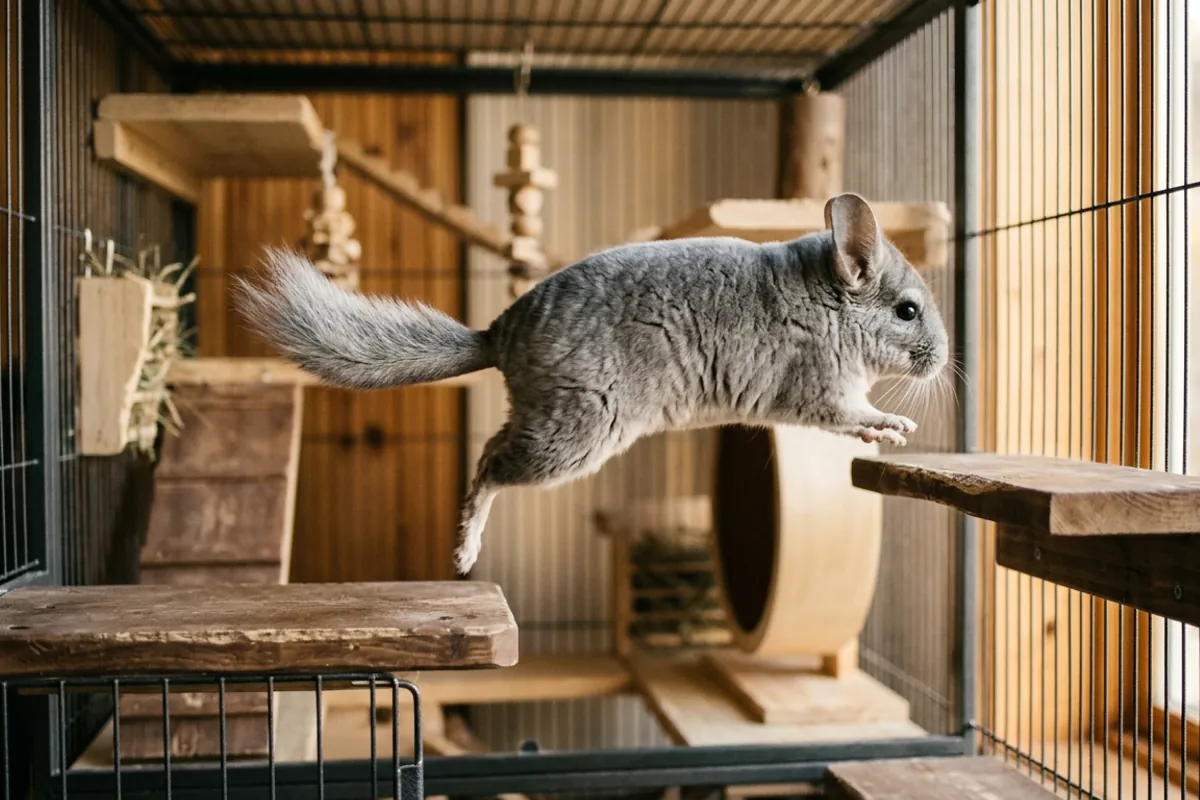
Which makes jumping a housing specification, not a bonus. It is exactly why height beats floor space in a cage, and why a short, wide box wastes the single best thing the animal can do. Give them a tall metal-and-wood cage with wooden ledges set at different heights to bounce between. Critter Nation double unit small animal cage As an Amazon Associate I earn from qualifying purchases. For running, the surface has to be solid, never wire and never mesh, because a foot or a tail slipping through a rung is a real and preventable injury. 15 inch Chin Spin solid surface chinchilla wheel As an Amazon Associate I earn from qualifying purchases. I made the height argument in full in why height beats floor space.
A few facts that catch new owners off guard
Now a handful of smaller ones, each with a hook worth remembering. The females are the larger sex, and often the bossier one, which throws people who expect the reverse. Chinchilla pregnancies are long for a rodent, around 111 days, and the babies arrive fully furred with their eyes open, ready to move almost at once, nothing like the pink, blind pups most rodents produce. They are talkers, too, with a real range of squeaks, barks, and chirps, and once you learn to read the sounds they make you can read the mood in the room.
And one that looks like a magic trick until you understand the biology behind it. A frightened chinchilla can release a clean patch of its own fur, a defense called fur slip, leaving a predator holding a tuft while the animal bolts. In your hands that means you never grab or scruff one roughly, or you are left with a bald patch that takes months to fill back in. Handle gently, support the whole body, and let the animal come to you on its own clock. Every one of these traces back to the same cold-mountain rodent we started with, and the more of these chinchilla facts you hold in your head, the fewer surprises end up at the vet.