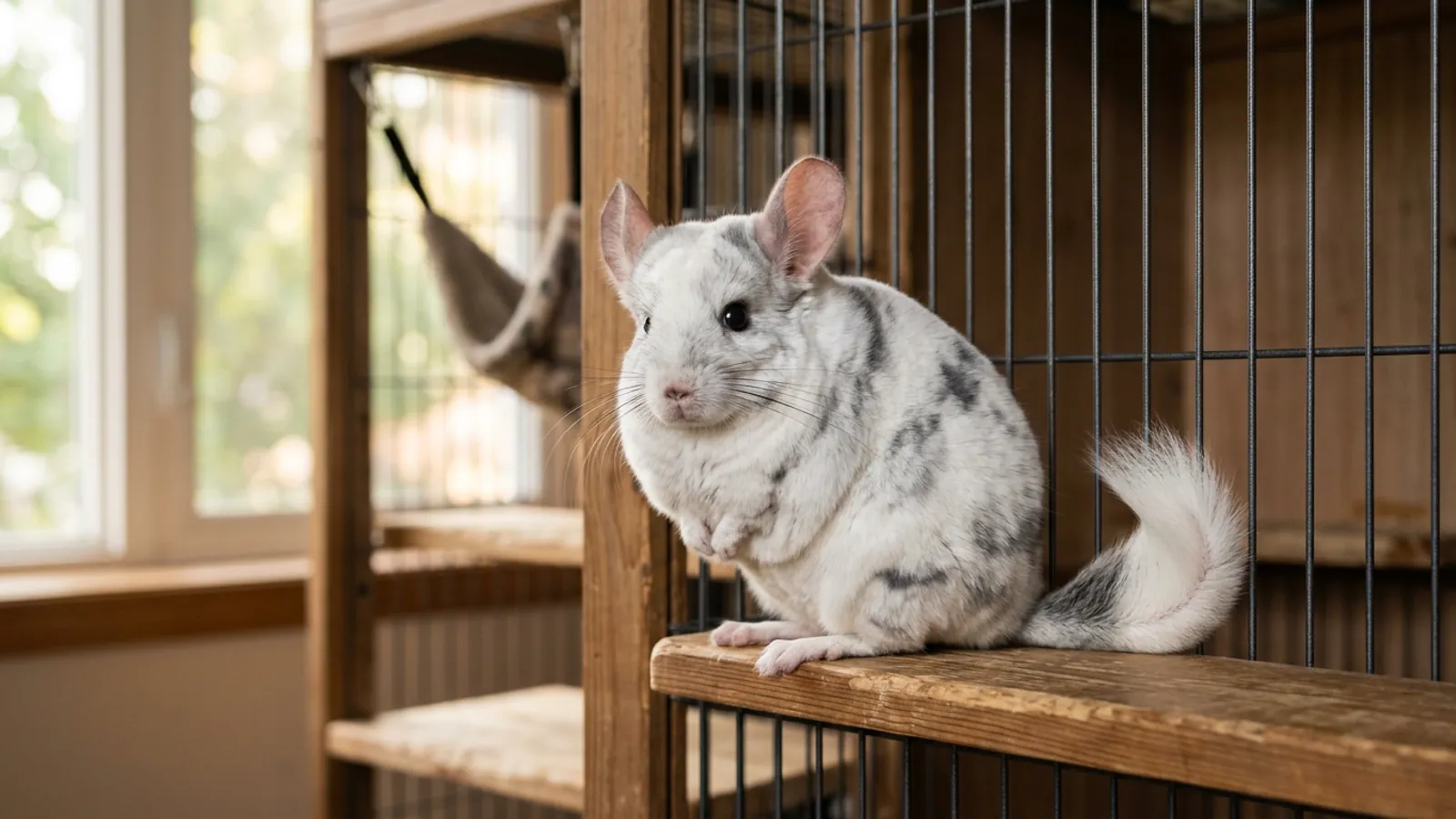
If you have run into the phrase chinchilla white mosaic and come away unsure whether it names a color, a breed, or a bit of breeder marketing, you are in good company. It is none of those, not quite. Mosaic is a pattern, not a color, a scatter of gray laid across a white coat, and no two animals wear it the same way. I have kept chinchillas for about ten years, and I still catch myself looking twice at a good mosaic, because the patchwork really is lovely. But I want to be blunt at the top, because it is the whole reason this site exists: the pattern is skin deep. It changes nothing about how you keep the animal alive.
What a chinchilla white mosaic really is
Strip away the pretty name and a white mosaic is a chinchilla whose coat is mostly white with irregular patches, splashes, or marbling of gray showing through. The gray is usually standard gray, the same slate color a wild chinchilla wears, sitting in blotches over a white ground. The eyes are dark, close to black, and the ears are usually gray. That dark eye is one of the quickest tells, and I will come back to it, because it is what separates a mosaic from the pink-eyed whites people mix it up with.
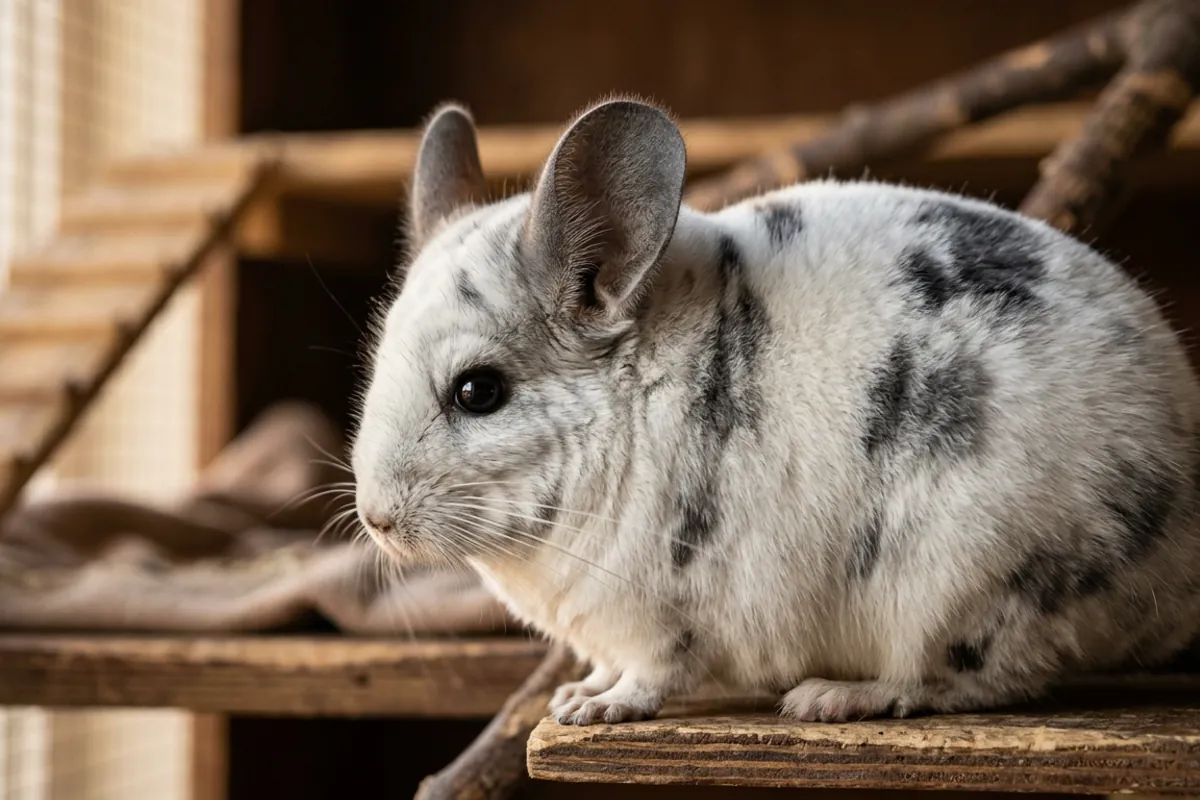
The word to hold onto is pattern. A mosaic is not a distinct color mutation the way beige or black is. It is the white gene expressing itself unevenly, so that some of the base coat still shows. Say it as a mosaic white chinchilla or a white mosaic chinchilla, the words in whatever order you like, and you are pointing at the same thing: white plus patchy gray, dark eyes. If you want the pattern itself pulled apart in more detail, I go deeper in the piece on what a chinchilla mosaic really is, and the wider color picture sits in chinchilla colors and what the coat never changes.
It is not a breed. There is one species of pet chinchilla, and mosaic is one of the looks it comes in, no more a separate animal than a calico is a separate cat.
Where the white and the patches come from
The white in a white mosaic comes from a single dominant mutation most keepers call Wilson White, after the breeder credited with fixing it in the 1950s. Dominant means one copy is enough to show, so a white chinchilla has one white parent somewhere behind it. The gene lays white over whatever base coat the animal was going to have. Where it covers completely you get white fur, and where it does not quite take, the base color shows through as the gray patches you are looking at. That uneven coverage is the mosaic.
Because the white sits on top of a base, the patches are not always the same shade. Over a standard gray base you get the familiar gray blotches. Stack in darker genes like ebony and the patches can run deeper and sootier, sometimes almost charcoal at the edges. That is why some mosaics look faintly dusted with gray and others look boldly marbled. None of it is a defect and none of it is a grade. It is just which genes happened to land in that particular animal.
I say all this so you can see the join. The white chinchilla label and the mosaic label are describing two ends of the same gene. A white that covers almost fully reads as a clean white. A white that leaves a lot of base showing reads as a mosaic. Same mutation, different amount of cover.
How to tell a white mosaic from the other whites
This is where names get slippery, so let me lay the whites side by side.
A mosaic is white with irregular gray patches and dark eyes. The gray is blotchy and unique to the animal.
A silver is white shot through with gray guard hairs spread fairly evenly, so it reads as a soft, all-over pale gray rather than distinct patches. No blotches, more of a wash.
A pink white is the one people most often confuse with a mosaic, and it is genuinely different. Pink white is the white gene laid over beige, so the patches are beige or apricot rather than gray, the ears are pink, and the eyes are red or ruby. If you are looking at pink ears and red eyes, you are not looking at a mosaic. I pull that color apart in what a chinchilla pink white really is.
So the quick field test is the eyes and the patch color. Dark eyes and gray patches, mosaic. Red eyes and pink ears, pink white. And if the animal is white with sharp, well defined dark areas rather than a soft scatter, you may be looking at something closer to a black and white chinchilla, which is the same family of white over dark but heavier on the dark. None of these lines are laboratory precise, because breeders use the words loosely, but the eyes will keep you honest.
Every white mosaic is one of a kind
Here is the part I love. Because the mosaic pattern comes from the white gene covering the base unevenly, and that unevenness is not inherited as a fixed map, no two mosaics match. Litter mates from the same white parent can range from nearly all white with a smudge or two, to heavily marbled with gray running down the back and across the flanks. You cannot order a specific pattern the way you might pick a paint chip, and any breeder who promises you an exact marking is overselling.
The pattern can also shift a little over a life. A kit's markings soften or sharpen slightly as the adult coat comes in, and molts can nudge the look from season to season. It is subtle, not a transformation, so do not expect a patchy baby to turn solid white or the other way round. What you will not see is the pattern telling you anything about health. A mosaic is not more delicate, not more prone to anything, not a warning sign. It is a coat. A heavily patched mosaic and a nearly white one are the same animal underneath with the same needs.
What the pattern never changes: the care that keeps them alive
This is the section I would keep if I had to bin the rest. Coat color and coat pattern change the price tag and nothing else. A white mosaic needs exactly what every chinchilla needs, and getting that wrong kills them faster than any genetic quirk ever could.
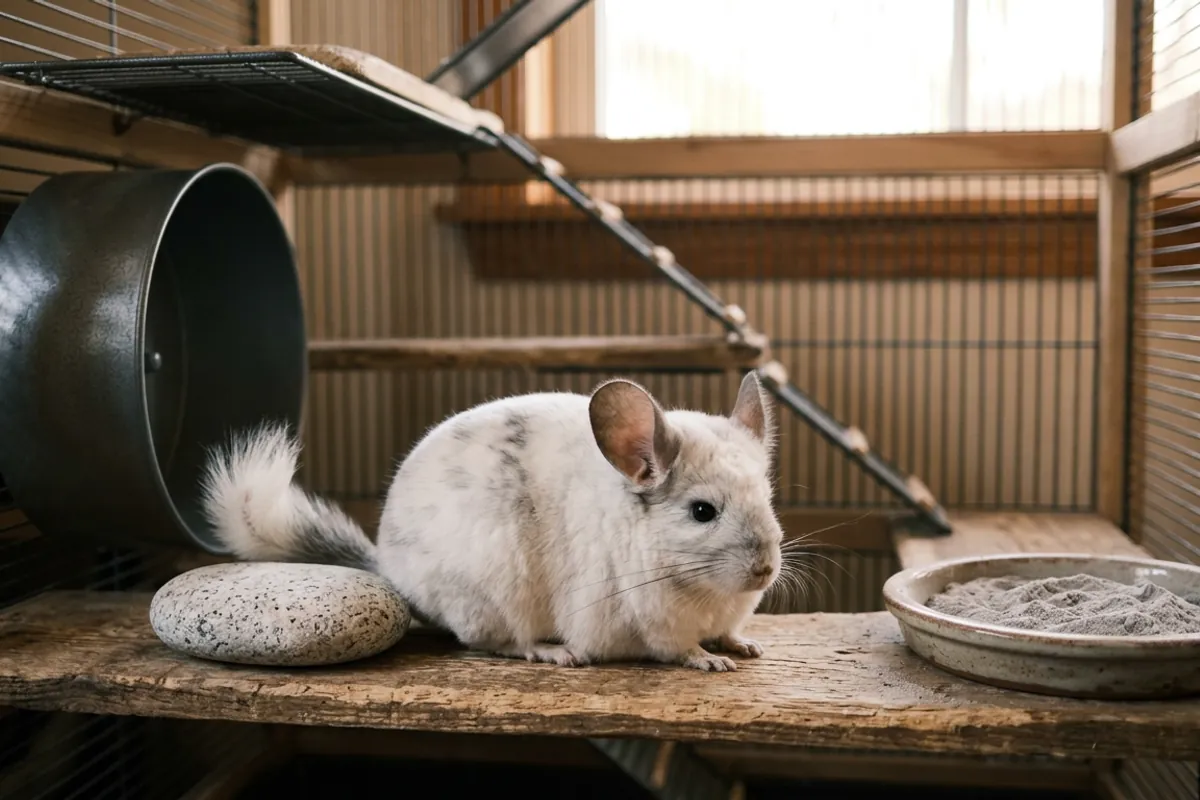
Start with heat, because it is the one that ends lives. Chinchillas are built for a cold, dry mountain climate, and they cannot shed heat well through that dense coat. The comfortable range is 60 to 70°F, roughly 15 to 21°C. Above 75°F, about 24°C, you are into risky ground, and 80°F, around 27°C, is an emergency, sooner in humid air because they cannot lose heat when the air is already wet. I am relentless about this because of Pebble, who came to me out of an overheated attic and spent a night at the emergency vet in her first summer after a heatwave nearly took her. On the cage I keep a combined thermometer and humidity gauge. digital thermometer and humidity gauge with remote probes As an Amazon Associate I earn from qualifying purchases. It means I am reading the room the animal is in, not the guess in my head, and on a warm afternoon a slab of chilled granite gives her somewhere to dump heat. Kaytee Chinchilla Chiller granite stone As an Amazon Associate I earn from qualifying purchases. If you want to see how fast a warm room turns dangerous, the heat danger calculator makes it concrete, and I go through the red flags in chinchilla heat stroke warning signs.
Then the diet, which is simpler than the internet makes it. Unlimited grass hay is the whole meal, not a side dish, in front of them at all times, because the chewing is what keeps their constantly growing teeth worn down. I buy grass hay in bulk so I never run short. Oxbow Western Timothy Hay, 9 lb box As an Amazon Associate I earn from qualifying purchases. I keep it in a box that stops it being crushed and soiled. Oxbow Western Timothy Hay, 40 oz bag As an Amazon Associate I earn from qualifying purchases. Juniper, my rescue, has dental disease I manage every single day, and she is the reason I will not cut corners on hay or on chews. A rotation of plain safe woods gives the teeth more work to do. emours apple wood chew sticks, 40 count As an Amazon Associate I earn from qualifying purchases. Plain pellets go on top as a measured supplement, a tablespoon or two a day, not a bowl to graze from, and treats stay tiny and rare. The full version is in the chinchilla diet that keeps hay first.
They bathe in dust, never in water. A soaked coat holds damp against the skin and will not dry properly, which invites fungal trouble, so the bath is always fine volcanic dust and not a drop of water. A few times a week in a dish of proper bathing dust keeps the coat right. Lixit Blue Beauty chinchilla dust, 3 lb As an Amazon Associate I earn from qualifying purchases. There is more on frequency and technique in the chinchilla dust bath done right.
And the home. A tall cage of metal and wood, no plastic anywhere they can reach, because a chinchilla will chew plastic and a swallowed piece is a real problem. You want wooden ledges to jump between, since they climb far more than they run along the floor. Critter Nation double unit small animal cage As an Amazon Associate I earn from qualifying purchases. If you add a wheel it has to have a solid running surface, never wire or rungs that can trap a foot or a tail. 15 inch Chin Spin solid surface chinchilla wheel As an Amazon Associate I earn from qualifying purchases. None of that shifts by a hair for a mosaic, and the whole build is in the chinchilla cage setup guide.
Why breeders don't pair white with white
There is one genetics point worth knowing even if you never breed, because it explains why whites are priced the way they are and why a responsible breeder pairs them carefully. The white gene is dominant, and a double dose of it, one white copy from each parent, is understood to be lethal in the embryo. Breeding a white to a white does not give you a whiter or a guaranteed-white kit, it gives you smaller litters and lost pregnancies. So careful breeders pair a white with a non-white and take the roughly half-white litters that come.
That is the accepted understanding among breeders, and I pass it on as exactly that rather than a claim I have proven in my own home, because I do not breed. If you are thinking seriously about it, the responsibilities are heavier than most people expect, and I lay them out in what breeding a chinchilla asks. For the vast majority of us the takeaway is simpler: a white mosaic bought as a pet is a fine, ordinary chinchilla, and its color genetics are the breeder's problem, not yours.
Buying a white mosaic without regretting it
Buy the animal, not the coat. I understand the pull, a good mosaic is striking, but a pattern tells you nothing about whether the chinchilla was raised well, and that is the thing that decides the next ten years. Watch it move before you commit. You want a bright, alert animal that springs around, with clean dry eyes and nose, dry front paws, an even coat, and a firm body that is neither bony nor bloated. Ask the age, ask what it eats, ask to see the parents if you can, and treat a seller who only wants to talk about how rare the color is as a small warning in itself.
Rarity markups are mostly that, markups. A patterned coat can carry a higher price, but you are paying for looks, not for a better or healthier animal, and I would not let a color talk me into a seller I did not trust. There is a fuller version of that whole conversation in rare chinchilla colors and what the color never changes and in how to buy a chinchilla without regretting it later. Adoption is worth a look too, and I walk through what chinchilla adoption really asks, because whites and mosaics turn up in rescues like any other chinchilla, and a rehome comes with history you can ask about. Whichever way you go, the coat is the last thing that matters and the care is the first. Get the heat, the hay, the dust, and the cage right, and your white mosaic will be exactly as long-lived and as good a companion as any other chinchilla, patches and all.