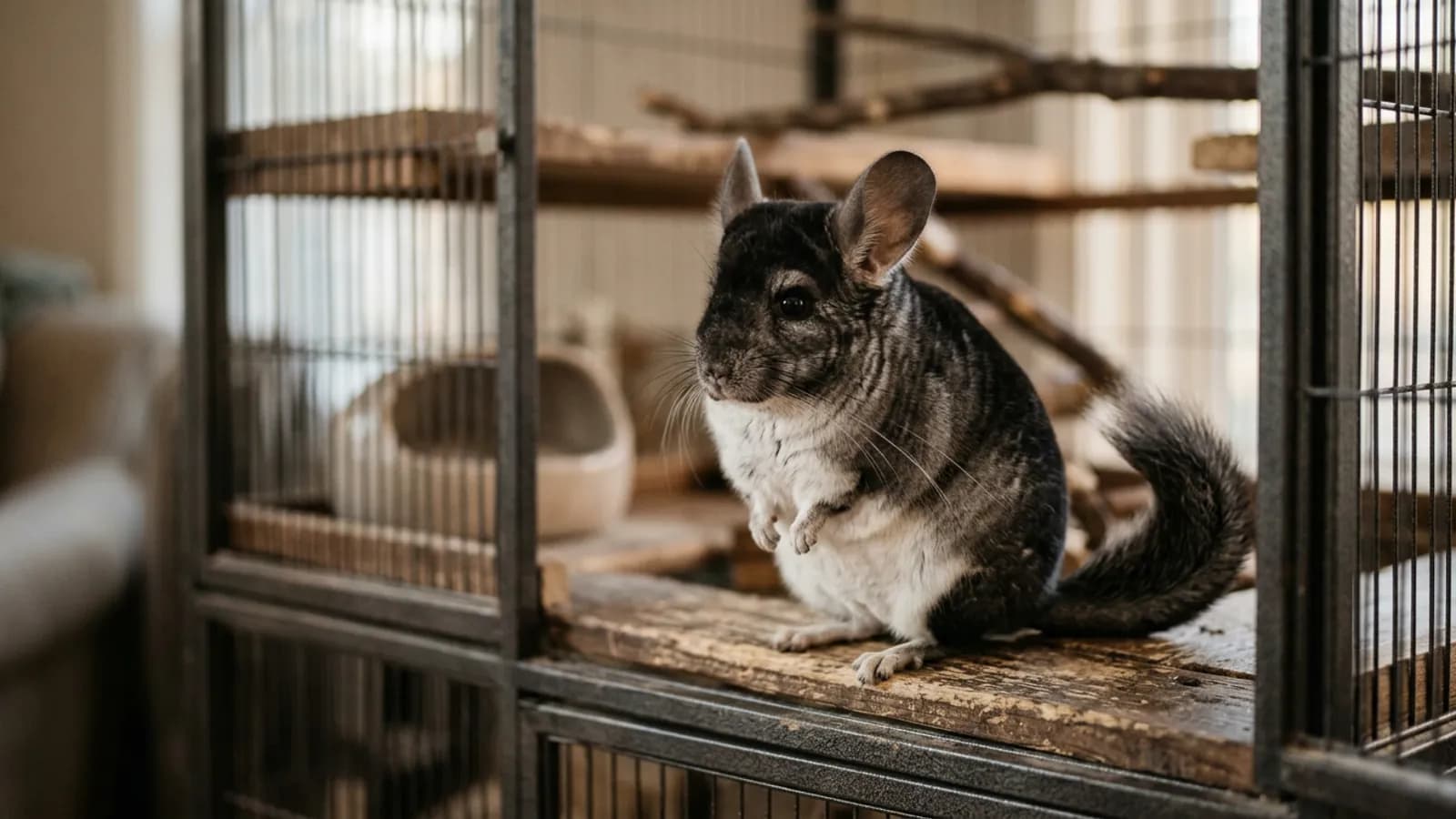
A black and white chinchilla is one of those phrases that tells me exactly what you saw and almost nothing about what you actually own. Someone points at an animal with a dark back and a pale belly, or a white coat splashed with grey, and the words "black and white chinchilla" come out because that is honestly what it looks like. It is a description, not a breed and not an official colour name. Underneath that two-tone look sits real genetics, and once you know which mutation you are staring at, the animal in front of you gets a lot easier to understand. So let me walk through what actually produces a chinchilla black and white enough to earn the name, and, more importantly, what none of it changes about the care the animal needs.
What people mean by a black and white chinchilla
When keepers say "black and white chinchilla" they are almost always describing one of two things. The first is a black velvet, sometimes called a touch of velvet or TOV, where a dark, almost sooty veil covers the head, back and sides while the belly stays clean white. The contrast is sharp, and from across a room it reads as a dark animal wearing a white apron. The second is a mosaic, a white coat carrying irregular grey or dark patches, which looks like someone dropped ink onto snow. Both get called a white and black chinchilla by people going on colour alone, and both are perfectly ordinary, healthy-looking animals. Neither is a formal category you will find written on a pedigree as "black and white."
The reason the label is so loose is that chinchilla colour is a stack of separate mutations that combine in different ways. What one person calls a black white chinchilla, another calls a dark mosaic, and a breeder calls by the exact mutation names. None of them are wrong, they are just describing the same coat at different levels of detail. My job here is to get you from the words you would use to the genetics a breeder would use, because that is the version that actually predicts anything.
The pigment behind the look
Every chinchilla starts from the same wild blueprint: agouti grey, the colour of the animals still living in the Andes. Look closely at a single hair on a standard grey and it is banded, with a dark tip, a pale band, and a dark base. Thousands of those banded hairs together are why a standard chinchilla reads as that soft blue-grey rather than flat grey. If you want the full picture of the animal underneath any colour, I wrote about what a chinchilla really is and why its biology sets every care rule separately, because the biology matters far more than the coat.
A black-and-white appearance comes from two kinds of change to that agouti blueprint, and it helps to keep them straight. One kind adds dark pigment on top of the coat, a veiling that lies heaviest along the back. The other kind removes or interrupts pigment so that white shows through, either as an overall paling or as patches. Put plainly, black and white on one animal is usually dark veiling meeting white patterning, or dark veiling sitting above the naturally white belly that every chinchilla already carries. The same pigment machinery is behind the warmer mutations too, which is why it is worth understanding that a brown chinchilla changed only its colour and nothing else, and the same is true of what a violet chinchilla really is. Colour is a surface trait. It is genuinely skin deep.
Black velvet, the dark cape
Black velvet is the mutation doing most of the "black" work in a black and white chinchilla. It is a dominant gene, which matters for two reasons I will come back to. The veiling is heaviest along the spine and over the head, fading down the flanks, and it usually leaves distinctive dark bars running down the front feet that breeders use to confirm the mutation. Underneath and along the belly the fur stays white, and it is that hard line between the dark cape and the pale underside that makes the animal look so cleanly two-toned. The name is earned, too. The fur really does take on a deep, velvety quality where the veiling is thickest.
Because the gene is dominant, a single copy shows up in the coat. Cross a black velvet to a standard grey and, on average, about half the litter carries the velvet look while the rest come out standard. That predictability is part of why the mutation is common and why so many "black and white" animals in pet homes are some flavour of velvet crossed onto another colour. Velvet layered over beige gives a brown velvet, velvet over the white line gives the striking dark-on-white contrast people photograph, and so on. The velvet is not a colour of its own so much as a dark overlay that can sit on top of whatever base colour is already there.
The white and mosaic side
The "white" in a black and white chinchilla mostly traces back to the white mutation, often called Wilson white after the line it came from. Like black velvet, it is dominant, so one copy is enough to show. What it produces is a wide range: some animals are nearly pure white, some are silver with grey shading, and some are mosaic, meaning white with bold, irregular grey or dark patches scattered across the coat. That mosaic patterning is the classic look people mean by a chinchilla black and white when they are not describing a velvet. No two mosaics are marked the same way, which is exactly why I think of a mosaic as a pattern and not a colour. The genes decide there will be patches; they do not paint them in the same place twice.
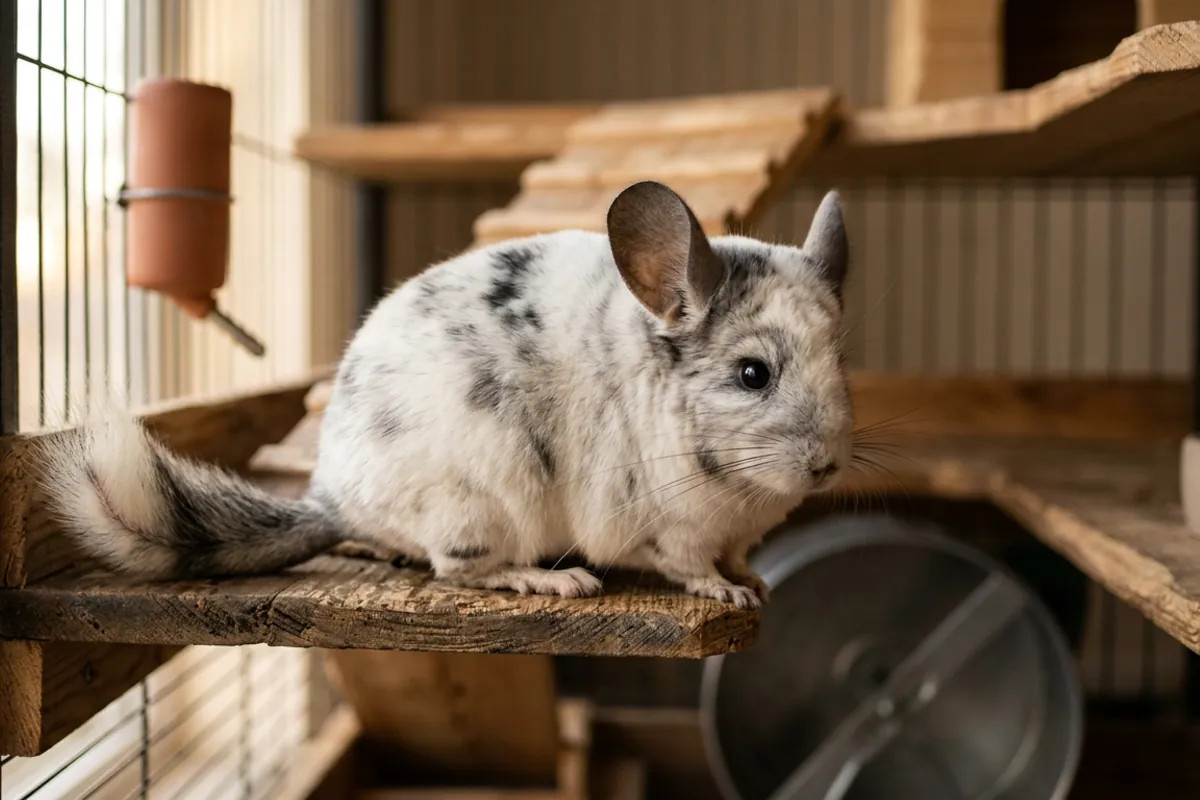
One thing worth nailing down, because it confuses people constantly: a white or mostly-white chinchilla is not an albino. White-line chinchillas have dark eyes and normally pigmented skin. A true albino has no pigment at all, red eyes included, and it is genuinely rare. I went into what an albino chinchilla really is and why the label rarely fits because pet listings throw the word around loosely, and what a white chinchilla actually is covers the same ground from the white side. If the eyes are dark, it is a white or mosaic chinchilla, not an albino, no matter how pale the coat.
Why you cannot just pair two showy colours
Here is the part that turns a fun colour discussion into something with real stakes. Both the white mutation and the black velvet mutation carry what breeders call a lethal factor when an animal inherits two copies. Because both genes are dominant, it is tempting to think you could pair two striking white and black chinchillas together and get a litter full of striking pups. In practice, the pups that inherit a double dose of the white gene do not survive, and the widely followed breeder rule is the same for doubling up black velvet. So responsible breeders do not pair white to white, and they are careful about velvet to velvet, precisely to avoid losing pups to a pairing that looked like a shortcut to more colour.
I am an experienced keeper, not a geneticist, so I will be honest about the edges here: the white lethal factor is very well established, and the velvet caution is the standard rule breeders live by. What I would not do is treat any of it as a licence to experiment. If you are seriously thinking about breeding for colour, the genetics are only the smallest part of the cost, and I laid out what breeding a chinchilla actually asks of the animal so nobody wanders into it because a two-tone coat looked worth chasing. For anything about a specific pairing or a pregnancy that has already happened, that is a conversation for an exotics vet, not a blog. The practical takeaway for a buyer is simpler: a dramatic black white chinchilla is often two showy dominant genes stacked, and a seller breeding hard for that look may be walking straight into losses. That tells you something about the seller.
The colour changes nothing about care
This is the sentence I most want you to keep. A black and white chinchilla needs precisely the same care as a plain standard grey, because pigment does not touch the parts of the animal that actually keep it alive. The coat is a surface trait. Temperature regulation, teeth, and diet are not.
Start with heat, because it is the one that kills fastest. Chinchillas are built for a cold, dry mountain climate, and they are comfortable at 60 to 70°F (15 to 21°C). Above 75°F (24°C) you are into risky territory, and 80°F (27°C) and up is an emergency, faster still if the air is humid. That is true of a white animal, a black velvet, and everything in between. I keep a combined thermometer and hygrometer on the cage so I am reading the actual room, not guessing. digital thermometer and humidity gauge with remote probes As an Amazon Associate I earn from qualifying purchases. When summer pushes, a chilled solid stone gives the animal somewhere to dump heat. Kaytee Chinchilla Chiller granite stone As an Amazon Associate I earn from qualifying purchases. If you want to see where your own room lands, I built a heat danger calculator, and the fuller version of my thinking is in the chinchilla heat safety guide. None of it cares what colour the chinchilla is.
Diet is the next non-negotiable, and colour has nothing to say about it either. Unlimited grass hay is the whole foundation, all day, every day, because it is what keeps the constantly growing teeth worn down. A tidy hay box keeps it clean and off the cage floor, Oxbow Western Timothy Hay, 40 oz bag As an Amazon Associate I earn from qualifying purchases. and if you go through it as fast as my two do, buying timothy hay in bulk is cheaper. Oxbow Western Timothy Hay, 9 lb box As an Amazon Associate I earn from qualifying purchases. On top of the hay, a measured amount of plain pellets, and that is it for the staples. My Juniper came to me with dental disease, and watching her manage it up close is why I am uncompromising about hay and about a real variety of chews. A chew variety pack gives the teeth different shapes and textures to work against. emours apple wood chew sticks, 40 count As an Amazon Associate I earn from qualifying purchases. More on both fronts in the diet guide and the teeth and health guide.
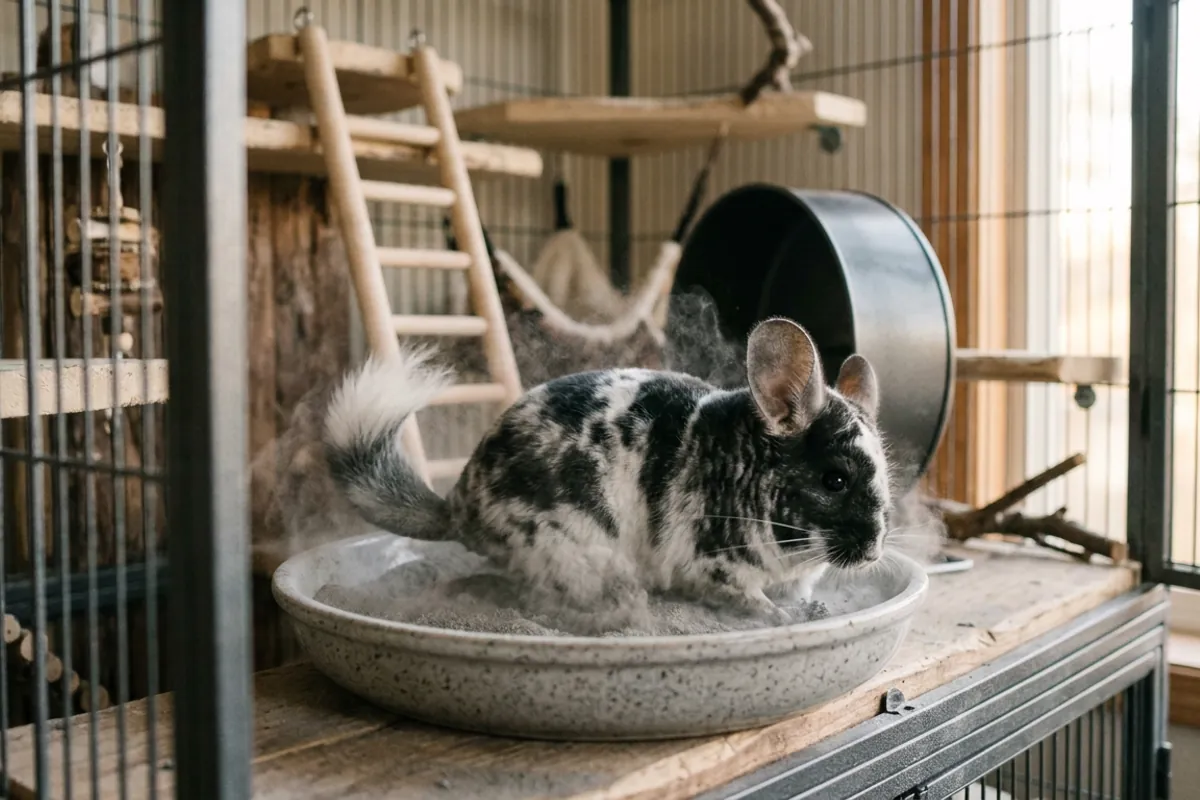
Then there is the bath, which surprises new owners more than colour ever should. Chinchillas never bathe in water. They roll in fine dust, and a wet chinchilla is a genuine problem, not a cute one. A proper dust bath with real chinchilla dust, Lixit Blue Beauty chinchilla dust, 3 lb As an Amazon Associate I earn from qualifying purchases. offered a few times a week, is how that dense coat stays clean and healthy, whether the coat is snow white, sooty black, or patched with both. And the cage itself should be tall, made of metal and wood with wooden ledges, never plastic, with a solid-surface wheel rather than wire rungs that can catch a foot. 15 inch Chin Spin solid surface chinchilla wheel As an Amazon Associate I earn from qualifying purchases.
Buying a black and white chinchilla without getting burned
If you have decided you want one, my honest advice is to let the colour be the last thing on your list, not the first. The striking coat is genuinely the least important fact about the animal you are bringing home. What matters is health, temperament, and whether the seller is telling you the truth. A clear-eyed, alert chinchilla with clean fur, a dry chin, and even teeth is worth far more than a dramatic pattern hiding a sick animal.
Watch out for the novelty premium. Sellers know a photogenic white and black chinchilla catches the eye, and some will price it well above a standard grey for no reason beyond the look. Colour is not rarity in any way that should cost you extra in a pet, and it certainly does not make the animal healthier. I dug into what a chinchilla price actually tells you and what a chinchilla really costs once you count the cage, the vet fund, and the years, because the sticker is the smallest number in the whole commitment. If you are still shopping, how to buy a chinchilla for sale without getting hurt or ripped off and how to find a chinchilla near me without bringing home trouble both go through the checks that actually protect you.
Ask the seller about the parents, and pay attention to how they answer the colour question. A breeder who understands the lethal factors, who does not pair two whites, and who talks about health before pattern is one I would trust. A seller who is breeding hard for the most dramatic black and white coat they can produce, and cannot tell you a thing about the genetics behind it, is one I would walk away from. The coat will look the same either way in the photos. The difference shows up in the animal, and in the years you spend with it.
So yes, a black and white chinchilla is a real and lovely thing to look at, and now you know what is actually going on under that two-tone coat: a dominant dark veil, a dominant white pattern, a naturally white belly, and a couple of lethal factors that keep honest breeders careful. Learn to read the coat if you enjoy it. Then set it aside and give the animal exactly what every chinchilla needs, because the black and the white are the only part of this that ever changed.