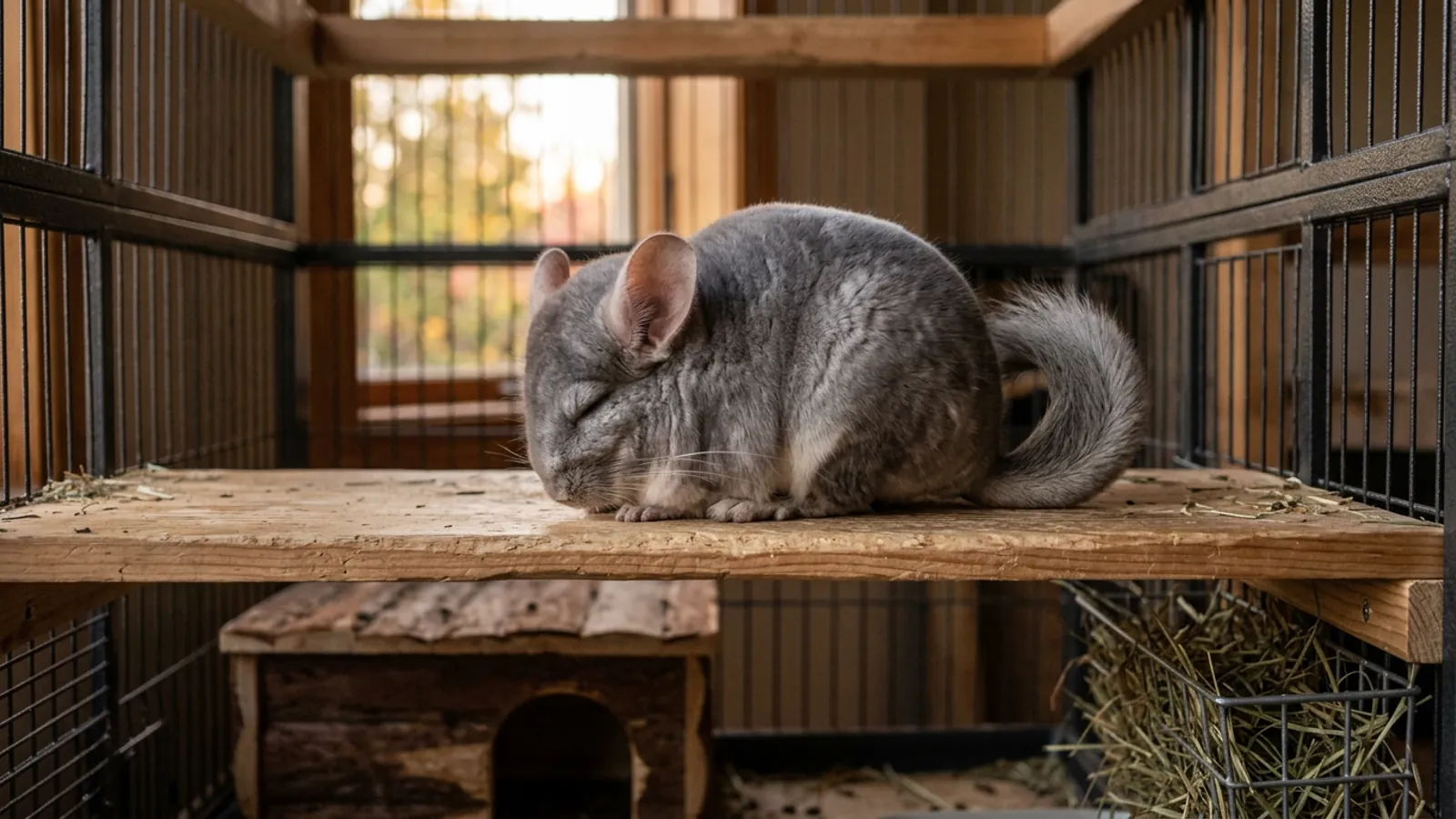
The first thing that surprised me about chinchilla sleep was how little of it happens in one long block. I had pictured a hamster: dead to the world all day, awake and wheeling all night. What I got instead, first with Pebble and later with Juniper, was an animal that naps in short bursts around the clock, comes properly alive at dawn and dusk, and considers 2 a.m. a reasonable hour to rearrange a shelf. Ten years in, I can read most of it: which flop means she feels safe, which noise means she wants a chew, and which one means I need to get up and look. That reading is worth learning, because a chinchilla's sleep is one of the earliest places a health problem shows itself.
How much chinchillas sleep, and when
You will see numbers quoted online, usually somewhere around 12 to 14 hours a day. I am not going to pretend I can stand behind a precise figure, because I have never seen one from a source I would trust with an animal's care, and nobody I know has sat with a stopwatch on a chinchilla for a week. What I can tell you is what is reliably observable in a home, because I have watched it thousands of times.
Chinchillas sleep in fragments. A nap runs anywhere from a few minutes to something closer to an hour, then they shift, stretch, chew a bit of hay, drink, and settle again. The bulk of that sleeping is packed into the daylight hours, but it is never one uninterrupted stretch. Pebble will be flat out at 11 a.m., upright and grinding through a hay stem at 11:20, and back asleep by 11:30. If you sit near a cage at midday and expect stillness, you will not get it.
The pattern matters more than the total. What you want to see is a chinchilla that sleeps mostly through the middle of the day, wakes properly in the late afternoon or evening, is busiest around dusk and again around dawn, and pokes around intermittently through the night. Anything that breaks that shape, especially a chinchilla asleep during its own peak hours, is worth paying attention to. I will come back to that at the end.
Nocturnal, crepuscular, or just inconvenient
Search "chinchilla nocturnal" and you will get a confident yes. Search a little further and you will find keepers insisting the right word is crepuscular. Both labels are used by people who know this animal well, and the sources disagree, so I would not spend much on the argument. The welfare organizations I trust say nocturnal. The round the clock activity measurements I have seen support the spirit of both: activity stays high right through the dark hours and falls to almost nothing in daylight, with the busiest stretches at the edges of the night. Nocturnal with a dusk and dawn peak describes what you will see, and the deepest sleep sits in the middle of the day.
That comes straight out of where they are from. Wild chinchillas live in rocky, high, dry country in South America, wedged into crevices during the day, out foraging when the light is going. Daytime in the open means raptors and heat, both of which kill a small animal fast. Nothing about a hundred generations in cages has unwound that. I wrote more about how the wild pattern still dictates home care in what a chinchilla in the wild is really like, and sleep is probably the clearest surviving piece of it.
The practical version, and I say this to everyone who asks me about getting one: do not put the cage in a bedroom you sleep in. Not because chinchillas are loud in the way a dog is loud, but because they are busy at exactly the hours you are trying to be unconscious, and the noise is the small, irregular, impossible-to-ignore kind. Jumping, landing, chewing, a wheel starting and stopping. Choose a room you can close the door on. The alternative is either a bad night for you or, far worse, an owner who starts trying to keep the animal quiet at night, which means keeping it from doing the one thing its body is built around. I go into more of these lifestyle realities in what keeping a chinchilla pet is really like.
What sleeping positions tell you
A settled chinchilla has a small repertoire, and once you know it, you can read the animal from across the room.
The default is upright, sitting on its haunches, body compacted into a loaf with the head tucked down toward the chest and the tail curled around. Eyes may be closed, half closed, or open. Open eyes while dozing is normal and I would not read anything into it. Prey animals do not shut down completely for the same reason you do not sleep in the middle of a road.
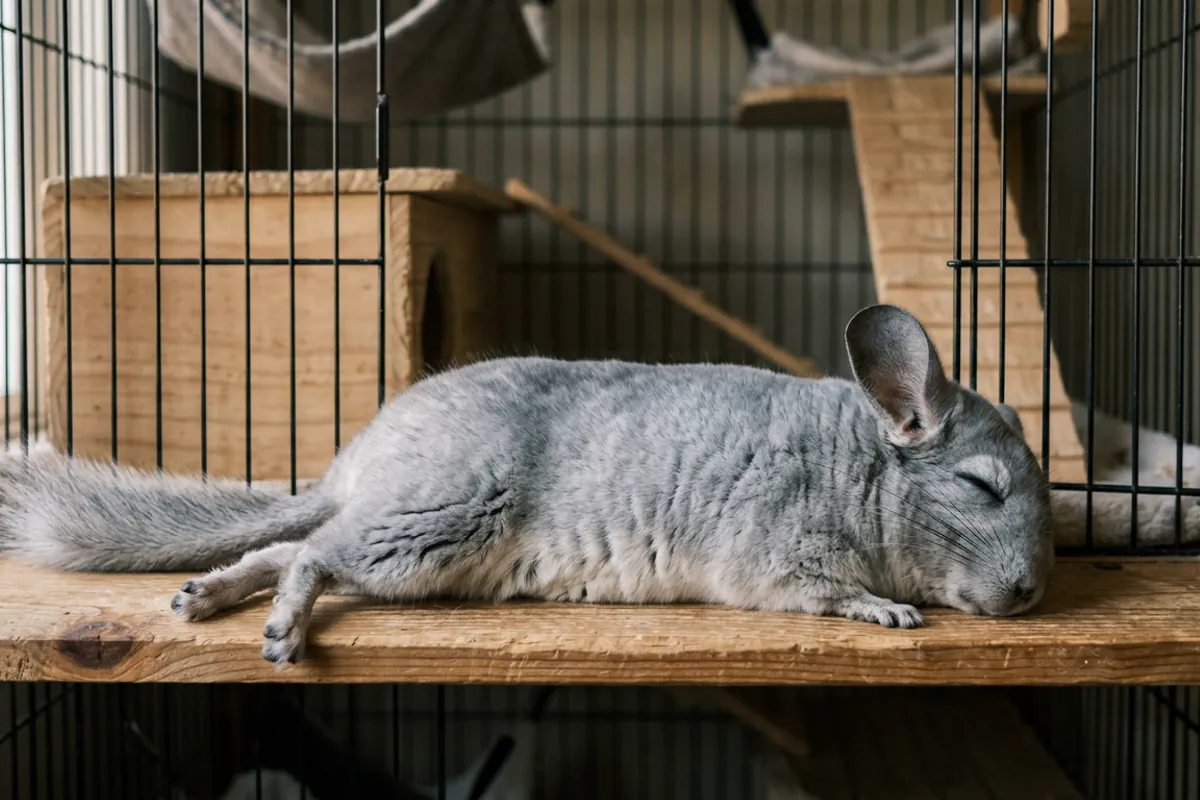
The second common one is a sideways lean, propped against a wall, a ledge edge, or the corner of a hide, head down, one hip taking the weight. Then there is the full flop: a chinchilla sleeping on side, legs stretched straight out, belly exposed, looking for all the world like it has been dropped from a height. The first time I saw it I thought Pebble was dead. She was not. She was comfortable.
That is what a flop means in a cool room: this animal feels safe. Chinchillas do not expose their belly and stretch their legs out where they feel watched or threatened. A newly adopted chinchilla often will not do it for weeks, sometimes months. When it finally happens, you have earned something. Juniper, who came from neglect, took a long time to flop, and I remember the day she did.
The one time a flopped chinchilla is not good news
Here is the distinction that keeps animals alive, so read it twice. A relaxed side sleeper is in a cool room, responds when you speak or open the cage, has cool ears, and gets up under its own steam. A chinchilla stretched flat out in a warm room, ears hot and flushed pink or red, breathing fast or open-mouthed, possibly drooling, slow or unable to respond, is not asleep. That is heat stroke and it is an emergency.
Pebble's first summer nearly ended that way. A heatwave, a room I thought was fine, and a night at the emergency vet. Everything I write about temperature comes out of that night. If the room is warm and the animal is flat, do not tell yourself a story about a nice relaxed nap. Check the ears, check for a response, check the thermometer, and read the warning signs of chinchilla heat stroke before you need them rather than during.
Chinchilla noises at night, and what each one means
Chinchilla noises at night fall into two buckets: the sounds of an animal living its life, and the sounds of an animal telling you something is wrong. Learning which is which saves you from both ignoring a problem and getting up at 4 a.m. for nothing.
Normal night sounds are mechanical more than vocal. Hay being pulled and chewed, a steady grinding you can hear across a quiet room. Wood being gnawed. The thump of a landing on a wooden ledge, which is startlingly loud for an animal that weighs about a pound. A wheel turning. The rattle of a water bottle. Soft, quiet teeth chattering while resting is generally a contentment sound, and I hear it most when one of mine is settling in.
The ones I get up for: sharp repeated barking, which is an alarm call and means something has frightened them, so check for a cat at the window, a loose animal, or a chinchilla stuck somewhere. Sneezing, wheezing, or any wet-sounding breathing, which is never background noise and warrants a vet. And loud, hard, deliberate teeth grinding from a hunched animal that is not doing anything else, which reads as pain rather than contentment, and with Juniper's dental history I never wait that one out. I break the whole vocabulary down further in what your chinchilla noises are telling you.
Then there is cage bar chewing, the metallic rattle that starts at 1 a.m. and does not stop. That is boredom and frustration, not illness, but it wrecks teeth and it wrecks your sleep. The fix is giving the mouth something better to do overnight. A rotating supply of safe hardwood, apple wood in particular, changed the overnight soundtrack in my house from bars to sticks.
emours apple wood chew sticks, 40 count As an Amazon Associate I earn from qualifying purchases.
Building a cage they can sleep in
A chinchilla that cannot get comfortable will not settle, and a chinchilla that cannot get away from light and sightlines will not sleep deeply.
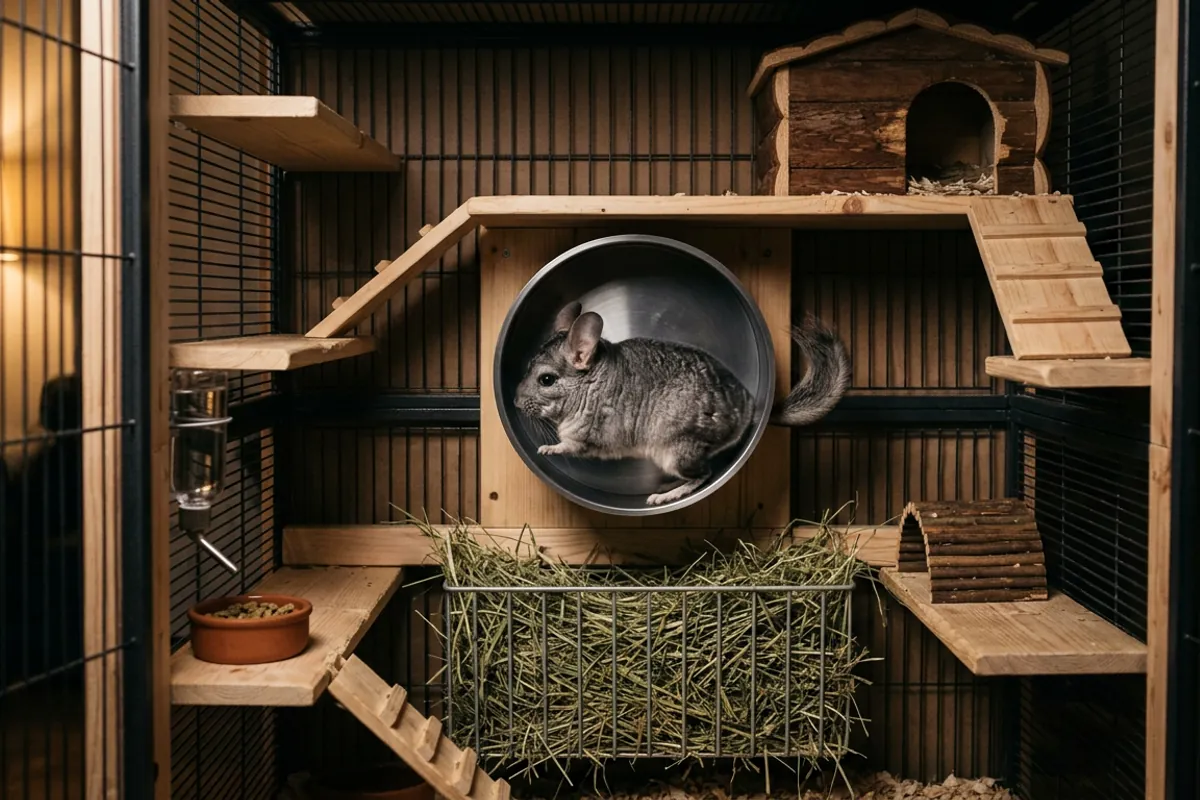
Start with a hide, and put it high. In the wild the sleeping spot is a crevice with rock over the top, and a wooden house on an upper shelf is the closest thing you can offer. Solid sides, a roof, one entrance, no plastic. Wood gets chewed and eventually replaced, which is fine and expected. There is more on picking one in the plain guide to a chinchilla wooden house.
The cage itself has to be metal, tall, and fitted with wooden ledges at varying heights. Height matters more than floor area because they sleep, watch, and move vertically. Plastic bases and plastic shelves get eaten, and eaten plastic causes blockages.
Critter Nation double unit small animal cage As an Amazon Associate I earn from qualifying purchases.
Hay has to be available all night, without exception. Grass hay is the whole meal, not a side dish, and the biggest single feeding period is overnight when you are not watching. Running out at midnight is not a small thing for an animal whose gut and teeth both depend on constant fiber. I buy timothy in bulk for exactly this reason, because the box that lasts a fortnight tempts you to ration.
Oxbow Western Timothy Hay, 9 lb box As an Amazon Associate I earn from qualifying purchases.
If you run a wheel, it must have a solid running surface. Wire and mesh wheels catch feet and tails and cause fractures, and they do it in the small hours when nobody is watching. A solid wheel with decent bearings is also dramatically quieter, which is the difference between a night's sleep for you and a night of squeaking.
15 inch Chin Spin solid surface chinchilla wheel As an Amazon Associate I earn from qualifying purchases.
Heat is what ruins daytime sleep
If a chinchilla will not settle during the day, the first thing I check is not the hide or the light. It is the temperature.
The comfortable range is 60 to 70°F, which is 15 to 21°C. Above 75°F, or 24°C, you are into risky territory. At 80°F, 27°C, and up you have an emergency, and humid air makes all of that arrive faster because that coat cannot shed heat into wet air. Chinchilla fur runs somewhere between 50 and 80 hairs from a single follicle, depending on which source you read, which is magnificent insulation and a death trap in a warm room. They cannot pant efficiently and they do not sweat.
A restless, sprawling, repeatedly-repositioning chinchilla during its normal sleeping hours is often a chinchilla trying to find somewhere cooler. Before I guess, I read the number. Every room with a chinchilla in it gets a thermometer with a humidity reading, positioned at cage height rather than up on a wall, because heat stratifies and the top shelf is warmer than your head.
digital thermometer and humidity gauge with remote probes As an Amazon Associate I earn from qualifying purchases.
For borderline warm days, a chilled granite or marble slab on a lower shelf gives them somewhere to lie against and dump heat, and mine both use it without being taught. It is a comfort measure, not a rescue: it does not make an 80°F room survivable.
Kaytee Chinchilla Chiller granite stone As an Amazon Associate I earn from qualifying purchases.
Two absolutes. Never soak the coat to cool a chinchilla down: no bath, no spray over the body, no wet towel wrapped around it. Wet dense fur holds moisture against the skin, dries almost never, and causes fungal problems and worse. Chinchillas bathe in dust. The one exception is the ears and paws, which are where a chinchilla sheds heat: cooling those with a cloth and cool, never ice cold, water is what the emergency guidance says to do while you are getting to the vet. And if you find one flat, hot-eared, and unresponsive, move it somewhere cool and call an exotics vet immediately. I am an experienced keeper, not a vet, and heat stroke is squarely across that line. The chinchilla temperature guide has the full detail.
Light, disturbance, and simply leaving them alone
Chinchillas do not need blackout conditions to sleep, but they do need consistency and they need to not be poked. A steady light cycle, roughly matching the room's natural day, is enough. What causes real trouble is a cage in a bright window, a room light snapped on and off through the afternoon, or a household that finds the sleeping chinchilla irresistible.
Covering part of the cage during the day can help if the room is unavoidably bright, and I mean part. Never wrap a cage in a way that restricts airflow, and never cover one in warm weather at all, because trapped air behind a cover turns a manageable temperature into a dangerous one.
The disturbance question is the one people get wrong out of affection. A chinchilla woken repeatedly through its sleeping hours is a chronically sleep deprived chinchilla, and that shows up as skittishness, biting, and an animal that never quite settles with you. Handle and play at the hours the animal is already awake: late afternoon, evening, or first thing in the morning. Out-of-cage time at dusk is time with an animal that wants to be out. Out-of-cage time at noon is you dragging someone out of bed.
The same logic applies to the other animals in the house. A dog that parks itself at the cage during the day is a predator standing over a prey animal's bed, whatever its intentions, and it is worth reading keeping a chinchilla and dog under one roof safely before assuming it is fine.
When a change in sleep is a health signal
This is the reason to know your chinchilla's normal pattern well enough to notice it changing. A prey animal hides illness for as long as it physically can, and often the first crack is the schedule.
What worries me: a chinchilla that stays in the hide through the evening and dawn hours when it should be at its busiest. One that comes out but sits hunched with half-closed eyes instead of moving. One that sleeps in odd spots it never used before, especially on the cage floor when it has always slept high. And any of that combined with reduced hay intake or a drop in the number and size of droppings, which is the single most reliable early warning there is, and something I check every morning without fail. The detail on what normal looks like is in chinchilla poop.
With Juniper I learned to link sleep changes to teeth first. A chinchilla in dental pain sleeps more, eats less hay, drools onto its chin and chest, and loses weight before anything looks obviously wrong. Malocclusion needs an exotics vet with a proper scope; you cannot see the problem teeth by lifting a lip. Chinchilla teeth problems covers what to watch for.
Age changes the baseline legitimately. An older chinchilla sleeps more, wakes later, moves less at night, and that is not automatically a problem, though it does mean lower ledges and easier routes to hay and water. What is not normal at any age is a sudden change over a day or two. Gradual and consistent with getting older is one thing; abrupt is a reason to pick up the phone. If you do not already know where the nearest exotics vet is, sort that out now rather than at 3 a.m., and how to find a chinchilla vet before you need one is where I would start.
Most nights, though, none of this applies. Most nights it is just an animal awake in a dark house, chewing a stick, doing exactly what it is built to do, while you lie in another room listening to a wheel turn and deciding it was worth it.