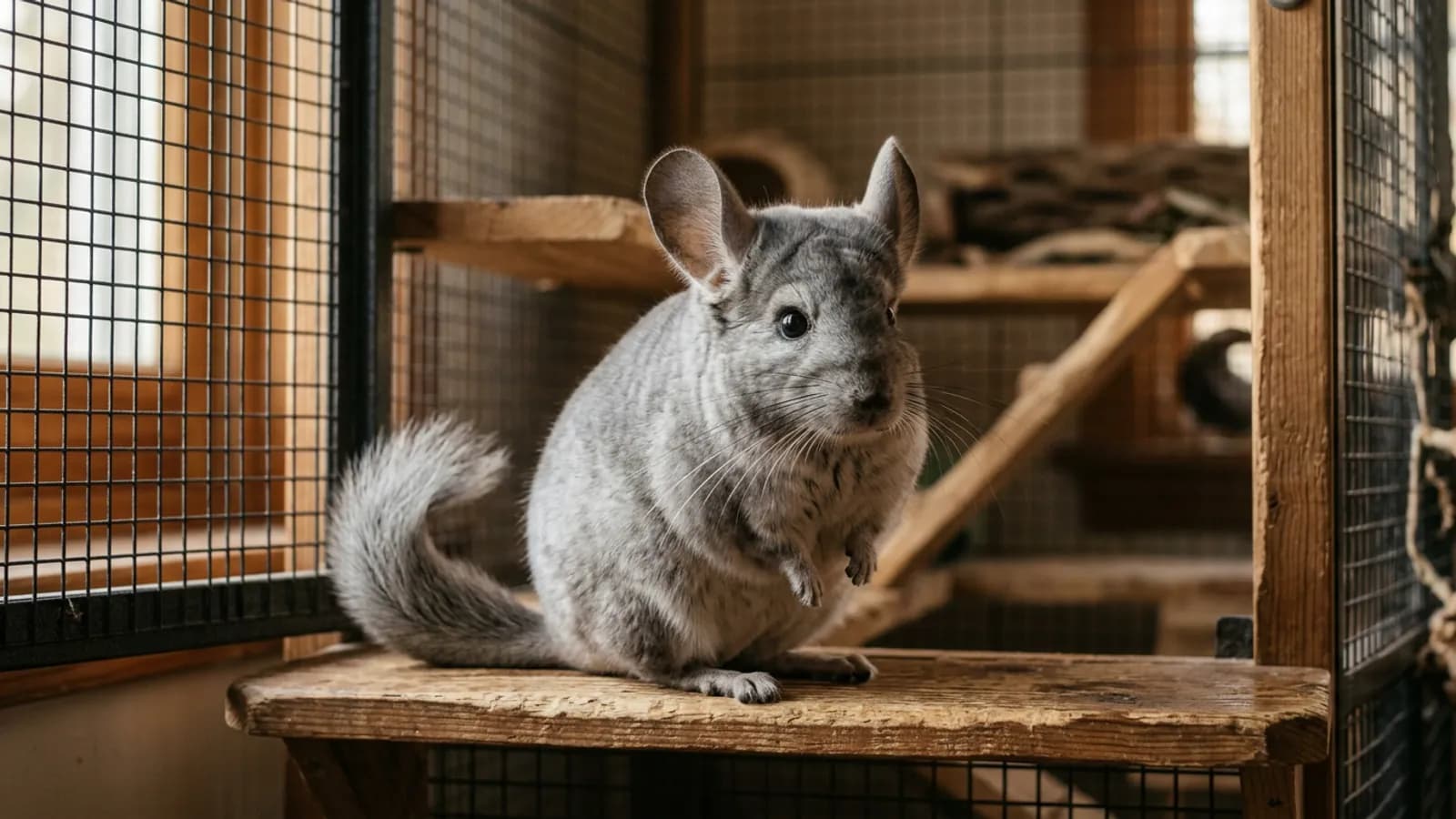
If you typed "soviet chinchilla" into a search bar expecting a small silver rodent with enormous ears, I have to be straight with you before you go any further: the Soviet Chinchilla is a rabbit. It is a breed of large domestic rabbit developed in the former Soviet Union, and it took its name from the color of its coat, not from any relation to the animal I have kept for about ten years. That single fact rearranges everything, because a rabbit and a chinchilla need almost opposite care, and getting the two confused is the kind of mix-up that hurts an animal. So this piece does two jobs. First, it tells you honestly what the Soviet Chinchilla rabbit is. Then, because most people who land here are somewhere on the road to owning a real chinchilla, it lays out what the actual animal needs.
What a Soviet Chinchilla actually is
The Soviet Chinchilla, Sovetskaya Shinshilla in Russian, is a breed of domestic rabbit. It was developed in the Soviet Union across the middle of the last century and recognized as its own breed in the early 1960s. Breeders crossed smaller chinchilla-colored rabbits with larger local stock to build an animal that could handle a harsh climate and still put on size, and the result is a big rabbit. Grown adults commonly land around 5 kilograms, roughly 11 pounds, which is a different order of animal from the half-kilogram chinchilla sitting in a cage in my living room. Its temperament, its space, its diet, and its handling are all a rabbit's, and none of that maps onto the rodent I keep.
It was bred for meat and fur, which is worth stating plainly because it explains the whole design of the breed. Soviet agriculture wanted a rabbit that grew fast, tolerated cold, and produced a dense, attractively banded pelt. None of those goals had anything to do with keeping a small exotic rodent as a companion. I keep chinchillas, not rabbits, so I will not pretend to be your source on rabbit husbandry. Treat the breed history here as the widely repeated version, and go to rabbit-specific keepers for the day-to-day.
Where the "chinchilla" in the name comes from
The name is about fur, and only fur. A real chinchilla's coat is famous for a specific look: each hair is banded, dark at the tip over a lighter middle over a slate base, and packed so densely that the whole animal reads as a soft, even silver-gray. Rabbit breeders in the early twentieth century managed to reproduce that banded, ticked appearance in rabbit fur, and the color pattern picked up the name "chinchilla" because it mimicked the pelt everyone already knew and prized.
There is an earlier Chinchilla rabbit behind all of this. A French-bred Chinchilla rabbit appeared in the early 1900s, and it spread widely enough to spawn larger regional versions, the American and Giant Chinchilla rabbits among them. The Soviet Chinchilla is the USSR's own large entry in that family. So the lineage of the name runs rabbit to rabbit to rabbit. At no point does it cross into the rodent I write about. If the color logic here sounds familiar, it is the same reason people get tangled up over a black and white chinchilla or a brown chinchilla: the word describes a look, and a look travels onto animals that share none of the biology.
Two animals, opposite care
This is the part that matters if there is any chance a live animal is about to come home with you. A rabbit and a chinchilla are not two flavors of the same pet. They are built for different worlds, and the care that keeps one healthy can quietly wreck the other.
A chinchilla comes from the high, dry, cold slopes of the Andes. It carries one of the densest coats of any land mammal, often cited at fifty or more hairs growing from a single follicle, and that fur is its whole survival strategy in thin mountain air. It cannot shed heat the way a thinner-coated animal can, it must never get wet to the skin, and it cleans itself by rolling in fine dust rather than in water. A rabbit sheds heat through large thin ears, tolerates a far wider range of temperatures, grazes on fresh greens a chinchilla should never eat, and has a completely different social and handling profile. I have written the full version of this collision in the bunny chinchilla piece, and the short lesson holds here too: feed, house, or cool one of these animals the way you would the other, and you do damage.
So if you came here because a listing or a relative called something a "soviet chinchilla" and you assumed it was a pocket-sized silver pet, slow down and find out which animal you are actually looking at. The rest of this article is about the real chinchilla, because that is the animal I can speak to with ten years behind me.
The real chinchilla, in one honest paragraph
A chinchilla is a small, dense-furred, crepuscular rodent that lives ten to twenty years when it is kept well, often the upper end with good care. It needs a tall metal-and-wood cage, unlimited grass hay, a measured amount of plain pellets, dust to bathe in, cool air, and a lot of things to chew. It does not need water baths, it does not need fruit and treats, and it does not need a warm room. Most of what goes wrong with pet chinchillas traces back to heat, to teeth, or to a cage and diet built for looks instead of the animal. If you want the ground-up version, I keep a plain overview at what a chinchilla really is and a full chinchilla care hub. Below are the two things that kill quietly, and the gear that actually earns its place.
Heat is the number that keeps yours alive
I am relentless about temperature, and I have a reason. Pebble came to me as a rehome out of an overheated attic, and her first summer brought a heatwave and a night at the emergency vet that I do not want to repeat with any animal. That scare is why the heat guidance on this site reads like a set of rules rather than suggestions.
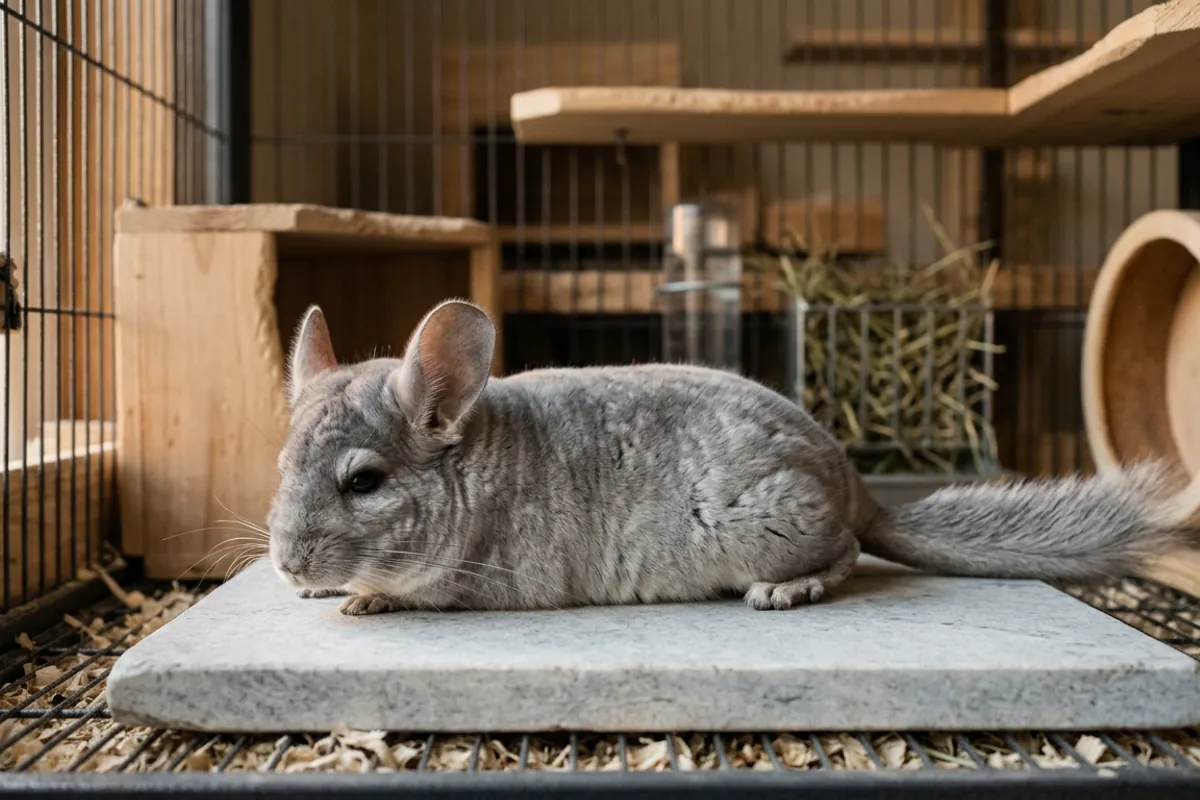
Here are the numbers, and I keep them exactly. A chinchilla is comfortable between 60 and 70°F, which is about 15 to 21°C. Above 75°F, roughly 24°C, you are into risky territory. At 80°F, about 27°C, and up you are in an emergency, and it arrives faster when the air is humid, because that dense coat cannot dump heat and the animal cannot sweat its way out of trouble. If you only remember one thing from this whole article, remember that a chinchilla dies of heat long before a person in the same room feels truly hot.
The practical version is simple. Keep the room in the comfortable range, with air conditioning if your climate needs it, put a thermometer where the cage actually sits rather than trusting the hallway, and give the animal a cool surface it can choose to lie on. A cage thermometer and hygrometer costs almost nothing and turns "it feels okay in here" into a number you can act on.
digital thermometer and humidity gauge with remote probes As an Amazon Associate I earn from qualifying purchases.
A chilled solid stone gives a chinchilla somewhere to dump heat on a warm afternoon, and unlike a lot of gimmicks it works because the animal uses it on its own terms.
Kaytee Chinchilla Chiller granite stone As an Amazon Associate I earn from qualifying purchases.
If you want to pressure-test your own room against real conditions, I built a heat danger calculator for exactly that, and the deeper write-up lives at chinchilla heat safety and in the piece on heat stroke warning signs. Watching for those signs is the difference between a scare and a loss.
Teeth and hay, the slow problem you cannot see
The other thing that kills quietly is teeth. A chinchilla's teeth never stop growing, and the only thing that keeps them worn to a healthy length is chewing, hour after hour, mostly on coarse grass hay. When that wearing does not happen, the teeth overgrow, roots included, and the animal slides into dental disease. I know this one up close, because Juniper came to me as a neglected rescue and I manage her dental disease day to day. Watching what happens when teeth do not get worn down is why I am uncompromising about two things.
The first is hay, unlimited and always available. Grass hay, timothy or a similar meadow hay, is the entire base of the diet and the main tool that grinds the teeth down. It should never run out, not overnight, not while you are at work. I buy it in quantity so I am never tempted to ration it.
Oxbow Western Timothy Hay, 9 lb box As an Amazon Associate I earn from qualifying purchases.
Pellets are a supplement, not the meal. Plain, chinchilla-appropriate pellets in a measured daily amount round out what hay does not cover, and that is all they are for. There is no place in this diet for fruit, nuts, seeds, or the colorful mixes sold at pet stores. If you want the full breakdown of what belongs in the bowl, I keep it at chinchilla diet, food, and hay and what can a chinchilla eat.
The second thing is chewing material beyond hay. Safe wood gives the teeth more to work against and gives a bored animal a legal job. A variety pack of apple wood and similar safe woods keeps it interesting, because a chinchilla that ignores one shape will often go at another.
emours apple wood chew sticks, 40 count As an Amazon Associate I earn from qualifying purchases.
Chews are dental care, not decoration, and I have laid out the safe and unsafe woods in chinchilla chew toys. When you see drooling, a wet chin, weight loss, or a chinchilla that wants to eat but backs off the food, that is a vet visit, not a home fix. Dental disease is exactly where an experienced keeper's job ends and an exotics vet's begins.
The cage, the dust, and the wheel
The last piece is the physical setup, and here the honest naming matters as much as anywhere. A chinchilla needs a tall cage, because it climbs and jumps, built from metal and wood with wooden ledges. Not plastic, which it will chew and swallow, and not a short wide floor plan built for a hamster. Height, metal, wood, room to move.
Critter Nation double unit small animal cage As an Amazon Associate I earn from qualifying purchases.
I have written the long version of choosing one without buying the wrong cage twice, and it is worth reading before you spend, because the cage is the single most expensive mistake people repeat. The full walkthrough is at best chinchilla cage and chinchilla cage setup.
Inside it, an exercise wheel has to have a solid running surface. Wire rungs and mesh catch feet and tails and cause real injuries, so a solid surface is not a preference, it is a safety line.
15 inch Chin Spin solid surface chinchilla wheel As an Amazon Associate I earn from qualifying purchases.
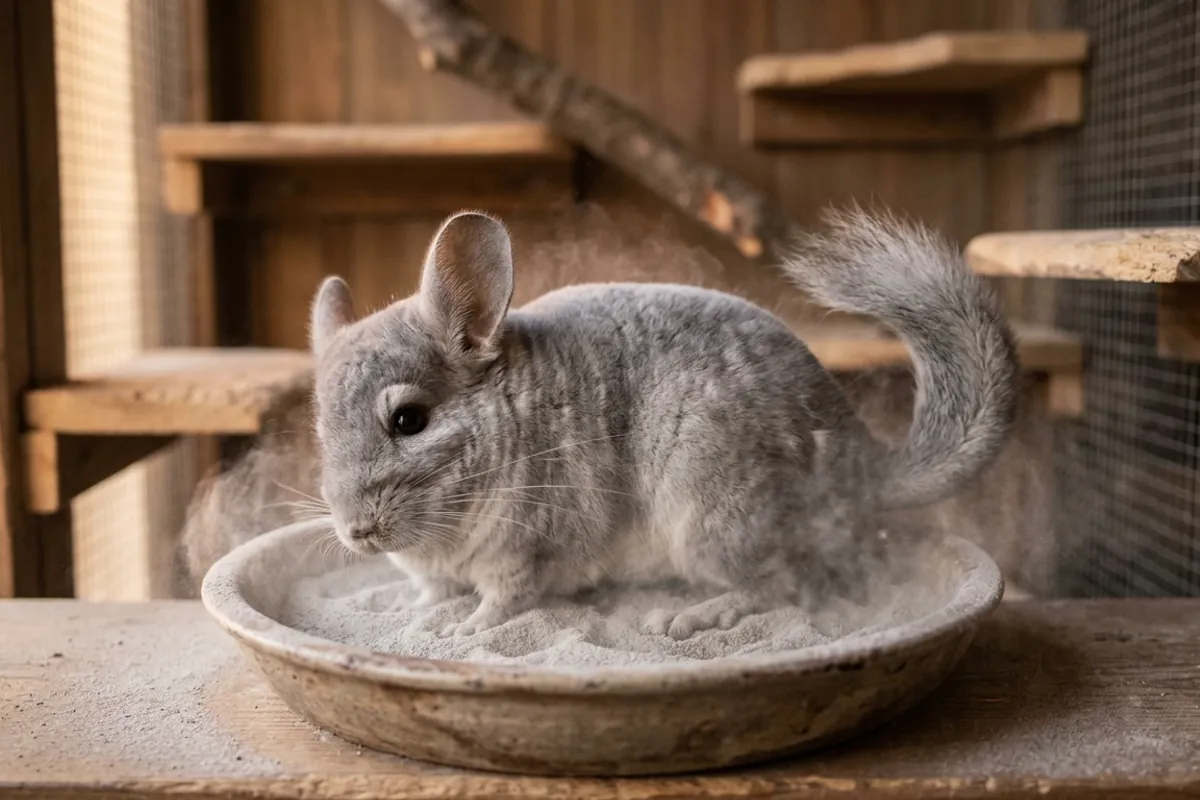
And the bath is dust, never water. A chinchilla cleans that dense coat by rolling in fine volcanic dust that lifts oil and moisture out of the fur. Water is the opposite of clean here: it soaks into a coat that cannot dry, and a chinchilla that gets wet to the skin is a real problem, not a cute one. A couple of dust baths a week, using proper chinchilla dust, is the whole routine.
Lixit Blue Beauty chinchilla dust, 3 lb As an Amazon Associate I earn from qualifying purchases.
I cover the how and how-often in the chinchilla dust bath done right and what the dust actually is in bathing dust for chinchillas.
So, is a Soviet Chinchilla for you
If you wanted the rabbit, then you want a large meat-and-fur breed with its own set of needs, and I am honestly not your best guide for it. Go find rabbit keepers who work with big breeds and learn the diet, the space, and the handling from people who live with them.
If, as I suspect, you drifted here on your way toward a real chinchilla, then let the name be the lesson. The word "chinchilla" gets stuck on rabbits, on cats, on stuffed toys, and on plenty of things that are not the animal. The real one is a ten to twenty year commitment to cool air, endless hay, dust instead of water, and a mouth that needs constant work to stay healthy. It is a wonderful animal to live with when you meet it on its own terms. It just has nothing to do with a Soviet farm rabbit beyond a shared word for the color of a coat.