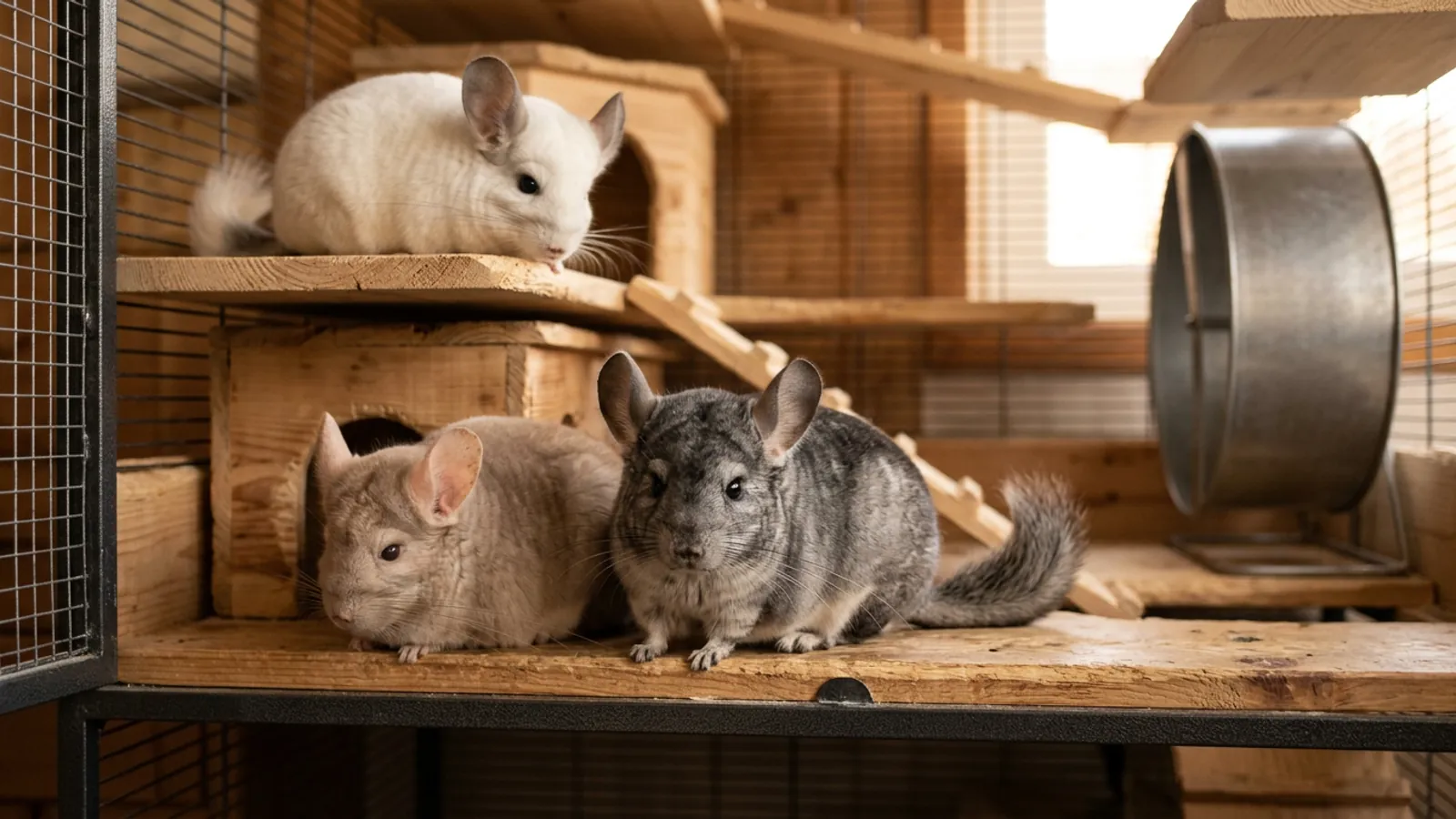
People come to chinchillas picturing one animal in one color, the soft blue-gray from every photo, and then they meet the actual spread of chinchilla colors and get a little lost. I did too. The names alone are a wall at first: ebony, beige, violet, sapphire, mosaic, pink white. So let me lead with the part almost nobody leads with, because I have kept these animals for about ten years and it is the thing that matters most. The color is a coat trait and very little else. It changes what your chinchilla looks like sitting on a ledge. It does not change what the animal is, what it needs, or how fast it overheats. Pebble is a standard gray and Juniper is a standard gray, and if either of them had been born sapphire I would run the exact same house around them. Once you line up all the chinchilla colors side by side, the differences are real and often lovely, but they sit entirely on the surface. None of that is a knock on the colors. It is just the order of importance, and getting it backwards is how people end up with a beautiful animal they do not know how to keep.
Standard gray is the original every other color came from
The wild chinchilla, the one still hanging on in the mountains of northern Chile, is gray. Slate to blue-gray down the back and sides, a clean white belly, and a coat that reads as one solid color from across the room but is banded up close: a dark tip, a pale band, a blue-gray base. That banding is why the fur seems to shift and shimmer when the animal turns. Every other color you will ever read about is a mutation off that gray baseline, a single change or a stack of changes in how pigment lands in each hair. Breeders call the wild color "standard," and to my eye it is still one of the prettiest of the lot. Even within standard you will see light, medium, and dark grays, all the same color, just graded by how much pigment the line carries. Standard is also the most common and usually the cheapest, which says nothing about the animal's health and everything about supply.
Gray is the wild type for a reason. It is the camouflage that kept the species alive on bare rock, and it comes with the same dense, fine coat every chinchilla carries, with dozens of hairs growing from each follicle. That density is exactly why heat is such a danger, and it is identical in a gray and in a violet.
Standard grays have black eyes, gray ears, and that white belly. If you are teaching yourself to read chinchilla coat colors, keep the standard in your head as the reference point. Most of the other names are really just "the standard, but darker here," or "the standard, but the pigment dropped out there." Learn the standard well and the rest of the list stops being intimidating.
The dark colors: ebony, black velvet, and charcoal
The darkest chinchillas are some of the most striking, and their names get muddled constantly. Ebony is an accumulative color, which means it deepens over generations of selective breeding, and it runs from a medium charcoal all the way to an extra-dark ebony that is nearly solid black with no white belly at all. A true ebony is dark right around the underside, which is the quickest way to tell it from a standard at a glance. Breeders grade ebony from light through medium and dark to extra dark, and a well-bred dark ebony is glossy rather than dull. The eyes stay dark in all of them, so eye color will not help you tell them apart here; the belly will.
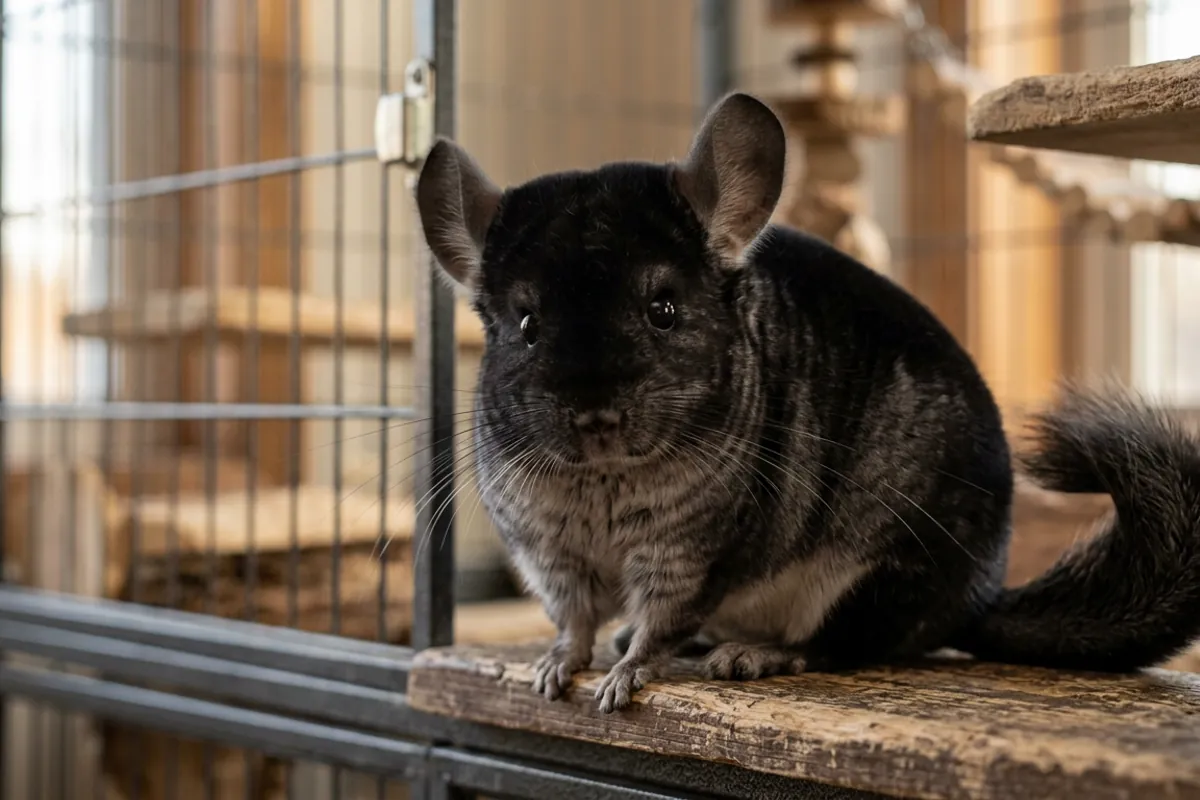
Black velvet, sometimes called TOV or touch of velvet, is different. It carries a dark veiling over the head and back that fades to a white belly, with distinct dark bars across the front legs. It is a dominant mutation, and that matters for breeding in a way I will come back to. Combined with beige it gives you a brown velvet, a warm cocoa version of the same veiled pattern. Charcoal is an older, recessive dark color, flatter and more matte than ebony, and it gets confused with ebony all the time. None of these darker coats is fragile or sickly because it happens to be dark. Dark fur is just dark fur, and it needs the same cool room and the same hay as every other color.
The warm and pale colors: beige, brown, white, and mosaic
Warm the palette up and you reach beige, a dominant tan color with pinkish, often freckled ears and red or ruby eyes. Those red eyes and pink ears are the fastest way to spot a beige across a room. Cross beige with ebony and you get tan, a warm brown with a dark wrap-around belly. Push the beige line further and you land in genuine brown chinchilla territory, which is almost always a beige-based combination rather than a color of its own.
Then there is white, and white is a whole family rather than one color. Wilson white, the common one, ranges from nearly pure white to silver, which is white with gray tipping, to a patchy mosaic, which is white broken up with gray patches instead of an even coat. A black and white chinchilla is usually a white carrying velvet markings. Add beige to white and you get pink white, a pale coat with pink ears and red eyes that people badly want to call albino. It almost never is. A real albino, with no pigment anywhere, is not something you will realistically meet in a chinchilla; the label gets slapped on pink whites and on whites that plainly still carry color somewhere on the coat or in the eyes.
The rare recessives: violet, sapphire, and the blues
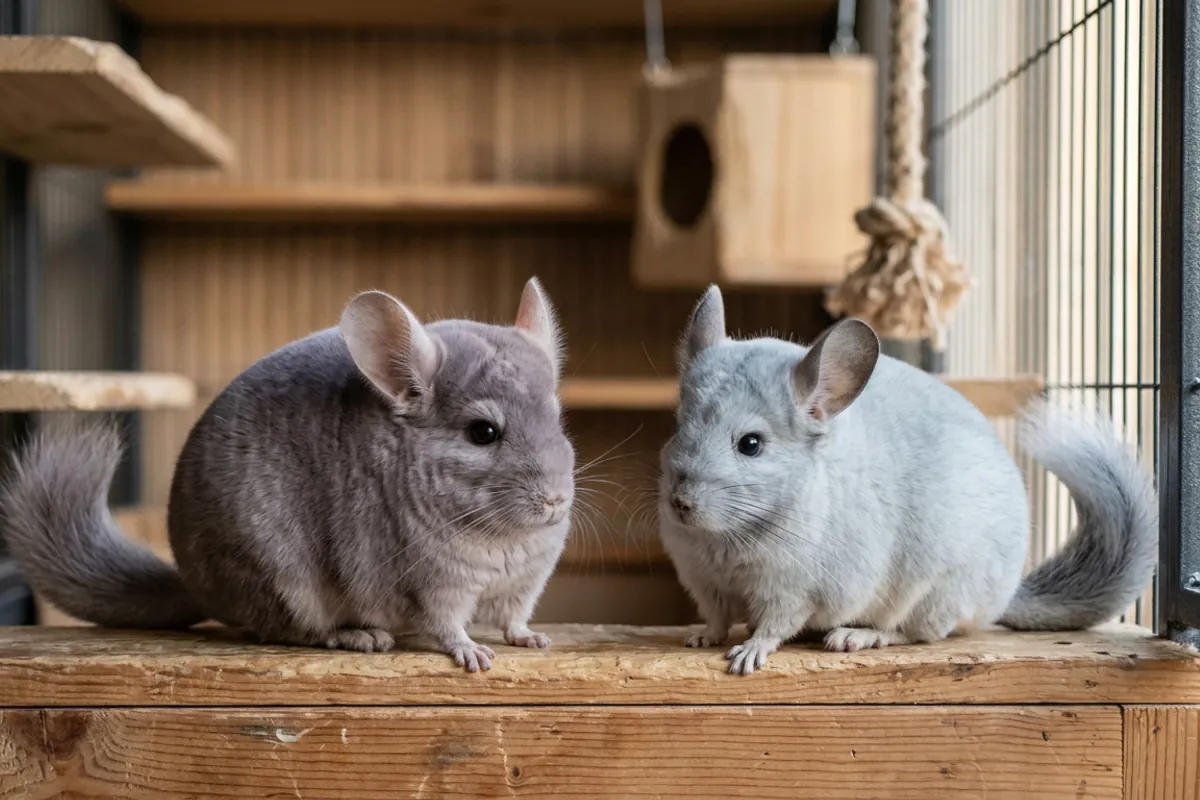
The colors that carry the biggest price tags are mostly recessive, which is exactly why they cost what they do. A recessive color only appears when an animal inherits the gene from both parents, so a breeder can carry it hidden for many generations before a single visible pup shows up. Violet is a soft gray with a lavender cast and a white belly, no black pigment in the coat at all. If you have been chasing photos of a purple chinchilla, violet is the real animal behind that search; there is no grape-colored chinchilla, only this gentle gray-violet. Sapphire is a pale, cool blue-gray, and it is fiddly to breed and not always robust, which is one reason careful breeders go slowly with it. Eye color earns its keep here too: violets and sapphires keep dark eyes, so a pale coat with red eyes is a beige combination, not a true violet or sapphire.
Stack these recessives with each other or with velvet and you get the headline names: blue diamond, black pearl, and the rest of the rare chinchilla colors that show up in listings with a matching price. Blue diamond, the violet and sapphire cross, is about as rare as pet chinchillas get. A rare color is harder to produce, and I understand the appeal of it. It is not a better pet, though, and it does not need or deserve a softer or a tougher standard of care than the standard gray in the next cage.
The colors that turn out to be myths
A fair chunk of what gets searched does not exist as a real, stable chinchilla color. There is no true red chinchilla; the warm-toned beiges and tans get called red under the right light, and that is as red as it gets. Same story with orange. Purple, as I said, means violet. And hairless is not a color at all; a bald chinchilla is either an extremely rare genetic oddity or, far more often, an animal telling you something is wrong, from fur chewing to a fungal infection. If you see bare patches appear on a coat that used to be full, treat it as a health question, not a new color.
I am blunt about this because the myth colors are where money changes hands over nothing. Different color chinchillas are worth admiring for exactly what they are. They are not worth inventing categories for, and nobody should pay a premium for a "red" that is just a beige with a good photographer. The genetics behind the real colors are interesting enough on their own without dressing up a plain beige as something exotic.
What the color never changes
Here is the conviction under all of this. Not one of these colors alters the care the animal needs, and the two things I am hardest about do not bend for a coat.
The first is heat. Chinchillas evolved for cold mountain nights and they carry the densest fur of nearly any land mammal, which is wonderful until the room warms up. Comfortable is 60 to 70°F (15 to 21°C). Above 75°F (24°C) you are into risky, and 80°F (27°C) and up is an emergency, faster still in humid air. A sapphire sheds heat no better than a standard. Pebble's first summer taught me this the hard way, with a heatwave near-miss and a night at the emergency vet, and every heat rule on this site comes out of that scare. Keep the room cool, watch the temperature and give a heavy stone they can stretch out on when it climbs. Kaytee Chinchilla Chiller granite stone As an Amazon Associate I earn from qualifying purchases.
The second is the gut. Every color eats the same way: unlimited grass hay first, always, with plain pellets as a small measured supplement and treats kept tiny. Oxbow Western Timothy Hay, 9 lb box As an Amazon Associate I earn from qualifying purchases. Juniper carries dental disease from a rough start, and I watch every single day what happens when teeth do not get worn down by constant chewing. Her coat is a plain standard gray. Her teeth do not care what color she is, and neither do yours. Bathing is the same across the board too: fine dust, never water, a few times a week. Lixit Blue Beauty chinchilla dust, 3 lb As an Amazon Associate I earn from qualifying purchases.
Chinchilla pee color is the one color that reports on health
There is one chinchilla color worth watching closely, and it is not on the coat. Chinchilla urine color tells you things the fur never will. Normal chinchilla pee runs yellow through amber, and it can look cloudy or chalky white, which is usually nothing to worry about on its own. Some chinchillas even pass a naturally reddish or orange urine from pigments in their food, and that too can be perfectly harmless.
The catch is that you cannot tell harmless red pigment from actual blood just by looking. So I treat red or pink urine as a question for the vet, not a thing to wait out, especially if it happens more than once or comes alongside straining, hunching over the spot, frequent tiny puddles, a strong ammonia smell, or wetness and staining around the back end. Those can point to a bladder stone or an infection, and both need an exotics vet rather than a guess at home. A chinchilla that is eating, drinking, and passing yellow-to-amber urine is almost always fine. When the line into medical territory gets crossed, that is where I stop being useful and a vet starts.
Choosing by color, and the one thing breeders must never do
Pick the animal, not the paint job. A calm, healthy, well-socialized standard gray from someone who prioritizes health will give you a far better decade than a fragile rare color from someone chasing a look. If you are shopping by color, the most important thing to understand is the lethal factor. Both the dominant white and the dominant black velvet genes are lethal when an animal inherits two copies, so pairing white with white, or velvet with velvet, produces pups that do not survive. A responsible breeder simply never makes those crosses, and a seller pumping out white-on-white litters to chase whites is telling you exactly what they are optimizing for, and it is not the animals. Price tracks rarity, not quality, so a four-figure color from a careless breeder is still a worse bet than a modest gray from a good one.
Breeding chinchillas properly means putting the animal ahead of the color every single time, and it is a good reason to buy from people who can talk fluently about this without flinching. Ask what colors the parents carry and why a pairing was made. Handle the animal first, check that the coat is full and the eyes and nose are clean, and let the color be the last thing you ask about. Whatever coat you end up bringing home, standard gray or a name that took years to breed, the care underneath it is identical, and that is the point.
Color is only skin deep, and why a chinchilla is so fluffy explains the coat underneath all of it.