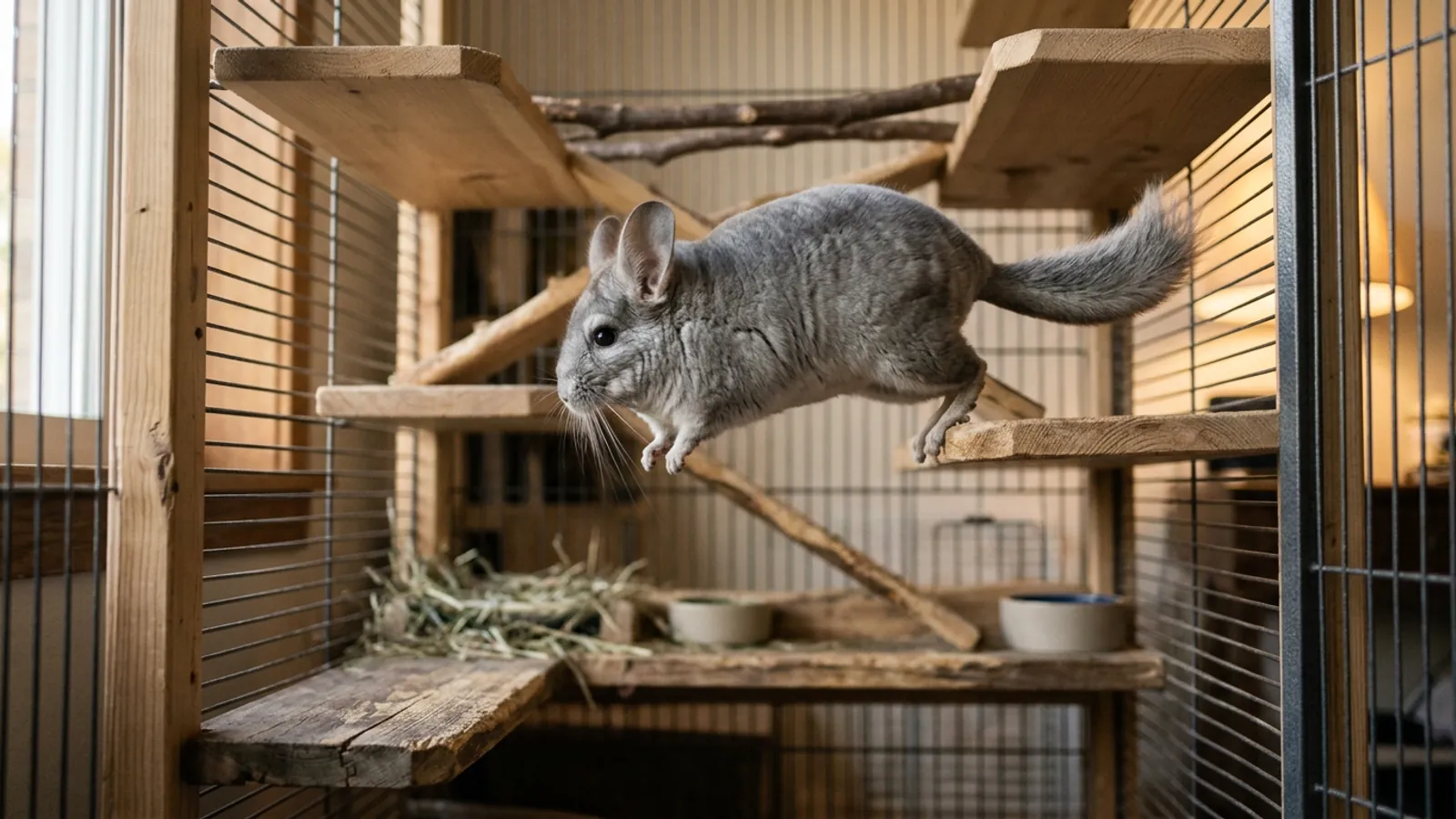
After about ten years of keeping chinchillas, I have stopped treating chinchilla behavior as a set of cute quirks and started reading it as a health chart, one that updates every evening for free. Every hop, freeze, chew, and squeak is the animal telling you how it feels and whether something is wrong. That matters more with a chinchilla than with most pets, because like other prey animals they hide illness until they cannot anymore, so a shift in behavior is often the first and only early warning you get. Learn what normal looks like for your own animal and the abnormal will jump out at you. When Pebble goes still on a warm afternoon, or Juniper starts chewing on one side of her mouth, I notice because I know their ordinary.
A chinchilla is awake when you are winding down
The single most useful fact about chinchilla behavior is timing. Chinchillas are crepuscular, which means they are built to be most active at dawn and dusk and to sleep through the middle of the day. If you check on yours at two in the afternoon and it is flat out and barely responsive, that is not a sick animal, that is a chinchilla doing exactly what its body wants. Judge behavior in the evening, when the animal is naturally switched on. This is also why chinchillas and a nine-to-five household can rub against each other. Yours will be at its liveliest right as you are heading to bed, and it may thump and bounce around the cage while you are trying to sleep in the same room. None of that is misbehavior. It is a wild-clock animal living in a house. Understanding this rhythm alone saves you from misreading a sleepy afternoon as illness and a busy midnight as a problem that needs solving.
The behavior characteristics that come standard
Some chinchilla behavior characteristics are just part of the package, and it helps to recognize them so you are not alarmed by normal. The famous one is popcorning, those sudden vertical hops and mid-air twists that a happy, energized chinchilla throws out during an evening burst. Close to it is wall-bouncing, where the animal ricochets off the bars or a ledge and lands somewhere new. In the wild these are rock-dwelling animals from the Andes that leap between ledges, and that athleticism does not switch off in captivity; it simply needs somewhere to go. Chewing is another constant, and it is not optional. A chinchilla's teeth grow continuously for its whole life, so gnawing on wood is how it keeps them worn down, not a bad habit to break. Dust bathing is a third built-in behavior: a chinchilla rolls and flips in fine dust to keep that dense coat clean, and a chinchilla that stops asking for its bath is worth a second look. There is also fur slip, where a frightened or roughly handled chinchilla releases a clean patch of fur to escape a predator's grip; that is a defense mechanism, not a skin disease, though it tells you the animal was badly stressed. Chinchillas are vocal too, from soft contact chirps to sharp alarm barks, and the sounds are as much a part of the behavior as the movement. I have written separately about chinchilla sounds and fur slip, because both are their own language and worth learning on their own.
What happy chinchilla behavior looks like
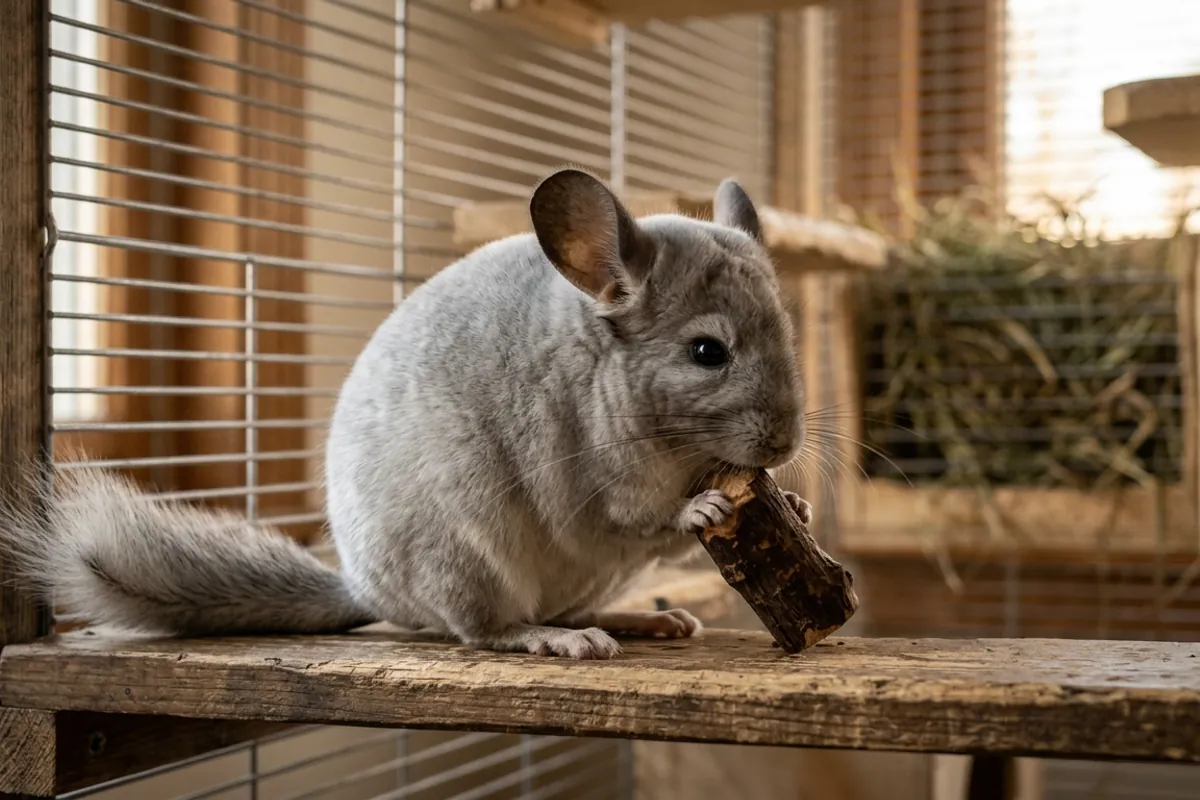
Happy chinchilla behavior is loud, in the best way. In the evening a content, healthy chinchilla is busy: popcorning, running its ledges, bouncing off the walls, sampling every chew in the cage, and coming to the front to see what you are up to. Curiosity is a strong signal. A chinchilla that investigates a new toy, sniffs your hand, and wants out for supervised floor time is telling you it feels secure. Appetite is another. A chinchilla that grazes hay steadily all day and drops plenty of dry, well-formed droppings is one whose gut, and mood, are working. Relaxed posture matters too: a happy animal sits up, grooms itself, stretches out to nap on its side, and does not sit hunched in a corner. Trust shows up slowly and is worth waiting for; a chinchilla that has decided you are safe will take a chew from your fingers and give a gentle, careful nibble that never breaks skin. The eager, almost frantic joy of a dust bath is about as clear a happy signal as chinchillas give. When Pebble hears the bath go into the cage and dives in before I have set it down, I know she is well. Enthusiasm for the bath, the food, and the evening run is the daily proof that everything upstream, temperature, teeth, and diet, is right.
Chinchilla social behavior, and what it asks of you
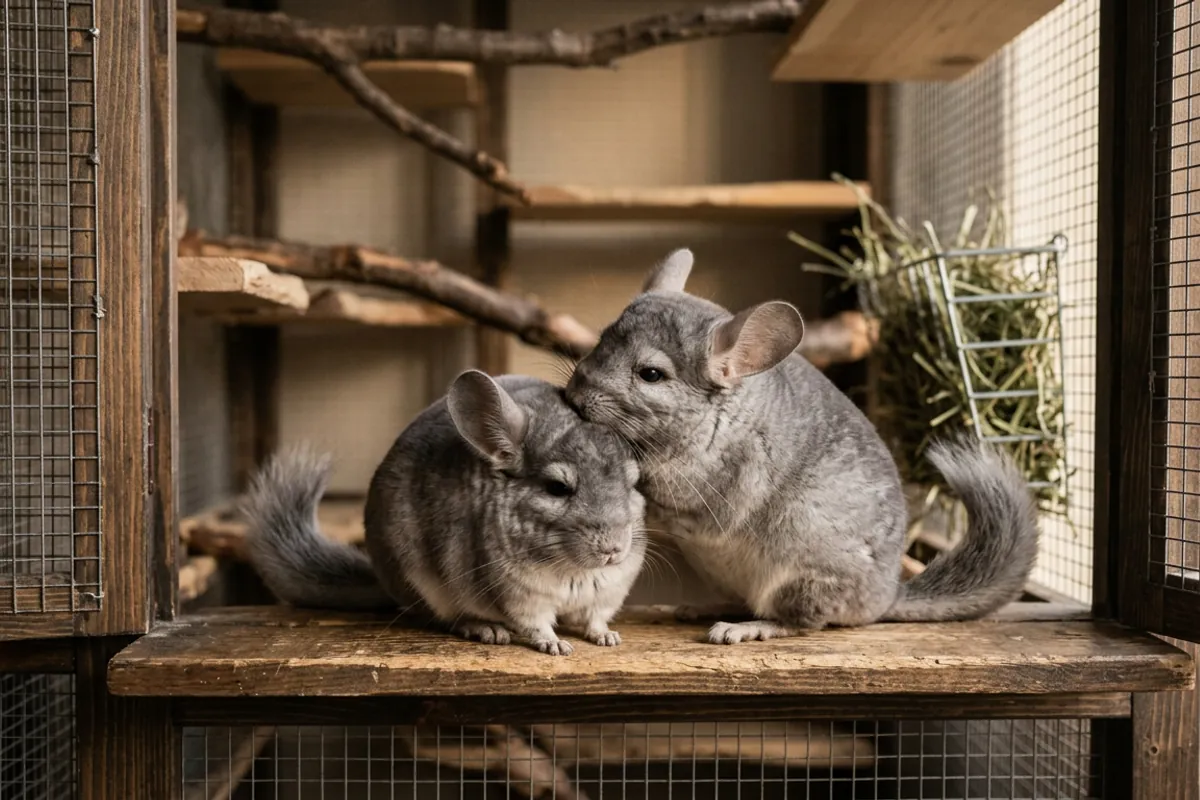
Chinchilla social behavior is more complicated than the cuddly reputation suggests. In the wild these animals live in colonies, sometimes large ones, so they are genuinely social and most do better with company than entirely alone. But social does not mean any two chinchillas will accept each other. They form pairs and small groups with a real hierarchy, and an introduction between strangers can slide from grooming to a serious fight fast. Bonding is done slowly, over weeks, with the animals housed in cages side by side so they can see and smell each other long before they ever share space, and even then it can fail. Same-sex pairs, often two females or two males from the same litter, tend to settle best, but there is no guarantee, and a bad pairing is worse than a solo animal. A chinchilla that has had enough will stand up, chatter, and sometimes spray a jet of urine as a clear back-off signal, and that is normal communication rather than a vice. If you do keep a single chinchilla, you become its company, which means real daily interaction on its terms and in its active hours, not a glance on your way past. A bonded pair will groom each other, sleep in a pile, and call back and forth softly, and watching that is one of the quiet pleasures of keeping them. What these animals still are at heart is set by where they come from, which I get into in what a chinchilla in the wild is really like.
Male chinchilla behavior and one thing you must check
Male chinchilla behavior is, day to day, not dramatically different from female behavior; individual personality matters far more than sex. Males can run a little calmer on average, but I have kept bold males and shy ones, so I would not choose an animal on that basis. There are a couple of male-specific behaviors worth knowing. Some males will mount or show hormonal restlessness, especially near a female, and some barber, which is chewing their own or a cage mate's fur, often under stress or in a cage that is too small. The one thing that is not optional for any male owner is checking for a fur ring, sometimes called a hair ring, where fur works its way around the penis and tightens like a band. It can cause real pain, block urination, and become an emergency if it is missed. Learn to check for it as routine, gently, and if you find one you cannot ease off yourself, that is a same-day exotics vet call, not something to force at home. New aggression, biting that was not there before, or a male who has suddenly gone withdrawn are all changes to read rather than shrug off as just being male. When biting is the specific problem, I go into what it means and how to fix it in what chinchilla biting really means.
Abnormal chinchilla behavior and when it is a warning
Abnormal chinchilla behavior is the part I most want owners to take seriously, because it is where the early warnings live. The big ones are appetite and energy. A chinchilla that stops eating hay, sits hunched, grinds its teeth in pain, or goes still and unresponsive during its normal active evening is not sulking; it may be ill, and a chinchilla that is not eating is an emergency on a short clock. Drooling or a wet chin, dropping food, or chewing on only one side often point to dental disease, which is exactly what I manage with Juniper day to day, and her teeth are the reason I never let hay run low. If you see any of that, read chinchilla teeth, from what healthy looks like to when to see a vet and get an exotics vet involved, because overgrown molars are not something an owner fixes at home. Then there are stereotypies: repetitive bar-chewing, backflipping, or pacing that goes on and on. These usually mean the animal is bored, under-stimulated, or in a cage that is too small, and they are a welfare flag even when the animal is otherwise healthy. Overgrooming and barbering sit in the same bucket. The rule I hold to is simple: a sudden change from your own animal's normal is the signal, whatever the specific behavior happens to be.
Heat deserves its own line here, because the behavior of an overheating chinchilla is subtle right up until it is not. A chinchilla that lies flat and stretched out on a warm day, goes sluggish, breathes with its mouth open, or has red, hot ears is trying to shed heat and is in danger. The comfortable range is 60 to 70°F (15 to 21°C); above 75°F (24°C) is risky, and 80°F (27°C) and up is an emergency, faster in humid air. Pebble came to me from an overheated attic and had a near-miss her first summer that ended at the emergency vet, and that is why this is not negotiable. If you see heat behavior, cool the animal and the room right away and treat it as urgent, not a wait-and-see. I keep the thresholds and the math in the chinchilla heat danger calculator, with the fuller version in the heat safety guide.
How the cage and the routine shape behavior
Most behavior problems I get asked about trace back to the setup, not the animal. Space comes first: chinchillas are jumpers, so height and room to leap are not luxuries, and a cramped cage is exactly where barbering, bar-chewing, and pacing tend to start. Give the animal a tall metal and wood cage with wooden ledges at different heights to bounce between. Second, hay. Unlimited grass hay is the whole meal, not a side dish, with plain pellets as a small measured supplement; a chinchilla with hay in front of it all day chews, forages, and keeps its teeth and gut working the way they should.
I keep a box of Timothy hay topped up at all times. Oxbow Western Timothy Hay, 40 oz bag As an Amazon Associate I earn from qualifying purchases.
Third, things to chew. A real variety of safe wood chews gives that constant gnawing somewhere useful to go, which is dental care as much as enrichment.
Apple wood is a safe favorite in my cages. emours apple wood chew sticks, 40 count As an Amazon Associate I earn from qualifying purchases.
Fourth, the dust bath. A couple of baths a week in fine volcanic dust, never water, keeps the coat right and gives the animal one of its most satisfying natural behaviors. Lixit Blue Beauty chinchilla dust, 3 lb As an Amazon Associate I earn from qualifying purchases.
Fifth, a way to burn the evening energy. A solid-surface running wheel, never a wire one that can catch a foot or tail, lets a bouncy chinchilla run off the zoomies safely. 15 inch Chin Spin solid surface chinchilla wheel As an Amazon Associate I earn from qualifying purchases.
Finally, watch the temperature, because it drives behavior more than anything else on this list. A cheap thermometer and hygrometer clipped to the cage tells you when the room is drifting toward the risky range before the animal has to. digital thermometer and humidity gauge with remote probes As an Amazon Associate I earn from qualifying purchases.
Get these right and most of the "bad behavior" questions answer themselves, because a chinchilla with space, hay, chews, dust, a safe wheel, and a steady temperature is an animal with very little to complain about. If you want the whole thing laid out in order, I have written up how to build a chinchilla cage setup that keeps the animal healthy.
Reading your own chinchilla is the real skill
No article can tell you what is normal for your specific chinchilla, because so much of behavior is individual. One of mine sulks at a new food for a day before trying it; another investigates everything at once. The skill worth building is not memorizing a list of behaviors but knowing your own animal well enough that a change stands out. Spend a few minutes most evenings just watching, when the chinchilla is naturally active and being itself. You learn its ordinary appetite, its ordinary noise level, the way it moves and grooms and greets you, and that baseline is what turns a vague "something seems off" into an early, useful alarm. When Juniper eats a shade slower or Pebble is quieter than usual on a warm day, I catch it because I know the animal, not because I read it in a chart. Behavior is the most honest thing a chinchilla gives you, and the owners who watch it closely are the ones whose animals get help in time.