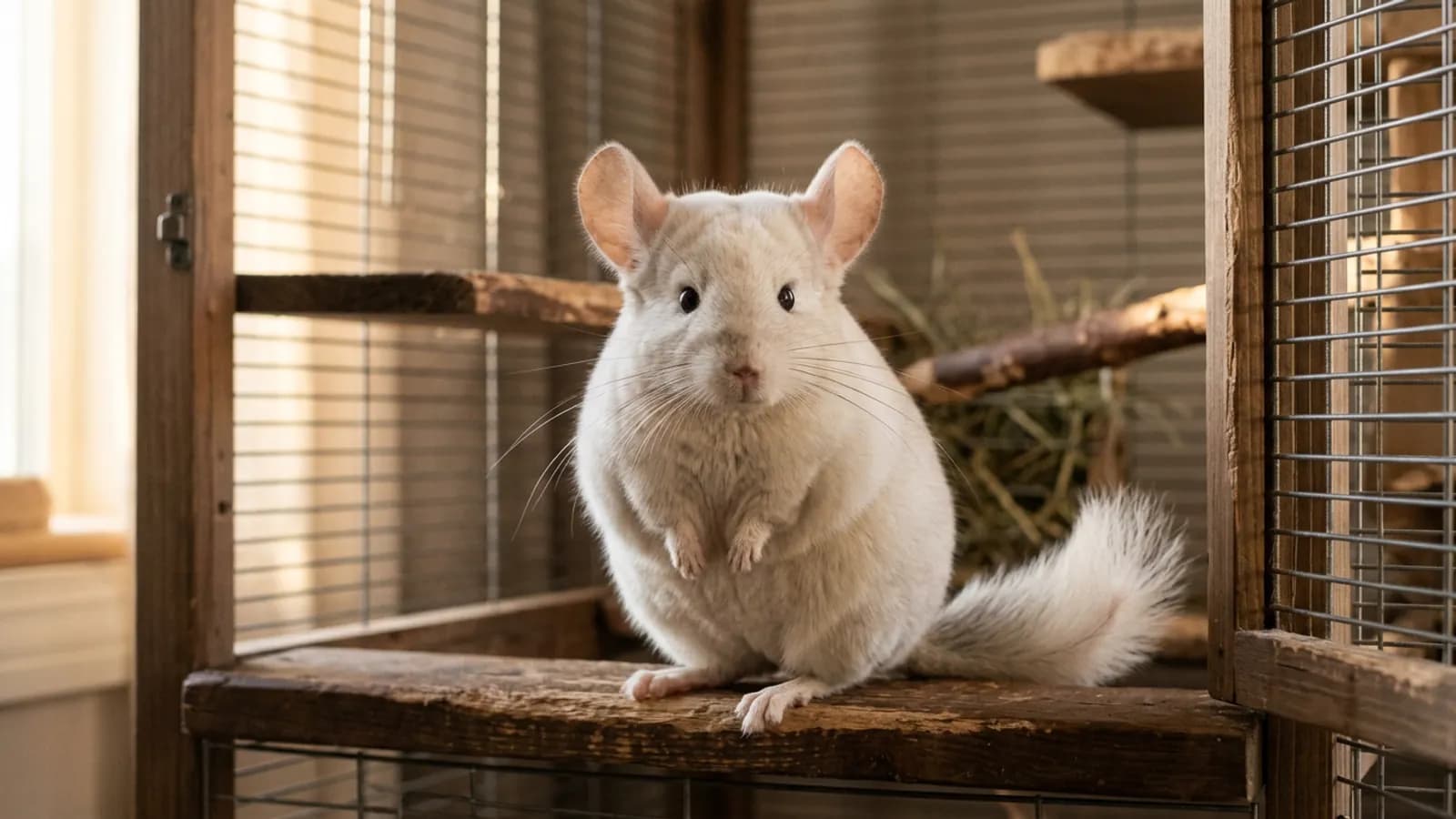
If you have searched for an albino chinchilla, you have probably seen listings that use the word with total confidence next to a photo of a pale, snowy animal with pinkish ears. I want to be straight with you before you spend a cent on one: "albino" is doing a lot of work in those listings that the biology does not actually support. In ten years of keeping these animals and reading everything I can find on their color genetics, I have never seen a true albino chinchilla credibly documented, and it is not one of the recognized colors. What people are almost always pointing at is a white chinchilla, and the difference between those two words matters more for your understanding than it does for the animal's care.
So this article is really two things at once. First, what albinism actually is in biology, and why the chinchilla color mutations do not add up to it. Second, and more important, the fact that none of this changes how you keep the animal alive. Color is paint. The chinchilla underneath is the same fragile, heat-sensitive, hay-dependent rodent whether it is silver-gray, beige, or so pale it looks white, and I would rather you understood that than memorized a genetics chart.
What albinism actually means
Albinism is a specific, well-understood genetic condition, and it is the same idea across mammals. The body carries a fault in the machinery that makes melanin, the pigment that colors fur, skin, and the iris of the eye. In a true albino, that machinery is switched off almost entirely. The result is not just pale fur but an absence of pigment everywhere it should be. The classic tell is the eyes: with no pigment in the iris, there is nothing to hide the blood vessels at the back of the eye, so the eyes read as pink or red depending on the light.
That is the key point people miss. Albino is not a color, and it is not "very white." It is the near-total shutdown of a pigment system. A truly albino animal produces essentially no melanin at all. So when you ask whether a chinchilla is albino, you are not asking "is it white," you are asking "does this animal make pigment or not." And that is a much harder bar to clear than a pale coat.
Why there is no established albino chinchilla
Here is where I have to be honest about the edge of what anyone can say for certain. The chinchilla colors that breeders and hobbyists actually recognize are all built on a handful of mutations layered on top of the wild standard gray. There is beige, black velvet, ebony, violet, sapphire, charcoal, and white, plus the combinations you get when you stack them. Albinism is not on that list. It is not a color that established breeding lines produce and name, the way they produce and name a violet or a mosaic.
I cannot stand here and tell you that no chinchilla with true albinism has ever been born anywhere, because I have no way to prove a negative and pigment mutations do arise. What I can tell you plainly is that true albinism is not an established, recognized chinchilla color, and that every animal I have seen sold as "albino" turned out, on a closer look, to be a white chinchilla or a pink-white one. When a word describes real biology but does not appear in the accepted color list of a well-studied species, the safe reading is that the listing is using a familiar-sounding label loosely, not reporting a rare genetic diagnosis.
If you want the same honesty applied to the colors that are real, I have written it up for violet, for the supposed purple, and for the brown that is really a beige. The pattern is always the same: the color is the only thing that changed.
What people are usually looking at
Nine times out of ten, the "albino" chinchilla in front of you is a white chinchilla. White in chinchillas comes mostly from a dominant mutation, and it produces a range of looks, from an animal with white fur and dark markings to one that is almost entirely white. I have written the full story of that color in what a white chinchilla actually is, and it is worth reading if this is the look you are drawn to.
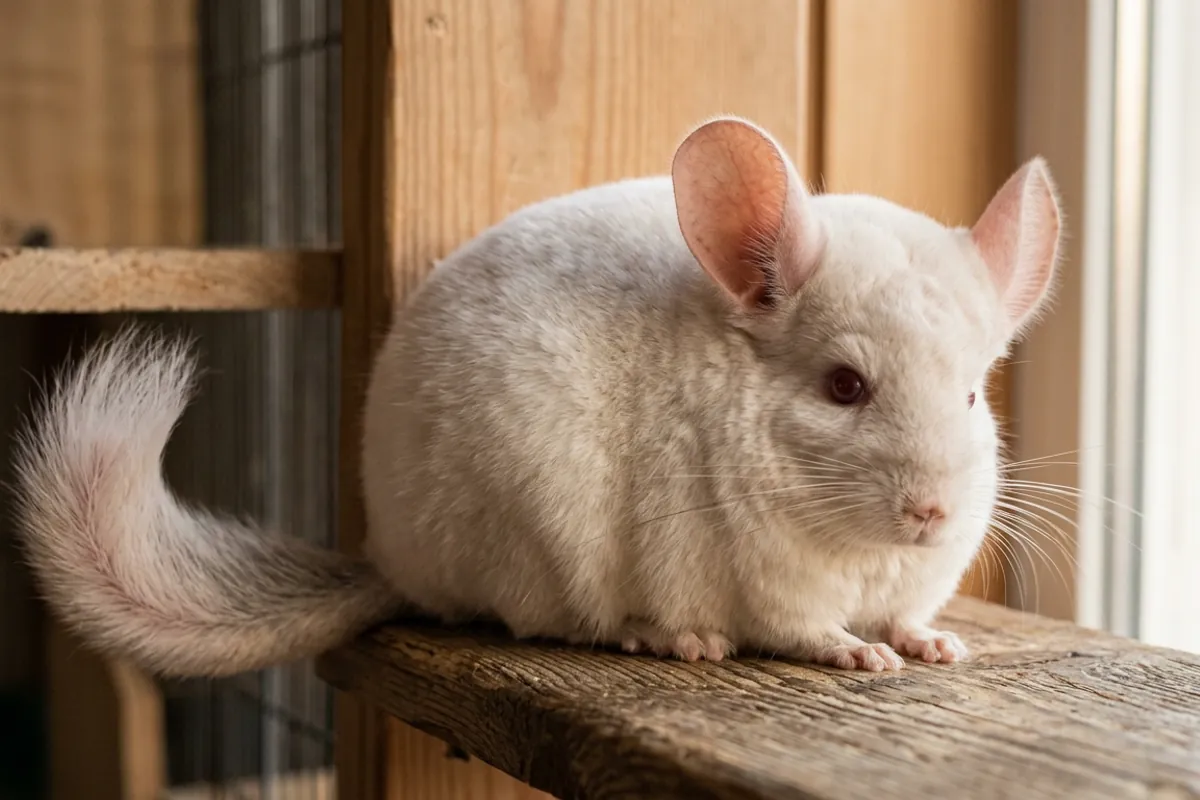
The animal that fools people most is the pink white. A pink white is what you get when you combine the white mutation with beige. The fur is very pale, the ears look pink rather than gray, and the eyes can read as reddish or ruby, especially in certain light. To an eye expecting an albino, that ticks every box: white coat, pink ears, red eyes. But a pink white is still producing pigment. The beige is doing visible work in the ears and the warm cast of the coat. That pigment is exactly the thing a true albino would not have. So the pink white is the animal most likely to be mislabeled, and it is the clearest proof that "red-eyed and white" does not equal "albino."
None of this is a reason to avoid the animal. A white or pink-white chinchilla is a perfectly good chinchilla. It is just not a genetic unicorn, and you should not pay a unicorn price for one. What a color label is worth, and what it hides, is the whole subject of what a chinchilla price actually tells you.
Do the eyes and skin change the care
This is the fair question to ask once you know a pink white has reddish eyes and less pigment in the ears, and I want to answer it carefully rather than invent a rule. In animals with genuinely reduced eye pigment, bright direct light can be uncomfortable. I have not seen good evidence that pink-white chinchillas need dimmer housing than any other chinchilla for pigment reasons specifically, so I am not going to hand you a number I cannot back.
What I will say is that the practical advice lands in the same place regardless. Every chinchilla, whatever its color, should be kept out of direct sunlight, because a chinchilla is crepuscular by nature and, far more urgently, because direct sun is a heat trap. A window that bakes a cage will cook the animal inside it long before anyone worries about its eyes. So "keep it out of the sun" is already a rule you follow for a standard gray, and following it protects a pink white too. If you ever see an eye that looks cloudy, weepy, or sore, that is not a color question at all, that is a call to an exotics vet, same as it would be for any chinchilla.
The skin and coat need nothing special either. A paler chinchilla is not more fragile, does not need a different diet, and absolutely still bathes in dust and never in water. If anything, a very white coat shows dust residue and staining more visibly, which just means you notice sooner when something is off. That is a small gift, not a burden.
Color changes nothing about the husbandry that keeps a chinchilla alive
This is the part I care about most, because it is the part that actually keeps the animal breathing. Whatever the listing calls the color, the care is identical to the care for a plain gray chinchilla, and it is unforgiving in exactly the same ways.
Start with heat, because heat is what kills these animals fastest. My Pebble came to me out of an overheated attic, and her first summer brought a heatwave near-miss and a night at the emergency vet that I still think about. That scare is why I am relentless here, and why I will not soften it. Chinchillas are comfortable between 60 and 70°F (15 to 21°C). Above 75°F (24°C) you are into risky territory, and at 80°F (27°C) and up you have an emergency on your hands, faster still if the air is humid, because a chinchilla cannot shed heat through that dense coat. A pink white does not tolerate heat any better than a gray does. Put a thermometer with a humidity reading on the cage and actually look at it.
digital thermometer and humidity gauge with remote probes As an Amazon Associate I earn from qualifying purchases.
A cooling stone gives the animal somewhere to dump heat on a warm afternoon, and it is a cheap, honest piece of kit.
Kaytee Chinchilla Chiller granite stone As an Amazon Associate I earn from qualifying purchases.
If you want the full logic instead of just the numbers, it is all in chinchilla heat safety, and there is a heat danger calculator that turns the temperature and humidity into a plain risk reading. Read the heat stroke warning signs once before summer, not during it.
The diet and the teeth do not read the color chart either
The other thing that quietly decides whether a chinchilla thrives is what goes in its mouth, and here my Juniper is my teacher. Juniper is a rescue with dental disease, and I manage it day to day, which means I watch up close what happens when teeth do not get worn down. A chinchilla's teeth grow for its whole life. The only thing that keeps them in check is chewing coarse grass hay, hour after hour, day after day.
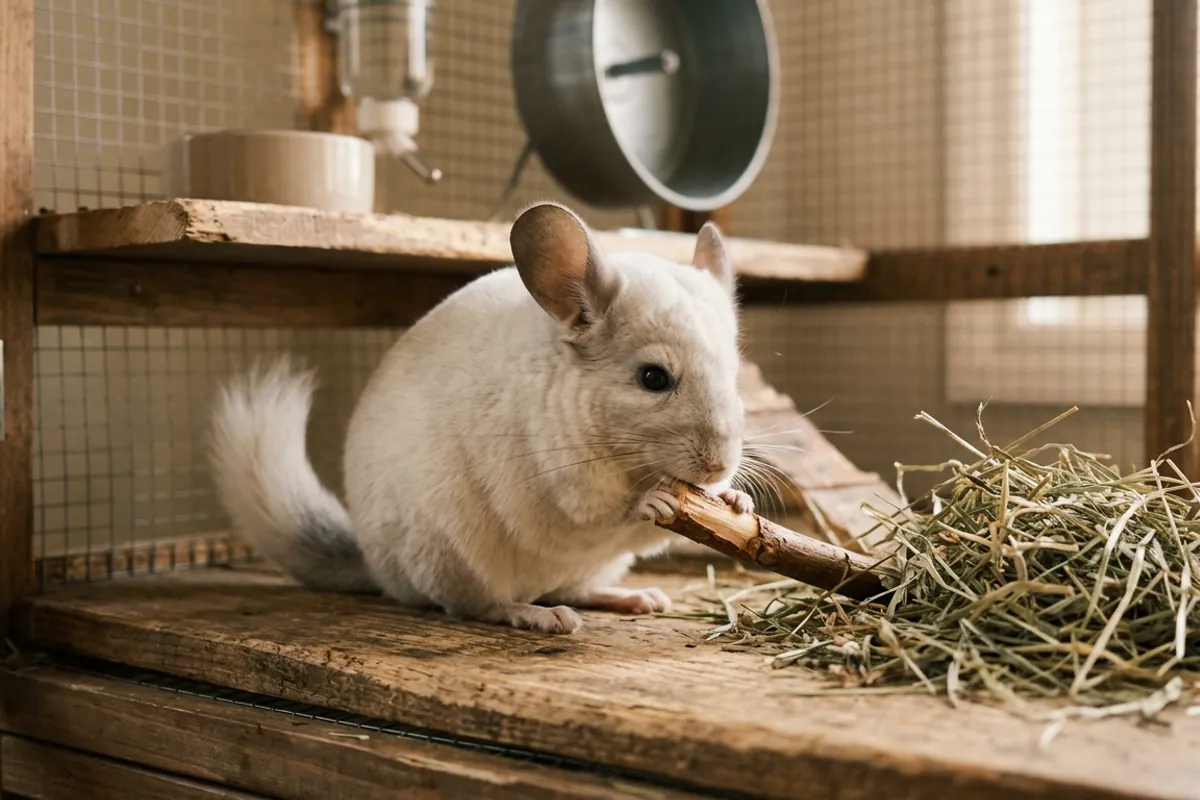
So the rule is the same for a pale chinchilla as for any other: unlimited grass hay, always available, as the base of the whole diet. Timothy is the standard choice and it should never run out.
Oxbow Western Timothy Hay, 40 oz bag As an Amazon Associate I earn from qualifying purchases.
If you go through hay the way a healthy chinchilla should, buying it in bulk saves both money and trips.
Oxbow Western Timothy Hay, 9 lb box As an Amazon Associate I earn from qualifying purchases.
Pellets are a measured supplement on top of the hay, not the main event. Plain, chinchilla-specific pellets, a set small amount a day, no colorful mueslis with seeds and dried fruit picked out and left behind. The full honest version of that is in chinchilla pellets, and the wider "what can it eat" question is answered in what can a chinchilla eat.
Chews are dental care, not decoration. Safe untreated wood gives the teeth something to grind against between meals. A variety pack keeps the animal interested, which matters because a chew that gets ignored does nothing.
emours apple wood chew sticks, 40 count As an Amazon Associate I earn from qualifying purchases.
If you want the why behind all of this, chinchilla teeth and health and chinchilla chew toys both cover it, and spotting malocclusion early is the one I would not skip. Dental problems are the slow killers, and by the time you see weight loss or drooling you are already behind.
The cage, the dust, and buying one without getting burned
The housing does not care what color the animal is either. A chinchilla needs a tall cage made of metal and wood, with wooden ledges to jump between, and no plastic anywhere the animal can reach it, because a chinchilla will chew plastic and a swallowed piece can block a gut that cannot cope with it.
Critter Nation double unit small animal cage As an Amazon Associate I earn from qualifying purchases.
The exercise wheel inside it must have a solid running surface. A wire or barred wheel catches feet and legs and causes real injuries, and I will name that plainly every time it comes up.
15 inch Chin Spin solid surface chinchilla wheel As an Amazon Associate I earn from qualifying purchases.
The full build is in chinchilla cage setup, and there is a room-by-room version in setting up a chinchilla cage the right way.
Then there is the bath, which is where a pale chinchilla actually stays pale. Chinchillas clean themselves by rolling in fine dust, not water, ever. The dust is a fine volcanic pumice that works its way through that dense coat and carries off oil and moisture. A wet chinchilla is a genuine problem, not a bath, and chinchilla wet explains why. Give a few dust baths a week in proper chinchilla dust.
Lixit Blue Beauty chinchilla dust, 3 lb As an Amazon Associate I earn from qualifying purchases.
The mechanics of how often and how much are in the chinchilla dust bath done right and what bathing dust really is.
Finally, buying one. If a seller leans hard on the word "albino," treat that as a flag to slow down, not speed up. Either they do not know their color genetics, or they are dressing up a white or pink-white as something rarer to justify a higher price. Ask what the actual color mutation is, ask to see the parents, and judge the animal on its health, not its label. A clear eye, a clean nose, a steady weight, and good teeth are worth more than any color name. How to buy a chinchilla without getting hurt or ripped off and what a chinchilla and cage for sale listing is really selling you walk through the whole checklist, and if you are still deciding whether the species suits you at all, chinchillas as pets, the honest version is the place to start.
The short version is this. There is no established albino chinchilla, and the animal behind the label is almost always a white or pink-white one that still makes pigment. That is not a disappointment. It is a lovely animal that asks exactly the same of you as any other chinchilla: cool air, unlimited hay, hard things to chew, dust to bathe in, and an exotics vet on call. Get those right and the color takes care of itself.