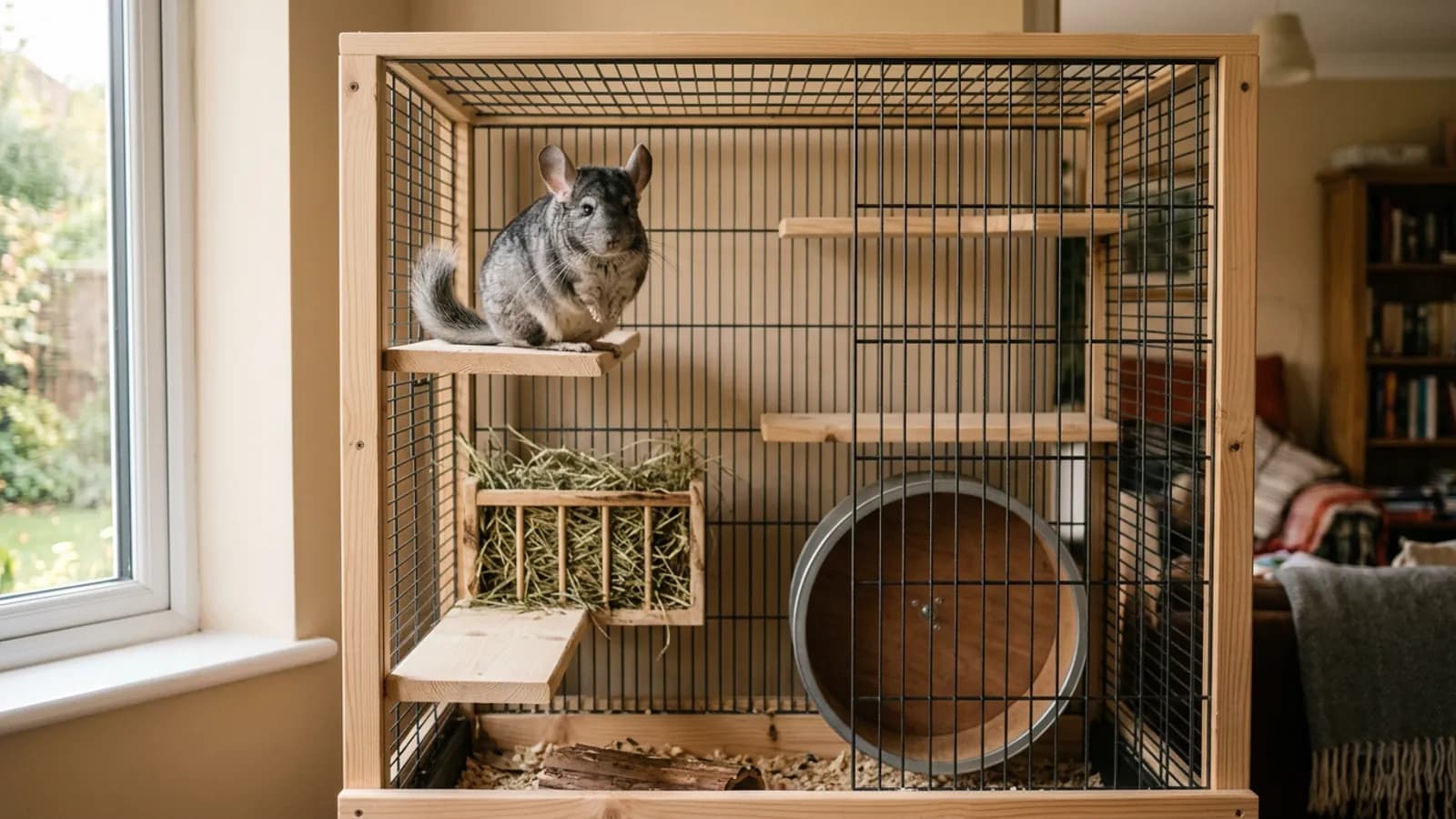
Setting up a chinchilla cage is the part of ownership people rush, and it is the part they end up redoing. When I brought Pebble home from a rehome out of an overheated attic, I had a cage that looked fine in the pet store and was wrong in three ways I only understood later. So this is the honest version of how I set a cage up now, after about ten years of it, in the order that actually matters: the enclosure itself, where it goes in the room, and only then what fills it. Get that order right and you set the cage up once. Get it backward and you buy the wrong thing twice.
Start with the cage, because everything else depends on it
Before you think about ledges or wheels or hay racks, you need the right box to hang them in. Chinchillas are athletic climbers who move up, not across, and a cage that is wide and short wastes the space they most want. I look for tall, with real vertical distance between levels, and a frame made of metal wire and untreated wood rather than plastic. A good starting enclosure is a tall metal and wood cage with wooden ledges built in.
Critter Nation double unit small animal cage As an Amazon Associate I earn from qualifying purchases.
Bar spacing needs to be narrow enough that a chinchilla cannot get its head through, roughly half an inch, and the wire has to be sturdy because these are relentless chewers. If your budget only stretches to a small cage or a big one, buy the big one and skip an accessory this month. Floor space and height are the things you cannot add later. I have written a longer piece on picking the enclosure without regretting it in How to choose a chinchilla cage without buying the wrong one twice, and if you are weighing the popular double-unit option, Is the Critter Nation cage right for a chinchilla covers what that cage does and does not do well.
One warning that belongs right here: if you are buying a "chinchilla and cage" bundle from a private seller, the cage is often the reason the animal is being rehomed. Read What a chinchilla and cage for sale listing is really selling you before you hand over money for someone else's mistake.
Where the cage goes, before what goes in it
This is the decision that scared me straight, so I put it before the fun part. Chinchillas cannot shed heat the way we do. Their dense fur, the same coat that makes them so soft, traps warmth, and they have no way to sweat it off. The comfortable range is 60 to 70°F (15 to 21°C). Above 75°F (24°C) you are into risky territory, and 80°F (27°C) and up is a genuine emergency, faster still if the air is humid. Pebble's first summer brought a heatwave and a night at the emergency vet, and every placement rule I follow traces back to that night.
So pick the spot in your home that stays coolest and steadiest. That means away from direct sun through a window, away from radiators and heat vents, and out of the path of afternoon light that creeps across a room as the day goes on. Do not put the cage in a conservatory, an attic, or a room that bakes in the afternoon, no matter how nice it looks there. Keep an eye on the actual numbers with a cage thermometer and hygrometer mounted at cage height, not a guess from across the room.
digital thermometer and humidity gauge with remote probes As an Amazon Associate I earn from qualifying purchases.
If your coolest room still climbs in summer, plan for cooling now rather than in a panic. A chilled cooling stone gives the chinchilla a surface to lie against and pull heat off its belly.
Kaytee Chinchilla Chiller granite stone As an Amazon Associate I earn from qualifying purchases.
I keep the full plan in Chinchilla heat safety, and there is a chinchilla heat danger calculator that turns a temperature and humidity reading into a plain risk level. If you want to know the warning signs to watch for on the animal itself, Chinchilla Heat Stroke: Warning Signs Every Owner Should Know is the one to read and reread.
Ledges and levels, laid out the way a chinchilla moves
Now the fun part, and the heart of most chinchilla cage set up ideas. A bare cage with a single floor is a box; a good setup is a climbing structure. I fit solid wooden ledges at staggered heights so the chinchilla can hop from one to the next without a straight drop to the bottom. Wood is the material here, kiltingdried untreated pine or kiln-dried timber that they can gnaw on without harm, never plastic shelving and never anything coated or painted.
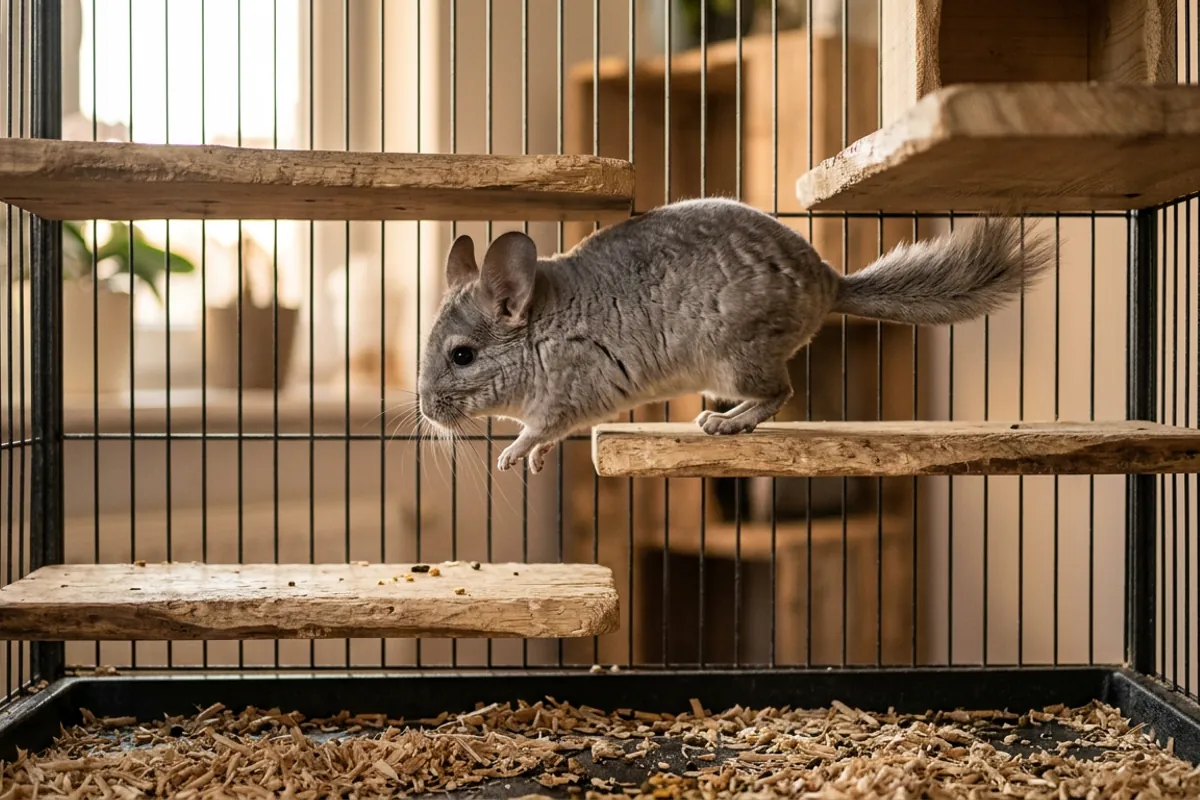
Stagger the ledges so a fall from the top is broken by the ones below. I leave the very bottom of the cage clear-ish as a landing zone and keep the food and water in the lower third where they are easy to reach. Vary the ledge depths too, a mix of wide platforms to sit on and narrower ones to perch, because a chinchilla that only ever stands on flat surfaces does not wear its nails or its feet the way varied terrain does.
Leave open vertical runs between levels so the animal actually jumps. That jumping is exercise, and exercise is not optional for an animal built to bound around Andean rock. If you want a room-by-room walkthrough of arranging the interior, I go deep on it in How to build a chinchilla cage setup that keeps the animal healthy and How to set up a chinchilla enclosure that fits the animal.
The wheel, and why the surface is the whole point
A wheel earns its space in the cage, but only the right kind. It has to be a solid running surface, one continuous track with no rungs, no wire, and no crossbars. A wire or barred wheel catches toes and legs and causes exactly the kind of injury you set the cage up to prevent, and I will name that plainly because I have seen the damage. I use a large solid-surface wheel, big enough that the chinchilla runs with a flat back rather than an arched spine.
15 inch Chin Spin solid surface chinchilla wheel As an Amazon Associate I earn from qualifying purchases.
Size matters as much as material. A wheel that is too small forces the animal to curl to fit it, and a curled-spine run night after night is not doing the good you think it is. Mount it where the chinchilla has a clear approach and where a fast spin will not fling bedding all over the water bottle. If a wheel comes with a bundle cage and it is wire, take it out and replace it. That is not a corner to cut.
Hay first, pellets measured, dust never wet
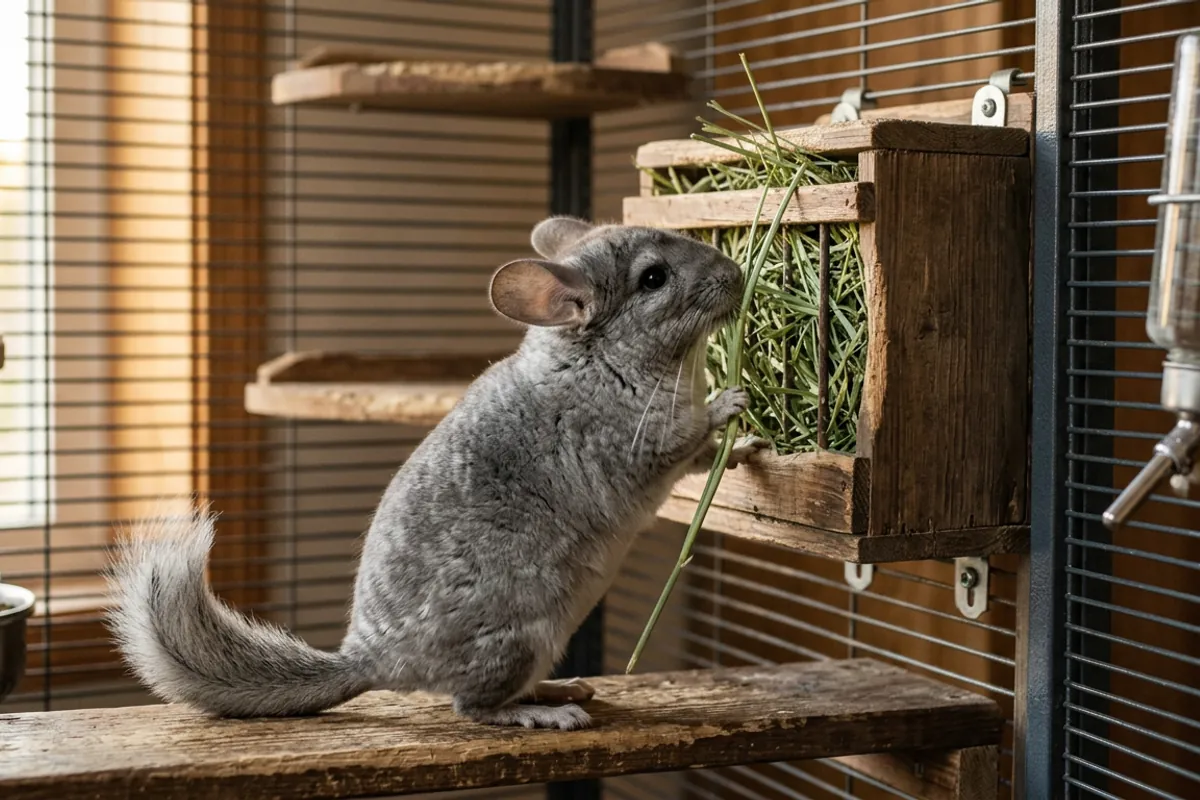
The feeding side of the setup is where I am uncompromising, because I watch my rescue Juniper manage dental disease every single day, and the thing that keeps her mouth working is grass hay. A chinchilla's teeth grow for life, and chewing coarse hay is what wears them down. So the cage needs unlimited grass hay available at all times, refreshed daily so it stays clean and dry. I feed timothy as the everyday hay and keep it coming from a bulk supply so I am never rationing it.
Oxbow Western Timothy Hay, 9 lb box As an Amazon Associate I earn from qualifying purchases.
A hay rack or box mounted at ledge height keeps the hay off the cage floor, out of the mess, and where the chinchilla can pull at it comfortably.
Oxbow Western Timothy Hay, 40 oz bag As an Amazon Associate I earn from qualifying purchases.
Pellets are a supplement, not the meal. A measured amount of plain, chinchilla-specific pellets each day covers the nutrients hay does not, and that is all they are for. Skip the colorful mixes with seeds and dried fruit; those are junk dressed up as food. What can a chinchilla eat, and what should you never feed it and chinchilla pellets lay out the details, and treats get their honest reckoning in Chinchilla treats, the honest version of what is safe.
Water goes in a bottle with a metal spout, hung on the outside of the bars so it cannot be chewed, filled fresh daily. And the bath: chinchillas never bathe in water. They clean their coat by rolling in fine volcanic pumice dust, and a soaked chinchilla is a genuine problem, not a cute one. I keep a dust bath house that I put in for a rolling session and then take back out, rather than leaving it in as a permanent litter box.
Lixit Blue Beauty chinchilla dust, 3 lb As an Amazon Associate I earn from qualifying purchases.
The how and how-often of dust bathing lives in The chinchilla dust bath, done right from dust to schedule, and if you want to understand what the dust actually is, What bathing dust for chinchillas really is, and how to use it explains it. If your chinchilla is genuinely wet, Chinchilla wet: a soaked coat, a drooling chin, and what each one means tells you which kind of wet is an emergency.
Chews are equipment, not decoration
I treat chew toys as part of the cage build, not an afterthought, because they do the same dental job the hay does. Wearing teeth down is a full-time requirement, and a chinchilla that runs out of safe things to gnaw will find unsafe ones. I hang a variety of untreated apple wood and other safe woods around the cage so there is always something within a hop.
emours apple wood chew sticks, 40 count As an Amazon Associate I earn from qualifying purchases.
Variety is the point. One kind of chew gets boring and gets ignored; a rotating mix keeps them working. Avoid anything with plastic parts, glue, or dyes, and skip cedar and other aromatic softwoods, which are not safe. I explain why this is dental care rather than play in Chinchilla chew toys, and why they are dental care, not decoration, and if you ever suspect the teeth are not wearing right, Chinchilla Teeth Problems: Spotting Malocclusion Before It Turns Serious is where I would send you, followed by an exotics vet. Overgrown or misaligned teeth are a medical problem, not something you fix with a better chew.
Bedding, cleaning, and the rhythm of upkeep
Under all of that goes the bedding and the cleaning routine, which is where a good setup stays good. I line the cage tray with kiln-dried pine shavings or paper-based bedding, never cedar and never anything scented. Many owners add a corner litter tray or a fleece liner over the tray to make cleanup easier; both work, as long as fleece is anchored so it cannot be chewed and swallowed.
The rhythm I keep: spot-clean the messiest corners every day, swap out and refresh the hay daily, and do a full bedding change and wipe-down weekly. Chinchilla droppings are small and dry, so daily upkeep is quick if you stay on top of it and miserable if you let a week pile up. Wooden ledges get chewed down over time, which is normal; check them every few weeks and replace any that are gnawed thin or soiled.
A word on smell, since people ask: a properly maintained chinchilla cage barely smells, because these are dry, clean animals. If the cage starts to reek, that is a signal to clean more often or to check that the ventilation and placement are right, not a reason to add scented anything.
A simple starting layout to build from
If you want a plain plan rather than a menu of ideas, here is the setup I would build for a first cage. Put the tall metal and wood cage in the coolest, steadiest room, out of the sun, with the thermometer and hygrometer at cage height. Fit three or four solid wooden ledges staggered from top to bottom with open jumping runs between them. Mount the solid-surface wheel low where the approach is clear. Hang the hay box at mid height with unlimited timothy, set the water bottle on the outside of the bars, and put the measured pellet dish on the lowest ledge. Scatter three or four different apple wood and safe-wood chews around the levels. Keep the dust bath and the cooling stone on hand to add when they are needed rather than leaving them in full time.
That is a setup that fits the animal instead of fighting it, and it is the one I would set up again tomorrow. The mistakes I made early on all came from thinking of the cage as furniture to fill. It is not. It is the whole environment a prey animal built for cold mountains has to live its life inside, so build it for the animal first and the aesthetics second. If you are still deciding whether a chinchilla is the right pet at all, Chinchilla as pets, the honest version after ten years is the reality check I wish someone had handed me before Pebble.