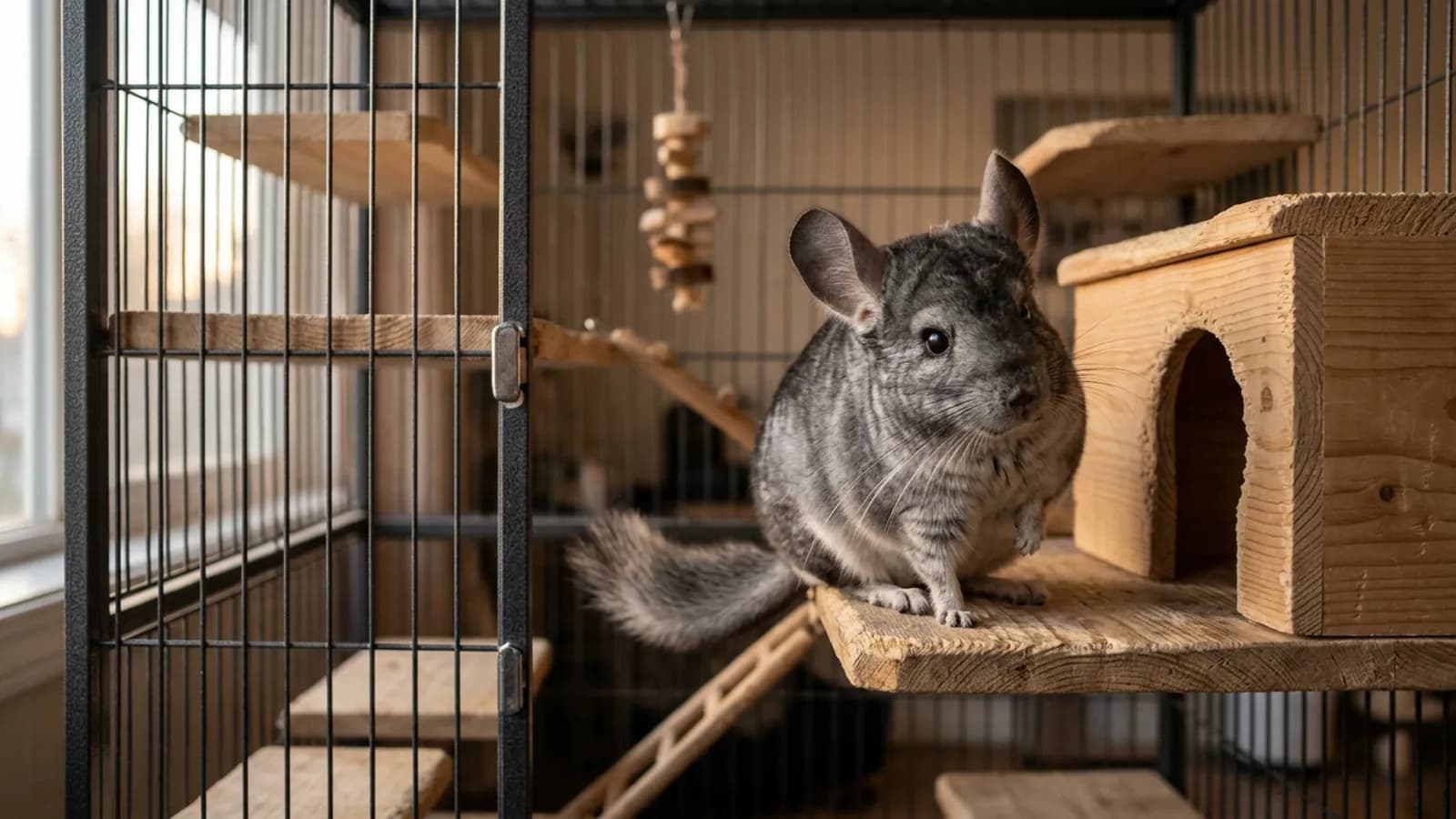
The phrase "chinchilla house" points at three different things, and that is exactly why people end up buying the wrong one. Sometimes it means the little hideout that sits inside the cage, the box your chinchilla ducks into when it wants to feel safe. Sometimes it means the whole enclosure, the physical home you keep the animal in. And sometimes it means the idea of keeping a chinchilla as a house pet at all, living inside your rooms and your routine. I have kept chinchillas for about ten years, and all three meanings matter, so this piece takes them one at a time. What is worth your money, what will sit unused in a corner, and where a bad choice quietly puts the animal at risk.
What people mean by "chinchilla house"
When most owners type "chinchilla house" into a search bar, they want the hidey house: a small enclosed shelter that goes inside the cage. Chinchillas are prey animals, and a nervous prey animal with nowhere to hide is a stressed animal. A hidey house gives it a dark box to retreat into, and a settled chinchilla is easier to bond with and less likely to chew the bars.
The second meaning is the cage itself, the full home. People say "I need a house for my chinchilla" and mean the enclosure. If that is you, the shelter question is a small part of a bigger one, and I would send you to read how to choose a chinchilla cage without buying the wrong one twice and how to set up a chinchilla enclosure that fits the animal before you spend anything.
The third meaning is the whole lifestyle: a chinchilla as a house pet, sharing your home. That is the last section here, because it is a real question with an honest answer, and the answer is not a straight yes for everyone.
For most of this article I mean the hidey house, because that is what the searches are really after, but the material rules I am about to give you apply to every version.
Why the material matters more than the shape
Owners fixate on the shape of the house, the cute little roof, the round doorway. The animal does not care about any of that. What decides whether a house is safe or dangerous is what it is made of, because chinchillas chew everything, and they chew their house most of all.
Plastic is the one to rule out completely. A chinchilla will gnaw a plastic house, swallow the shards, and those shards do not pass. They cause gut blockages, and a gut blockage is a life-threatening emergency that needs a vet, not a wait-and-see. Any house sold as a "chinchilla hidey house" that is molded plastic is a house I would not put in the cage. The same goes for painted or varnished surfaces and for glued composite board, which sheds formaldehyde and adhesives when chewed.
Wood is the standard for good reason. Kiln-dried pine is the workhorse, and safe hardwoods like apple, willow, and aspen are fine too. Wood is chewable by design, which means it doubles as something for the teeth to work against, and that is not a small bonus. My Juniper is a rescue with dental disease, and I watch every day what happens when teeth do not get worn down, so anything in the cage that gives the teeth a job is earning its place. Avoid cedar and fresh softwoods with strong aromatic oils, and avoid anything treated, stained, or pressure-treated.
Metal has a narrow, useful role. A metal chinchilla house, meaning a house with a metal frame or metal panels, will not get chewed to bits, so it lasts. The catch is temperature. Metal holds heat, and in a warm room a metal box becomes a warm box, which is the opposite of what you want. I will come back to heat, because it is the thing that kills chinchillas fastest.
Ceramic is its own case, and worth its own section.
Ceramic and the summer problem
A ceramic chinchilla house sounds like a strange idea until you have lived through a heatwave with one of these animals. Chinchillas evolved in the cold, high Andes, wearing the densest fur of any land mammal. They cannot sweat, they cannot pant efficiently, and they overheat with frightening speed. The comfortable range is 60 to 70°F (15 to 21°C). Above 75°F (24°C) you are in risky territory, and 80°F (27°C) and up is an emergency, sooner if the air is humid.
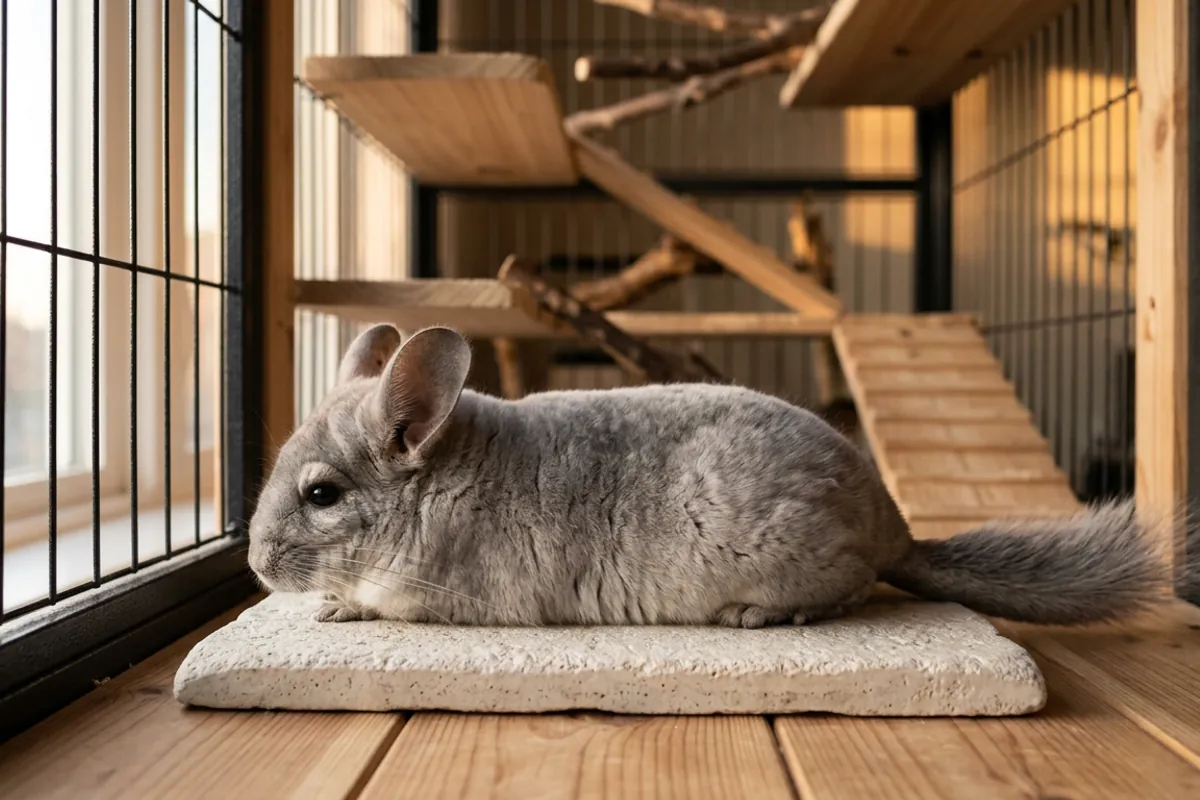
Ceramic stays cool to the touch and pulls heat out of the animal that lies against it. That is why a ceramic house, or more often a flat ceramic tile or cooling stone, becomes genuinely useful in summer. A chinchilla cooling stone is a slab of unglazed ceramic or marble the animal can sprawl on to shed heat.
Kaytee Chinchilla Chiller granite stone As an Amazon Associate I earn from qualifying purchases.
I want to be blunt about the limits, because I lost sleep learning them. Pebble came to me from an overheated attic, and her first summer brought a heatwave and a night at the emergency vet. A cooling stone is a comfort, not a cure. It does not lower the room temperature, and it does nothing once the whole room is too hot. It buys margin at the edges. The real fix for heat is air conditioning and a cool room, full stop, and if you cannot keep the room under those numbers you cannot safely keep a chinchilla in it. Do not let a ceramic house or a cool stone talk you into thinking the heat problem is handled.
Put a thermometer where the cage actually is, not across the room, and watch it. A combined thermometer and hygrometer tells you both the temperature and the humidity, and humidity matters because damp heat is far more dangerous than dry heat at the same reading.
digital thermometer and humidity gauge with remote probes As an Amazon Associate I earn from qualifying purchases.
If you want to know how close a given day is to dangerous, I built a chinchilla heat danger calculator that takes temperature and humidity together, and it is worth reading the warning signs of heat stroke before you ever need them.
The hidey house your chinchilla actually needs
Here is what a good hidey house looks like, stripped of the marketing. Solid wood, big enough that a full-grown chinchilla can turn around inside it and ideally that two can share if you keep a pair, with an entrance the animal fits through without squeezing. Open bottom or removable floor so you can clean it, because a closed wooden box becomes a soaked, ammonia-smelling problem fast. More than one exit is a real safety point: a house with a single doorway is a place a bullied or panicked chinchilla can get cornered, so I prefer houses with two openings or I add a second one myself.
Placement matters as much as the house. Chinchillas want to be up high, so a hidey house on an upper ledge gets used, and one sitting on the cage floor often gets ignored in favor of a shelf. Do not crowd the house right under the water bottle or beside the litter corner. Give it a quiet, high, dry spot.
One house per chinchilla is the rule if you keep more than one, plus a spare. Chinchillas guard resources, and a single shelter shared between two animals is a recipe for one hogging it and the other stressed. Cheap to solve: add another house.
You do not need anything fancy. A plain kiln-dried pine box does the whole job. The money you might have spent on a molded plastic "castle" with a slide is better spent on hay and on wood the animal can safely destroy.
Building your own: chinchilla house DIY
A chinchilla house DIY project is one of the few homemade cage items I actively recommend, because the safe materials are cheap and the animal treats the house as disposable anyway. If you build it yourself you can replace it for pennies when it gets chewed down, which it will.
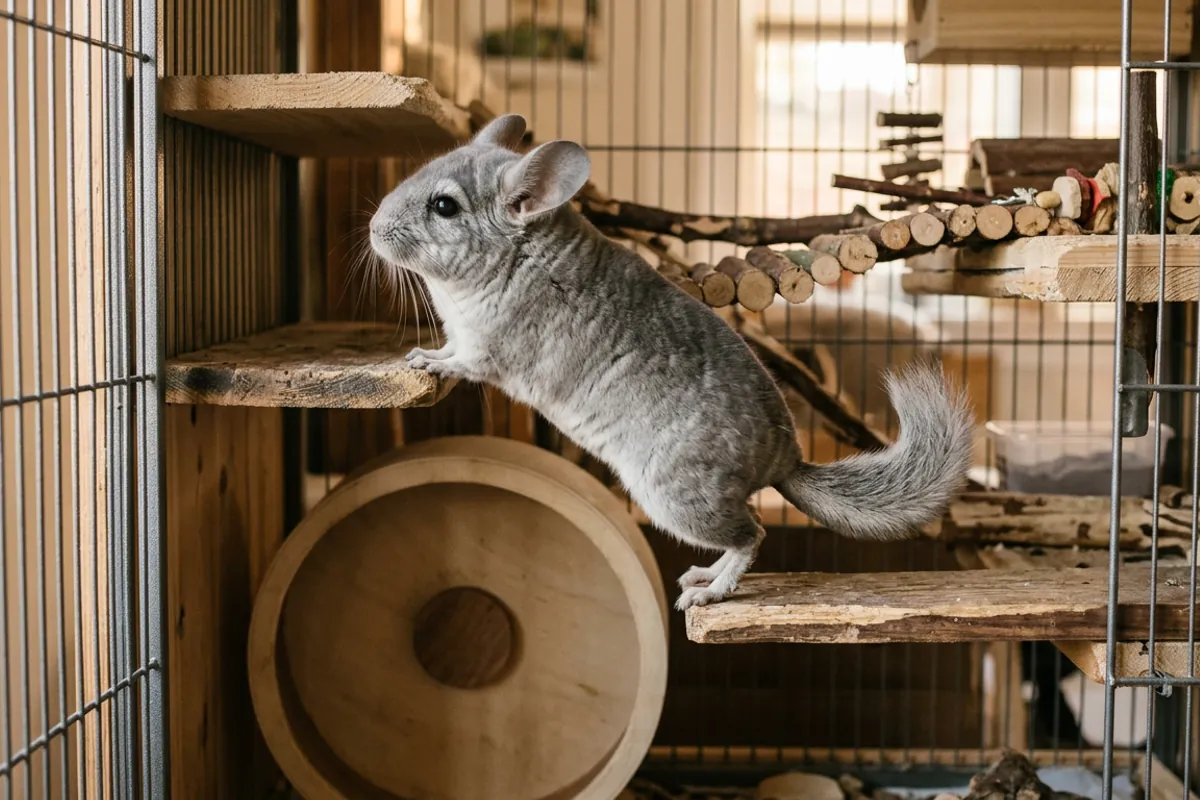
The rules for DIY are the material rules from earlier, held to strictly. Use kiln-dried pine or a safe hardwood, untreated, unpainted, unstained, and unglued where the animal can reach the joint. That last point trips people up: wood glue, hot glue, and construction adhesive are not chinchilla-safe, and a chinchilla will find the glued seam and gnaw straight into it. Join the pieces with screws or nails countersunk out of reach, or with simple wooden dowels, not glue. Sand any rough edges and check for splinters.
Keep the design simple. A four-sided box with a roof, an open or slatted bottom, and two doorways is all you need, and simple is easier to keep clean. Skip the tiny decorative details; they are chew hazards or dust traps.
If sourcing safe wood is the hard part, a pack of chinchilla-safe chew wood gives you known-safe pieces to build with and to restock the cage as chews at the same time. An apple wood chew variety pack is the kind of thing I keep on hand for exactly this dual purpose.
emours apple wood chew sticks, 40 count As an Amazon Associate I earn from qualifying purchases.
One caution on DIY: build the shelter, not the cage. A homemade hidey house is safe and sensible. A homemade full enclosure is where DIY goes wrong, because you end up with unsafe bar spacing, plastic bins, or poor ventilation. For the actual cage, buy a proper tall metal-and-wood enclosure and read how to build a chinchilla cage setup that keeps the animal healthy. A good example of the right build is a tall metal-barred cage with wooden ledges.
Critter Nation double unit small animal cage As an Amazon Associate I earn from qualifying purchases.
Play houses, ledges, and the clutter that earns its space
A "chinchilla play house" usually means a house with extras: platforms, a slide, tunnels, a lookout. The instinct behind it is right. Chinchillas are athletic, curious, and busy, and a bare cage bores them into bar-chewing and fur-chewing. The instinct is right; the products are often wrong, because "play house" is a phrase that sells plastic.
What actually enriches a chinchilla is vertical space and things to climb, chew, and leap between. Wooden ledges at staggered heights turn the cage into a set of levels to bounce through. Wooden bridges and untreated apple or willow branches give the animal somewhere to go. A tunnel of hardened cardboard or wood gives a prey animal a route to scoot through, and it will be chewed apart, which is fine and expected.
The one piece I would not skip is a wheel, and the wheel is where "play house" marketing does the most damage. A chinchilla needs a solid running surface, never a wire or rung wheel, because feet and toes and even legs break in the gaps. A wire wheel is not enrichment, it is an injury waiting to happen. Get a large solid-surface running wheel sized for a chinchilla, at least around fifteen inches so the back is not forced into a curve.
15 inch Chin Spin solid surface chinchilla wheel As an Amazon Associate I earn from qualifying purchases.
Rotate the clutter rather than piling all of it in at once. Swap chews and rearrange ledges every couple of weeks, and the same objects feel new again. The goal is not a crammed cage; it is a cage where every item is safe, chewable or climbable, and worth the space it takes.
A chinchilla as a house pet, honestly
That leaves the biggest meaning of the phrase: a chinchilla as a house pet, living in your home. People picture a cuddly, low-effort pocket pet, and that picture is wrong in ways worth saying plainly, because the mismatch is why so many chinchillas get rehomed. I go through the full version in chinchilla as pets, the honest version after ten years, but here is the short, blunt shape of it.
Chinchillas as house pets are a long commitment. They live commonly into their teens and sometimes to twenty, so this is a ten-plus-year relationship, not a passing phase. They are crepuscular, most active at dawn and dusk and well into the night, which does not match a household that wants a quiet evening cuddle. Many chinchillas do not enjoy being held at all; they bond by sitting near you and taking treats from your hand, on their terms, and forcing handling breaks the trust.
Then there is the part that governs everything: the house has to stay cool. A chinchilla house pet cannot live in a warm room, so the room it lives in dictates your thermostat, all summer. If your home runs hot and you cannot air-condition the chinchilla's room reliably, keeping one is not fair to the animal, and I would rather say that now than have you learn it the way Pebble and I did.
The daily care is real but not exotic. Unlimited grass hay is the whole foundation of the diet, day and night, because the constant chewing is what keeps the ever-growing teeth worn down. Keep good timothy hay in front of the animal at all times.
Oxbow Western Timothy Hay, 40 oz bag As an Amazon Associate I earn from qualifying purchases.
Plain pellets are a measured supplement on top of the hay, not the main meal. Fresh water, a safe cage, and a dust bath a few times a week keep the coat right, because chinchillas never bathe in water, only in fine dust.
Lixit Blue Beauty chinchilla dust, 3 lb As an Amazon Associate I earn from qualifying purchases.
None of that is hard. It is just non-negotiable and daily, for well over a decade, in a room you keep cold. If that sounds like a home you can give, a chinchilla is a wonderful animal to share it with, and the house you build for it, all three meanings, is where that starts.