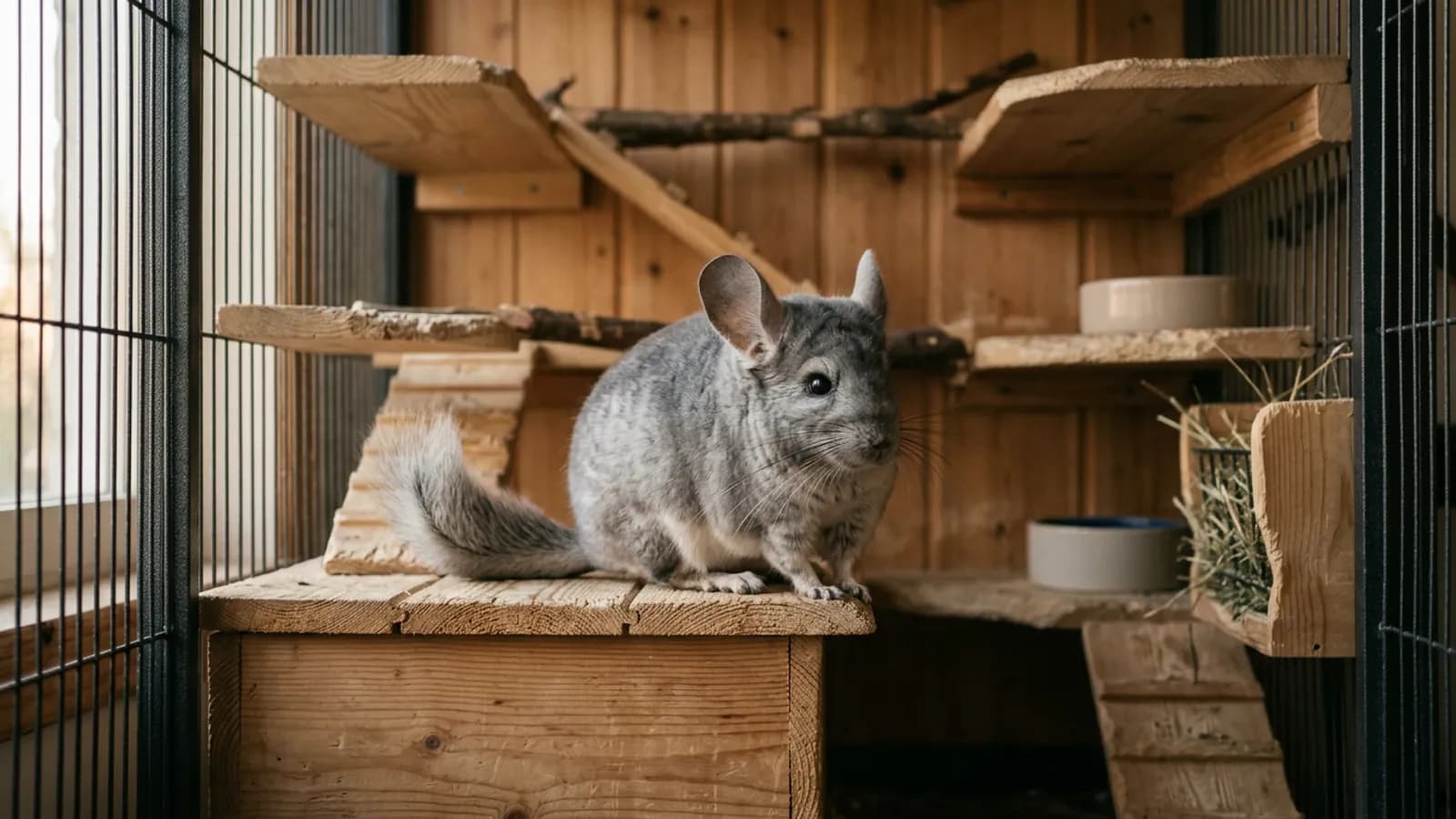
A chinchilla wooden house is one of the few pieces of cage furniture I would never skip. It is a small solid hideout, built from untreated wood, that gives your chinchilla a dark corner to disappear into, a surface to gnaw, and a roof to perch on. That sounds simple, and it is, but the details decide whether the thing is a real shelter or a slow problem sitting in the corner of your cage. Ten years in with Pebble and Juniper, I have bought good houses, thrown out bad ones, and watched, up close, what a chinchilla actually does with one once it is in the cage. Here is what matters, what does not, and how to buy one you will not have to replace for the wrong reasons.
What a wooden house is actually for
Chinchillas are prey animals. In the wild they wedge into rock crevices, and a house is the closest thing a cage offers to that. When something startles Pebble, a car door outside, a dropped pan, she goes straight for her house and sits in the dark until the world feels safe again. A chinchilla without a hideout is a chinchilla that never fully switches off, and a stressed animal is a sicker animal over time. The house is not decoration. It is the one spot in the cage the animal controls.
It does two other jobs at the same time. The roof and the ledge around it add usable height, which for a climbing animal is real territory, not just square footage. And every surface of it is something to chew. Chinchilla teeth grow for the animal's whole life, and they only stay the right length if the animal wears them down constantly. Juniper taught me that the hard way, and it is why I treat every wooden thing in the cage, the house included, as part of her dental care rather than furniture. A wooden house is a hideout, a lookout, and a chew toy in one object.
Why it has to be wood and not plastic
I will name the bad product plainly, the way this site always does: a plastic house is a mistake. Chinchillas gnaw everything, and they will gnaw the doorway of a plastic igloo down to sharp edges within weeks. The shards do not pass safely. Swallowed plastic can lodge in a gut that is built to move a steady stream of fibre, and a blockage in an animal this small is a genuine emergency, not a wait-and-see. There is no plastic house safe enough to earn its place, no matter how the packaging is styled.
Wood is different because it is meant to be eaten. When your chinchilla chews the corner of a proper wooden house, the shavings are the same untreated wood you would hand it as a chew, and they pass through without drama. This is the same reason the whole cage has to be metal and wood in the first place, and I have written the full case for that in why a chinchilla cage has to be metal. The house follows the same logic. If a part of the cage can go in the mouth, and all of it can, it has to be a material the animal can safely swallow a little of.
Which woods are safe and which ones hurt
Not all wood is friendly, and this is the part people skip. The safe list is the one I actually use: kiln-dried pine, aspen, apple, pear, willow, and hazel. Kiln-dried is the phrase that matters for pine, because kiln drying drives off the aromatic oils that irritate a chinchilla's airway. Plain fresh pine and anything cedar or redwood stay out of the cage entirely, whether as a house, a shelf, or bedding. Those aromatic softwoods release phenols that are hard on small lungs, and there is no version of a cedar house I would put near an animal.
The other group to avoid is the stone-fruit woods in their raw state, cherry, plum, peach, and apricot, along with citrus, because they carry compounds you do not want a chinchilla eating. Oak and walnut come off the list too, oak for its heavy tannins. When people ask me for a single rule, it is this: if you cannot confirm the wood is on the safe list and is untreated, do not use it. Better to buy a house whose material is stated outright than to guess with a mystery offcut.
Treatment matters as much as species. Varnish, paint, wood stain, and the glue in cheap plywood are all things I keep away from a chewing animal. A raw pine house that is a little plain is worth far more than a pretty one finished in something you cannot identify.
What to look for when you buy one
Start with the material, stated plainly by the seller: untreated kiln-dried pine or one of the safe hardwoods, no varnish, no paint, no stain. Then look at how it is held together. The best houses are joined with wooden dowels or slotted panels rather than a mess of glue, and any screws should be countersunk metal, not exposed staples the animal can pull loose and swallow. Run your eye over every edge for splinters and rough saw marks before it goes in the cage.
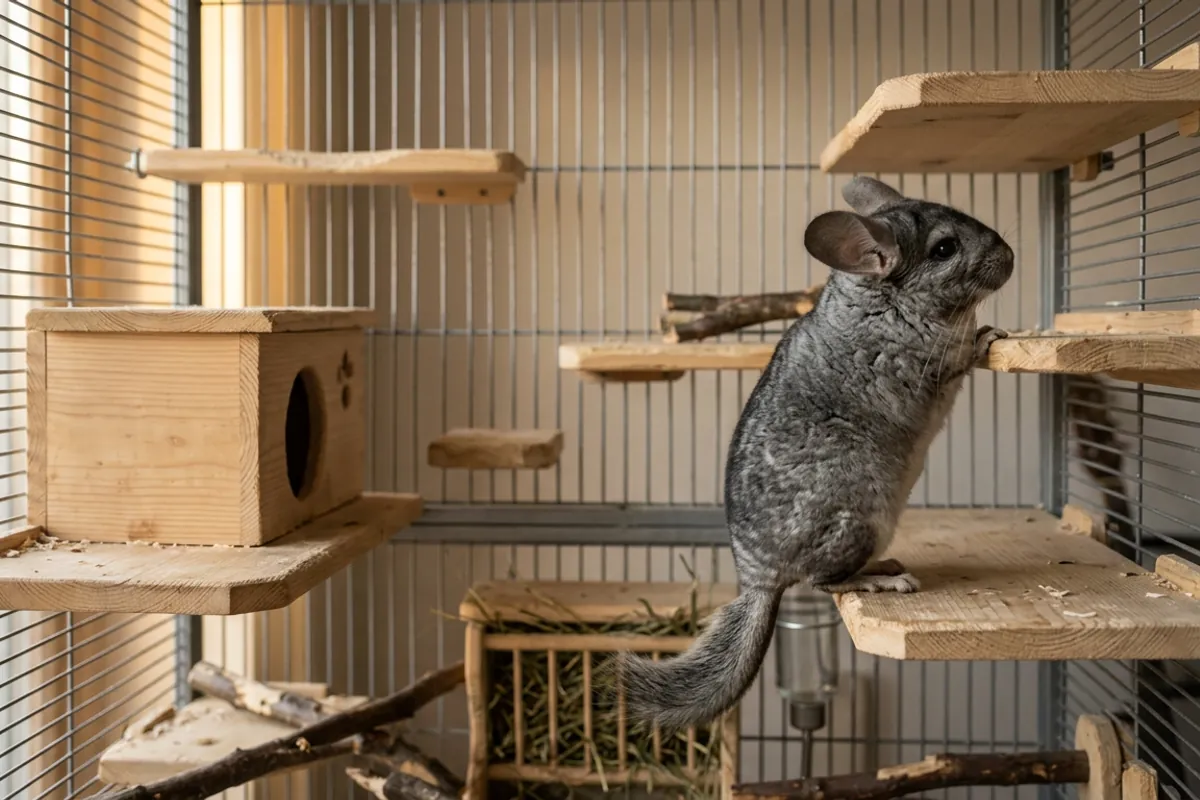
Size is the next thing, and people go too small. A chinchilla should be able to turn around inside comfortably and, ideally, two chinchillas should both fit if you keep a pair, because a house that only holds one becomes a thing to squabble over. I like an open floor or a large doorway so I can see whether the animal is in there and get it out without a wrestling match, which matters more than you think on a vet morning.
I would skip anything sold as a "chinchilla house" that turns out to be a repurposed hamster or rabbit item scaled wrong, and I would be wary of listings that bundle a house with a whole cage of questionable parts. If you want a sense of how those bundles are put together, what a chinchilla and cage for sale listing is really selling you walks through the pattern. A good standalone wooden house is not expensive, and buying it on its own lets you judge it on its own.
Wooden shelves and ledges around the house
The house rarely lives alone. What turns a tall cage into a proper home is a run of chinchilla wooden shelves stepping up the height, with the house sitting on one of them as a landing. Chinchillas move up and down far more than side to side, so vertical ledges give them the exercise and the choice of temperature levels they want. Kiln-dried pine shelves are the standard, and I mount them at staggered heights so the animal can hop rather than climb a ladder, which their feet handle better.
I mix in a few lava ledges among the wooden ones, because the rough stone helps keep nails filed down in a way plain wood does not. The wooden shelves take the daily chewing and the lava ledges do the pedicure, and between them the cage stays interesting. Wooden shelves are also consumable in the best sense: when one gets gnawed thin or urine-stained past cleaning, you swap that single board rather than the whole setup.
Keep the chewing supply generous while you are at it, because a well-fed chew habit is what saves the house and shelves from being demolished in a month. I keep a rotating stash of untreated apple and other safe woods going at all times. emours apple wood chew sticks, 40 count As an Amazon Associate I earn from qualifying purchases. The more loose chews an animal has, the slower it works through the fixed wood, and the better its teeth do. I go deeper on why in chinchilla chew toys, and why they are dental care, not decoration.
Keeping a wooden house clean and dry
The honest downside of wood is that it soaks things up. Chinchilla urine goes into an unsealed pine house, and if you ignore it the wood turns dark, starts to smell, and eventually grows mould, which is exactly what you do not want an animal breathing inside its safe corner. This is the trade you accept for a chewable material, and it is a fair one as long as you stay on top of it.
My routine is simple. I spot-check the house and shelves whenever I do the cage, scrape off droppings, and knock loose the shavings from chewing. When a wooden surface gets soiled, I let it dry fully in the sun rather than scrubbing it wet and putting it straight back, because a damp house is worse than a stained one. Sanding a lightly marked board brings it back a few times before it needs replacing. What I never do is wash wood with soap or disinfectant and return it wet to the cage. If you want the whole cleaning rhythm laid out, I keep it in how to keep a clean chinchilla cage without it becoming a chore. Plan on retiring each wooden piece eventually. It is a consumable, and pricing a house as a one-time purchase sets you up to keep a manky one too long.
The house and heat, which is where I get strict
This is the part I will not soften. Wood insulates, and a closed wooden house is a warm little box. On a comfortable day that is a feature, a cosy spot to nap. In a heatwave it can become a trap, because a chinchilla that retreats into an enclosed house on a hot afternoon is sitting in the worst-ventilated corner of the cage. Pebble's first summer brought a heat near-miss and a night at the emergency vet, and everything I do about temperature traces back to that scare.
The comfortable range for a chinchilla is 60 to 70°F, which is 15 to 21°C. Above 75°F, meaning 24°C, you are into risky territory, and 80°F, which is 27°C, is an emergency, faster still when the air is humid. Keep a thermometer where the animal actually lives so you are reading the cage, not the far side of the room. digital thermometer and humidity gauge with remote probes As an Amazon Associate I earn from qualifying purchases. When the numbers climb, give the animal a cool hard surface as an alternative to the warm house, so retreating does not mean overheating. A chilled stone slab is what I reach for. Kaytee Chinchilla Chiller granite stone As an Amazon Associate I earn from qualifying purchases. It draws heat out of the body and costs nothing to run. None of this replaces cooling the room itself. The house is never the heat plan; it is just one object that has to be managed within a real one, and I have laid out the whole approach on the chinchilla heat safety page and the chinchilla temperature guide.
How the house fits the rest of the cage
A wooden house earns its place inside a cage that already gets the basics right: tall, metal-framed, fitted with wooden ledges, unlimited grass hay, a solid-surface wheel rather than dangerous wire rungs, and dust for bathing instead of water. The house is one accessory among several, and it works best when it is not doing a job some other piece should be doing. It is a retreat and a chew surface. It is not a substitute for floor space, and it is not a bed you need to buy separately, because a chinchilla will happily sleep in a bare pine box.
If you are choosing everything at once, cage accessories for chinchillas, and which ones actually earn their place sorts the useful from the pointless, and the honest guide to a chinchilla house covers the three different things people mean when they say house. My short version is this: buy a plain untreated wooden house of the right size, surround it with safe wooden and lava shelves, keep a steady supply of chews so the fixed wood lasts, clean it on a schedule, and never let it become the warm corner an animal hides in on a dangerous day. Get those five things right and a chinchilla wooden house is one of the best-value things you will ever put in the cage.