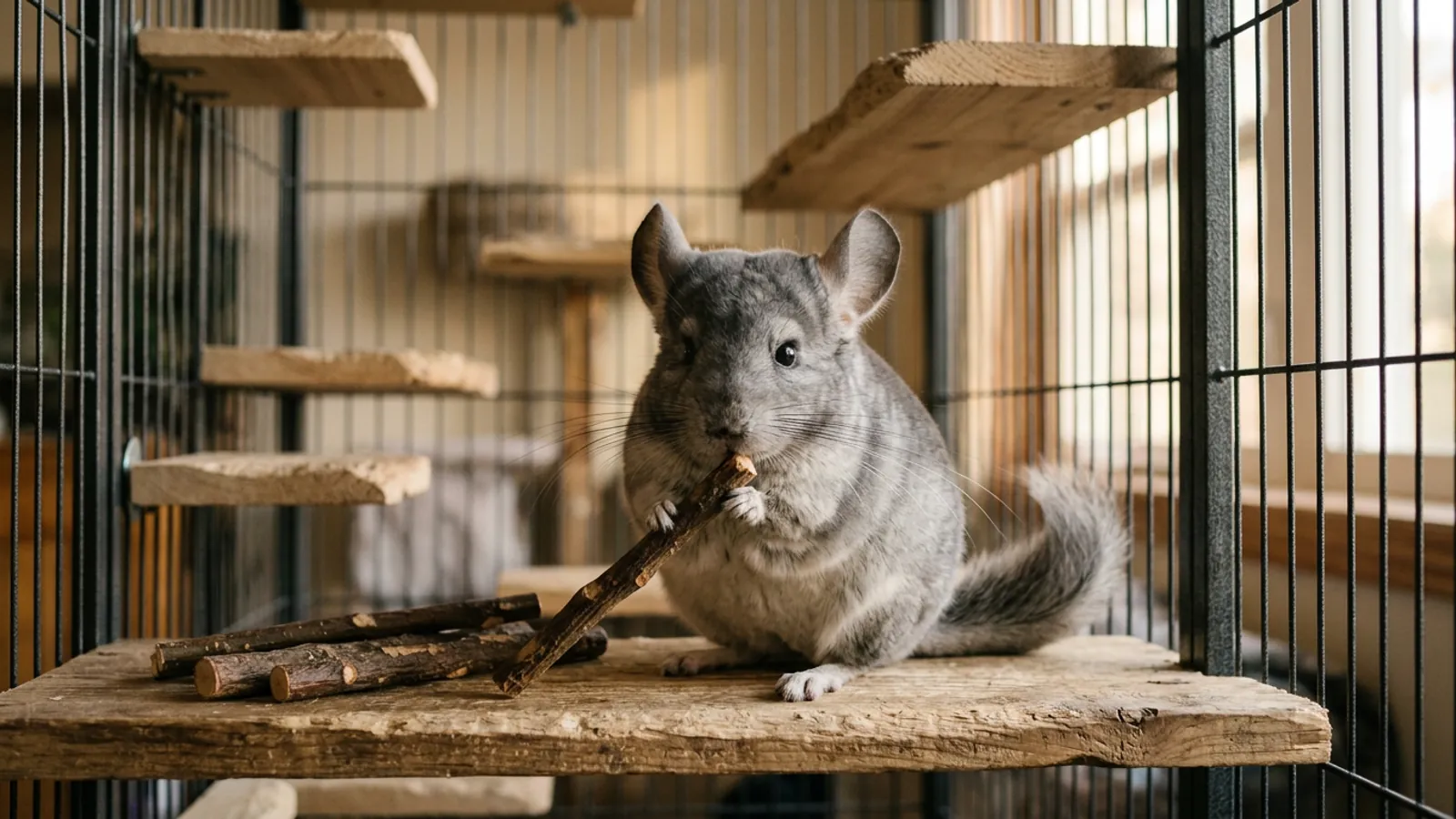
Chinchilla safe wood is a shorter list than the pet aisle suggests, and the mistakes it hides are quiet ones. A bad shelf does not hurt an animal the day you bolt it in. It sits there getting gnawed, week after week, until you work out that your chinchilla has been eating varnish, glue or cedar oil for the better part of a year. After about ten years of keeping these animals, I have come to treat cage wood the way I treat food, because that is exactly what it becomes. Everything wooden in my cages ends up inside Pebble and Juniper in small pieces, so it has to be a species they can safely swallow slivers of, and it has to be clean.
What chinchilla safe wood means
Four things have to be true before a piece of wood goes into one of my cages, and all four carry equal weight.
The species has to be non toxic. Some trees carry compounds that are genuinely dangerous to a small herbivore, from cyanogenic glycosides in stone fruit wood to the aromatic oils in cedar. A chinchilla cannot tell one branch from another, and it will not nibble cautiously to check.
It has to be untreated. No paint, no stain, no varnish, no lacquer, no wood glue, no wax, no pressure treatment, no fire retardant. That disqualifies almost every piece of furniture offcut, every scrap of decking, and most craft store dowels, which are often surface sealed even when they look bare.
It has to be solid wood rather than a composite. Plywood, MDF, particle board and chipboard are wood particles held together with adhesive, and the adhesive is precisely the part a chinchilla grinds free first. I do not use them anywhere an animal can reach, including cage bases.
It has to be dry and properly cured. Green wood holds sap and resin, and resin is where most of the irritating volatile oils sit. Kiln drying or a long air dry drives them off. This is the reason some sources put kiln dried pine in a different category from a pine branch you cut this morning, though not every veterinary source accepts pine at all.
There is a fifth thing that is not about the wood at all: the hardware. Shelves get mounted with metal bolts, washers and wing nuts, arranged so the animal meets wood and metal only. Plastic anchors, cable ties and glue are chew targets, and a chinchilla will find them faster than you expect.
The woods I use, and the ones that stay out of my house
The woods I am comfortable putting in a cage, untreated and dried, are apple, pear, willow, poplar, aspen, cottonwood, hazel, hawthorn, mulberry, elm, ash, birch, grapevine and kiln dried pine. Manzanita is on my list too, though it is hard enough that I treat it as a gnaw block rather than a chew stick.
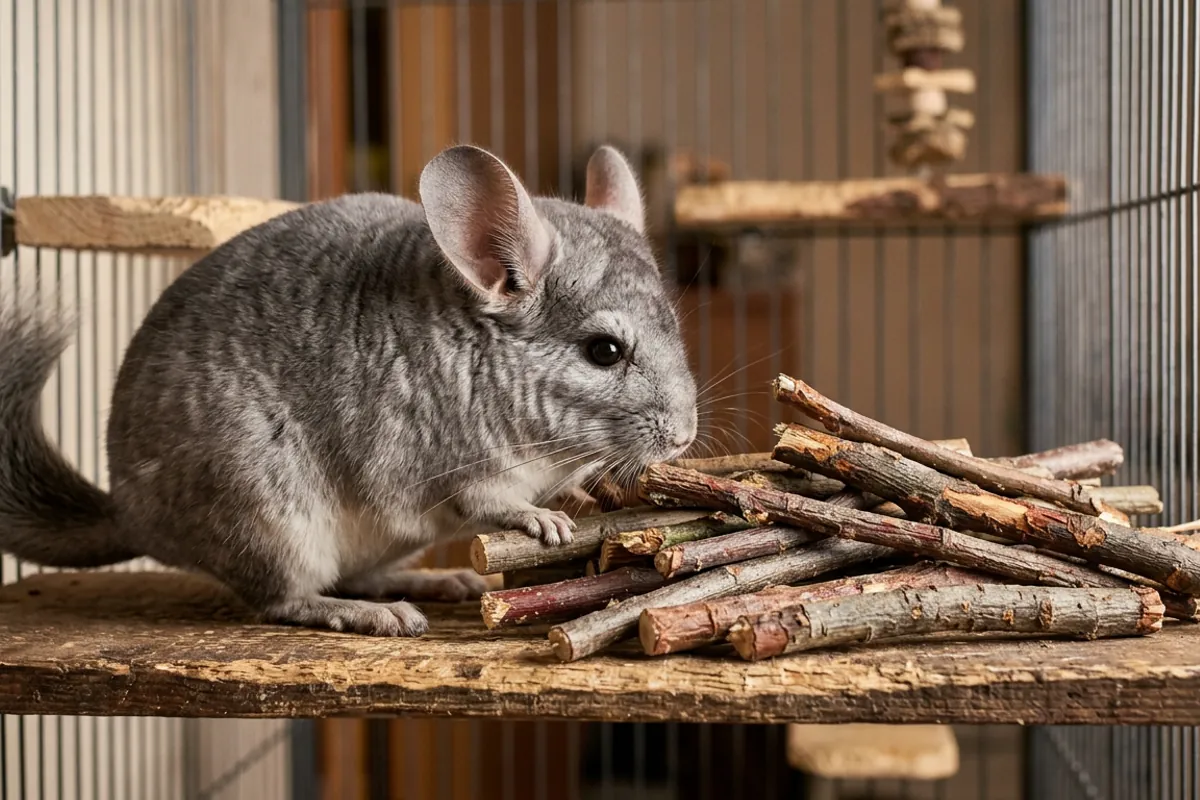
The list I refuse is just as worth memorizing. Cedar and redwood are out, because of the aromatic phenols in them, which are linked in rodent studies to airway irritation and changes in liver enzymes. Fresh, uncured pine, fir and spruce are out for the same family of reasons. All stone fruit woods are out, meaning cherry, plum, peach, apricot, nectarine and almond, because the whole tree carries cyanogenic compounds. They are most concentrated in leaves and seeds, and the bark carries more than the seasoned heartwood, but there is no upside to finding out where your branch sits on that scale. Walnut is out. Oak is out, on tannin content. Yew, oleander, laurel, rhododendron, elderberry, holly and ivy are toxic plants generally and have no business near a chinchilla.
A few sit in debated territory, and I would rather say so than pretend the internet agrees. Citrus wood appears on some safe lists and some avoid lists, and the disagreement is about the oils in the peel and bark. Eucalyptus is the same story. Bamboo is not a true wood at all and can shred into long splinters. I skip all three, not because I can point you to a study showing harm, but because the safe list is long enough that I do not need them.
If you cannot identify a tree with confidence, it is not chinchilla safe wood. It is unknown wood, and unknown does not go in the cage.
Apple wood, the stick I always have in the house
If I could keep only one, it would be apple. Apple wood for chinchillas is the standard for good reason: the bark is soft enough to strip and interesting enough that even a fussy chinchilla works at it, the branches come in sizes that suit a small mouth, and the wood is on a major veterinary manual's chew list, though a major poison-control database lists apple stems, leaves and seeds as cyanogenic. Juniper, my dental rescue, will sit and shred an apple stick for twenty minutes when she ignores everything else in the cage.
Apple sticks for chinchillas are sold everywhere, and quality varies more than price does. What I look for is bark still attached, no mold, no musty smell, and no mention of scenting or flavoring anywhere on the bag. Flavored chews are usually sugar coated, and sugar has no place in this diet. I also want sticks thick enough to require real work; pencil thin twigs get destroyed in a sitting and teach nothing.
Apple wood sticks for chinchillas do not need to be the whole chew rotation, and they should not be. Juniper taught me that variety matters, because different textures and diameters make an animal work its jaw in different ways, and a chinchilla that gets bored of a chew stops using it. I keep apple as the constant and rotate willow, hazel and pear alongside it. A mixed pack is the cheapest way to find out what your particular chinchilla likes.
emours apple wood chew sticks, 40 count As an Amazon Associate I earn from qualifying purchases.
Store sticks somewhere dry and open. A sealed bag in a warm room grows mold, and moldy wood goes in the bin, not the cage. More on the rest of the chew rotation in my guide to chinchilla chew toys.
Chinchilla safe wood for shelves
Shelves are where the volume is. A chew stick weighs a few grams; a shelf is a slab your chinchilla stands on, sleeps against and gnaws at every night for months. Chinchilla safe wood for shelves therefore means the same species rules with more attention to what happens as it wears down.
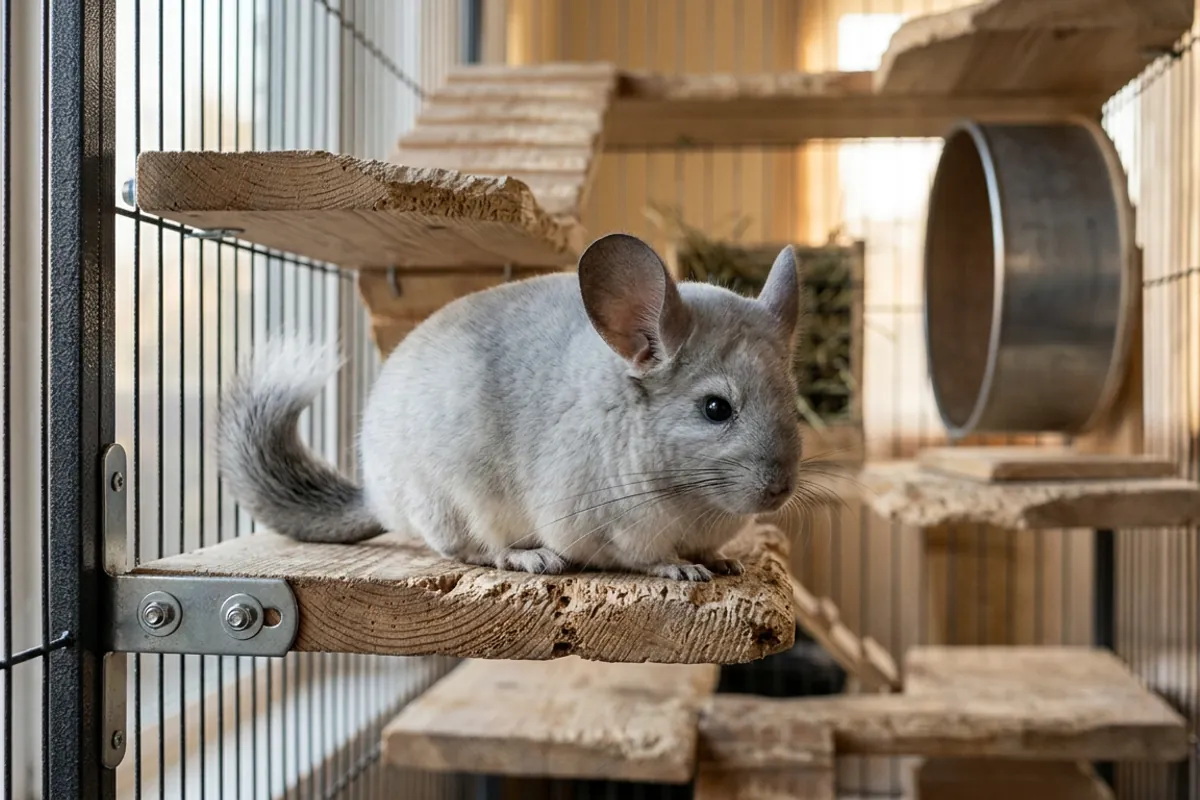
Kiln dried pine is what most people use, and what I use. It is cheap, it is soft enough that gnawing on it does something useful for the incisors, and it is easy to replace, which matters more than durability. Poplar and aspen work too. Hardwoods last longer but give less back as a chewing surface, so I would rather swap a soft shelf twice a year than mount an oak plank I would not want chewed anyway.
Practical points I have learned the expensive way. Make the shelves wide enough to land on and turn around on, not narrow perches; something in the region of 6 inches deep is a sensible floor. Stagger heights so there is no long unbroken drop, since chinchillas jump rather than climb, and give them a route down as well as up. Bolt through the cage bars from the outside with metal hardware and cover the bolt end, or cap it, so nothing sharp faces inward. Sand cut edges by hand.
Replace shelves when they are soaked with urine, chewed thin, or splintering along the grain. Wet wood harbors bacteria and never really dries out inside a warm cage. Nobody enjoys this job, which is exactly why I keep spare planks cut to size, ready to swap in.
Safe wood for chinchilla cages, and the parts that should never be wood
Here is the distinction that trips people up. Safe wood for chinchilla cages means wood inside the cage, not a cage built out of wood. The enclosure itself has to be metal, because a chinchilla will chew through a wooden frame, and because wood absorbs urine and cannot be properly cleaned. I go into the reasoning in more detail in why a chinchilla cage has to be metal. A well built cage is a metal frame and metal bars with wooden ledges fitted into it.
Critter Nation double unit small animal cage As an Amazon Associate I earn from qualifying purchases.
Plastic is the other thing to strip out on day one. Plastic bases, plastic ramps, plastic shelf clips and plastic wheels all get chewed, and swallowed plastic can cause a gut blockage that a chinchilla will not survive without surgery. Where a wheel is concerned, it needs a solid running surface rather than wire rungs, which catch feet and tails.
15 inch Chin Spin solid surface chinchilla wheel As an Amazon Associate I earn from qualifying purchases.
Wooden houses and hides count as cage wood too, and they come with a seasonal caveat. A closed wooden box holds heat, and heat is the thing that kills these animals. Pebble came to me out of an overheated attic, and her first summer included a heatwave near miss and a night at the emergency vet, so I am not gentle about this. Chinchillas are comfortable at 60 to 70°F (15 to 21°C). Above 75°F (24°C) is risky, and 80°F (27°C) or higher is an emergency, arriving faster in humid air. In hot weather the wooden hide comes out of my cages entirely and a cooling stone goes in.
Kaytee Chinchilla Chiller granite stone As an Amazon Associate I earn from qualifying purchases.
You cannot manage that by feel, so put a thermometer and hygrometer at cage height, where the animal lives, not on the far wall.
digital thermometer and humidity gauge with remote probes As an Amazon Associate I earn from qualifying purchases.
Preparing wood you gather yourself
Cutting your own branches is cheaper and, done properly, perfectly safe. It just asks for care at the front end.
Identify the tree first, with certainty. Then think about what has been sprayed on it. I avoid anything within reach of a road, because of exhaust residue and winter salt, anything from a commercial orchard, which is sprayed on a schedule, and anything from a garden where the owner cannot tell me what has been applied. Pesticide and fungicide residue is invisible and does not wash off reliably.
Take living branches rather than deadfall. Wood already lying on the ground has been colonized by fungi and insects. Strip the leaves off and leave out any fruit, blossom or seeds, because on apple and the other fruiting trees the cyanogenic compounds concentrate in leaves and seeds far more than in seasoned wood. The wood is the part you want; the rest goes in the compost. Cut to length, scrub with hot water and a stiff brush, and rinse. No soap, no bleach; you will never get the residue fully out of the grain.
Then dry it. The slow way is to leave it somewhere warm, dry and airy for several weeks until it is hard and light. The fast way, and the one I use, is a low oven at around 200 to 250°F (95 to 120°C) for an hour or so, turning it partway through. Do not walk away from an oven full of wood, and do not push the temperature to speed things up.
I want to be clear about what baking achieves. It kills insects and their eggs and drives off remaining moisture. It is not sterilization, and it does not neutralize a toxic species or wash out pesticide, so it cannot rescue a branch that was wrong to begin with. Anything that smells musty, shows fuzzy growth, or has dark streaks through the grain gets binned rather than baked.
Wood is dental care, not decoration
Chinchilla teeth grow continuously for life, all twenty of them, with the incisors alone pushing out steadily year after year. You will see a figure quoted for how much, with the usual caveat that it varies between animals, and I leave the number out on purpose. The principle does not need it: teeth that are not worn down keep growing, and the molar roots can grow the wrong way, into the jaw and up towards the eye sockets.
This is where I have to correct a comfortable myth. Chew sticks are not what keeps molars in shape. The long, side to side grinding of coarse grass hay does that job, and nothing substitutes for it. Hay should be in front of your chinchilla constantly, unlimited, with plain pellets as a measured supplement rather than the main event.
Oxbow Western Timothy Hay, 40 oz bag As an Amazon Associate I earn from qualifying purchases.
What wood does well is give the incisors something to work against, and give a nocturnal animal a job to do. Both matter. Juniper arrived with dental disease already established, and I manage it day to day rather than cure it, which means watching her eat, weighing her, and keeping a rotation of chews that she will use. If she stops chewing wood, that is information, and I act on it.
Signs that something is wrong with the teeth include dropping food, chewing on one side, drooling, a permanently damp chest or chin, weight loss, and smaller or fewer droppings. Those are vet signs, not wood signs. I am an experienced keeper, not a vet, and the inside of a chinchilla's mouth cannot be assessed properly without an exotics vet and usually sedation. My guides on chinchilla teeth and teeth problems go further, but none of it replaces the appointment.
When the wood is not the problem
Occasionally someone tells me their chinchilla will not touch any of the safe woods, and worries the sticks are bad. Usually the sticks are fine. Chinchillas get bored of a chew they have had for months, they ignore wood that is too thin to be satisfying, and they lose interest in anything left in the cage permanently. Rotating three or four types on a weekly cycle fixes most of it.
A chinchilla that stops chewing everything, including hay, is a different situation altogether. That is a sudden change in behavior, and in an animal that hides illness by instinct, it is often the first sign you get. Pair it with soft or absent droppings, hunching or lethargy, and the answer is an exotics vet the same day, not a new bag of sticks. Find that vet before you need one, because a chinchilla in trouble goes downhill in hours.
The rest is straightforward, which is the relief buried in a long list of rules. Buy or cut a few known safe species, keep them untreated and dry, mount shelves with metal hardware, keep plastic and composite board out entirely, and give the animal enough hay that its molars never depend on a chew stick. Get that right and wood stops being something to worry about and goes back to being what it should be, which is the cheapest enrichment in the cage.