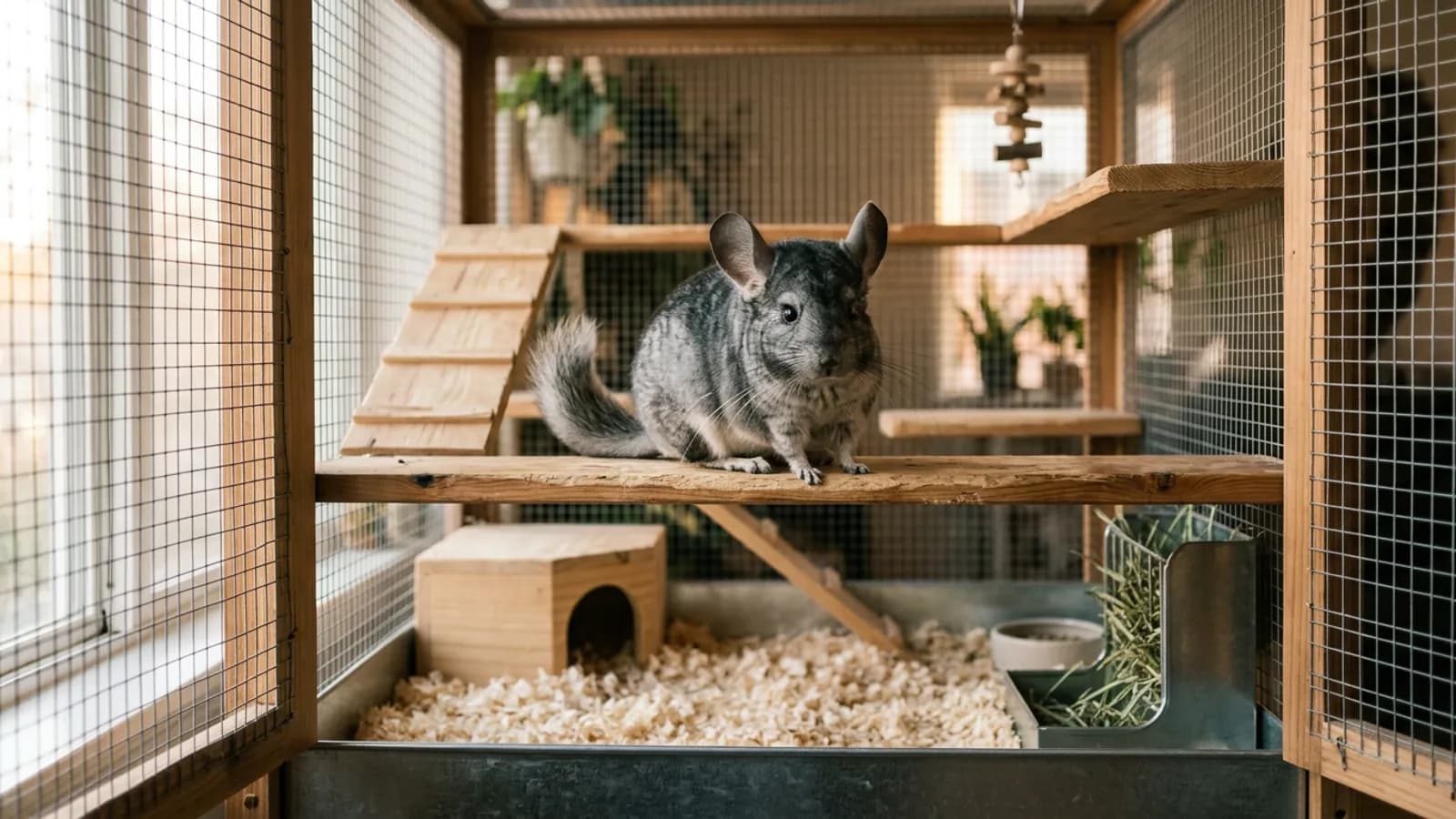
A clean chinchilla cage is one of the quietest ways to keep a chinchilla healthy, and one of the easiest things to get wrong. It is not about how the cage looks to you from across the room. It is about the air a small animal breathes for most of the day, a few inches above a tray that collects urine, droppings, and stray hay. Chinchillas have delicate respiratory systems, and ammonia building up in a soiled tray is one of those things that wears an animal down without ever announcing itself. I have kept chinchillas for about ten years, and cage cleaning is the chore I am strictest about, precisely because the cost of skipping it stays invisible until it is a real problem.
Why a clean cage is a health issue, not a chore
Urine is the thing to worry about, not droppings. Chinchilla droppings are dry, firm little pellets with almost no smell, and a healthy chinchilla produces a lot of them. They are easy to sweep up and they are not the source of the ammonia problem. Urine is. When it pools in a tray or soaks into bedding and sits there, it breaks down into ammonia, and that gas collects at exactly the height where your chinchilla sits, sleeps, and grooms. You might not smell it until it is strong, but a chinchilla is breathing it long before you notice.
That matters more for this animal than for most pets, because a chinchilla's respiratory system is not built for irritation. The same dense fur and dry-climate biology that makes them so particular about temperature also means they do poorly with damp, warm, ammonia-heavy air. A dirty cage raises local humidity too, and humidity is its own risk: it makes heat far more dangerous, and it can mat the coat. So when I talk about a clean cage, I am really talking about clean, dry air at chinchilla height. Everything below is in service of that.
There is a second reason, and it is behavioural. A chinchilla that lives in a filthy cage stops keeping itself tidy. They are fastidious animals by nature, and a clean space makes it easier for them to stay that way. A neglected one gets urine on its feet and fur, and that is when you start seeing stained coats and skin problems that were entirely preventable.
What you actually need before you start
You do not need much, and most of it you already own. The cage itself should be metal and wood to begin with, because a chinchilla cage has to be metal: they chew everything, plastic gets ingested, and a plastic base is impossible to keep truly clean once it is scratched and gnawed. If you are still shopping, a tall metal frame with wooden ledges and a deep metal tray is what you want.
Critter Nation double unit small animal cage As an Amazon Associate I earn from qualifying purchases.
Beyond the cage, keep a small kit within reach so cleaning never feels like a project. I use a plastic scraper or an old spatula for the tray, a stiff brush for corners, a roll of paper towels, and a spray bottle of plain white vinegar diluted about half and half with water. That is the whole arsenal for routine work. For deep cleans I add a second cloth and a spare set of bedding so the animal can go back into a dry cage without waiting.
Two things I deliberately do not use: scented cleaning sprays and anything with bleach. More on why below, but keep them out of the kit entirely so you are never tempted when you are in a hurry. A bottle of diluted vinegar handles almost everything a chinchilla cage will ever throw at you.
If you litter train, which I strongly recommend, you also want a small metal litter pan and a chinchilla-safe litter. Paper-based litter or kiln-dried pine shavings are both fine. Cedar is not, ever, and I will come back to that.
The daily spot clean
The daily job is small on purpose, because a job you do in two minutes is a job you actually do. Every day I scoop or brush out the droppings that have collected on ledges and in the tray, wipe up any obvious wet spots, and deal with the litter pan if the chinchilla uses one. Droppings are dry, so this is genuinely quick, more sweeping than scrubbing.
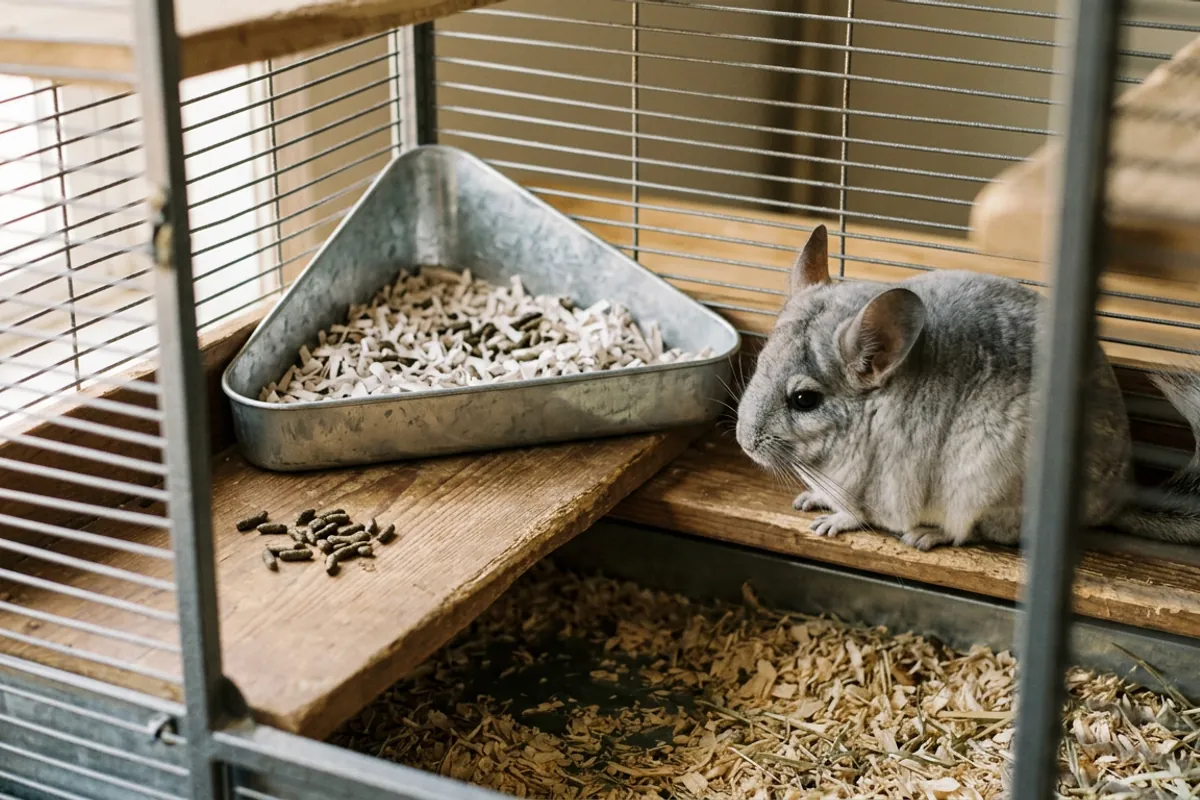
While I am in there, I do the daily checks that piggyback naturally on cleaning. I refill hay, because unlimited grass hay is the foundation of the whole diet and the rack should never run empty. I top up pellets to their measured amount. And I check the water bottle, both that it is full and that the spout is not dripping, because a leaking bottle is a hidden source of the wet, mouldy corner that ruins your air quality. A steady drip onto bedding will grow mould faster than you would believe, and a chinchilla should never be near that.
The daily clean is also your best early-warning system. When you are handling the droppings every day, you notice fast when they change: smaller, fewer, softer, or wetter than normal. Those are things you want to catch early, because changes in droppings can be the first sign something is off with the gut or the teeth. Cleaning is not just tidying. It is the moment you look closely at your animal's output every single day.
The weekly clean
Once a week the job gets bigger but still stays manageable. This is when I empty the tray completely, not just skim it. I pull all the old bedding or litter, scrape out anything stuck, and give the tray a wipe with the diluted vinegar. Vinegar is mildly acidic, which is exactly what you want against dried urine and the mineral scale it leaves behind, and it rinses away with no lingering fumes once it dries.
I wipe down the wooden ledges too, or at least the ones that have taken any urine. Wood is the tricky part of any chinchilla cage, because it absorbs, and a ledge that has soaked up urine will smell and harbour bacteria no matter how clean the tray is. Light surface wiping is usually enough weekly, but keep an eye on ledges that sit under a favourite sleeping spot, because those take the most abuse and eventually need replacing outright. Plain kiln-dried pine ledges are cheap and meant to be swapped when they are past saving.
This is also when I clean the accessories that need it. The hideout gets checked, the dust bath house gets its dust changed, and the wheel gets a wipe. A solid-surface running wheel is far easier to keep clean than an open wire one, and it is also the only kind that is safe for chinchilla legs.
15 inch Chin Spin solid surface chinchilla wheel As an Amazon Associate I earn from qualifying purchases.
The whole weekly routine takes me maybe fifteen minutes, and it is the single most important cleaning habit for keeping ammonia from ever building up in the first place.
The deep clean, and how often it really needs to happen
Every four to six weeks, or sooner if you have more than one chinchilla in the cage, I do a full strip. Everything comes out. Ledges, hideout, wheel, food bowl, water bottle, litter pan, the lot. The empty frame gets wiped down bar by bar where droppings and urine have splashed, the tray gets a proper vinegar scrub, and every removable wooden part gets inspected for damage and deep staining.
The single rule that matters most here is this: everything must be bone dry before the chinchilla goes back in. This is the point people rush and regret. A cage that goes back together damp is a cage that grows mould and drives up humidity, which for a chinchilla is not a cosmetic problem but a health one. Wood especially needs time. If I wash a wooden ledge, I let it dry fully, ideally in the sun or somewhere warm and airy, before it returns. If that means the chinchilla waits an hour in a safe travel carrier or a clean playpen, so be it.
I also use the deep clean to think about the space as a whole, the way you would when setting up a cage from scratch. Are the ledges still solid or splintering? Is the wheel still running smoothly? Is the layout still working, or is one corner always the dirty one because of where the bottle drips? A deep clean is the natural moment to fix the small things that daily tidying papers over.
One thing the deep clean is not: a bath for your chinchilla. Chinchillas never bathe in water, and the cage cleaning schedule has nothing to do with how the animal itself gets clean. They stay clean by rolling in fine volcanic dust, not water, and a wet chinchilla is a genuine problem, not a clean one. Keep the two ideas completely separate in your head. You clean the cage with a damp cloth; the animal cleans itself in dust.
What to clean with, and what to keep far away
I clean chinchilla cages with two things: plain white vinegar diluted with water, and warm water on its own. That is deliberately boring, and boring is correct here. Vinegar cuts through dried urine and mineral scale, it is cheap, and once it dries it leaves nothing behind that would harm an animal that chews on everything.
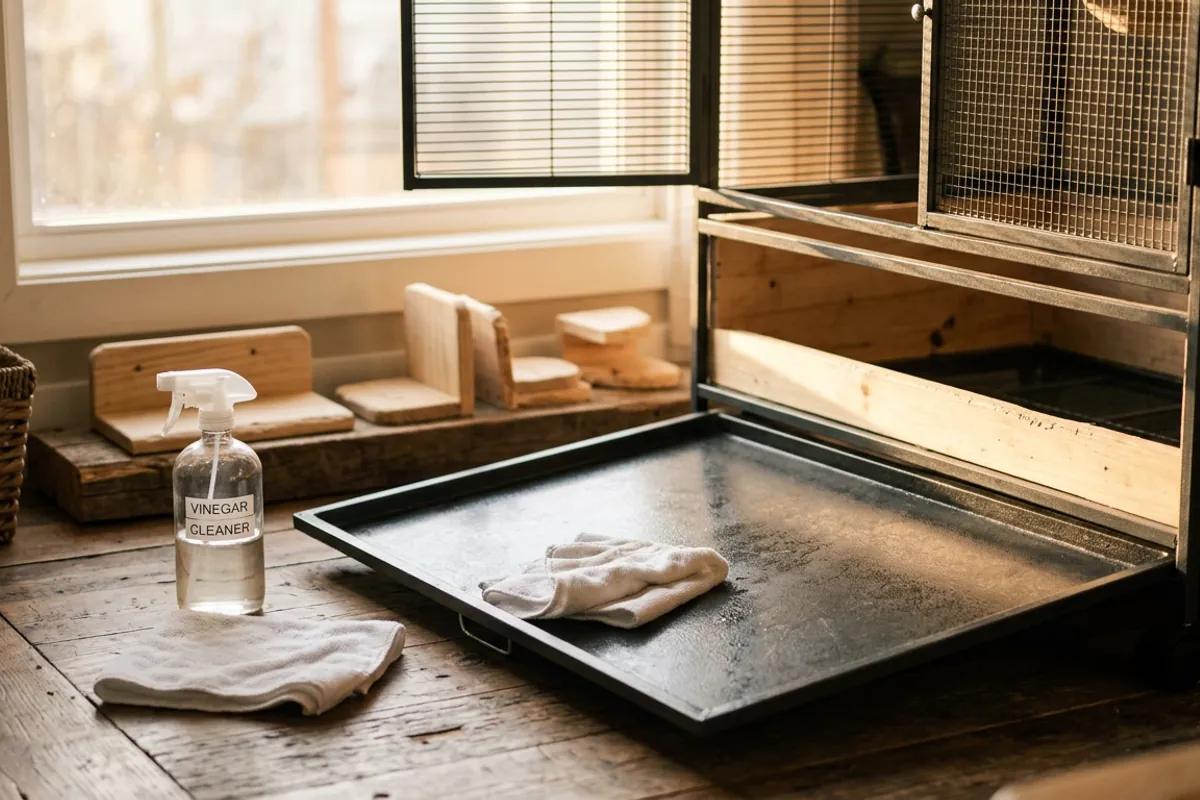
What I keep well away from the cage is anything scented or harsh. Bleach is the obvious one. Even diluted, bleach fumes are hard on a chinchilla's airways, and residue on a surface a chinchilla will chew is a real risk. If you ever feel a cage needs bleach for a serious contamination, that is a job to do with the animal in another room entirely, rinsed many times over, and dried completely before it ever goes back. For routine cleaning it is simply unnecessary. The same goes for the scented multi-surface sprays most of us have under the sink: the perfumes and disinfecting agents are not made with a small chewing rodent's lungs in mind, and a chinchilla cannot leave the room the way you can.
Rinse whatever you use. Even vinegar should be wiped clean and dried rather than left wet, because you want the cage returned to that dry, low-humidity state as fast as possible. The goal is never a strong clean smell. The goal is no smell at all, and dry surfaces.
Bedding, litter, and the parts people forget
The bedding you choose changes how often the cage needs attention. Kiln-dried pine shavings and paper-based bedding are both good, absorbent, and safe. What you must avoid is cedar, and untreated pine that has not been kiln dried. Cedar and raw pine release aromatic oils, phenols, that are irritating to a chinchilla's respiratory tract, and that irritation is exactly the thing a clean cage is supposed to prevent. A cage bedded in cedar is working against you no matter how diligently you scoop.
Litter training makes the whole job dramatically easier. Many chinchillas will reliably urinate in one corner, and if you put a small metal pan with safe litter in that corner, you concentrate almost all the wet mess into one thing you can empty daily. It does not fix droppings, which land everywhere, but droppings are the easy part. Getting the urine into a pan is what keeps ammonia down between cleans.
Then there are the parts people forget. The hay rack collects fine hay dust and old bits that should be cleared so fresh hay never sits on stale. I keep hay in a rack rather than loose on the tray floor, both for cleanliness and to keep it off soiled surfaces.
Oxbow Western Timothy Hay, 40 oz bag As an Amazon Associate I earn from qualifying purchases.
The food bowl needs a wipe so old pellet dust does not go rancid. Wooden chews get chewed down and grubby and eventually need replacing, which is fine, because worn chews mean teeth are being worn down too, and that is the whole point of them.
emours apple wood chew sticks, 40 count As an Amazon Associate I earn from qualifying purchases.
And the wheel, hideout, and dust bath house all quietly accumulate droppings and dust in ways the tray does not show. They are the parts that make a cage smell despite a spotless tray, so put them on the weekly list and keep them there.
Keeping it clean between cleans
The best cleaning routine is the one you barely have to do, and a few habits get you most of the way there. Litter training, as above, is the big one. Positioning the water bottle so any drip lands in the tray rather than on a wooden ledge is another, and checking that bottle daily for leaks costs you ten seconds. Keeping hay in a rack rather than scattered keeps it off wet surfaces and out of the litter pan.
Placement of the cage itself matters too, for reasons that overlap with heat safety. A cage in a cool, dry, well-ventilated spot stays fresher than one in a warm, still corner, because warmth and stagnant air are what turn a bit of urine into a smell and a humidity problem. The comfortable range for a chinchilla is 60 to 70°F, roughly 15 to 21°C, and a room kept in that band is also a room where a cage stays cleaner between washes. Good airflow does double duty: it keeps the animal safe from heat and keeps ammonia from concentrating.
None of this is complicated, and that is the honest takeaway. A clean chinchilla cage is not a heroic monthly scrub. It is a two-minute daily sweep, a fifteen-minute weekly reset, and a proper strip-down every month or so, all in service of one thing: dry, clean, breathable air a few inches above the tray, for an animal that cannot open a window when the air goes bad. If you want to get the layout right so cleaning stays easy from the start, it is worth reading up on cage setup and which accessories actually earn their place before you build the whole thing. A cage designed to be cleaned is a cage that stays clean.