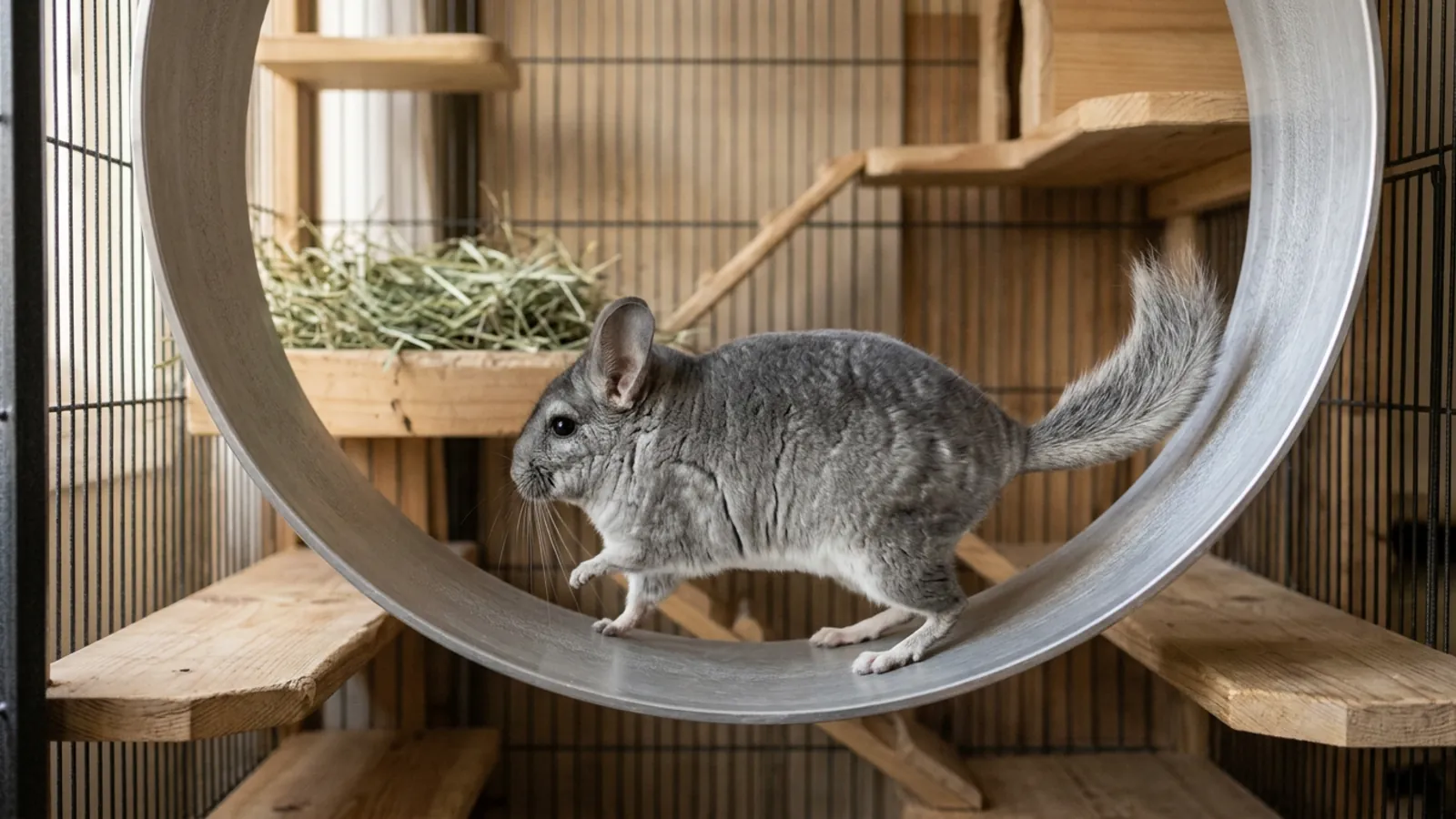
A chinchilla exercise wheel is one of the few pieces of cage gear I refuse to treat as optional. These animals are built to sprint, bounce, and cover ground across steep, rocky Andean slopes, and even a tall, well-planned cage cannot give them the distance their bodies are wired to run. A wheel is where a chinchilla burns that energy at two in the morning while the rest of the house sleeps. Pebble runs hers in long, quiet bursts most nights, and I can tell the difference in her mood on the rare stretch when the wheel has been out for cleaning. But the wrong wheel, bought in the wrong style or the wrong size, is also one of the most common ways I have seen chinchillas get badly hurt. So here is the owner-to-owner version: what the wheel is for, the single feature that decides whether it is safe, what size fits the animal, and the confusing product names you will meet the moment you start shopping.
Why a wheel earns its place in the cage
Chinchillas are crepuscular and largely nocturnal. They wake up as the light drops, and their most active hours land squarely in the middle of your night. That timing matters, because it means their need to move does not switch off just because you have gone to bed and cannot supervise floor time. A wheel is the one piece of equipment that lets them exercise on their own schedule, safely inside the cage, without you standing guard.
The need underneath that is real. In the wild these animals live on broken terrain and move constantly. Penned into a box, even a large one, an under-exercised chinchilla gets restless, and restlessness in a chinchilla often shows up as fur barbering, bar chewing, or a general edginess when you handle them. Juniper came to me from a neglect situation, and one of the first things that settled her was simply having room and a wheel to work off the nervous energy she arrived with. I am not going to claim a wheel fixes behavior problems on its own, because it does not. But movement is a large part of a content chinchilla, and the wheel is how you deliver that movement in the hours you are not there. If you want the wider picture of what belongs in the cage, I go through it in the chinchilla toys that earn their place.
The one rule: a solid running surface, never wire
If you take nothing else from this, take this. A chinchilla wheel must have a solid, continuous running surface. No wire mesh, no ladder rungs, no gaps between spokes. This is the single feature that separates a safe wheel from a dangerous one, and it is not a matter of preference.
Here is why I am blunt about it. A chinchilla's foot is small, and its toes and the base of its tail are thin. On a wire or barred running surface, a foot slips through the gap at speed, the wheel keeps turning, and you get a broken toe, a broken leg, or a degloving injury where the skin is stripped off. The same barred surface can catch a tail. I have read too many vet accounts and owner reports of exactly these injuries to treat it as a small risk. Those hamster-style wire wheels sold in most pet aisles are not scaled or surfaced for a chinchilla, and I would not put one in a cage under any circumstances.
What you want instead is a wheel with a single solid metal or hard, chew-resistant running track, mounted so it turns freely and quietly. A good solid-surface wheel is one of the few pieces of gear I will tell someone to spend real money on up front, because the cheap alternative is a vet bill and an injured animal. 15 inch Chin Spin solid surface chinchilla wheel As an Amazon Associate I earn from qualifying purchases. Metal is the material I trust for both the running surface and the frame; plastic gets chewed, and a chinchilla will eat the pieces it breaks off, which is its own emergency. I walk through the safe-running question in more detail in what a chinchilla on a wheel really needs to run safely.
What size a chinchilla exercise wheel needs to be
Size is the second thing people get wrong, usually by buying something meant for a smaller rodent. A chinchilla wheel needs to be large enough that the animal runs with a roughly level back, not hunched into a C shape. When a wheel is too small, the spine is forced into a constant curve as the chinchilla runs, and that repeated arching is hard on the back over time.
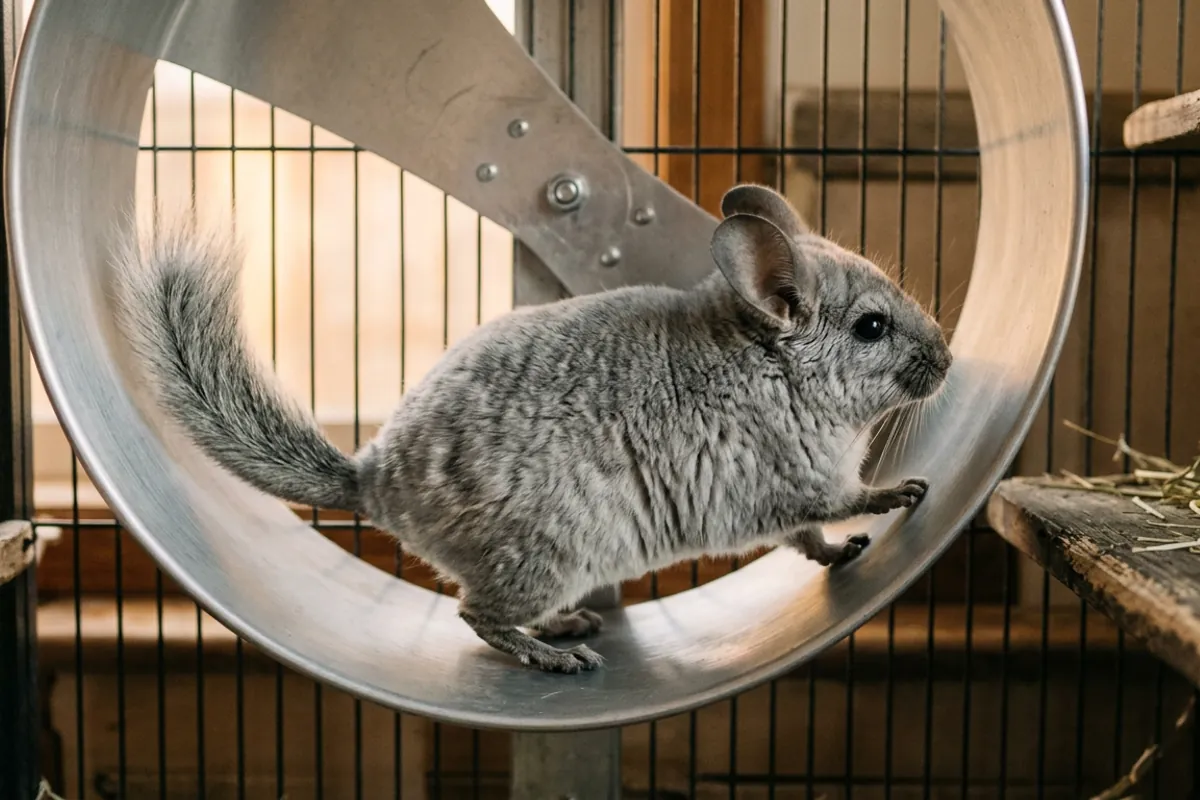
The number I give people is a minimum of about 15 inches in diameter, and I would rather see 16. A 16 inch chinchilla exercise wheel gives even a large adult room to run with a straighter spine, and chinchillas are bigger under all that fur than they look. Going larger is generally better here, within reason, as long as the wheel still fits the cage without crowding out the ledges and jump routes they also need. If you are choosing between a 15 inch and a 16 inch model and both are the solid-surface style, the larger one is the safer default. What you should not do is talk yourself into a small wheel because it is cheaper or because it fits a small cage. If the wheel does not fit, the cage is too small, and that is the thing to fix, not the wheel.
Chin Spin, saucers, and cat wheels: the names you will meet
Once you start searching you will hit a wall of product names, and it helps to know what they mean.
The Chin Spin is the name that comes up most in chinchilla circles. The Chin Spin 15 chinchilla exercise wheel refers to a roughly 15 inch, all-metal, solid-surface wheel that has been the reference standard among keepers for years. I am not sponsored by anyone and I do not hand out endorsements I have not reasoned through, but I will say plainly that this style, a solid metal running surface at 15 inches or more, is exactly what I mean whenever I say "a proper chinchilla wheel." The brand name matters less than the design.
A chinchilla exercise saucer is a different shape: a tilted disc the animal runs around rather than an upright wheel. Some keepers like them because there is no axle bar for a tail to catch on. My take is that saucers can work, but the good large ones are hard to find, the cheap ones are usually plastic, and the tilt can be awkward for some animals. A solid upright wheel of the right size is the more reliable choice for most people.
You will also see people recommend an exercise wheel for cats from Amazon as a budget stand-in, because large cat wheels are sold widely. Be careful here. Some cat wheels do have a solid running surface and a big enough diameter, which is the right idea, but many have a running surface made of carpet or fabric, or slats with gaps, and those are wrong for a chinchilla for the same reason wire is wrong. If you go this route, judge it by the two rules that never change: a solid continuous surface, and 15 inches or more. Do not buy on price or the word "large" alone.
Why I never use an exercise ball
A chinchilla exercise ball is the one product in this whole category I will tell you to skip outright, and I want to be clear about why, because they are sold specifically for chinchillas and that label does not make them safe.
An exercise ball is a sealed plastic sphere, and that is a problem for an animal that cannot shed heat well. Chinchillas do not sweat, they dump excess heat mainly through their ears, and they are comfortable only in a fairly cool room, roughly 60 to 70°F (15 to 21°C), with real danger starting above 75°F (24°C). Trap a running, working animal inside a plastic ball with almost no airflow and you have built a heat trap around the one pet that overheats fastest. On top of that, the ball rolls where the chinchilla cannot control it, it bumps into furniture and down steps, the ventilation slots are exactly the size to catch a toe, and the plastic is something they will try to chew. Pebble's first summer taught me how fast a chinchilla can tip into heat trouble, and a sealed ball is the opposite of everything that scare taught me. There is no version of this product I would use. If you want your chinchilla out and moving, the answer is supervised floor time in a safe space, not a ball. I cover safe out-of-cage movement in how to set up a chinchilla playpen, and the heat side of it in chinchilla temperature.
Setting the wheel up so they use it
Buying the right wheel is half the job. Mounting it well is the other half.
Fix the wheel securely to the cage bars or a solid stand so it does not wobble or walk across the shelf as the chinchilla runs. A wheel that rocks is noisy, and a noisy wheel is one they may avoid. Mount it at a height where the animal can step into it from a ledge without an awkward jump, and leave clear space around the outside so nothing, including a tail, can get pinched between the wheel and a wall or shelf. Check the bolts every so often, because constant running works fasteners loose over time.
Introduction is usually undramatic. Most chinchillas work out a wheel on their own within a few days once it is in the cage and steady. Do not force a chinchilla onto a wheel or spin it while they are on it, which only teaches fear. Just let it be a fixture and let them find it. One thing worth watching: running is work, and work makes body heat. In a room that is already warm, a chinchilla that runs hard can push itself toward overheating faster than one sitting still. In summer I keep the room genuinely cool and give Pebble a cool surface to lie against, like a granite or ceramic slab, so she can dump heat between runs. A cooling stone is cheap insurance in warm weather. Kaytee Chinchilla Chiller granite stone As an Amazon Associate I earn from qualifying purchases. I also keep a thermometer on the cage so I am reading the real number instead of guessing. digital thermometer and humidity gauge with remote probes As an Amazon Associate I earn from qualifying purchases. If you are not sure whether your room is safe once the wheel gets busy, run the numbers through the chinchilla heat danger calculator.
A wheel is part of exercise, not all of it
The last thing I want to leave you with is that the best chinchilla exercise wheel in the world is still only one piece of the picture. A wheel handles the solo, middle-of-the-night running. It does not replace the two things that matter just as much: a cage tall enough to climb and jump in, and regular supervised time outside the cage.
Chinchillas are vertical animals. They want height, ledges, and routes to leap between, and a cramped cage with a wheel bolted in is still a cramped cage. The wheel should sit inside a tall metal cage with wooden ledges, not stand in for the space. If you are still choosing the enclosure, a proper metal and wood cage is the foundation everything else clips into. Critter Nation double unit small animal cage As an Amazon Associate I earn from qualifying purchases. I lay out what that looks like in why a chinchilla cage has to be metal and why a multi level chinchilla cage suits how they move.
Beyond the cage, give them out-of-cage time in a chinchilla-safe room or pen most days if you can, so they get the bursts of sprinting and popcorning that a wheel cannot provide. Fill the cage with things that keep the body and the teeth working too. Wood chews are not decoration; they are how a chinchilla wears its constantly growing teeth down, which is a lesson Juniper's dental disease drives home for me every single day. A rotating set of safe apple wood chews earns its place right next to the wheel. emours apple wood chew sticks, 40 count As an Amazon Associate I earn from qualifying purchases. Put together, that is what real chinchilla exercise looks like: a safe solid wheel for the solo hours, a tall cage to climb, floor time to sprint, and chews to keep the whole animal working. Get the wheel right first, because it is the piece that runs while you sleep, but do not let it be the only thing you get right.