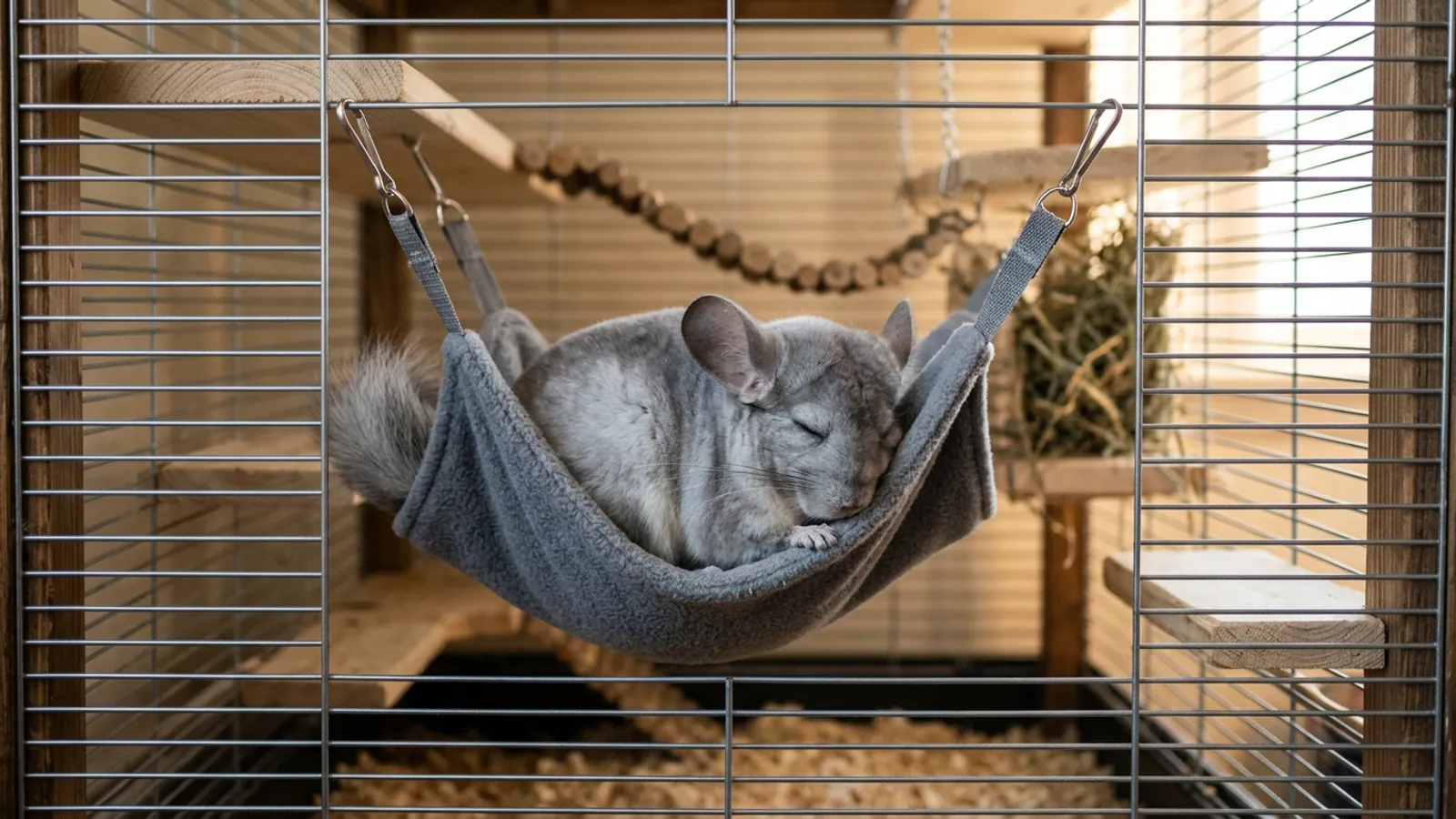
The first chinchilla hammock in this house was a gift: a fleece corner sling with a wooden dowel holding the front edge open. I hung it in Pebble's cage and expected her to ignore it for a week, the way she ignores most new objects. She was curled in it before I finished clipping the second strap. Juniper has never set foot in one.
That difference is the whole subject. A chinchilla hammock is a comfort item, and comfort is personal. Some chinchillas sleep in a hanging bed every night. Others walk around one for years. Neither response tells you anything about how well you keep the animal.
What a chinchilla hammock is
A hammock is a piece of fabric hung from the cage bars, usually fleece, usually with a strap at each corner. The shapes get muddled in listings, so here is how I sort them:
- A flat sling: one panel of fleece, four straps, and the animal lies on top.
- A corner sling: triangular, wedged into a cage corner, sometimes with a wooden dowel to keep the front edge open.
- A hanging bed: a sling with raised sides and often a roof, so the chinchilla is enclosed on more than one side.
- A tunnel: fabric sewn into a cylinder and hung horizontally.
What they share is movement. A shelf is rigid. A hammock gives under the animal's weight and shifts when she shifts, and that is the point of owning one. Chinchillas sleep wedged into narrow spaces, and in the Andes that means a rock crevice, where something presses against the back and sides. A hanging bed does not copy a crevice, but it offers contact on more than one side, and plenty of chinchillas settle into that quickly.
The name matters less than the shape. A "chinchilla in hammock" photo is almost always a flat sling or a corner sling, because those are the two an animal can walk into without ducking.
It is an optional extra, not equipment
A hammock is not required, and it is not a replacement for a solid shelf or a hide. A chinchilla needs a flat, solid surface to sit and sleep on, and she needs a covered place to retreat to. Fabric that swings is neither of those things, no matter how soft it looks.
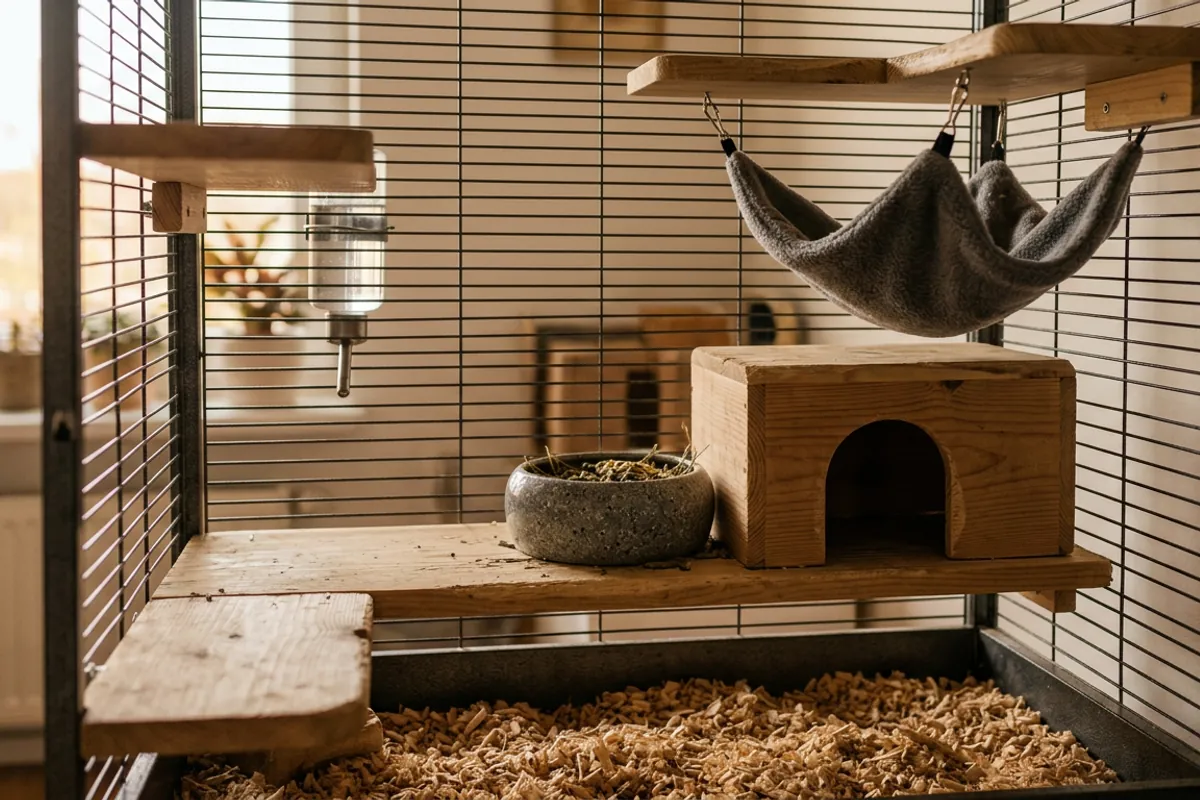
If your cage does not have a wooden ledge and a hide yet, buy those first. The cage setup guide walks through the order I would build in, and the wooden house guide covers what to look for in a hide she will actually use.
Where a hammock fits is after that: a sleeping spot in a tall cage, in a corner that would otherwise stay empty. Nothing bad happens if you skip it. Some chinchillas never use one, and that is not a failure of the hammock or of you. If you want more ways to fill the space, the enrichment ideas that hold up over months are worth reading before you buy anything else.
What I look at before I buy one
Search for the best chinchilla hammock and you get a wall of listings with the same five photos and no measurements that mean anything. I do not have a brand to hand you, and I would not trust a list that did. What I can give you is the checklist I run, in order.
Fabric, seams and straps
Fleece, two layers, sewn together. Anti-pill or blizzard fleece is what most makers use and what I use. I avoid loose weaves, terry cloth loops, sherpa, and anything with stuffing that could work its way out through a seam. No fringe, no dangling toys, no beads or bells on the straps.
Turn it inside out before you hang it. Seams should be flat and stitched twice. The first failure I had was a single-stitched corner that opened inside a month.
Short straps, and sewn loops where you can get them. Long straps let the bed swing through a wide arc and knock against the cage, and a lot of chinchillas dislike a bed that moves that much. Metal clips are fine. Plastic snaps, plastic rings and plastic carabiners go straight into the bin, because a chinchilla in a cage will chew plastic and I do not put plastic in a cage on purpose. The same reasoning is behind why the cage frame has to be metal.
Size and washability
Big enough that she can lie flat with her head down and her body inside the fabric rather than spilling over the edge. Check the measurements against your cage, not against the photo. A corner sling needs a corner with bars on two sides; a flat sling needs two parallel walls or a roof panel to hang from.
It will be washed, so it has to survive that. Fleece that pills into knots after three cycles is a false economy, and a hammock you avoid washing is worse than no hammock.
Hanging it in a tall cage
Chinchillas move vertically. A tall cage with staggered wooden ledges gives them the height they use, and it is also what makes a hammock work, because there is somewhere to hang it without blocking the middle of the cage. The guide to multi level cages explains the layout. If you are buying a cage now, buy a tall metal and wood one with wooden ledges, because the bars and the ledges are what make a hanging bed usable.
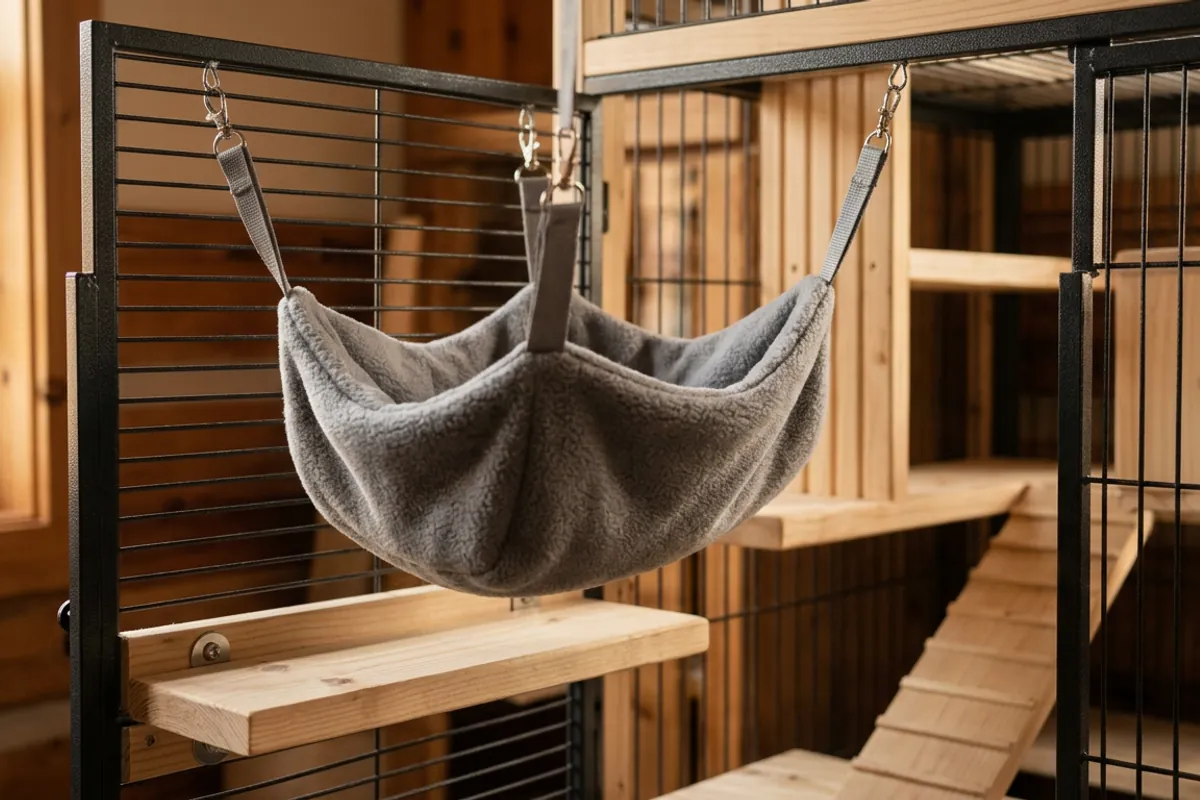
Critter Nation double unit small animal cage As an Amazon Associate I earn from qualifying purchases.
Then hang it like this:
- Put the bottom a short hop above a ledge, so she steps in rather than jumps into a swinging target.
- Use a corner or a wall side. The middle of the cage is the running line.
- Keep it out from under another ledge, because droppings fall and fabric holds them.
- Keep it away from the wheel and the water bottle, so a moving bed is never in the landing zone.
- Use all four attachment points. Two straps on a four-strap hammock turns it into a swinging bag.
- Check the bars where the straps sit. Thin wire bends under a small load that never stops, and a bent bar changes the angle of the whole bed.
Give it a pull yourself before the chinchilla gets in. If it moves so much that you would not want to lie in it, she probably will not either.
The chewing question
I cannot tell you a fleece hammock is safe for every chinchilla, and an article that does is guessing about your animal. Some chinchillas ignore fabric completely. Some chew it. You find out which one you have by watching her, not by reading a product page.
My rule is simple. A new hammock goes in while I am home and checking daily for the first week. If I find chewed edges, loose threads, or a hole at a seam, it comes out and stays out. A chinchilla who has never touched the fabric keeps hers. During any recovery or treatment period the hammock leaves the cage, and the exotics vet decides whether it goes back in. That is a medical question and not mine to answer.
Fur is the other thing to watch. A strap or a rough seam that catches the coat can trigger a fur slip, the reflex that lets a chinchilla shed a patch of fur when something grabs her. The fur slip guide explains how it happens. The fur grows back, but I would rather the hammock not be the thing pulling it.
Heat, and the enclosed hanging bed
A hammock is not a cooling aid. It is fabric, and fabric is warm. It is also not a place to leave a chinchilla in a room that runs hot, and an enclosed hanging bed is exactly the spot an animal will choose to stay in when she should be moving somewhere cooler.
The room matters more than the hammock. The comfortable range is 60 to 70 degrees Fahrenheit, or 15 to 21 Celsius. Above 75 degrees Fahrenheit, 24 Celsius, is risky, and 80 degrees Fahrenheit, 27 Celsius, and up is an emergency, with humid air making every one of those worse. The temperature guide has the full numbers, the heat safety guide is the page I would read before summer, and the heat calculator turns a reading into something a chinchilla actually feels.
Measure at cage height, not on the wall across the room. A thermometer and hygrometer clipped to the bars is the cheapest piece of cage equipment I own, and it is the one I would replace first if it broke.
digital thermometer and humidity gauge with remote probes As an Amazon Associate I earn from qualifying purchases.
The tool that does help on a hot day is a cooling stone kept in the freezer and set on a wooden ledge, so she has something cold to press against.
Kaytee Chinchilla Chiller granite stone As an Amazon Associate I earn from qualifying purchases.
Signs a chinchilla is too hot
Lying stretched out with her legs splayed, breathing fast, drooling, or dull and unresponsive. Any of those means she needs an exotics vet the same day, and the room needs to cool down now. That is not a wait-and-see situation, and a hammock has nothing to offer it.
Cleaning and the weekly check
Two hammocks, one in the cage and one in the wash, is the only way I keep up with it. Shake the droppings out daily. Wash weekly in a laundry bag with unscented detergent and no fabric softener, which coats the fibers and cuts absorbency. Warm water, then air dry or a low tumble.
The weekly check
- Straps: pull each one where it meets the fabric.
- Seams: turn it inside out and look hard at the corners.
- Bars: run a finger along the wire where the straps hang.
- Fabric: any thinning, holes, or stiff patches and the hammock retires.
Watch whether she is using it, too. A hammock that stays empty for two or three weeks is taking up space in a cage where space matters, and there is no reason to keep it hanging out of guilt. If she likes being up high but ignores the fabric, the lava ledges and plain wooden shelves may be the better answer.
When I would not hang one
Some situations where the hammock stays in the cupboard:
- She has ignored it for a few weeks. Take it out and stop thinking about it.
- She chews fabric, and keeps chewing it after a second attempt.
- The cage is too small to hold one without crowding her. In a cramped cage a hammock eats movement space, and the guide to small cages is blunt about what that costs.
- She is recovering from an injury or a treatment. The exotics vet makes that call, not me, and not a blog post.
- The room cannot be held under 75 degrees Fahrenheit in summer. Fix the room first; the hammock can wait.
If you want to try one, hang a single hammock in one corner, watch for two weeks, and then decide. You will either have a chinchilla who sleeps in it every afternoon or a clean piece of fleece to fold away, and both of those answers are fine.