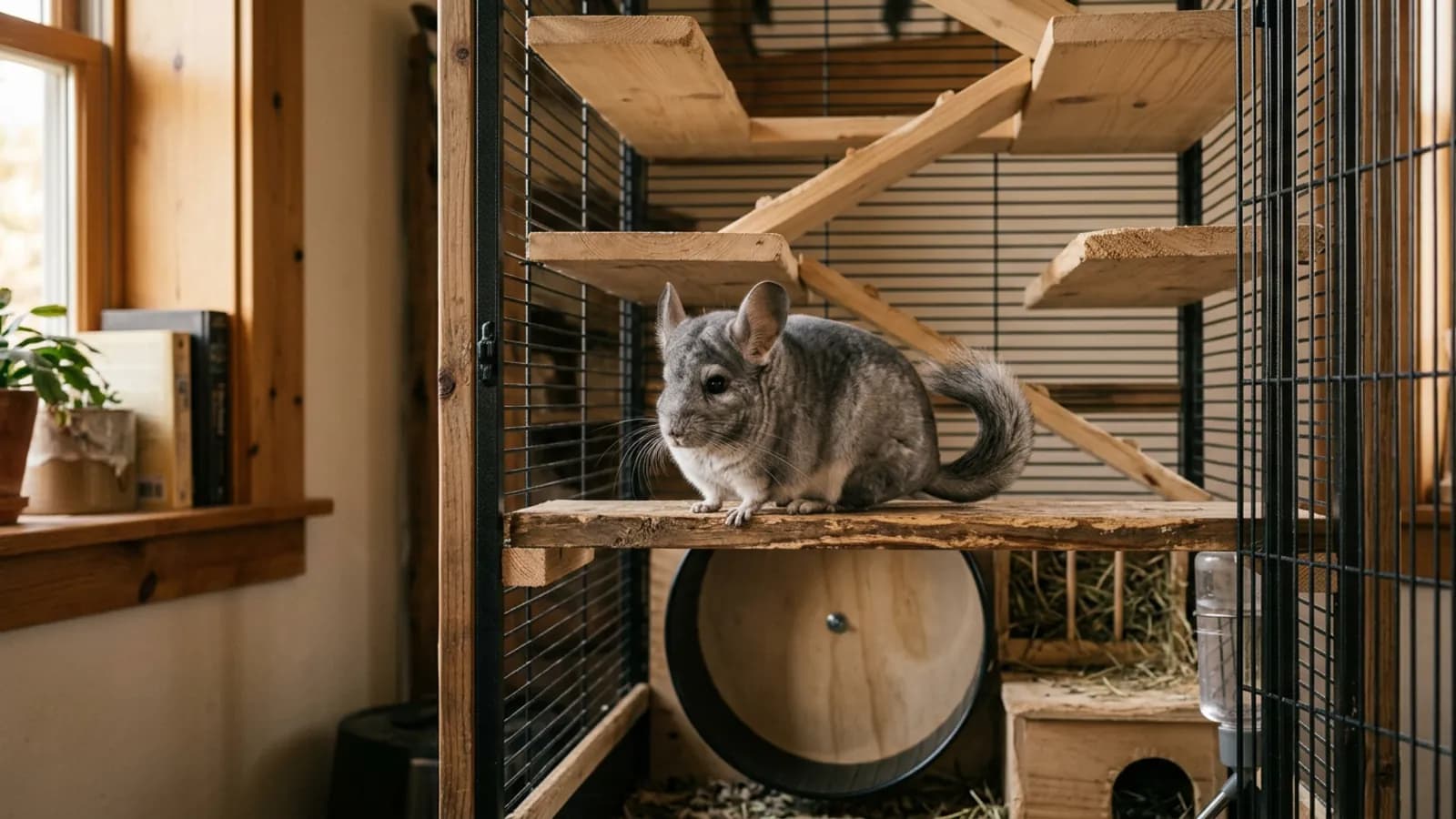
If you searched chinchilla cage small, I want to be honest with you before you spend a cent. That search usually comes from one of two places: you have a small room and you are hoping a compact cage will fit, or you saw a neat little enclosure at a pet store and it looked like plenty. I have kept chinchillas for about ten years, and the hard truth is that "small" and "chinchilla cage" pull in opposite directions. A chinchilla is a mountain animal built to leap, and the cage is where it spends the overwhelming majority of its life. This article is about how to think about size honestly, when a small cage genuinely earns its place, and how to squeeze the most out of a footprint you truly cannot change.
Why people shop for a small cage in the first place
I get the appeal. A small chinchilla cage is cheaper on the shelf, it slots into a corner, and it looks manageable. The pet trade knows this, which is why so many "starter" enclosures sold under a chinchilla label are barely bigger than a rabbit hutch and shorter than they are wide. Marketing leans on the word compact because compact sells to someone standing in an aisle doing quick math about their apartment.
The problem is that the animal never read the marketing. A chinchilla does not scale itself down to fit a smaller box. Its need to jump, climb, and burn off a genuinely startling amount of energy at dusk stays exactly the same whether you give it two feet of height or five. So when I see someone shopping for the smallest cage that a store is willing to call chinchilla-appropriate, I know two things: they are trying to be responsible on a budget, and they are about to be sold something that will not hold up. The goal of this piece is to get you off the "how small can I go" track and onto "what is the smallest thing that actually works," which are very different questions.
What a chinchilla actually does with space
Watch a chinchilla for one evening and the size argument settles itself. Mine wake up around dusk and turn into springs. Pebble will launch from a low ledge to one near the ceiling in a single bound, ricochet off a side wall, and land somewhere I did not expect. This is not showing off. Vertical leaping is how these animals move in the wild rock of the Andes, and a cage that does not let them do it forces a natural behavior to simply stop happening.
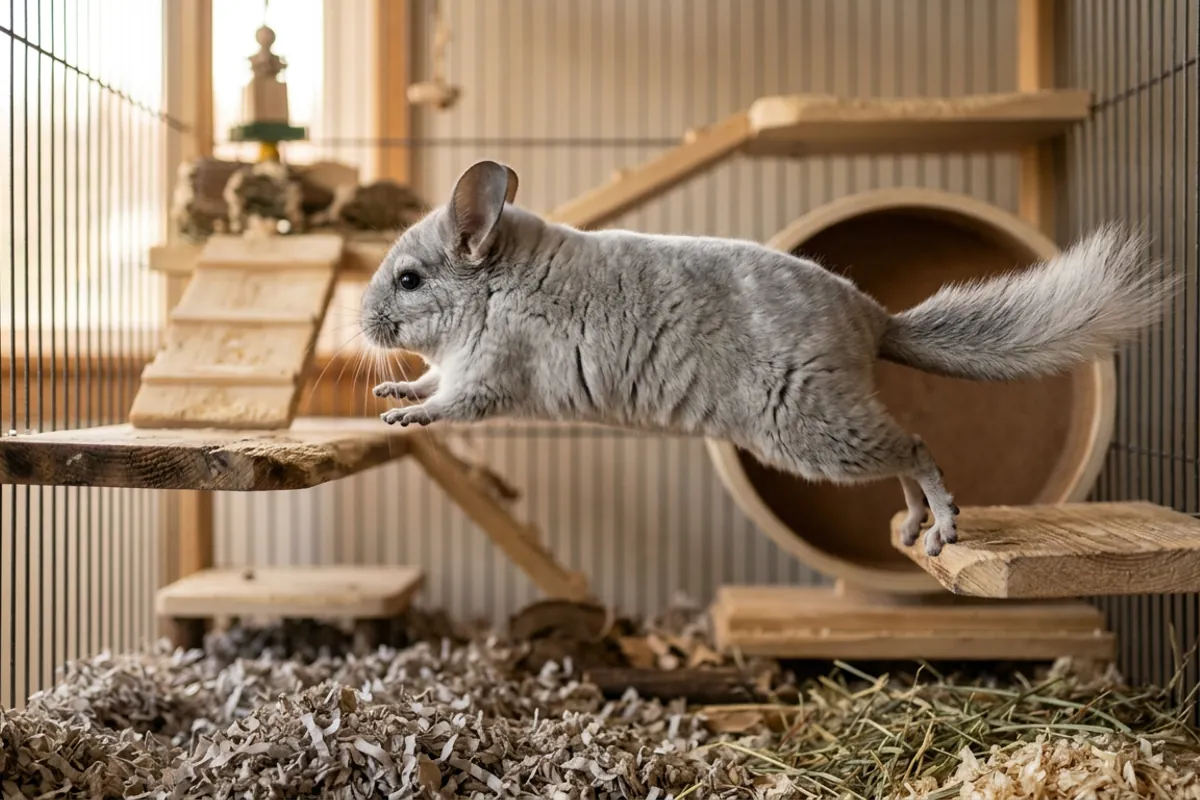
That is why height matters more than floor area for this species, and why I care so much about tall enclosures over long low ones. A chinchilla uses the vertical column of a cage the way a person uses stairs: constantly, and as the whole point. Ledges at different heights turn dead air into usable territory. A wheel gives them a place to run flat-out without a landing at the far wall. When people tell me their chinchilla "just sits there" or chews the bars, the cage is very often the reason. Boredom and frustration in an animal this active are not personality quirks, they are symptoms of nowhere to go. Before you decide how small you can get away with, spend a real evening watching what the animal is trying to do, because the cage has to answer that.
When a small chinchilla cage is genuinely the right call
I am not going to pretend every small enclosure is a crime, because that is not true either. There are real situations where a smaller cage is correct, and pretending otherwise just makes owners tune me out.
A kit that is still tiny should not be in a tall cage with high ledges, because a fall onto a hard pan can break a leg. For the first weeks I keep young ones low, with short drops and everything within an easy hop, and I move them up as they get coordinated. If you have brought home a newborn, lower and smaller is the safer starting point, not the permanent one.
The other honest case is short-term: a hospital cage for a sick or recovering animal where you want to limit jumping while something heals, or a quarantine setup for a new arrival before it meets the others. Small and simple makes cleaning and observation easier when you need both. Just do not confuse a temporary medical setup with a home. And a carrier is not a cage at all, no matter how the listing frames it. If you need something for vet trips, buy an actual carrier and keep it separate in your head from where the animal lives. The test is simple: if the answer to "how long will it be in here" is measured in weeks or months, small stops being acceptable.
The real costs of a cage that is too small
Here is what a too-small cage actually does, because "it is not ideal" is too soft to be useful. First, it takes exercise away. A chinchilla that cannot leap and run does not just get bored, it can put on weight and lose muscle tone, and stress behaviors creep in: bar-chewing, fur-chewing, pacing. Second, and this is the one that keeps me blunt, a small cage crowds heat.
Chinchillas are wrapped in one of the densest coats of any mammal, and they cannot sweat. They shed heat slowly, through their ears and by moving to cooler air. The comfortable range is 60 to 70°F (15 to 21°C). Above 75°F (24°C) you are into risky territory, and 80°F (27°C) and up is an emergency, faster in humid air. A cramped cage gives the animal nowhere to move away from a warm spot, and it packs body heat, bedding, and stale air into a small volume that warms faster than a roomy one. Pebble's first summer brought a heatwave near-miss and a night at the emergency vet, and that scare is exactly why I will not soften this. If you want the full picture, I have written it out under chinchilla heat safety and there is a heat danger calculator that pairs temperature with humidity. A small cage makes every one of those margins thinner.
If floor space is fixed, build upward
Now the practical part, because a lot of you genuinely cannot give up more floor. The good news is that the thing a chinchilla needs most is the cheapest dimension to add: height. You do not need a bigger footprint nearly as much as you need a taller one.
A cage that is tall and multi-level gives you the leaping column and the exploration that a wide, low box never will, on roughly the same patch of floor. This is why I keep steering people toward a proper metal-and-wood enclosure with several full-width shelves rather than a squat "starter" model. A well-built metal wire and wood cage with removable wooden ledges lets you stack usable levels up a wall. Critter Nation double unit small animal cage As an Amazon Associate I earn from qualifying purchases.
Inside that vertical space, arrange ledges so the animal can climb from bottom to top in a series of hops with no single dangerous drop, and stagger them so there is always a landing. Fit a solid-surface running wheel, never a wire or rung one, because open rungs catch feet and tails and cause real injuries. 15 inch Chin Spin solid surface chinchilla wheel As an Amazon Associate I earn from qualifying purchases. A good wheel gives a chinchilla in a modest footprint a way to run at full effort without needing a long floor. If you want the full walkthrough of arranging one of these, I have it under chinchilla cage setup. The principle is simple: when you cannot go out, go up.
Materials matter as much as size
A small cage made of the wrong stuff is worse than a slightly smaller cage made of the right stuff, so do not let dimensions be the only thing you check. Chinchillas chew everything, constantly, and they chew because they must: their teeth grow for their whole lives and only get worn down by grinding. Plastic is the fastest way to a vet visit. A chinchilla will gnaw a plastic pan, ledge, or hideout, swallow the pieces, and risk a gut blockage that can kill. I keep the cage all metal and wood for exactly this reason, and I say plastic anything with feeling.
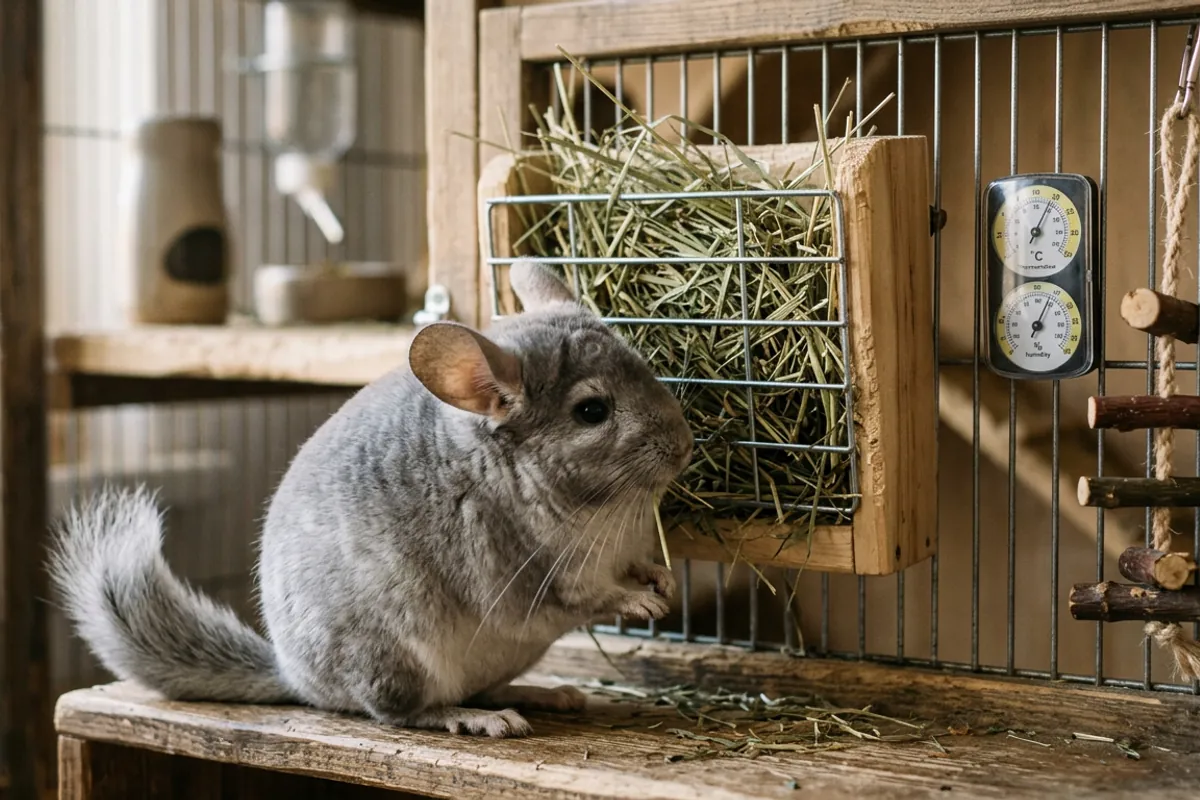
Bar spacing matters more in a small cage, not less, because the animal is closer to every wall. Bars set too wide let a slim chinchilla push its head through and hurt itself. Wire flooring is the other trap: it looks tidy but it causes bumblefoot and catches limbs, so I want a solid floor with deep bedding the animal can sit on. And because a small cage swings hot faster than a large one, I hang a combined thermometer and hygrometer right on it so I am reading the air the animal actually breathes, not the far side of the room. digital thermometer and humidity gauge with remote probes As an Amazon Associate I earn from qualifying purchases. On the worst summer days I add a chilled stone slab the animal can choose to lie against. Kaytee Chinchilla Chiller granite stone As an Amazon Associate I earn from qualifying purchases. None of this depends on the cage being large. It depends on you refusing to compromise on what the cage is made of. For the deeper version of choosing well, see how to pick the best chinchilla cage without buying the wrong one twice.
Setting up a smaller cage so it works harder
If you have decided a modest cage is what you can do right now, then make every inch pull its weight, because a small space punishes clutter and rewards thought. The first rule is that a smaller cage needs more out-of-cage time, not less. I give mine a daily supervised run in a chinchilla-proofed room, and if the home enclosure is on the small side that time is not a luxury, it is the pressure valve that keeps the animal sane and fit.
Inside, do not crowd the floor with a pile of accessories that eat the very space you are short on. Prioritize ruthlessly: unlimited grass hay, always, because hay is the whole foundation of both digestion and dental wear. Juniper, my rescue with dental disease, is why I am uncompromising here, I have watched up close what happens when teeth do not get worn down. A wall-mounted hay feeder keeps that hay off the floor and out of the mess. Oxbow Western Timothy Hay, 40 oz bag As an Amazon Associate I earn from qualifying purchases. Next comes chewing. A rotating set of safe wooden chews does real dental work and does not need floor space if you hang them, so a variety pack of apple wood earns its keep. emours apple wood chew sticks, 40 count As an Amazon Associate I earn from qualifying purchases. Pellets are a small measured supplement on top of the hay, not a main course, and they take almost no room. Dust bathing needs a container two or three times a week, but it does not have to live in the cage full time. Offer the dust bath for ten or fifteen minutes and then take it out, which frees space and keeps the dust cleaner. In a small cage, the discipline of putting things in and taking things out is what makes it liveable.
Knowing when to stop compromising
I will end where honesty demands. A small chinchilla cage can be a genuinely fine starting point, a safe place for a kit, a short-term hospital or quarantine setup, or the best a real budget and a real room can manage today. What it should not be is a permanent home you have quietly decided is good enough because upgrading is a hassle. The animal will tell you when it has outgrown the space: bar-chewing, restlessness, weight creeping on, a coat that starts looking chewed. Those are not the animal being difficult, they are the cage being too small.
If money is the wall, know that a good metal-and-wood cage is close to a once-in-the-animal's-life purchase, so the cost spreads across the ten to twenty years a well-kept chinchilla can live. That changes the math from an expensive month to a cheap decade. Buy the tallest, best-built enclosure you can, even if it means waiting a little and running the animal outside the cage more in the meantime. And when you do shop, read the listing hard, because "chinchilla cage" on a box is a marketing claim, not a guarantee, and plenty of small cages for sale are simply the wrong home dressed up as the right one. I would rather you buy once and buy tall than buy small twice. That is the whole of it: small can be a stage, a stopgap, or a mistake, and the difference is entirely in whether you treat it as temporary.