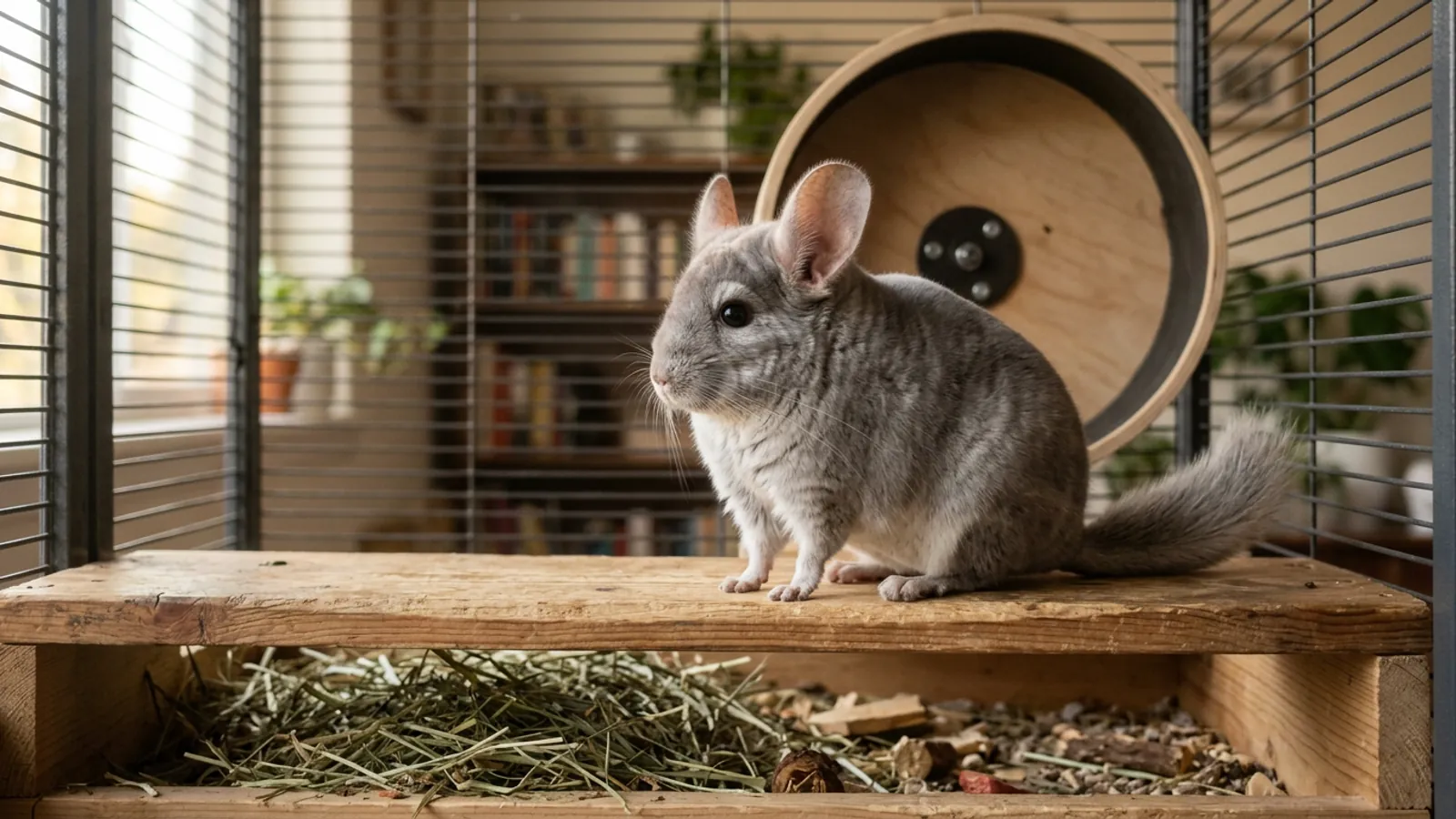
If you are searching for a chinchilla price, you have probably already found the confusing part: the numbers are all over the place. One listing says $75, the next says $600, and a third one wants $1,200 for something described as a blue diamond. Nothing about that spread makes sense until you understand what you are paying for, which is rarely the animal itself. I have kept chinchillas for about ten years, and the purchase price is the least important number in the whole decision. It is also the only one most people research.
So let me lay out what chinchillas sell for, why the range is so wide, what the color names mean, and which of those numbers should make you walk away rather than reach for your wallet.
What a chinchilla costs to buy
For a standard gray chinchilla, the ordinary chinchilla price range from a decent breeder sits somewhere around $150 to $300 in most of the United States. Rescues and rehomes are usually cheaper, often $50 to $150, and that fee frequently includes the cage and whatever supplies the previous owner had. Pet stores tend to land in the same neighborhood as breeders, roughly $150 to $250, sometimes more.
Those figures are what I have consistently seen and heard from other keepers, not a published index. Prices move with region, with how many breeders operate near you, and with how in demand chinchillas happen to be that year. If a breeder in your area quotes something outside that band in either direction, that is not automatically a red flag, but it is a reason to ask why.
The number that surprises people is the low end. A healthy young chinchilla can be genuinely inexpensive to acquire. Pebble came to me as a rehome for almost nothing, out of an attic that had gotten far too hot in summer, and the emergency vet bill from her first summer with me cost many times what any breeder would have charged. That ratio is the whole point of this article. The animal is cheap. The animal's life is not.
Why the same chinchilla costs $75 in one place and $400 in another
Four things drive most of the spread.
Who is selling. A hobby breeder who tracks pedigrees, weans at the right age, and screens for malocclusion in the parent lines is charging for years of record keeping. A person rehoming a chinchilla their teenager lost interest in is charging for nothing, because they want the animal gone. Both can produce a fine pet. Only one of them can tell you anything about the parents.
Color. This is the biggest single multiplier, and I will break it down below.
Age and sex. Young chinchillas, roughly four to six months, tend to cost the most. Adults over a few years old are usually discounted, and seniors are often free. Proven breeding pairs are priced differently again, but if you are buying a pet, ignore that market entirely. Sex rarely changes price much on its own.
What comes with it. A $400 listing that includes a good tall metal cage, a solid wheel, and a dust bath house is often cheaper in real terms than a $150 animal you then have to equip from scratch. Read what is bundled before you compare two prices at all.
None of these tell you whether the chinchilla is healthy. Price and health are only loosely related, which is why I never let a low chinchilla animal price talk me out of the same questions I would ask a premium breeder. The full picture of vetting a seller is in how to buy a chinchilla for sale without getting hurt or ripped off.
Chinchilla colors and prices, from standard gray to blue diamond
Chinchilla colors and prices track rarity of the mutation, plus how hard that mutation is to breed well. Here is roughly how they stack up, cheapest to dearest, with the caveat that every one of these ranges shifts by region and breeder.
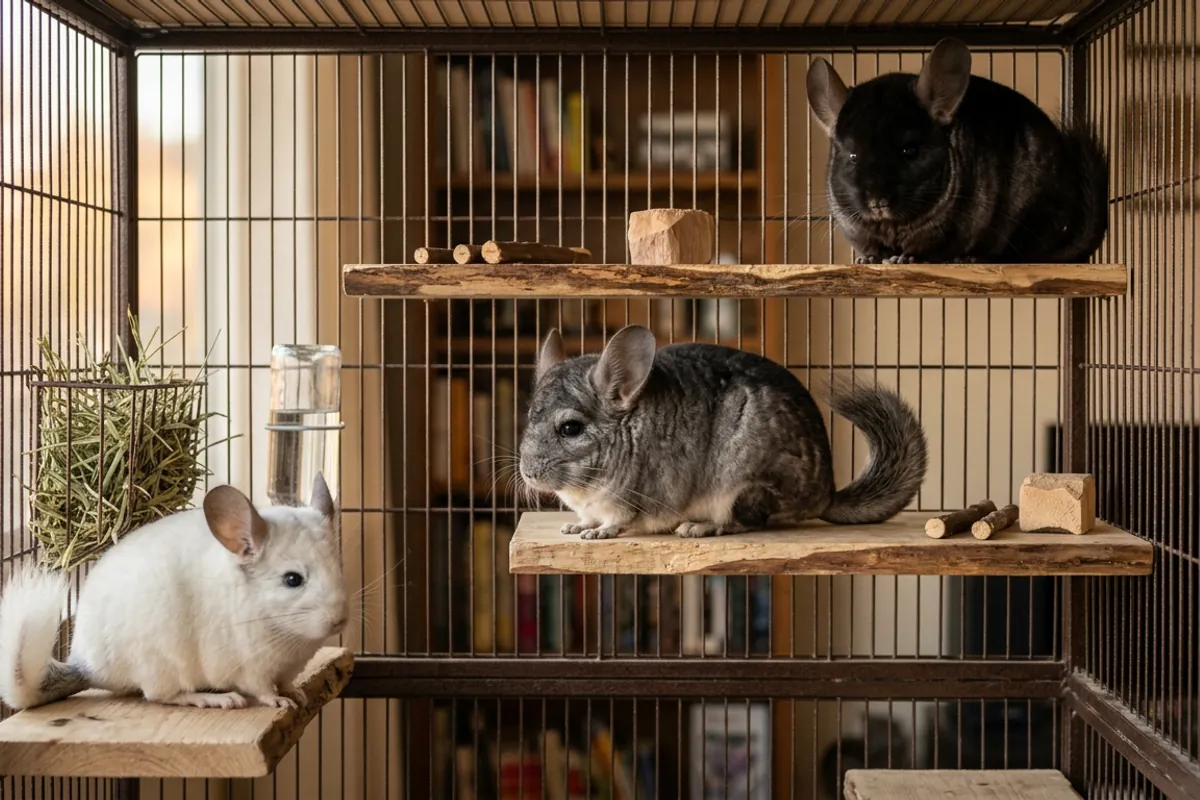
- Standard gray. The wild type, and the baseline: about $150 to $300. Nothing about gray makes a chinchilla a lesser pet. Pebble is a standard gray.
- Beige, ebony, and mosaic. Common mutations, usually $200 to $350. Mosaics in particular vary enormously in appearance, and a striking one commands more.
- Black velvet. A black velvet chinchilla price commonly falls around $250 to $400. Velvet is a dominant gene with a lethal homozygous form, so responsible breeders never pair velvet to velvet, which limits supply a little.
- White. A white chinchilla price is broadly similar, roughly $250 to $400 depending on how clean the white is. White is also a gene that cannot be doubled up safely, same principle as velvet.
- Violet. A violet chinchilla price generally runs $300 to $500. Violet is recessive, so it takes more generations to produce, and a deep even violet is uncommon.
- Sapphire. Similar to violet or a little above, often $350 to $600, and true sapphires are rarer than the number of listings using the word would suggest.
- Blue diamond. A blue diamond chinchilla price is where things get steep, frequently $600 to $1,200 and sometimes beyond. Blue diamond is a combination of recessive genes, which makes it slow and difficult to produce reliably.
- Angora and royal persian angora. The long coated varieties are the top of the market, commonly $800 to $2,000 or more. They are rare, and they need more grooming attention than a standard coat.
Two blunt points about all of this. First, an angora chinchilla price buys you a coat, not a temperament. Personality is individual and is not linked to color. Second, long coated chinchillas are, if anything, a heat liability. A dense coat is already why chinchillas overheat so readily; more coat does not help. If you cannot hold a room reliably in the safe range, an angora is a worse choice than a gray, not a better one.
Color names also get used loosely by people reselling animals they did not breed. If you are paying a mutation premium, ask the breeder to name the genes involved and the parents' colors. Someone breeding violets can answer that in a sentence.
The chinchilla price confusion: cats, rabbits, and Persians
A large share of searches for chinchilla price are not about the rodent at all, and it is worth sorting out because the animals could not be more different.
A chinchilla cat price or chinchilla persian price refers to a coat pattern in cats, not a species. Chinchilla silver and chinchilla golden are Persian and British Shorthair colorings where the hair is tipped rather than fully pigmented, giving that sparkling look. Those are cats, they cost what pedigree cats cost, and nothing on this site applies to them.
A chinchilla rabbit price refers to rabbit breeds, standard, American, and giant chinchilla, bred originally for a pelt that mimics the chinchilla's. They are rabbits. They eat differently, they handle differently, and they tolerate temperature differently. Mixing the two up leads to real harm, because they need close to opposite care.
The actual chinchilla, the one this site is about, is a dense coated rodent from the high Andes. If you want the biology that drives every care rule, start at what a chinchilla really is.
Pet store prices and what the tag hides
The chinchilla petsmart price, and the equivalent at other chain stores, usually sits around $150 to $250 for a standard gray. Chains do not publish national pricing and stores do not always stock chinchillas at all, so treat any figure you read online as a rough guide and call your local store.
The price is not the problem with chain stores. Three other things are.
You almost never learn anything about the parents. Malocclusion, the tooth root disease that quietly ruins chinchillas, has a hereditary component. A breeder who has been culling for it in their line can tell you what they have seen across generations. A store can tell you which distributor the animal arrived from. Juniper came to me as a neglected rescue with dental disease already established, and managing it day to day taught me exactly how much that unknown history is worth. Read chinchilla teeth problems before you decide the history does not matter.
Second, store staff turnover means husbandry advice at the counter is a coin flip. I have been told, in person, that chinchillas need water baths. They do not, ever. Chinchillas bathe only in fine dust, and a wet chinchilla is a genuine emergency because that coat does not dry.
Third, the upsell bundle is usually wrong. The starter kits pair a cage that is too small with a wire wheel that can break legs and plastic accessories a chinchilla will chew and swallow. If you buy at a store, buy the animal and source the equipment separately.
The purchase price is the small number
Here is the budget nobody quotes you.
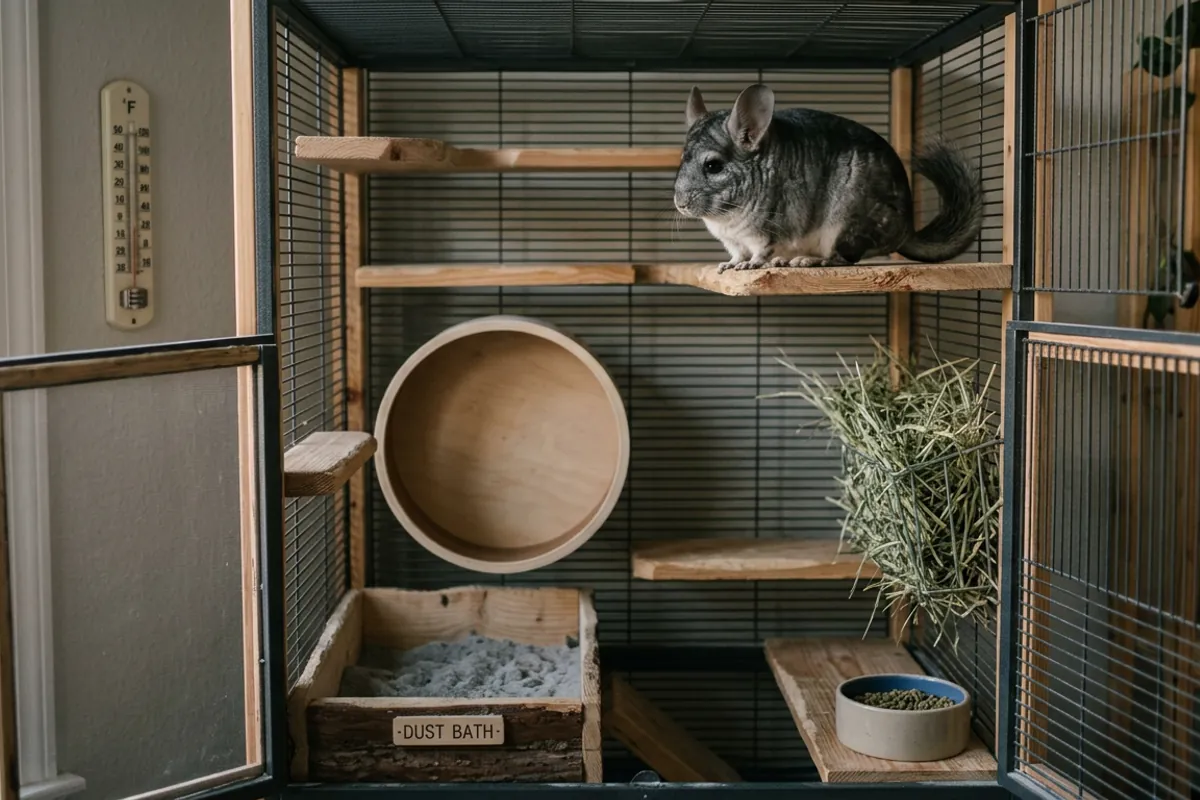
The cage. A proper tall multi level cage with metal bars and wooden ledges runs about $200 to $400 new. This is not the place to save money, because the cheap ones get replaced within a year. Critter Nation double unit small animal cage As an Amazon Associate I earn from qualifying purchases. Skip anything plastic and anything marketed as a hamster cage. My full reasoning is in how to choose a chinchilla cage without buying the wrong one twice.
A solid surface wheel. Around $60 to $150. Wire and mesh wheels catch feet and break legs. 15 inch Chin Spin solid surface chinchilla wheel As an Amazon Associate I earn from qualifying purchases.
Dust and a bath house. Dust is fine volcanic pumice, cheap, maybe $15 to $30 for a bag that lasts months. Lixit Blue Beauty chinchilla dust, 3 lb As an Amazon Associate I earn from qualifying purchases.
Hay, endlessly. Unlimited grass hay is the foundation of the diet and it never stops. Timothy or orchard grass, a fresh pile always available, with plain pellets as a measured supplement rather than the main event. Oxbow Western Timothy Hay, 9 lb box As an Amazon Associate I earn from qualifying purchases. Budget $20 to $40 a month for hay, pellets, and a rotation of safe wood chews. The chews are not optional. Juniper's teeth are why I am uncompromising about that.
Cooling. This is the line item people skip and it is the one that kills. Chinchillas are comfortable at 60 to 70°F (15 to 21°C). Above 75°F (24°C) is risky. At 80°F (27°C) and up you are in an emergency, and humid air makes it worse and faster. If your home cannot hold that range in summer, you need air conditioning for that room, and that cost belongs in the purchase decision, not after it. Run your own numbers through the heat danger calculator and read the warning signs of heat stroke before an animal is in the house, not after.
The vet fund. Set aside $500 to $1,000 before you bring one home, and keep topping it up. Exotics vets cost more than dog and cat vets, there are fewer of them, and chinchillas hide illness until it is urgent. Dental work under anesthesia can run into several hundred dollars per visit and is often recurring. Find your exotics vet and confirm they see chinchillas before you need them at 11pm.
Add it up and the first year usually lands somewhere around $700 to $1,500 all in, with the animal being the smallest slice. A full breakdown lives in what a chinchilla really costs. And since chinchillas commonly live 10 to 20 years, you are committing to that monthly spend for a very long time. See how long chinchillas really live.
What a low chinchilla price should make you check
Cheap is not automatically bad. Rescues and rehomes are often the best value in the hobby and the animals need homes. But a low price changes what you should be inspecting.
Look at the teeth you can see, the incisors, and ask about eating habits. Yellow orange incisors are normal and healthy; white or chalky ones are not. Drooling, a wet chin, dropping food, or weight loss all point to dental trouble that will cost you far more than you saved.
Look at the coat. It should be dense and even. Patchy fur, bald spots, or a matted look need explaining. Check the eyes and nose are clear and dry.
Ask how the animal has been kept. Ask the temperature of the room it lived in. Ask what it has been eating. If the answer is a diet of treats and yogurt drops with hay as an afterthought, expect a transition period and possible gut trouble.
Watch out for very young animals. A chinchilla should not leave its mother before about eight to twelve weeks. Someone selling a tiny kit at a bargain price is telling you something about their standards.
And be clear about the direction of the discount. A free senior chinchilla with a known dental history may be the right animal for you if you go in with open eyes and a funded vet budget. A suspiciously cheap "rare violet" from someone who cannot name the parents is a different thing entirely. Guidance on searching locally is in how to find a chinchilla near me.
What I would tell someone budgeting today
Buy a standard gray from a breeder who answers questions, or take a rehome with a clear history, and put the money you saved on color into the cage, the cooling, and the vet fund. That allocation, more than anything else on this page, is what determines whether your chinchilla reaches its teens in good shape.
If the mutation colors delight you, that is a real reason to want one, and I am not going to pretend otherwise. Just fund the boring parts first. A $1,000 blue diamond in a room that hits 80°F in July is a tragedy waiting for a heatwave. A $100 rehome in a cool room with unlimited hay and a solid wheel is a chinchilla with a good long life ahead of it.