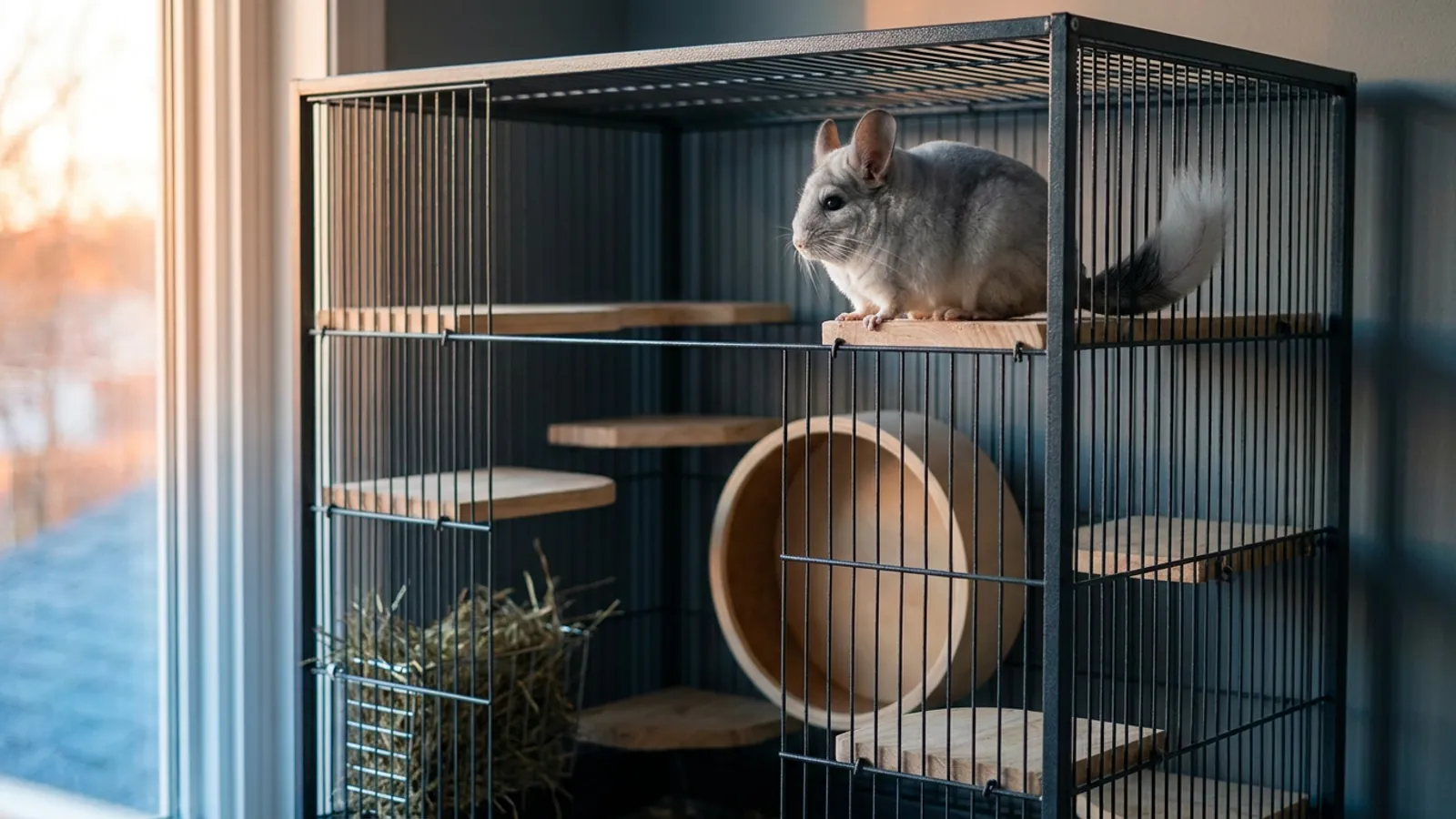
A chinchilla cage is the one purchase most new owners get wrong twice, because the cheap starter cage you buy first is almost never the one your chinchilla can live in. I learned this the slow way. Pebble came to me from a rehome, out of an overheated attic, wedged into something short and half-plastic, and the first real money I spent on her was hauling that cage to the curb and starting over. Ten years on I have opinions, and most of them come down to a few unglamorous things: height, bar spacing, solid surfaces, materials, and where in the house the thing sits. Get those right and everything else is decoration. Get them wrong and you are either replacing the cage in six months or, worse, watching an animal chew plastic or overheat because the cage failed at its one job.
Why height beats floor space every time
Chinchillas are vertical animals. In the wild they live in rocky crevices and they move by leaping, not by pacing a floor like a hamster. So when people ask me what size cage to buy, my first answer is always the same: buy a tall chinchilla cage before you buy a wide one. A cage that is short and sprawling wastes the dimension your chinchilla most wants to use.
There is genuine debate about exact minimum numbers, and I would rather be straight than pretend there is one blessed figure. What keepers broadly agree on is that a single chinchilla needs a multi-level cage, not a single-floor box, and that bigger is simply better within the limits of your room. A common floor-footprint starting point cited by keepers is around 24 by 24 inches, but treat that as a floor, not a target, and prioritize a frame that is well over three feet tall with several levels of ledges to jump between. Pebble's current setup is taller than she is by many times over, and she still uses every inch of it at three in the morning.
Inside that height, what matters is the jumping geometry: ledges staggered so she can climb without a single fall risk, and gaps that a chinchilla can clear but not plummet through. If you are setting the interior up from scratch, my full walk-through lives on the chinchilla cage setup page, but the frame decision comes first, and it is the one you cannot fix later with accessories.
Bar spacing, doors, and the frame
The bars are a safety spec, not a style choice. Spacing wider than about 1 inch is a leg-trap and an escape route, and for a young or small chinchilla I want it closer to half an inch. Wider than that and a curious animal gets a limb through, panics, and injures itself. This is the number I check first on any cage I am judging, before I even look at the size.
The frame should be metal, and I mean the structural bars and the outer frame both. Powder-coated steel wire is the standard for a reason: it does not get chewed to pieces and it does not trap heat the way a solid enclosure can. Where I want wood is on the inside, as ledges and chews, not as the cage walls carrying the whole structure. More on that split in a moment.
Doors deserve a hard look too. You want at least one large door you can get two hands through, because a chinchilla who does not want to come out is a surprisingly determined animal, and reaching through a cramped hatch is how people get scratched and chinchillas get grabbed by the tail. Latches should be ones your chinchilla cannot work open. They are clever. Pebble figured out a simple spring latch inside a week, and after that everything on her cage got a clip.
The floor is where cheap cages fail
Here is the rule that matters most: no wire floors, and no wire on the running surface of any wheel. Wire mesh under a chinchilla's feet causes bumblefoot, which is a painful, chronic infection of the footpad, and it is entirely preventable. If a cage ships with a wire grate floor, either that grate comes out or the cage goes back.
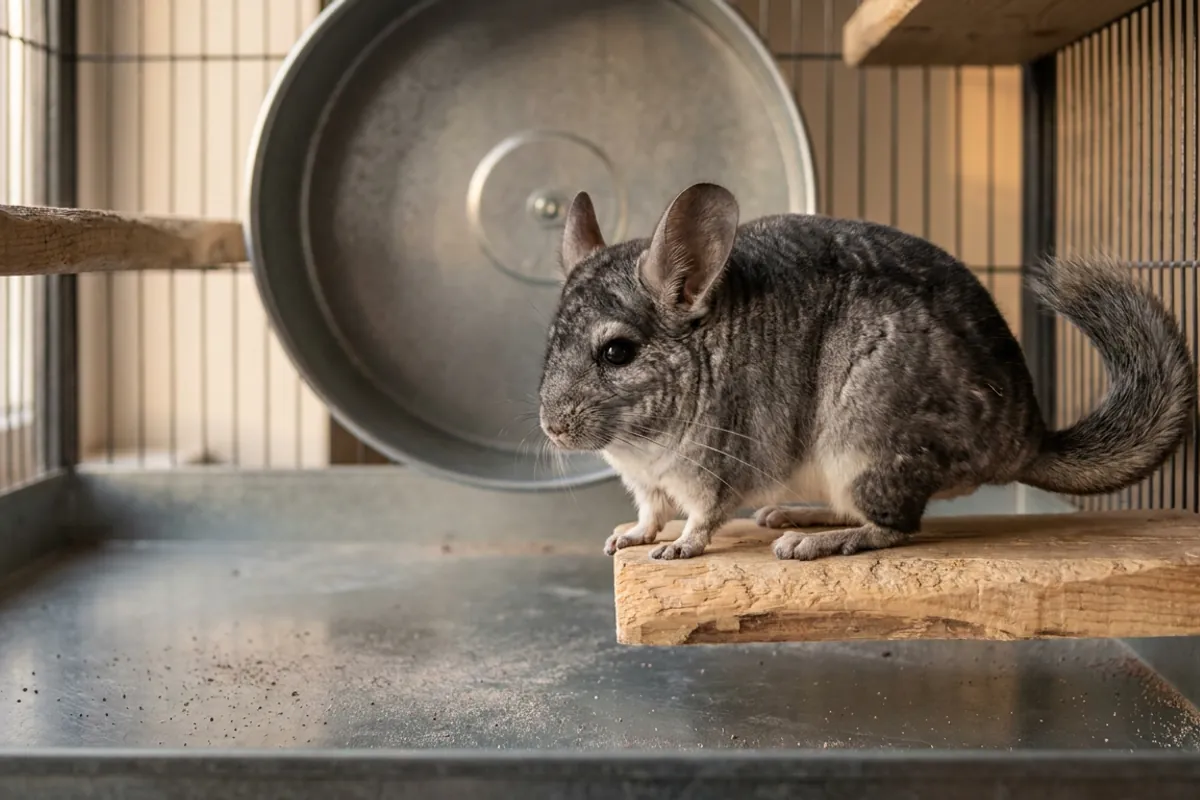
What I want underfoot is solid. Solid metal pans, solid wood ledges, and fleece or kiln-dried pine as bedding depending on how you like to clean. If you run a wheel, and most chinchillas love one, it must be a solid running surface with no rungs and no gaps. A wire wheel or a spoke wheel is a broken leg waiting to happen, and I will name that plainly every time it comes up.
A solid-surface metal wheel of the right diameter is one of the few pieces of gear I think is close to non-negotiable for a chinchilla in a cage all day.
15 inch Chin Spin solid surface chinchilla wheel As an Amazon Associate I earn from qualifying purchases.
Get the diameter right so her back stays flat and not arched as she runs, and mount it firmly enough that it does not wobble.
Wood, acrylic, and the materials that are safe
This is where people get lost, so let me lay out the three materials you will see marketed and what I think of each.
Wooden cages
A wooden chinchilla cage sounds lovely and photographs beautifully, but I am cautious. Chinchillas chew constantly, that is the point of their teeth, and any wood they can reach they will eventually eat. That is fine for kiln-dried pine ledges you replace as they wear. It is a problem for a wooden cage whose walls and joints are load-bearing, because a chinchilla will happily gnaw a structural corner, and because wood soaks up urine and holds odor and bacteria in a way metal does not. If you want a wooden cage for a chinchilla, I would only trust one built as a metal frame with removable, replaceable wood panels and untreated safe-wood ledges inside, never glued particleboard or anything with finishes. Solid untreated pine or kiln-dried aspen is the safe list; treated, painted, or resinous woods like cedar are not.
Acrylic cages
An acrylic chinchilla cage is the current darling of the hobby, and I understand the appeal: clear walls, no bar-spacing worry, a tidy look, and no bedding kicked across your floor. A well-built chinchilla acrylic cage with proper ventilation panels can be a genuinely good home. But acrylic has two real risks I will not gloss over. The first is heat: a mostly-enclosed box traps warmth and cuts airflow, and for an animal this sensitive to temperature that can turn dangerous fast, which is why ventilation is not optional. The second is chewing: chinchillas can and do gnaw acrylic edges, and swallowed plastic is not something you want in a gut built for hay. If you go acrylic, buy one designed with generous mesh ventilation, keep it out of any warm spot, and check the chewable edges often.
Plastic
Plastic anything inside a cage is a hard no from me. Plastic shelves, plastic hides, plastic wheels, plastic bases within reach: they get chewed, swallowed, and cause blockages. Metal, safe wood, ceramic, and fleece are the material palette. Everything else is either a chew hazard or a heat trap.
Where the cage goes matters as much as the cage
I could hand you the perfect cage and you could still lose a chinchilla to a bad location, so this section is the one I would tattoo on a new owner if I could. Chinchillas carry a dense coat built for cold Andean nights, and they cannot shed heat well. Their comfortable range is 60 to 70°F (15 to 21°C). Above 75°F (24°C) you are into risky territory, and 80°F (27°C) and up is a genuine emergency, faster still in humid air where they cannot cool themselves at all.
Pebble's first summer brought a heatwave and a night at the emergency vet, and that scare is the reason I am relentless about this. So the cage does not go against a sunny window, not near a radiator or heat vent, not in the warmest upstairs room, and not in a spot that bakes in the afternoon even if the morning felt fine. Put it in the coolest, most stable room you have, up off the floor drafts but away from direct sun, with real airflow around it. Learn the warning signs of a chinchilla in trouble on the chinchilla heat stroke page, and if you want to sanity-check your room before summer, the chinchilla heat danger calculator will tell you plainly whether your numbers are safe. The whole of my thinking on this lives under chinchilla heat safety, and it is not the section to skim.
This is also why I am wary of enclosed acrylic in any home that gets warm: the cage and the room have to be judged together, never separately.
Setting up a cage for two
A 2 chinchilla cage is not just a one-chinchilla cage with a second animal added, and people underestimate this constantly. Chinchillas can live happily in pairs when they are properly bonded, but a chinchilla cage for 2 needs more of everything and a bit of planning on top.
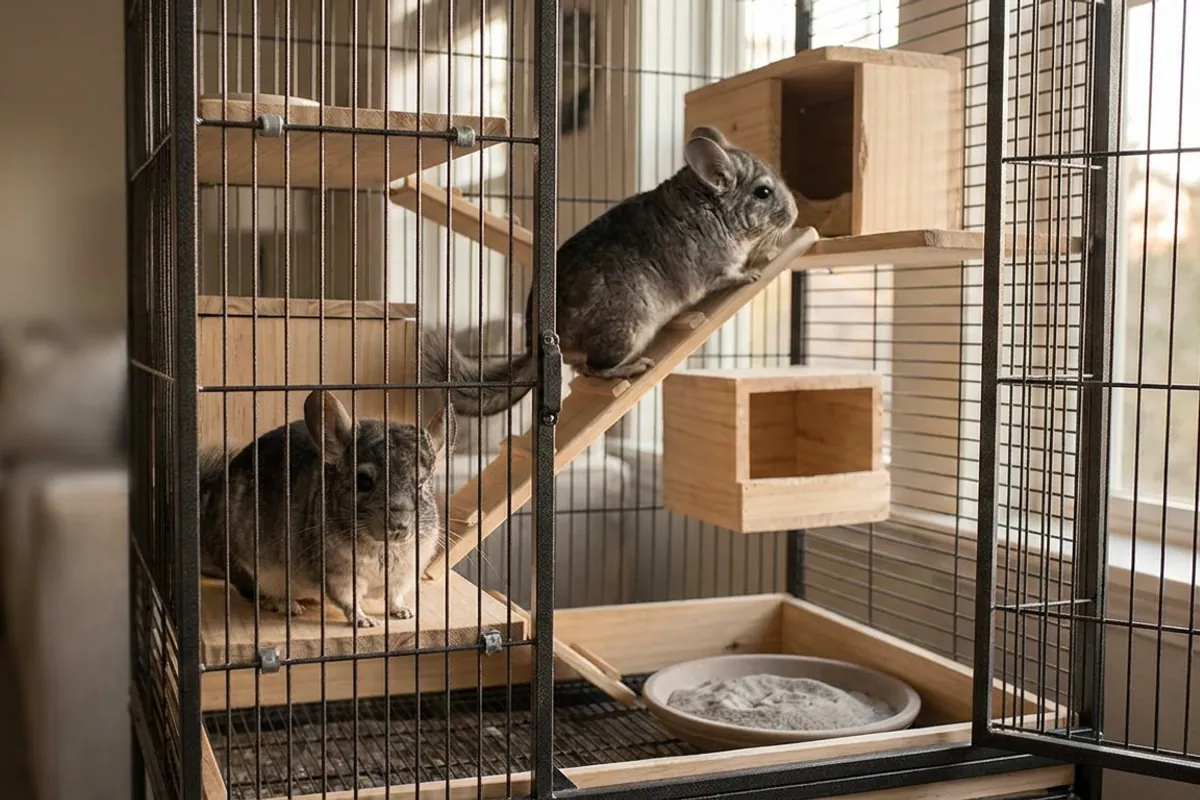
More of everything means duplicated resources so neither animal can corner the other: two hides, two water sources, hay in more than one spot, and enough ledges that a lower-ranked chinchilla always has an escape route upward. Cramped pairs fight, and fights over a single resource in a single-exit corner get bad fast. So for two I want more floor footprint and considerably more height and levels than the single-chinchilla starting point, with the interior laid out so there is never a dead-end.
The other half is the bond itself, which is a separate project from the cage. Do not simply drop two strangers into one enclosure and hope. Introductions are done slowly and carefully, and until a pair is bonded they need to be housed where they can see and smell each other without sharing a space. That is a whole topic, but the cage rule is simple: buy the bigger, taller cage first, because splitting a fighting pair back into two cages later is a worse afternoon than sizing up on day one.
Store-bought, Petco, and DIY
People ask me where to buy the thing, and my answer is that the retailer matters less than the spec. A Petco chinchilla cage, or any pet-store cage, can be perfectly fine or quietly wrong depending entirely on the same checklist: is it tall, are the bars an inch or less, is the floor solid or can I make it solid, is the frame metal, and is there anything plastic within chewing reach. I have seen good cages on big-box shelves and I have seen small barred boxes marketed for chinchillas that I would not put a chinchilla in. Take the checklist to the store, not the brand.
A DIY chinchilla cage is a real option and often the best value for the height you get, and the classic route is a wire-shelving-and-panel build with a wooden frame and safe-wood ledges. Done well, a home build gives you more vertical space per dollar than almost anything off a shelf. Done carelessly it introduces every hazard at once, so the DIY rules are strict: metal mesh with correct spacing, no galvanized-after-welding mesh where zinc flaking is a concern, solid ledges, no toxic glues or finishes, no exposed sharp cut ends, and nothing plastic where teeth reach. If you are handy, build tall. If you are not, buy the tallest sound metal cage you can afford and put your effort into the interior instead.
Whatever route you take, the cage is the foundation the rest of care sits on. Unlimited hay, dust baths and never water baths, chews that wear the teeth down, and a cool stable room all depend on a cage that holds up. Juniper, my dental rescue, is the daily reminder of what happens when the basics slip, and it is her cage full of varied chews that keeps her comfortable. The frame is where it starts. Buy it once, buy it tall, and buy it right.