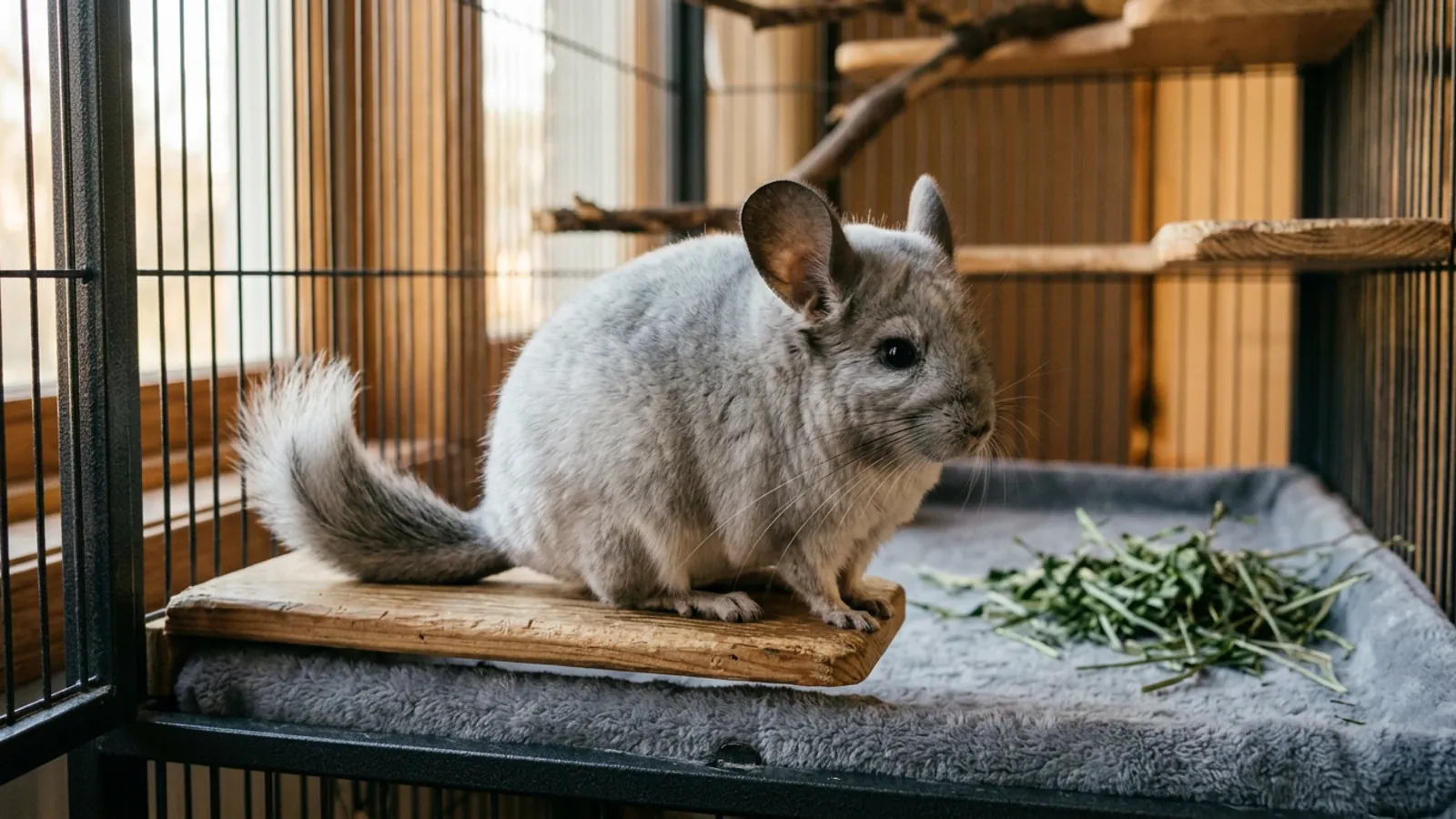
When people ask me about chinchilla bedding, they usually picture a deep, cozy nest the animal burrows down into. That is a hamster's world, not a chinchilla's. Bedding for a chinchilla does one main job: it soaks up urine and keeps the cage floor dry, which keeps the air clean and your chinchilla's feet healthy. Get it wrong and you end up with a damp, sour-smelling cage, sore feet, or a respiratory problem in an animal whose lungs irritate easily. Get it right and it becomes one of the quietest, lowest-effort parts of chinchilla care. After about ten years with Pebble and Juniper, here is exactly what I use, what I keep out of the cage, and the one softwood debate I refuse to paper over.
What bedding is really for with a chinchilla
The first thing to unlearn is the idea that a chinchilla needs a deep layer to dig and nest in. Mine don't burrow into their bedding. They pick one or two corners to urinate in and spend the rest of their time up on ledges, which is exactly how they move in the wild. So bedding is not a comfort blanket. It is an absorbent layer sitting in the base of the cage, catching what falls, and its whole value is measured in how dry and odor-free it keeps that floor.
That job matters more than it sounds, for two reasons. First, feet. A chinchilla standing on a wet or wire floor develops sore, cracked footpads, and in bad cases the ulcerated hocks keepers call bumblefoot. Solid resting surfaces and a dry floor prevent it. If your cage came with a wire floor grid, either cover it or take it out, and make sure the wooden ledges give your chinchilla somewhere dry to stand. Second, lungs. Chinchillas have sensitive respiratory tracts, so a dusty bedding or one giving off aromatic oils is not a small annoyance, it is a genuine health risk over time. Low dust is not a nice-to-have, it is the whole game.
One clarification I have to make on every bedding article, because the search terms blur it: bedding is not the sand your chinchilla rolls in. That is a dust bath, a completely separate thing, done with fine volcanic pumice dust a few times a week, and it is what keeps the coat clean because chinchillas never bathe in water. If you landed here looking for the bath, that is a dust bath, not floor bedding, and it needs its own dust and a container.
Lixit Blue Beauty chinchilla dust, 3 lb As an Amazon Associate I earn from qualifying purchases.
With that sorted, the real choices come down to three families: fleece, aspen, and paper.
Fleece bedding, and the routine it created
Fleece bedding for chinchillas is what I run in my main cage now, and it changed my cleaning routine more than any other single swap. Fleece is a washable fabric liner cut to fit the pan or the cage floor. It produces no dust, no shavings tracked across the room, and no bag of waste every week. That is the appeal, and it is real.
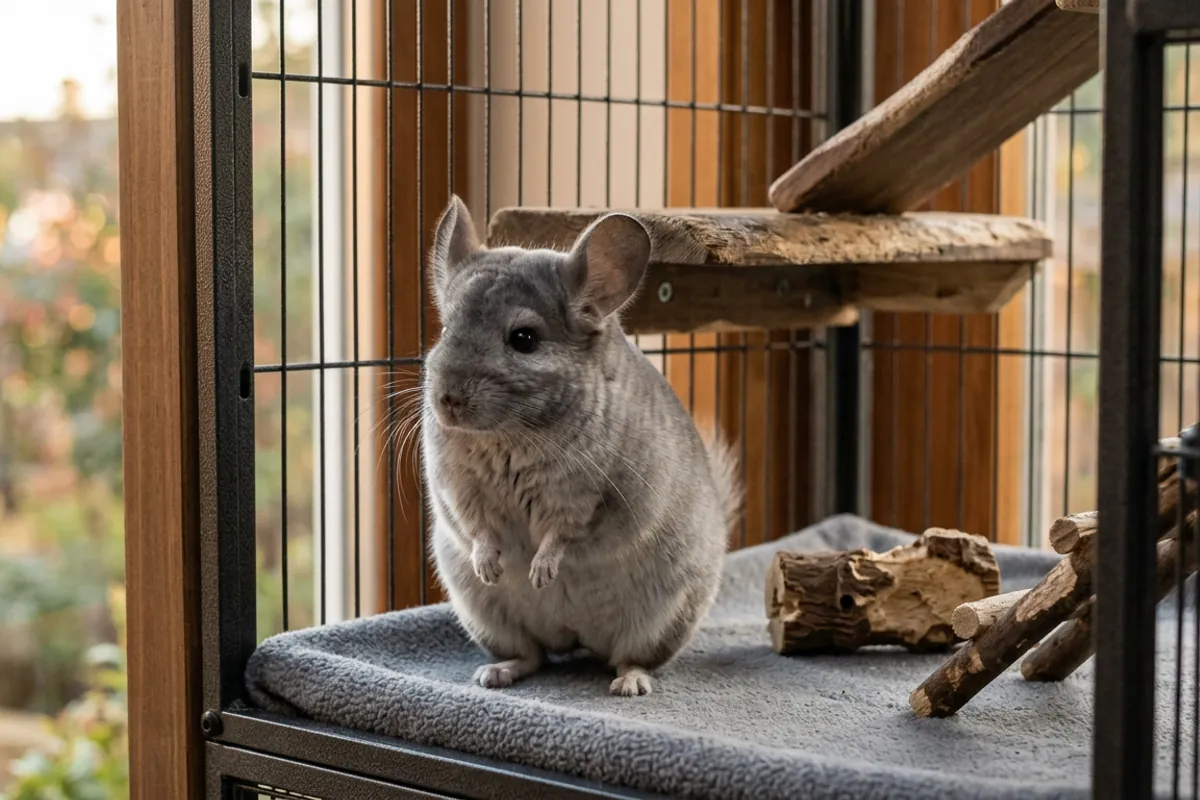
The catch that trips people up is that fleece on its own does almost nothing. Fleece wicks moisture through itself but does not hold it, so a bare liner leaves a wet floor underneath. Fleece chinchilla bedding only works as a two-layer system: the fleece on top, wicking, and an absorbent layer beneath it holding the moisture. I use an old towel underneath, though moving pads or purpose-made absorbent liners do the same job. Wash a new piece of fleece two or three times before its first use, with plain unscented detergent and absolutely no fabric softener, because softener coats the fibers and kills the wicking that makes the whole thing function.
Then it is a routine. I spot clean the fleece daily, sweeping off droppings and stray hay, which takes under a minute. Every two to three days the whole liner comes out for a wash and a fresh one goes in. If you let it go longer than that it starts to smell and stays damp, which puts you right back at the foot and lung problems fleece was supposed to solve. There is one more thing to watch: some chinchillas chew fleece, and a chinchilla that pulls and swallows threads can end up with a gut blockage. If yours is a chewer who goes after the liner rather than its chews, fleece is not the right bedding for that animal, and I would move to a loose bedding instead.
Aspen and paper, the loose beddings I reach for
When I want a loose bedding, or for a second cage and travel setup, I reach for aspen or paper. These are the two loose chinchilla bedding options I trust, and between them they cover almost everyone.
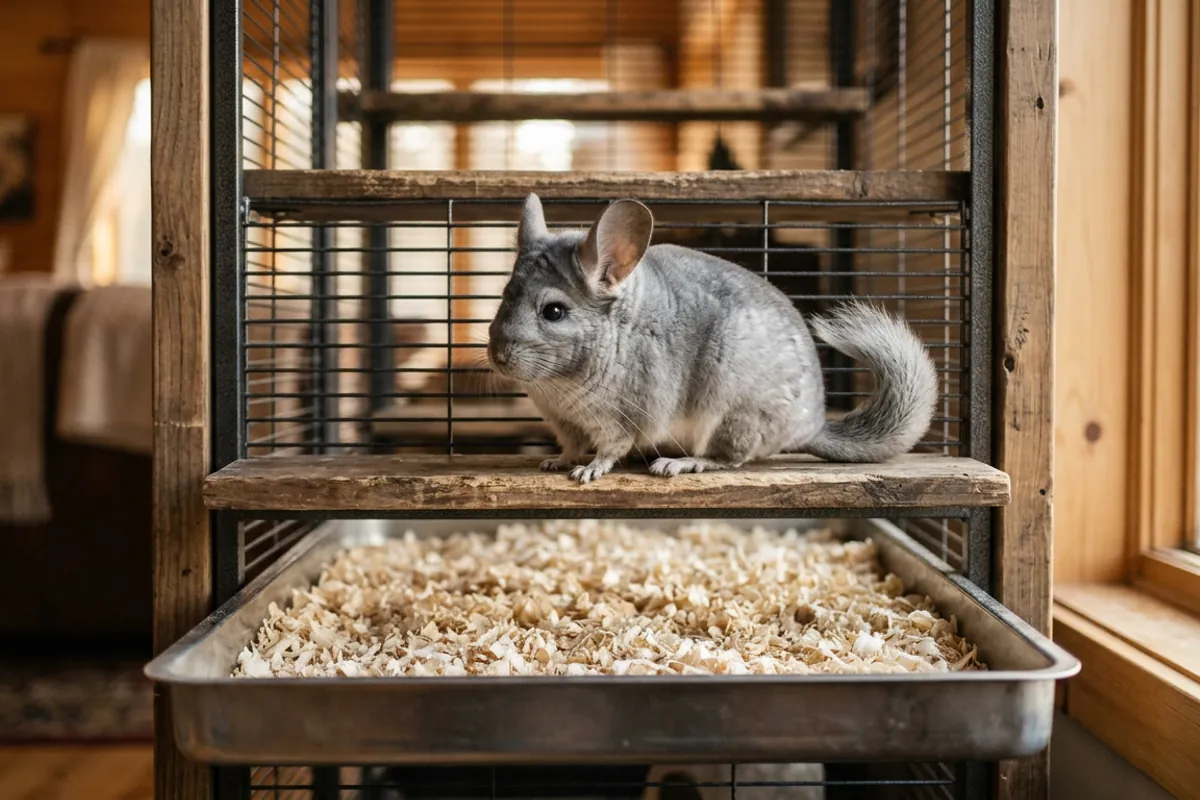
Aspen bedding for chinchillas is my default loose choice. Aspen is a hardwood, and unlike the aromatic softwoods it carries no strong oils to bother the airways, so it is a safe, absorbent, cheap shaving. When I buy chinchilla bedding aspen I look for kiln-dried and I give the bag a look for fine powder, sifting out the dusty bottom of the bag before it goes in the cage. A couple of inches in the pan is plenty. It absorbs well, it composts, and it does not pretend to be anything fancy.
Chinchilla paper bedding is the other one I keep around. Good paper bedding, the soft recycled-fiber kind, is very absorbent and does a better job on odor than aspen, which is why a lot of keepers prefer it. The thing to insist on is a low-dust, unscented product with no dyes. Skip anything perfumed or brightly colored, because the scent is there for human noses and the dye is there for the shelf, and neither belongs near a chinchilla's lungs. Both aspen and paper get changed out completely once a week, sooner if a corner is damp.
People want me to name the single best bedding for chinchillas, and there is no universal winner. The best bedding for chinchillas is the one you will keep dry and clean on schedule. Fleece rewards someone who will run a wash routine; aspen and paper reward someone who would rather scoop and toss. A perfect bedding you neglect is worse than a plain one you stay on top of.
Pine and cedar, the softwood question I won't dodge
This is the part that matters most. Cedar bedding is a hard no for a chinchilla. Cedar gives off aromatic oils and phenols that irritate the respiratory tract, and there is no version of it I would put near an animal with lungs as sensitive as a chinchilla's. If a bag says cedar, leave it on the shelf.
Chinchilla pine bedding is the debated one, and I would rather tell you that plainly than pretend the question is settled. Fresh, green pine shavings carry the same kind of aromatic oils as cedar and should be avoided. Kiln-dried pine is different: the drying drives off much of the volatile oil, and plenty of experienced keepers use kiln-dried pine for years with no visible problem. Others avoid all softwood shavings on principle, because the respiratory risk is hard to see until it is a real problem, and because aspen and paper do the same job without the question mark hanging over them. That is where I land. I do not tell people who use kiln-dried pine that they are poisoning their animals, but given a sensitive respiratory system and two clearly safe alternatives, I keep pine out of my own cages and reach for aspen or paper instead. Where a risk is uncertain, I would rather you know it is uncertain than trust a false certainty.
When your chinchilla eats the bedding
A chinchilla eating bedding worries owners, and it is worth understanding rather than panicking over. A little mouthing and nibbling of shavings is common and usually harmless, because a chinchilla investigates the world with its mouth. Bedding is not food, though, and it carries no nutrition, so it should never be a meaningful part of what goes into your chinchilla. The concern is quantity. A chinchilla eating paper bedding in real amounts, or swallowing fleece threads, can slow or block a gut that is built to run on a constant stream of fiber from hay.
The fix is almost always the same, and it is the fix for most chewing: give the gut and the teeth something better to do. Unlimited grass hay should be in front of your chinchilla at all times, because hay is both the diet and the thing that keeps those constantly growing teeth worn down, and a chinchilla with enough hay is far less interested in the floor. Alongside it, keep a rotation of safe wooden chews so the urge to gnaw has a proper target. Apple wood is a favorite in my cages.
emours apple wood chew sticks, 40 count As an Amazon Associate I earn from qualifying purchases.
Know the line where this stops being a habit and becomes an emergency. If a chinchilla that has been eating bedding goes off its food, produces smaller droppings or none at all, or turns quiet and hunched, that can be gut stasis, and it moves fast in a small animal. That is not a wait-and-see moment. Call an exotics vet the same day. I am an experienced keeper, not a vet, and a slowing gut is exactly the line where a keeper's job is to get the animal to someone who can treat it.
Buying bedding without the pet-store markup
You will find chinchilla bedding at PetSmart and every other pet store, and the aisle itself is not the problem. The aspen and the paper beddings on those shelves are usually fine products. Two things are worth knowing before you fill a cart. First, the same aisle almost always stocks cedar and pine and a wall of scented, dyed beddings aimed at people who want a cage that smells like a candle, and those are the ones to walk past. Read the label for kiln-dried, unscented, and dust-extracted, and ignore the marketing on the front.
Second is price. Small bags of chinchilla bedding at PetSmart or anywhere else are convenient and expensive per use. If you have settled on aspen or paper, buying it in a large bag brings the cost way down for the exact same product. Fleece is even starker: a couple of yards of plain fleece from a fabric store, hemmed or just cut to size, costs a fraction of a branded pet liner and works identically. None of this is about chasing the cheapest thing. It is about not paying a premium for a small bag and a picture of a happy rodent.
Keeping the floor clean without making it a chore
Whatever bedding you land on, the routine is what protects your chinchilla, and it is light once it is a habit. Every day, take thirty seconds to scoop the wet corner and shake or sweep the hay debris off. With loose bedding, do a full change weekly, or the moment a patch is damp. With fleece, spot clean daily and swap the whole liner every two to three days for a wash. A dry floor is the entire goal, because damp bedding is what breeds smell, raises the humidity right around your chinchilla, and rots footpads.
That humidity point ties into the one number that matters most for these animals. Chinchillas are comfortable at 60 to 70°F (15 to 21°C); above 75°F (24°C) gets risky and 80°F (27°C) and up is an emergency, and humid air makes all of that worse and faster. Damp, neglected bedding pushes the moisture up in the exact air your chinchilla is breathing, so a clean dry floor is quietly part of heat safety too. A cheap thermometer and hygrometer clipped to the cage tells you both numbers at a glance.
digital thermometer and humidity gauge with remote probes As an Amazon Associate I earn from qualifying purchases.
The floor also depends on the cage under it. A proper chinchilla cage is tall, made of metal and wood, with a solid pull-out pan you can line and wooden ledges to keep your chinchilla up off the bedding most of the day.
Critter Nation double unit small animal cage As an Amazon Associate I earn from qualifying purchases.
Get the pan and the ledges right, pick one of the safe beddings, and hold a simple routine, and bedding stops being something you think about. It just quietly does its one job: a dry, clean, low-dust floor under an animal that will pay you back with years. For the wider picture of putting the whole cage together, the cage setup guide walks through the rest.