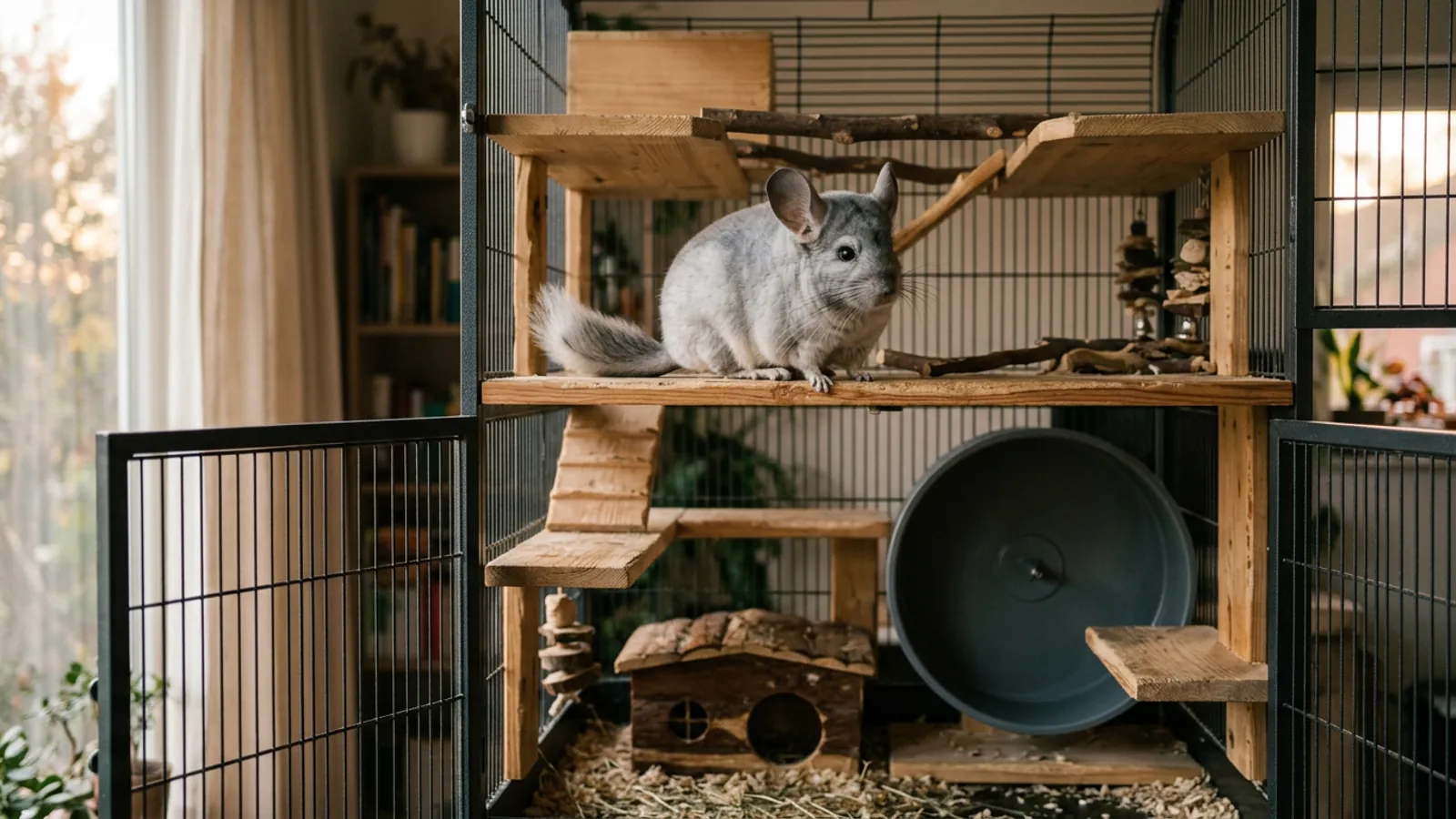
A multi level chinchilla cage is not a marketing upgrade or a clever way to make a cramped footprint look generous. It is the shape that matches how a chinchilla moves. These animals evolved on rocky Andean slopes, and everything about their bodies is built for climbing, leaping, and dropping from one ledge to the next. Pebble will use every inch of vertical space I give her before she bothers to cross the floor. So when someone asks me what matters most in a cage, my answer is almost always height, and a multi level cage is simply how you turn that height into something the animal can use.
Why a chinchilla needs a cage that goes up, not out
A chinchilla on flat ground is a chinchilla with most of its instincts switched off. In the wild they scramble over rock, wedge into crevices, and cover surprising distances by jumping rather than walking. A single level cage, even a wide one, asks the animal to live like a hamster, and it will not. What you get instead is a bored, under exercised chinchilla that either sleeps too much or chews the bars out of frustration.
Height is what a multi level cage buys you, and height is what chinchillas convert into movement. Give one a stack of ledges and it will bounce between them for the sheer joy of it, especially in the evening when it wakes up and wants to burn off the day. I have written before about why height beats floor space, and a multi level design is that principle made physical. Two cages can have the same footprint on the floor of your room, but the taller one with three or four working levels gives the animal several times the usable territory.
There is a health argument underneath the enrichment one. A chinchilla that jumps and climbs keeps muscle tone, keeps weight in check, and stays mentally busy. Boredom in this species does not stay harmless. It turns into fur chewing, bar biting, and stereotyped pacing, and those are miserable to watch and hard to reverse once they set in.
What a multi level cage has to get right
Not every cage that stacks shelves is a good multi level cage. The frame has to be tall enough that the levels are worth having. I would not go below roughly a couple of feet of floor space in each direction, and I want real height on top of that, ideally something in the range of four feet or more from base to roof for a single chinchilla, and more if you keep a pair. The point of the height is the gap between levels, because that gap is where the jumping happens.
Bar spacing matters just as much on a tall cage as a short one. Aim for spacing around half an inch, roughly 1.5 to 2 cm, so a chinchilla cannot force its head through and so a baby cannot slip out entirely. Horizontal bars are a bonus on a multi level cage because the animal will climb them like a ladder, which only adds to the vertical play.
Then there is the door. A tall cage with one small door is a daily fight. I want wide doors, ideally full height ones, so I can reach the back of every level without dislocating a shoulder and so the chinchilla has a generous opening for out of cage time. If you are shopping and want the full checklist, I have laid it out in the best chinchilla cage guide, and most of it applies double to a multi level build.
The materials that make or break it
This is where a lot of cages sold as multi level fail, and it is not a matter of taste. A chinchilla cage has to be metal and wood, and nothing structural can be plastic. Chinchillas gnaw constantly because their teeth never stop growing, and they will strip a plastic shelf, ramp, or pan tray down to fragments in an afternoon. Swallowed plastic can block a gut that is not built to pass it, and that is a genuine emergency. I go into the full reasoning in why a cage has to be metal, but in brief, it is a powder coated metal frame, wire, and safe untreated wood only.
The levels themselves should be solid wood shelves, not wire grate. Wire flooring is hard on chinchilla feet and can cause a painful condition called bumblefoot over time, and it gives nothing for the animal to gnaw safely. Kiln dried pine or a hardwood like apple or willow is ideal. Many cages ship with wire shelves, and the first thing I do is replace or cover them with wood. A metal frame cage that already comes fitted with wooden ledges saves you that job. Critter Nation double unit small animal cage As an Amazon Associate I earn from qualifying purchases.
Whatever wood you add, keep it as safe chew material too. Applewood, pear, and kiln dried pine are all fine. Cedar and most treated or painted woods are not, because the oils and finishes are toxic to gnaw. A pack of assorted safe wood chews earns its place on every level, doubling as both toys and dental care. emours apple wood chew sticks, 40 count As an Amazon Associate I earn from qualifying purchases.
Ledges, ramps, and the fall you have to plan for
Here is the part people miss when they first fall in love with a tall cage. A multi level cage is a multi level fall. Chinchillas are agile, but they are not immune to gravity, and a bad landing from the top of a four foot cage onto a hard shelf or the floor can break a leg. Older chinchillas and heavier ones are especially at risk. So the levels are not just about giving the animal somewhere to go, they are about breaking up the drop.
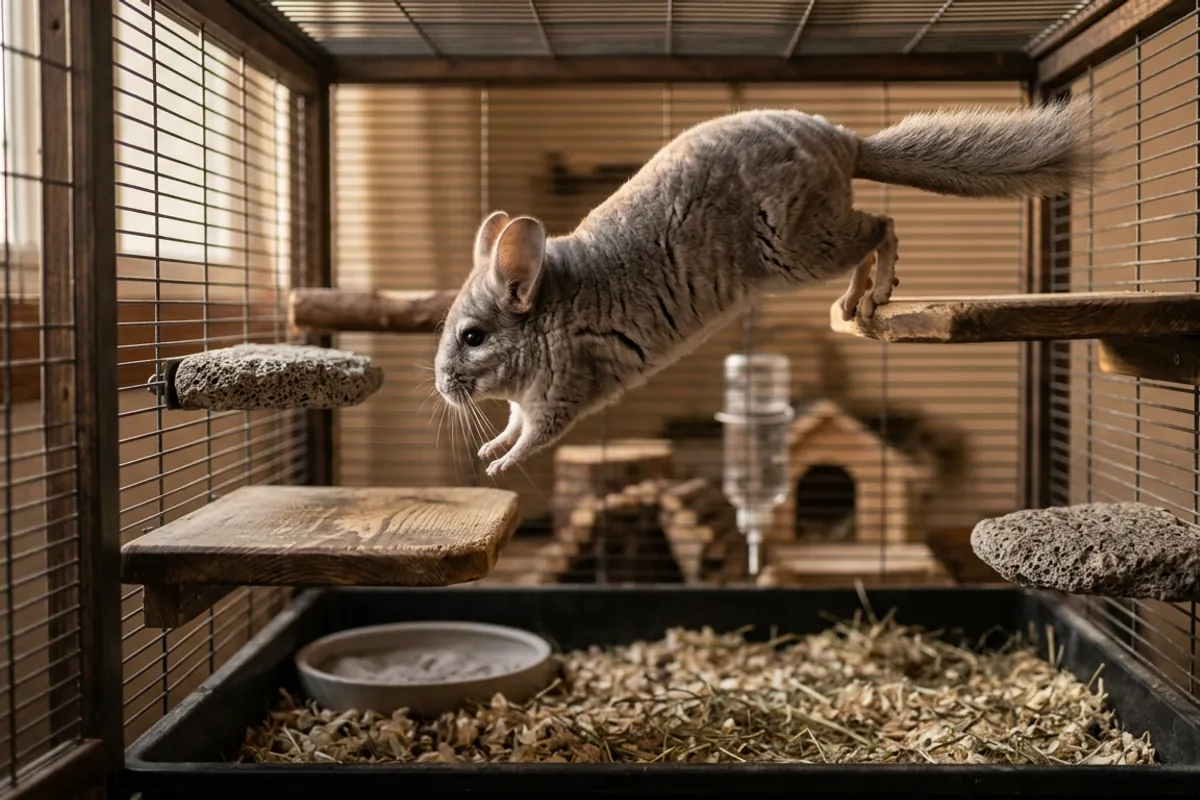
I stagger my ledges so there is never a clear straight fall from top to bottom. Each shelf should catch the animal if it misjumps, so I offset them left and right as I go up rather than stacking them in a single column. The gaps between ledges want to be jumpable but not huge, and I fill the vertical space with hammocks, tunnels, and hanging chews so a stumble hits something soft or grabbable on the way down.
Ledges made of lava or pumice stone are worth a word here because they do double duty, giving grip and filing nails at the same time. I keep a couple mounted at different heights, and they hold up far better than wood in a wet spot near a water bottle. If you have not used them, I wrote up what lava ledges really do separately.
For the very bottom, a deep base with plenty of bedding softens the last drop, and I never leave a bare metal or hard pan exposed as the landing zone.
How many levels, and the 3 level chinchilla cage question
The most common question I get is how many levels a chinchilla needs, and whether a 3 level chinchilla cage is enough. For a single chinchilla or a bonded pair, three well spaced levels in a tall frame is plenty, and it is what I would call the sensible default. The number of levels matters less than the height they are spread across and how you use the space between them.
I would rather have a 3 level chinchilla cage that is four feet tall with real gaps to jump than a six level cage where the shelves are stacked so close together that the animal just steps between them like stairs. Cramming in levels defeats the purpose. The jump is the exercise, so you want air between the platforms, not a bookshelf.
A popular route is a double unit cage where two identical sections stack into one tall enclosure, which gives you the height and the levels in one frame. These work well precisely because they are tall and roomy, though the shelves and ramps they ship with are usually wire and want swapping for wood. I have weighed up one of the best known versions in my write up on the Critter Nation cage for a chinchilla, and the same logic applies to any tall multi section unit. Buy for the height and the frame, then fit it out yourself.
Fitting out each level so it earns its place
A multi level cage only works if each level has a reason to be visited. If the top shelf is empty, the chinchilla will pick a favorite spot and ignore the rest, and you have wasted the height. So I think of the cage in zones and give every level a job.
The top level is usually the sleeping and hiding zone, because chinchillas like to perch high to feel safe. That is where a wooden house or a hammock goes. The middle levels are for movement and food, so that is where I hang hay and put the pellet dish. Hay is the whole meal for this species, unlimited grass hay every day, so I keep a rack or a box of it within easy reach on a level the animal passes constantly. Oxbow Western Timothy Hay, 40 oz bag As an Amazon Associate I earn from qualifying purchases.
Water goes where it will not soak a wooden shelf, and pellets stay a measured supplement rather than a free for all, a point I make in more detail in the chinchilla food guide. The wheel needs its own dedicated spot because it takes up room and it has to be a solid running surface, never wire or mesh, which can catch and break a toe or a tail. A proper solid surface wheel is one of the few pieces of gear I consider non negotiable. 15 inch Chin Spin solid surface chinchilla wheel As an Amazon Associate I earn from qualifying purchases.
The dust bath is not a permanent fixture. I offer it a few times a week and then take it out, because leaving it in invites the animal to use it as a litter box and to over bathe its coat. Chinchillas clean themselves in fine volcanic dust and never in water, so a tub of proper bathing dust offered on a lower level a few times a week is all it takes. Lixit Blue Beauty chinchilla dust, 3 lb As an Amazon Associate I earn from qualifying purchases.
Heat rises, and so does your chinchilla
This is the part that matters most, because it nearly cost me Pebble in her first summer. Heat rises, and in a tall cage the top level is the hottest spot in the enclosure, sometimes several degrees warmer than the floor. A chinchilla that likes to perch high is sitting in exactly the wrong place on a hot day. Their dense fur, the same coat that makes them irresistible, traps heat with brutal efficiency and they cannot shed it well.
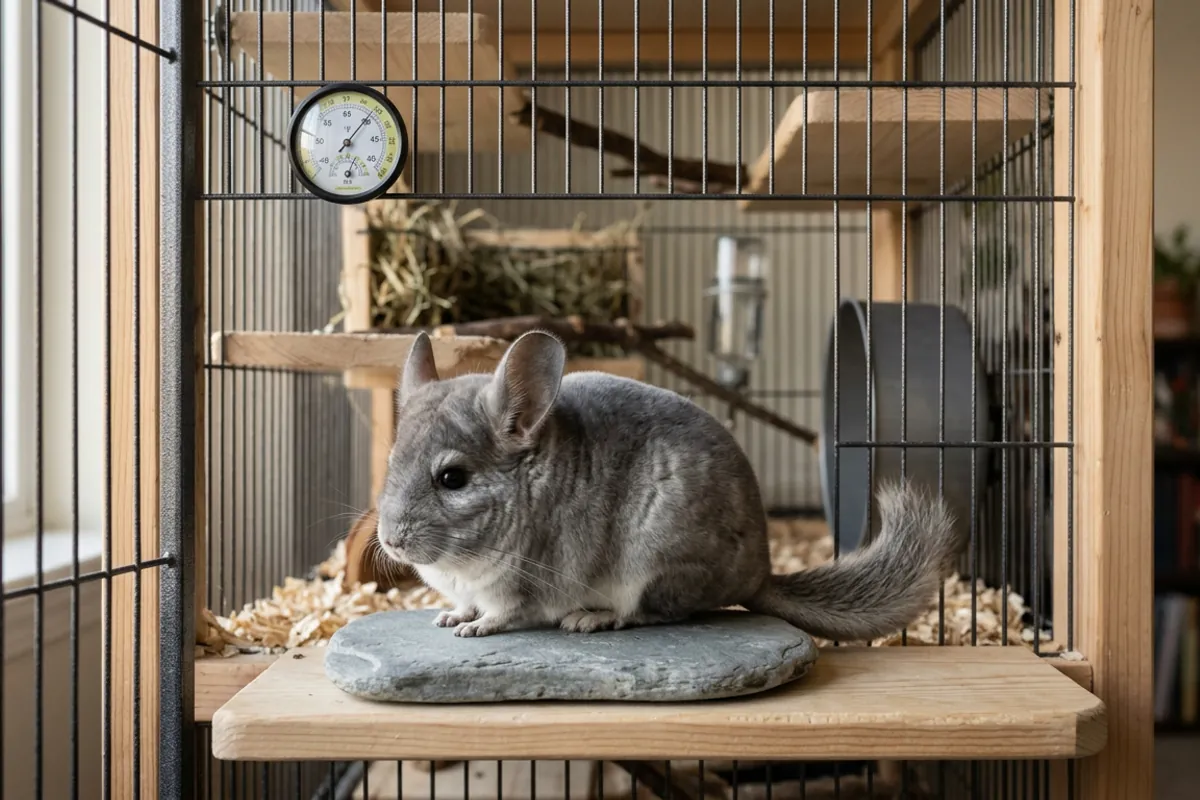
The numbers are not negotiable. Chinchillas are comfortable in a range of 60 to 70°F, which is 15 to 21°C. Above 75°F, about 24°C, you are into risky territory, and 80°F, roughly 27°C, is an emergency, faster still if the air is humid. In a multi level cage I measure at the top level, not the floor, because that is where the animal chooses to be and where the reading is worst. A combined thermometer and humidity gauge clipped up high tells me the truth about the hottest point in the cage. digital thermometer and humidity gauge with remote probes As an Amazon Associate I earn from qualifying purchases.
On warm days I give the animal a cool surface low in the cage so it has somewhere to escape the heat that collects up top. A chilled stone slab on a bottom ledge is simple and it works. Kaytee Chinchilla Chiller granite stone As an Amazon Associate I earn from qualifying purchases.
Fans, moving the cage away from windows, and air conditioning all help, but nothing replaces watching the number. If you want to know whether your room is safe right now, I built a heat danger calculator that factors in humidity, and the signs of overheating are laid out in chinchilla heat stroke warning signs. If your chinchilla is lying flat, breathing hard, or its ears are bright red, that is a vet call, not a wait and see.
Keeping a tall cage clean without dreading it
A multi level cage has more surfaces to clean than a flat one, and if the cleaning is a nightmare you will do it less often, which is bad for the animal. So I set the cage up to be cleaned from the start. Full height doors on both sides of a double unit are worth their weight, because they let me reach every level without contortion.
I spot clean daily, pulling soiled bedding and wiping the level under the water bottle, and I do a full strip down and wipe once a week. Wooden ledges take the worst of it, so I keep a couple of spare ledges to swap in while the soiled ones dry after a wash. Urine soaks into wood, and a shelf that never fully dries starts to smell and can harbor bacteria, so rotation beats scrubbing a permanently damp board.
A litter tray or a corner of the base with extra bedding, placed where the chinchilla already tends to go, keeps most of the mess in one spot and makes the daily job quick. The point of all this is not tidiness for its own sake. A clean, dry, well arranged multi level cage is one the chinchilla uses top to bottom, and using the whole cage is the entire reason you bought a tall one in the first place. Get the setup right once and a multi level cage rewards you with an animal that is fitter, calmer, and far more fun to watch than one kept on a single boring floor.
If you are weighing a branded model against a plain multi level, the Ferret Nation cage guide covers the conversion.