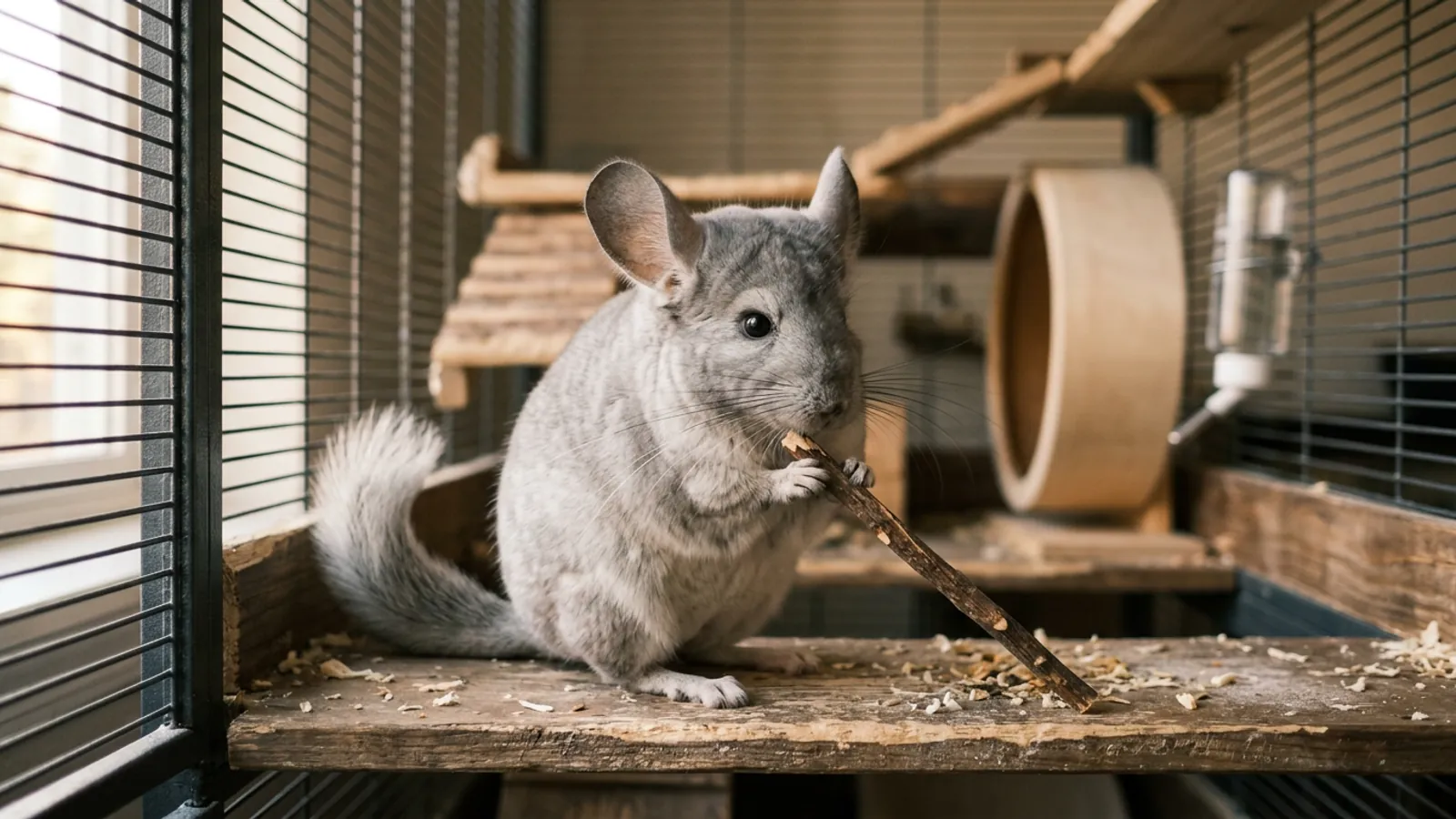
The most useful thing in either of my cages is not the wheel and it is not the fanciest ledge. It is the plain pile of chinchilla chew toys sitting where a bored chinchilla will find it at two in the morning. I did not always treat chews as essential. I treated them as enrichment, a nice extra, until I took in Juniper, a neglected rescue whose teeth had already gone wrong before she reached me. Watching what happens when a chinchilla's teeth do not get worn down changed how I think about wood in a cage. Chews are not a toy in the way a cat's feather wand is a toy. For a chinchilla they are dental equipment, and getting them right is one of the few things that stands between your animal and a lifetime of expensive, painful mouth problems.
Why a chinchilla has to chew every day
A chinchilla's teeth never stop growing. All of them, the incisors at the front and the cheek teeth at the back, are open-rooted and keep erupting for the animal's entire life. In the wild that growth is matched by constant wear from coarse, gritty plants. In your home, that wear has to come from somewhere, and if it does not, the teeth keep coming and there is nowhere for them to go.
When wear falls behind growth, you get malocclusion: the teeth meet wrong, the cheek teeth form sharp spurs that cut into the tongue and cheek, and the front teeth can overgrow until the animal cannot close its mouth. It is one of the most common serious health problems keepers see, and it is largely invisible until it is bad. The first sign is usually not the teeth at all. It is a chinchilla eating less, dropping weight, drooling so the fur under the chin gets wet and matted, or picking up a pellet and putting it down again. By then you are already at the vet.
This is why I stopped thinking of chews as optional. Hay does most of the grinding work, which I will come back to, but hard wood does something hay cannot: it makes the animal gnaw against real resistance, which wears the front teeth and gives a restless chinchilla a job. If you want the full picture of how these teeth fail and what to watch for, I wrote it up in Chinchilla Teeth Problems: Spotting Malocclusion Before It Turns Serious, and there is a broader overview on the chinchilla teeth and health hub.
What makes a good chew
The best chew toys for chinchillas are almost boring. They are untreated, chinchilla-safe wood, dry, hard, and free of anything a chinchilla should not swallow. That is the specification, and most of the failures I see are a failure to meet one of those plain points rather than a failure to find something clever.
Safe woods are the fruit and leaf woods that do not carry toxins or heavy oils. Apple is the one I reach for first and the one most keepers agree on. Pear, willow, hazelnut, poplar, and kiln-dried pine are all widely used and widely considered safe. These are the woods behind almost every good product sold as chinchilla wood chews, and they are what I would build a chew supply around.
The wood has to be genuinely untreated. No varnish, no paint, no stain, no glue, no scented finish. If a chew is dyed a bright color, I want to know exactly what the dye is, and if I cannot find out, it goes back. Chinchillas eat what they gnaw, in small amounts, so anything on the surface of that wood is going into the animal. The same rule kills off most of the cute chew toys marketed for small pets: the little wooden carrots and houses held together with hidden glue and finished with food dye are not worth the risk when a plain apple stick does the job better.
Texture matters more than shape. A chinchilla needs something hard enough to make it work, which is why dried, seasoned branches beat soft, spongy wood that just crumbles. Loofah and cardboard have their place as light novelty items a chinchilla can shred, but they do almost nothing for the teeth. Treat them as boredom-breakers, not dental care.
Woods and materials to keep out of the cage
The unsafe list matters as much as the safe one, because a well-meaning owner grabbing a branch from the garden can poison a chinchilla without ever knowing what went wrong.
Keep out cedar and fresh, un-dried pine: the aromatic oils are irritating to the airways. Keep out the stone-fruit woods, meaning cherry, plum, peach, apricot, and nectarine, because they can carry cyanide compounds. Keep out citrus woods, oak, walnut, and anything you cannot positively identify. If you forage your own branches rather than buying them, you take on the job of correct identification, thorough washing, and drying for weeks until the wood is bone dry, and you accept that any pesticide or roadside spray on that branch is now in your cage. I mostly buy mine for exactly that reason. The certainty is worth the small cost.
Two materials that are not wood belong on the banned list too. Plastic is the big one. A chinchilla will gnaw a plastic hut, ledge, or toy, and swallowed plastic can cause a gut blockage that kills. There is no safe plastic chew. The other is anything with metal parts small enough to be worked loose and swallowed, or soft metal like a cheap bell a chinchilla can crush. When I choose a cage I want metal and wood construction precisely so there is nothing tempting and dangerous to chew, and I go into that in How to choose a chinchilla cage without buying the wrong one twice.
Chew sticks, chew blocks, and building real variety
Once you are past the safe-versus-unsafe question, the useful distinction is form, and the two workhorses are chinchilla chew sticks and chinchilla chew blocks.
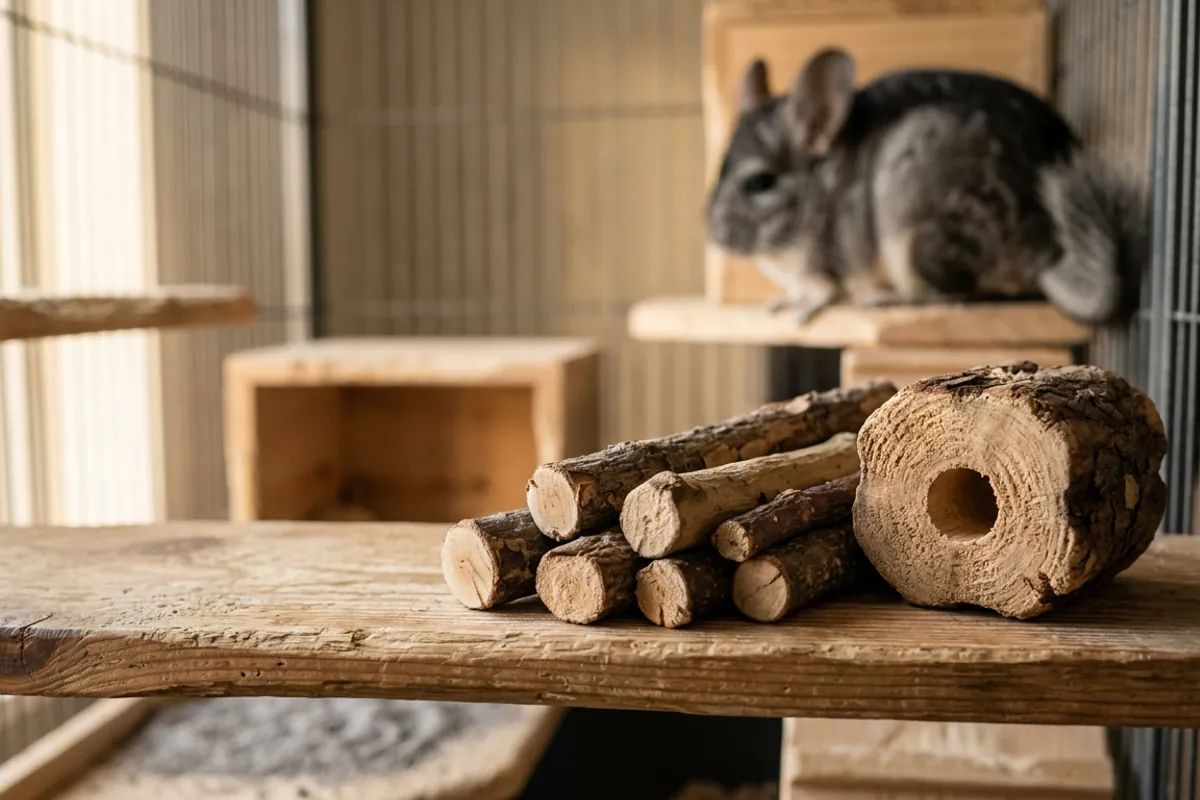
Chew sticks are thin branches and twigs. They are easy to hold, they wedge nicely between cage bars, and most chinchillas take to them straight away. They are the everyday chew, the thing that should always be in the cage. Chew blocks are chunkier pieces of solid wood, sometimes drilled and hung on a stainless hook. They demand more effort and are better for the strong front-tooth gnawing that a stick alone does not always provoke. A chinchilla that has flattened every stick you own but ignores a hard block is telling you it wants the stick, and that is fine, but I like both in the cage so the animal can choose.
Variety is not a marketing idea here, it is the point. Different woods have different hardness, and a chinchilla that only ever gnaws one soft wood is not getting the range of wear that keeps a mouth healthy. This is the single conviction I hold hardest because of Juniper: offer a real spread of textures, not one chew repeated. A mixed pack of apple-wood sticks and blocks in assorted thicknesses is the simplest way to cover that range without assembling it piece by piece. I keep an apple wood chew variety pack topped up in both cages for exactly this reason.
emours apple wood chew sticks, 40 count As an Amazon Associate I earn from qualifying purchases.
Rotating what is available also fights the other enemy, which is boredom. Chinchillas are neophilic in a mild way: a chew that has been in the cage for two weeks becomes furniture, and the same stick reintroduced after a rest gets attacked like it is new. I keep a box of chews outside the cage and swap a few pieces every week rather than dumping everything in at once.
Buying chinchilla chews in bulk without buying junk
Chews are a consumable. A busy chinchilla goes through them, which is the whole idea, and buying a single sad little pack every couple of weeks gets expensive and inconvenient fast. Buying chinchilla chew toys in bulk is the sensible move, with a couple of cautions.
The first caution is the same safe-wood rule at scale. A big bulk bag is only a bargain if every piece in it is a wood you would give one at a time. Some cheap bulk assortments pad the bag with dyed shapes, colored wood, or filler like pressed sawdust chews held together with binder. Read what is in the mix before the price tempts you. A plain bulk box of assorted apple and pear sticks is worth far more than a colorful bin of mystery pieces.
The second caution is storage. Wood chews keep almost indefinitely if they stay dry, so bulk buying carries no real downside there, but store them somewhere dry and airtight so they do not pick up damp or pantry pests. I keep mine in a sealed tub. Bought sensibly, a bulk supply of chinchilla wood chews is cheaper per stick, means you never run out, and lets you keep that weekly rotation going without a second thought. Chews are one of the cheapest lines in the whole budget, and I break down where the real money goes in What a chinchilla really costs.
How to offer chews and read whether they are working
Putting chews in the cage is easy. Reading whether they are doing their job is the part most owners skip.
Start with placement. Wedge sticks between bars, hang a block from a stainless hook, and scatter a couple of loose pieces on a ledge. You want the chews in the paths the chinchilla already uses, near the wheel and the ledges, not hidden in a corner it never visits. A chinchilla is more likely to gnaw a stick it trips over on the way to somewhere else.
Then watch. A healthy chinchilla using its chews leaves obvious evidence: gnawed ends, wood shavings under the ledges, blocks that shrink over weeks. That mess is good news. What worries me is the opposite, an animal that stops chewing. If a chinchilla that used to demolish sticks suddenly ignores them, I do not assume it is bored. Reduced chewing is one of the early signs of a sore mouth, because a chinchilla with a developing spur or an overgrown tooth finds gnawing painful and quietly gives it up.
So the chews double as a monitor. Alongside them I watch weight, appetite, and the fur under the chin. A chinchilla losing interest in food, dropping pellets after picking them up, drooling, or losing weight needs an exotics vet who treats chinchillas, and it needs one soon rather than after a week of waiting to see. No chew fixes a tooth that has already grown wrong. Chews prevent that day. Once it arrives, the tools are a vet's, not yours, and I would rather send you early than have you trust a chew to undo real disease.
One more honest note. Chews are not treats and should not be sweet. Chinchillas have delicate digestive systems and no business eating sugary things, so a chew coated in honey or fruit flavor is working against you. Keep the treat question separate, and keep it small: I cover what is safe in my guide to chinchilla treats.
Hay is the chew that matters most
I have spent this whole article on wood, so let me be blunt about the thing that outranks all of it. The most important chew in your chinchilla's life is hay.
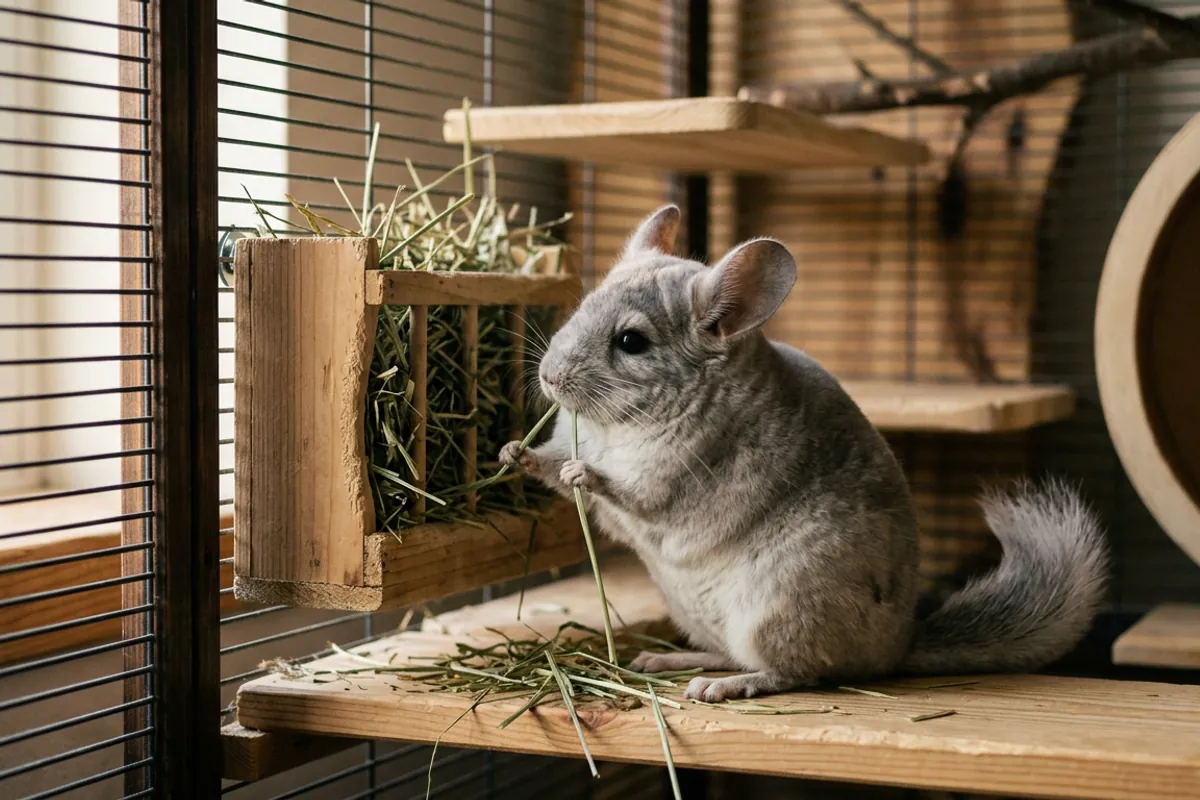
Unlimited grass hay, timothy or a similar meadow grass, is the foundation of the entire diet and the single biggest factor in dental wear. The side-to-side grinding a chinchilla does to break down coarse hay is exactly the motion that wears the cheek teeth, the teeth that wooden sticks barely touch. A chinchilla should have hay available all day, every day, more hay than it can eat, refreshed so it stays clean and dry. Pellets are a measured supplement on top of that, never a replacement, and I lay out the whole feeding picture in Chinchilla diet, food, and hay.
If I had to choose between a cage full of the best chew toys for chinchillas and a permanent, unlimited supply of good hay, I would take the hay without hesitation, every time. The wood chews are the supporting act. They wear the front teeth, they occupy a busy animal, and they let you spot trouble early, all of which matter. But they sit on top of a base of endless hay, and a keeper who gets the chews perfect while skimping on hay has the priorities backwards. I keep a hay box filled at all times.
Oxbow Western Timothy Hay, 40 oz bag As an Amazon Associate I earn from qualifying purchases.
For a heavy hay habit, buying it in bulk saves both money and the panic of running low, and the same dry-storage rule applies as with wood.
Oxbow Western Timothy Hay, 9 lb box As an Amazon Associate I earn from qualifying purchases.
Put together, the picture is simple. Endless grass hay does the essential grinding. A rotating spread of safe, untreated chinchilla chews, sticks and blocks in a real range of textures, wears the front teeth and keeps a clever animal busy. Nothing plastic, nothing dyed, nothing from a stone-fruit tree ever goes in the cage. And you watch the chewing itself as an early warning, because a chinchilla that stops gnawing is often a chinchilla telling you its mouth hurts. Do those things and you have handled one of the few parts of chinchilla care where cheap, boring diligence prevents a serious disease.