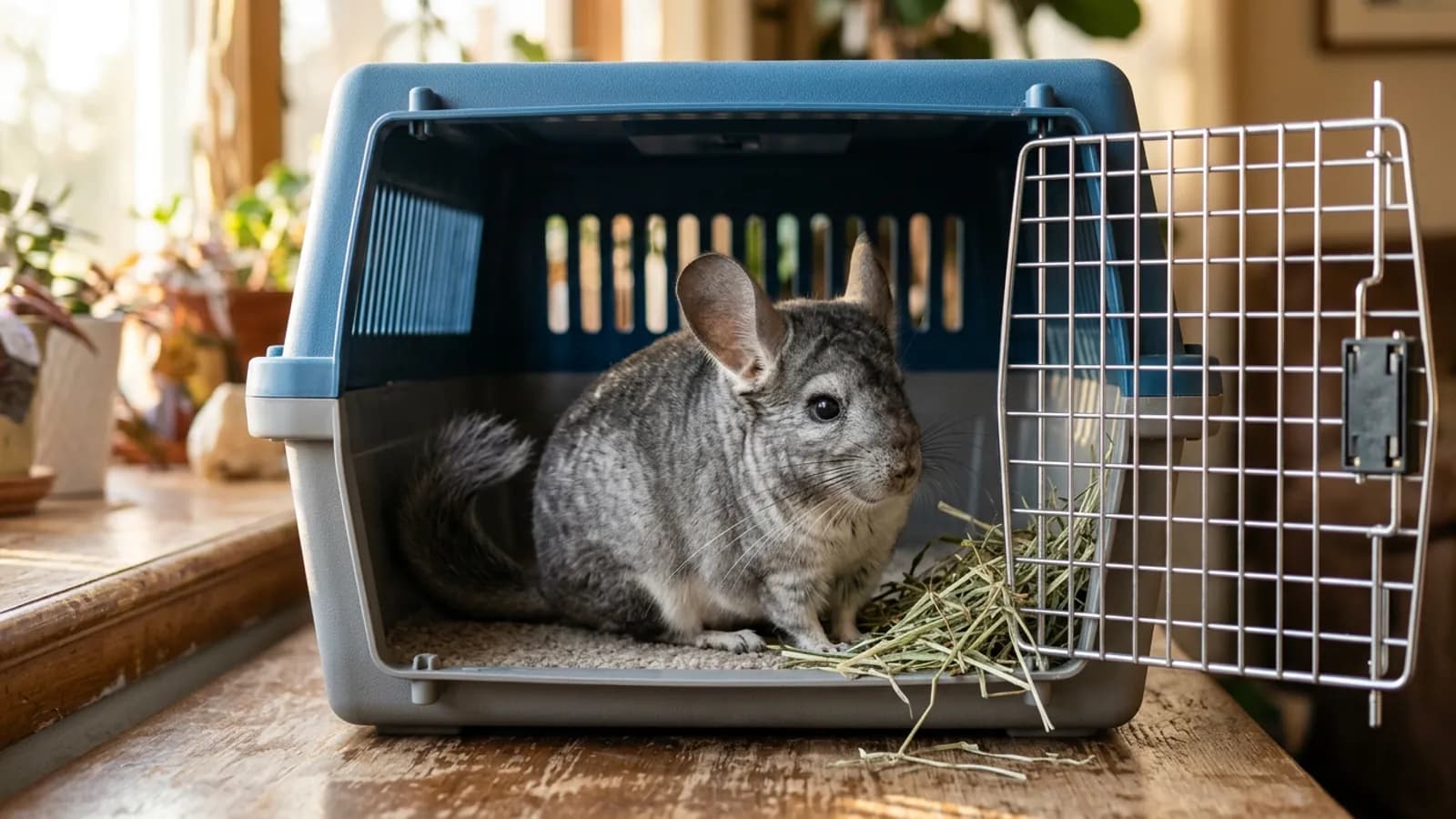
A chinchilla carrier is the one piece of equipment you buy hoping you rarely need it, and then need on the worst possible day. The emergency vet run, the move to a new home, the wildfire evacuation, the routine dental check that turns out not to be routine. I have owned Pebble for about ten years and Juniper long enough to manage her teeth day to day, and the carrier is the item I am most glad I chose carefully before a crisis rather than during one. When a chinchilla is overheating or a jaw has swollen overnight, you do not want to be improvising a box. You want to lift a small, sturdy, familiar container off the shelf, get the animal into it in seconds, and go.
Most of what people reach for when they think about a chinchilla is the cage, the dust, the hay. The carrier gets treated as an afterthought, something to grab from the cat aisle on the way to the till. That is a mistake, because a chinchilla is not a cat, does not travel like one, and cannot survive the same conditions in transit. This is a small animal built for cold mountain air, and everything about moving it comes back to that one fact.
Why a chinchilla needs its own carrier, not a shared one
You cannot safely move a chinchilla loose in a cardboard box, in your hands, or in the main cage. Cardboard is gone in minutes to those teeth, and a chinchilla that chews its way out inside a moving car is a genuine emergency. Hands fail the moment the animal startles, and a chinchilla that leaps from a height can break a leg on landing. The full-size cage is far too large and far too heavy to move with the animal inside, and a chinchilla thrown around a tall metal enclosure on a car seat can be hurt badly.
So the carrier is a real, separate item with a real job: hold one chinchilla securely, safely, and briefly, in conditions the animal can tolerate. Brief is the operative word. A chinchilla travel carrier is a transport container, not a second home. It is sized and equipped for a trip measured in minutes to a couple of hours, not for days. If you are looking at something big enough to live in, you have wandered back into cage territory, and I have written separately about how to pick the best chinchilla cage without buying the wrong one twice. Keep the two purposes distinct in your head and you will choose better hardware for both.
I keep the carrier stored assembled, with a scoop of hay already in it, in a spot I can reach without moving anything else. The point of owning one is speed on a bad day, and a carrier buried in a cupboard under the holiday decorations is a carrier you cannot use when it counts.
What actually makes a good chinchilla pet carrier
The material comes first, because it is where most carriers fail a chinchilla specifically. Wire wheels, plastic huts, plastic anything inside a cage are things I name plainly as bad, and the same rule follows the animal into a carrier. A chinchilla will chew, and a plastic carrier is both an escape route and a swallowing hazard. That said, a hard plastic pet carrier of the cat-and-small-dog type is the pragmatic choice most keepers actually use for short vet runs, for one honest reason: the trip is short and supervised, and a solid plastic shell with a metal grille door is far safer than the flimsy alternatives. The rule is not never-plastic here so much as never-unsupervised and never-for-long. If your chinchilla is a determined chewer who works at the door bars, that carrier is for the ten-minute drive to the clinic and nothing longer.
What I would avoid outright is soft-sided fabric carriers. They look cosy and they are a disaster for this animal: teeth open a seam in one focused session, urine soaks straight through, and the walls give no protection if the carrier is knocked. Fabric is for cats who tolerate it, not for a rodent whose whole survival strategy is gnawing.
Size is the next decision, and here chinchillas surprise people. Bigger is not better in a carrier. You want the animal to have room to turn around and sit upright, but not so much space that it is flung wall to wall when the car brakes. A carrier scaled for a small cat or a rabbit is about right for a single chinchilla. Too large and the animal has nothing to brace against; too small and it cannot settle. The grille door should be metal, the latches should actually hold, and the whole thing should have a solid floor you can line and clean.
Ventilation matters more than for almost any other pet, and it matters because of heat, which gets its own section below. Look for a carrier with real airflow on more than one side, not a closed plastic bucket with a few slots. A chinchilla generating heat in a poorly ventilated box in a warm car is the exact scenario that ends at the emergency vet.
Heat is the real danger of the trip, not the trip
Pebble came to me from a rehome out of an overheated attic, and her first summer with me brought a heatwave near-miss and a night at the emergency vet. That scare is why I am relentless about temperature, and travel is where temperature control is hardest, because you have surrendered the thermostat to a car, a car park, and the weather.
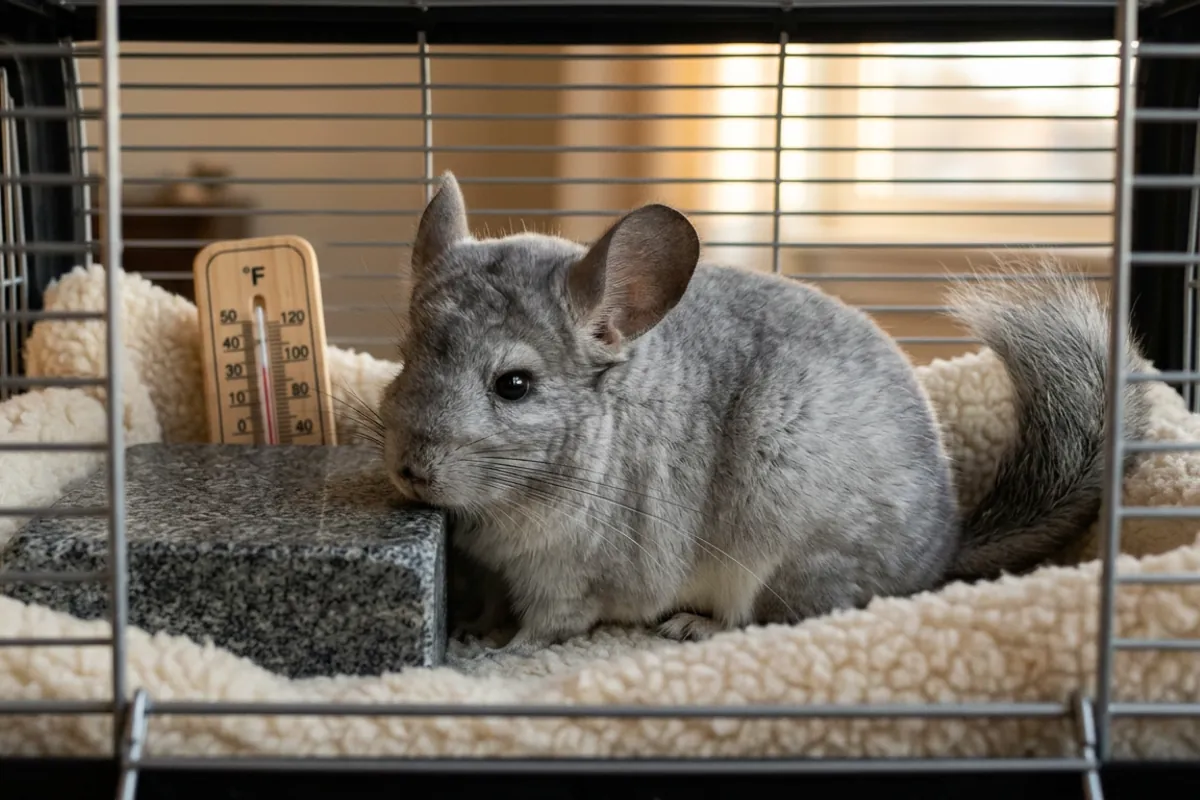
The numbers do not change because the animal is in a carrier. Chinchillas are comfortable between 60 and 70°F, which is 15 to 21°C. Above 75°F, or 24°C, you are into risky territory, and 80°F, 27°C, and up is an emergency that arrives faster in humid air. A closed carrier in a car concentrates the problem: the interior of a parked car climbs far past the outside temperature within minutes, a chinchilla adds its own body heat and the heat of stress, and dense fur that keeps a mountain animal alive in the cold becomes a liability the instant it cannot shed warmth. I have written the fuller version of this in Chinchilla Heat Stroke: Warning Signs Every Owner Should Know, and the short version is that a chinchilla in heat distress lies flat, drools, breathes through an open mouth, and has hot ears gone bright red. If you see that, the trip is now a medical emergency.
The defence is boring and it works. Never travel a chinchilla in a hot part of the day if you have any choice. Pre-cool the car before the animal goes in, keep the air conditioning aimed to keep the cabin in the comfortable range, and never leave the carrier in a parked car for even a minute in warm weather. Put a thermometer where you can see it, because your sense of comfortable and a chinchilla's are not the same number, and a device that reads both temperature and humidity takes the guesswork out.
digital thermometer and humidity gauge with remote probes As an Amazon Associate I earn from qualifying purchases.
For the trip itself, a chilled solid stone gives the animal a cool surface to lie against without any of the risks of ice packs melting or damp. I keep one in the freezer and drop it in the carrier for warm-weather journeys.
Kaytee Chinchilla Chiller granite stone As an Amazon Associate I earn from qualifying purchases.
One thing I will say plainly: a cooling stone and air conditioning are aids, not permission to travel a chinchilla in dangerous heat. If the day is genuinely hot and the trip is not a medical emergency, the right move is to wait for the cool of the evening or the early morning. The only time you override that is when the vet run itself is the emergency, and then you manage the heat as hard as you can and go. If you want to sanity-check a given temperature before you set off, the chinchilla heat danger calculator will tell you where you stand.
What goes inside the carrier
Keep the inside simple. A layer of the same bedding or fleece the animal already knows lines the floor and soaks up urine. I add a generous handful of grass hay, both because it is familiar and because a chinchilla that nibbles hay is a chinchilla doing something normal instead of panicking. Unlimited grass hay is the foundation of the diet every day, and there is no reason to interrupt that in transit. I use plain timothy for this, straight from the same box the cage hay comes from.
Oxbow Western Timothy Hay, 40 oz bag As an Amazon Associate I earn from qualifying purchases.
Skip the water bottle for a short trip. A bottle sloshing and dripping in a moving carrier soaks the bedding, and a wet chinchilla in a cool draught is its own problem, one I have written about in Chinchilla wet: a soaked coat, a drooling chin, and what each one means. For anything under a couple of hours a chinchilla does not need to drink in the carrier, and the hay carries some moisture. If you genuinely expect a long journey, that is a different plan altogether and one I would build around scheduled stops in a cool, secure indoor space rather than trying to make the carrier livable.
Do not put a dust bath in the carrier. Dust in a closed, jostling container becomes a cloud the animal breathes for the whole trip, and travel is not bath time. Save the dust for home on the normal schedule, which I cover in The chinchilla dust bath, done right from dust to schedule. A single small wooden chew is fine and gives an anxious animal something to do, but keep the interior sparse. The less loose gear rattling around, the calmer the ride.
The car ride itself
Secure the carrier before you secure yourself. A carrier loose on a seat becomes a projectile under braking, and a chinchilla inside a tumbling box can break bones. Belt it in, wedge it into a footwell where it cannot slide, or brace it so it stays put. The floor behind a front seat is often the steadiest, most shaded spot in the car.
Drive as if there is an open cup of coffee on the dashboard. Chinchillas do not enjoy the car and never learn to. Smooth acceleration, gentle braking, and no loud music make the difference between an animal that arrives shaken but fine and one that arrives in a state. Keep the cabin in the comfortable range the whole way, watch the thermometer, and if you are stuck in traffic on a warm day with the temperature creeping up, treat that as the developing emergency it is rather than waiting to see.
Cover part of the carrier with a light cloth to cut visual stress, but never cover it so completely that you choke the airflow. A chinchilla calms in a den-like dimness, but airflow always wins over cosiness when the two conflict. Talk quietly if it helps you, keep the trip as short as the errand allows, and get the animal back into its own cool room as soon as you arrive.
Getting your chinchilla used to the carrier before you need it
The worst time for a chinchilla to meet its carrier is the moment you are trying to catch a sick animal to rush it somewhere. Familiarity bought in advance pays off precisely when everything else is going wrong.
Leave the carrier open in or near the cage for a week or two with a little hay inside, so the animal explores it on its own terms and files it under harmless furniture rather than trap. Some chinchillas will start napping in it. Once it is familiar, do a few dry runs: gently encourage the chinchilla in, close the door for a minute, open it again, and let the animal leave with no drama and no trip. A carrier that has meant nothing bad a dozen times is far easier to use on the day it means the vet.
None of this makes a chinchilla love the car, and I would not promise otherwise. What it does is take the carrier itself off the list of frightening things, so the only novelty left on a stressful day is the journey, not the box.
When you actually reach for it
The honest list is short. Vet visits, and the biggest one is dental: Juniper's teeth are why I am uncompromising about hay and chews, and managing dental disease means real trips to an exotics vet who can look at the back molars properly. Overheating that has tipped into an emergency, where the carrier is how you move the animal to help. Moving house. Evacuation. And the unplanned injury or illness that a chinchilla, being a prey animal that hides weakness, often reveals only once it is already serious.
That last point is worth sitting with. Chinchillas mask illness until they cannot, so by the time you are certain something is wrong, you frequently need to move fast. Anything medical is a vet's call, not mine and not yours from a website, and the carrier is simply the tool that gets you there. Keep it assembled, keep it findable, keep a little hay in it, and know before you ever need it that it fits the animal, ventilates well, and latches shut. That preparation is cheap on a calm day and priceless on the day it stops being calm. A good chinchilla carrier is not gear you show off. It is the quiet insurance that when the worst morning comes, the moving part of the problem is already solved.