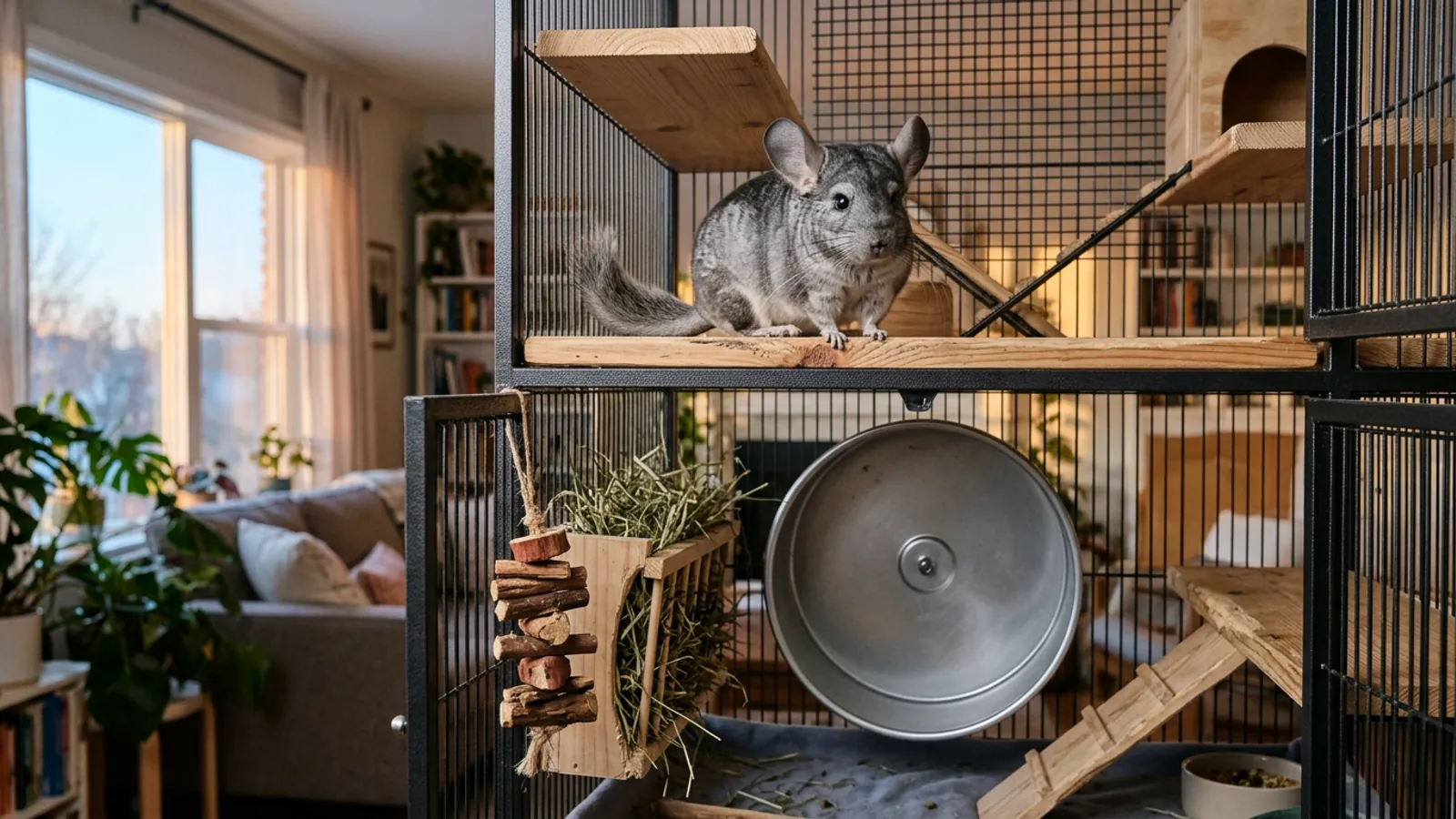
A chinchilla enclosure is not a cage with a fancier name. It is the single piece of equipment that decides whether your animal spends its life climbing, jumping, and wearing its teeth down the way it is built to, or whether it spends that life bored, cramped, and slowly getting sick in ways you will pay for later. I have kept chinchillas for about ten years, and I have watched people spend real money on the wrong box twice because nobody told them what the box is for. So before you buy anything, or reach for a drill, let me walk you through what an enclosure has to do, and how to give it those things without getting hurt or ripped off.
What an enclosure has to do
Everything about a chinchilla's body was built for the high, cold, rocky slopes of the Andes. They are made to leap between ledges, to sprint, to shed heat fast because the air up there is thin and cold, and to keep a set of teeth that never stop growing ground down against constant chewing. An enclosure that ignores any one of those facts is fighting the animal's biology, and biology wins.
That gives you a short, non-negotiable list. The enclosure must be tall enough to jump in, not just wide enough to pace. It must be made of materials a chinchilla cannot chew into a health problem. It must let heat escape, because a chinchilla cannot sweat and overheats faster than almost any pet you will keep. And it must hold the things that keep teeth and gut working: unlimited hay, hard things to chew, a place to run, and dust to bathe in. Get those four right and the specific brand barely matters. Get them wrong and no brand saves you.
If you want the deeper version of why the animal drives every one of these rules, I wrote it all out in what a chinchilla really is. This piece is the enclosure half of that same story.
Size and height come first
The most common mistake I see is treating floor space as the whole answer. It is not. Chinchillas are vertical animals. A cage that is wide and short is a treadmill; a cage that is tall with ledges at different heights is a gym. Given a choice between more floor and more height, take the height every time.
For one or two chinchillas, I would not go below roughly 3 feet wide, 2 feet deep, and 3 feet tall, and I would treat that as a floor, not a target. Bigger is better here, and unlike a lot of pet advice that is not marketing, it is physics: more vertical distance means more jumping, and jumping is how a chinchilla stays fit and sane. Multiple full-height levels connected by wooden ledges beat a single open box of the same volume.
Bar spacing matters more than people think, especially for a young or small animal. Aim for around half an inch; much wider and a small chinchilla can get a head or leg through, and a leg caught in bars is a break, sometimes an amputation. I have written a longer buyer's walkthrough in how to choose a chinchilla cage without buying the wrong one twice, and if you are weighing the popular double-unit option specifically, the Critter Nation piece covers where it wins and where it needs modifying. A good ready-made frame in metal and kiln-dried wood, tall with real wooden shelves, is worth the money. Critter Nation double unit small animal cage As an Amazon Associate I earn from qualifying purchases.
Metal and wood, and why never plastic
This is the rule that is not negotiable. A chinchilla chews everything, constantly, because its teeth demand it, and plastic is the one material that turns that instinct into an emergency. A chewed plastic shelf, ramp, hide, or base does not just break. It goes down the gut in sharp pieces and can cause a blockage that kills, and a chinchilla in gut stasis hides how sick it is until it is very late. There is no plastic accessory cheap enough to be worth that risk.
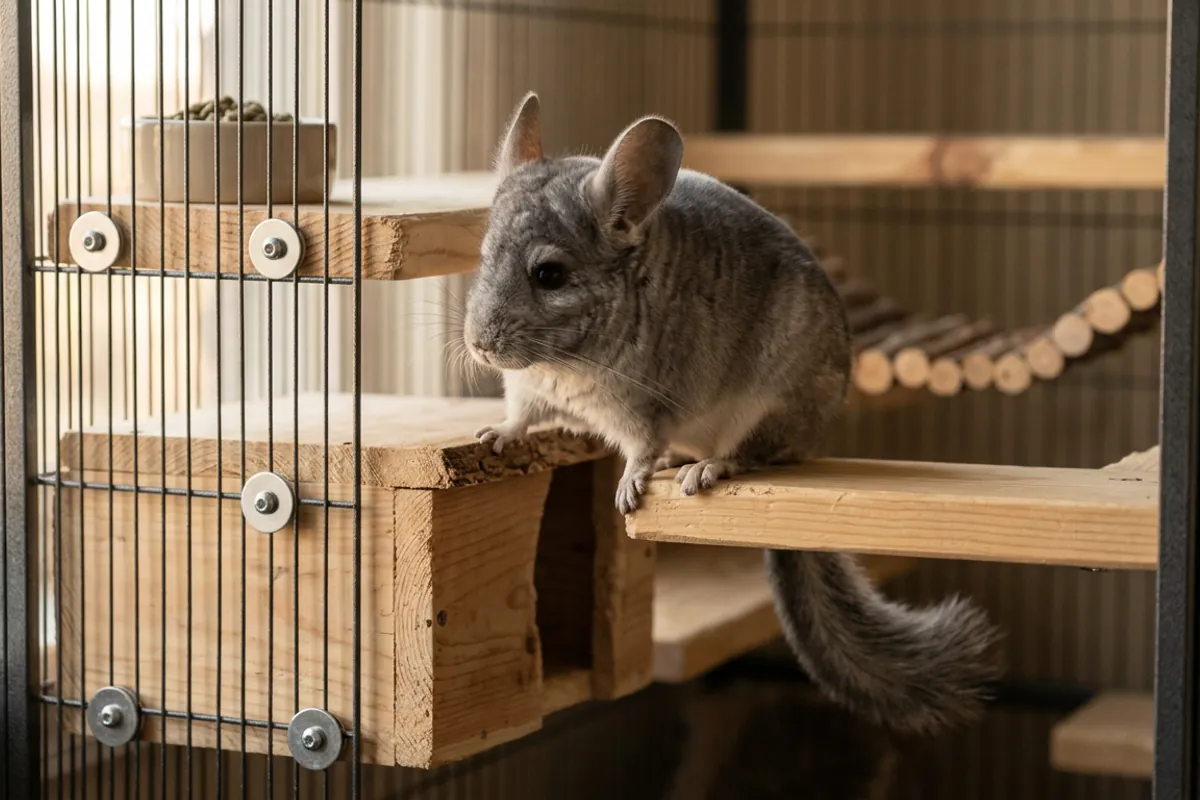
So the frame should be metal, the shelves and ledges should be solid wood, and the chew-safe woods are the ones you already know from the pellet aisle: kiln-dried pine, apple, willow, and similar untreated hardwoods. Avoid anything cedar or aromatic, anything painted, stained, sealed, or pressure-treated, and any wood you cannot confirm the source of. A natural chinchilla enclosure, in the sense that matters, just means one built from materials the animal was already going to gnaw and none it was not.
That same logic runs through the accessories. Wooden ledges instead of plastic ones, an unglazed clay or wooden hide instead of an igloo, and hanging chews of apple and other safe woods to give the teeth a real job. emours apple wood chew sticks, 40 count As an Amazon Associate I earn from qualifying purchases.
The wheel deserves its own sentence, because it is the accessory people get most wrong. Never a wire wheel and never a plastic one. Wire catches toes and hocks and does exactly the damage bars do; plastic gets chewed and swallowed. A chinchilla needs a large solid-surface metal wheel, and the diameter matters, because a wheel too small forces the spine into a permanent curve while the animal runs. 15 inch Chin Spin solid surface chinchilla wheel As an Amazon Associate I earn from qualifying purchases.
Building your own enclosure
A diy chinchilla enclosure is a good option, and often a cheaper and larger one than anything sold ready-made, as long as you respect the same rules a bought cage has to meet. People go this route to get more height and more space for the money, and that is a fine reason. What it is not is a shortcut around the materials list.
If you build, the classic approach is a repurposed metal shelving unit or a wire-panel frame lined so the bar spacing is safe, with every interior surface you add being solid untreated wood. Do the ledges yourself in kiln-dried pine, cut to leave a clear jumping path from level to level rather than a straight ladder. Skip the temptation to save time with plastic storage-tub bases or plastic connectors; a chinchilla will find them.
Three things trip up first-time builders. The first is hardware: exposed screws, staples, and zip ties get chewed, and swallowed metal or plastic is the same blockage risk as a plastic shelf, so recess or cover every fastener the animal can reach. The second is the door. It has to close on a latch a chinchilla cannot work open, because they are cleverer and more determined than they look. The third is ventilation, which a solid-walled homemade box quietly ruins; you need open mesh on enough sides that heat is not trapped, because a well-insulated enclosure is a death trap in summer for an animal that cannot shed heat. Line the tray with a solid metal or wood pan you can pull and clean, and use fleece or kiln-dried pine shavings on top, never cedar and never a wire mesh floor the animal stands on.
Build it, then live with it empty for a day and look at it like a chinchilla would: every gap, every chewable edge, every fastener. Fix what you find before the animal does.
Outdoor enclosures, and why I say no
People ask me about an outdoor chinchilla enclosure more than almost anything else, usually picturing a rabbit-style hutch on the lawn. I will be blunt, because this is one where friendly and safe point in different directions: I do not recommend keeping a chinchilla outdoors, and in most climates I would call it dangerous.
The reason is the same thermoregulation problem that runs through everything I write. A chinchilla is comfortable at 60 to 70°F (15 to 21°C). Above 75°F (24°C) it is at risk, and at 80°F (27°C) and up you are into an emergency, faster still if the air is humid, because that dense fur that keeps it warm on an Andean night cannot dump heat in a warm, still, muggy yard. Pebble, my first, came to me from an overheated attic and had a heatwave near-miss her first summer that put her in the emergency vet overnight, and that night is exactly why I do not gamble with ambient heat I cannot control. Outdoors you control none of it: not the afternoon sun, not the humidity, not the temperature swing overnight, not the predators, not the parasites, not the neighbor's dog.
If you want your chinchilla to experience fresh air, the safe version is a secure, chew-proof enclosure kept indoors near an open window in already-cool weather, supervised, never in direct sun, and brought back the moment the room warms. Not a permanent outdoor home. I go through the heat numbers in detail on the chinchilla heat safety page, and if you ever want to sanity-check a room temperature, the heat danger calculator does the math for you. If a dog shares the house, keeping a chinchilla and dog under one roof safely covers the separation an outdoor setup can never give you.
What goes inside
An empty enclosure of the right size and materials is a good start and a boring life. What goes inside is what keeps the animal healthy, and it comes down to teeth, gut, exercise, and coat.
Hay is the first thing in and the thing that must never run out. Chinchillas eat unlimited grass hay, timothy or another good grass hay, available all day every day, with plain pellets as a measured supplement and not the main meal. The hay is not filler; the long, sideways chewing motion it forces is the single best thing wearing those ever-growing teeth down evenly. I keep a hay rack mounted where it stays clean and cannot be soiled, and I keep the supply generous rather than rationed. Oxbow Western Timothy Hay, 40 oz bag As an Amazon Associate I earn from qualifying purchases.
If you go through hay the way a healthy chinchilla should, buying it in bulk saves real money over the little bagged amounts. Oxbow Western Timothy Hay, 9 lb box As an Amazon Associate I earn from qualifying purchases.
My Juniper is a rescue whose dental disease I manage day to day, and she is the reason I am uncompromising about this. When teeth do not get worn down, they overgrow into the jaw and against the tongue, eating stops, and you are into repeated vet sedations for filing. That is why unlimited hay and a real variety of hard chews are not optional extras but the core of what the enclosure holds. If you want to know the warning signs before it turns serious, chinchilla teeth problems lays them out.
Then the wheel for running, wooden ledges and hides at different heights for jumping and resting, and a scatter of safe wood chews so the teeth always have a job. And dust, which is how a chinchilla cleans itself, because they never bathe in water. The fur is so dense that water soaks in, cannot dry, and grows fungus against the skin; they roll in fine volcanic dust instead. Offer a dust bath a few times a week rather than leaving it in full time, because leaving it in dries the skin and gets soiled. I keep the dust and a heavy, tip-proof bath house on hand for this. Lixit Blue Beauty chinchilla dust, 3 lb As an Amazon Associate I earn from qualifying purchases.
The full routine, from the right dust to how often, is in the chinchilla dust bath done right, which also explains what the dust actually is if you are unsure.
Placement and keeping it cool
Where you put the enclosure is part of the enclosure. The best cage in the wrong spot is still a hot cage, and heat is the thing that kills chinchillas fastest.
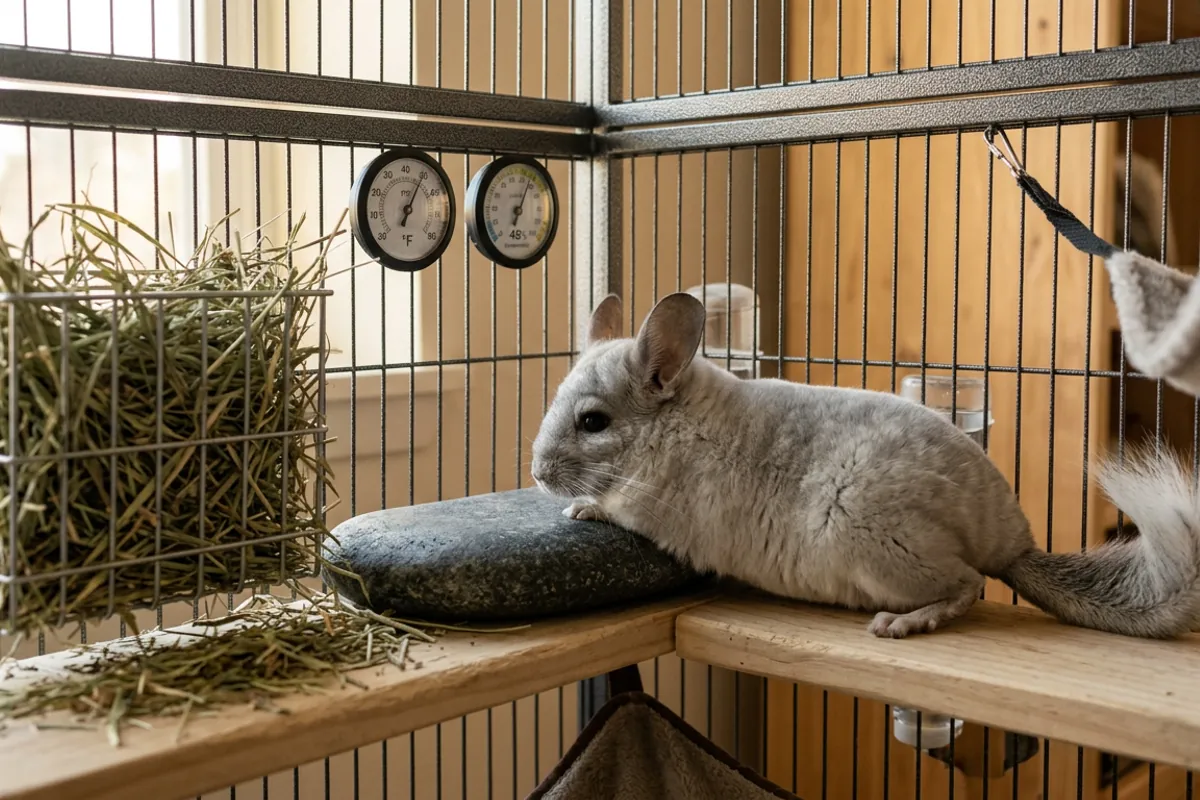
Keep it out of direct sun at every hour of the day, not just when you happen to look. Keep it away from heat sources, off the floor of a room that traps warm air, and out of a small closed room that bakes in the afternoon. What you are aiming to hold is that 60 to 70°F (15 to 21°C) band, treating anything above 75°F (24°C) as a problem to fix now and 80°F (27°C) as the emergency it is, sooner in humid air. Do not trust how the room feels to you; a chinchilla in dense fur experiences it very differently. Put a real thermometer and humidity gauge on or beside the cage and read it. digital thermometer and humidity gauge with remote probes As an Amazon Associate I earn from qualifying purchases.
For hot spells, a chilled solid stone the animal can lie against gives it a way to dump heat, and it is one of the few cooling tricks that works without soaking the fur. Kaytee Chinchilla Chiller granite stone As an Amazon Associate I earn from qualifying purchases.
None of that replaces controlling the room temperature itself with air conditioning when the weather demands it; a cooling stone buys minutes, not a season. If you ever see a chinchilla lying flat, with red ears, breathing hard or drooling, that is heat stroke and it is a straight-to-the-exotics-vet emergency, not something to wait out. The warning signs piece is worth reading before you need it.
A last word on the money, since it is where good intentions meet reality. A proper enclosure and its contents are the biggest single cost of keeping a chinchilla, and buying the right one once is cheaper than buying a too-small one and replacing it. I broke the whole picture down in what a chinchilla really costs. Build or buy tall, in metal and wood, keep it cool, fill it with hay and dust and things to climb, and you will have given the animal the one thing it needs most from you: a place that works with its biology instead of against it.