A cage full of accessories is not the same as a cage full of the right accessories, and the difference costs money at best and teeth or a life at worst. When people ask me about cage accessories for chinchillas, they usually mean the fun part: the ledges, the hammocks, the wheel, the little wooden houses. I get it. But a chinchilla does not care whether its cage looks good in a photo. It cares whether it can chew, jump, hide, and stay cool. So I sort every accessory into one of two piles: things that keep the animal healthy, and things that are decoration for me. The healthy pile comes first, and quite a lot of the decoration pile is actively dangerous. Here is how I decide what goes in the cage, what I leave out, and where you can safely save money by building your own.
Start with the cage, then hang nothing plastic in it
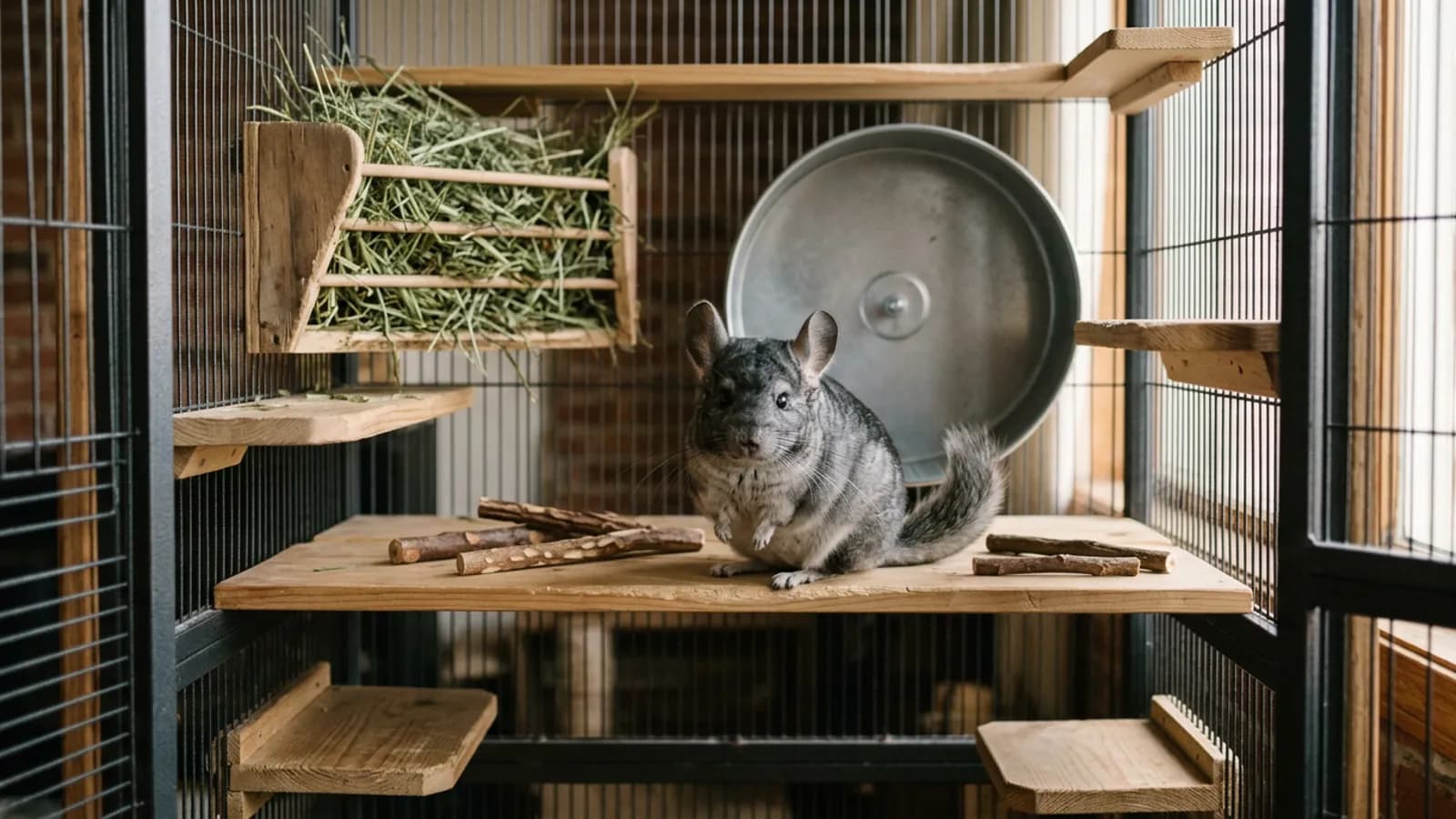
Accessories only make sense once the cage itself is right, because the cage is the one thing you cannot fix later with an add-on. Chinchillas need vertical space to jump, and they need bar spacing and materials that hold up to constant chewing. A tall metal-and-wood cage with solid wooden ledges is the frame everything else hangs on.
Critter Nation double unit small animal cage As an Amazon Associate I earn from qualifying purchases.
If you are still choosing, I have written the long version of that decision in how to pick the best chinchilla cage without buying the wrong one twice and the Critter Nation breakdown, because getting the cage wrong makes every accessory question harder.
The single rule that eliminates most bad accessories is this: no plastic anywhere a chinchilla can reach it. Chinchillas chew everything, and plastic breaks off in sharp pieces that they swallow. A swallowed shard can block or perforate the gut, and by the time you see symptoms you are at the emergency vet. That rule alone rules out plastic igloos, plastic ledges, plastic hideouts, plastic-runged wheels, and most of the "small pet" accessory aisle. When I say metal and wood, I mean it for the accessories too, not just the bars.
Ledges and shelves are the real floor of the cage
The most important accessories in any chinchilla cage are the ledges, because a chinchilla spends its life moving vertically and it lands on those ledges thousands of times. Wire mesh shelves are a common cause of bumblefoot, the painful foot sores that come from standing on a surface that concentrates pressure on the sole. Solid wood is what you want: kiln-dried pine or a safe hardwood, wide enough that the animal can turn around and sit fully on it.
Arrange ledges so the chinchilla can climb from floor to ceiling in a staggered path, not a straight ladder. I stagger mine so that if a chinchilla slips, it drops to the next ledge rather than the cage floor. That matters more as they age and their joints stiffen. Give the top a wide platform, because chinchillas like to survey from the highest point they can reach.
Lava ledges are the one non-wood ledge I use, and I use them narrowly. A pumice or lava ledge gives the feet a slightly abrasive surface and files the nails a little, but it is not a chew toy and it is not a foot treatment on its own. I explain where they help and where they get oversold in lava ledges for chinchillas. Put one near a favorite perch, not as a main walkway, and let it do its small job.
Chews are dental care, not decoration
If you take one thing from this whole article, take this: chew accessories are the most important thing in the cage after unlimited hay, and they are not optional. Chinchilla teeth grow continuously for the animal's whole life. If the teeth do not wear down against hay and hard chews, they overgrow, the roots press into the jaw and eyes, and you end up managing a painful, expensive dental disease for years.
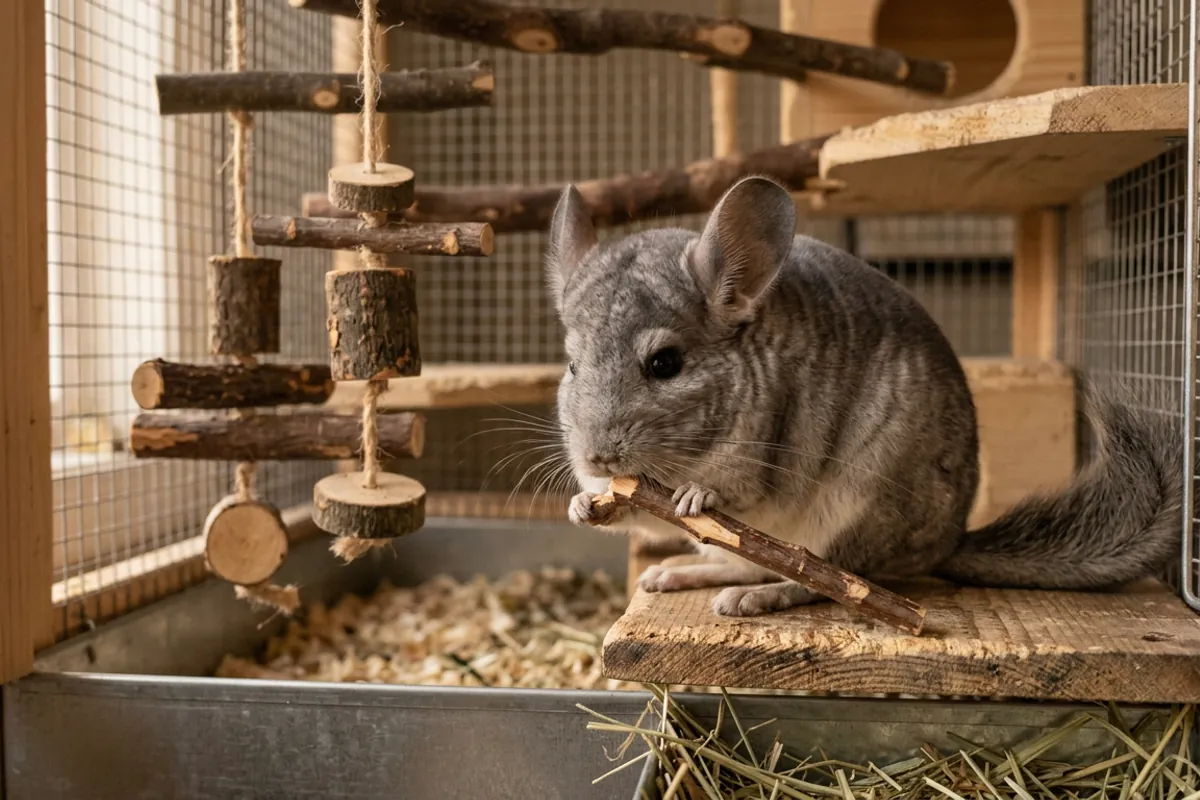
I know this one up close. My rescue Juniper came to me with dental disease already established, and I spend real effort every single day keeping her teeth worn and her chews varied. So when I say variety, I am not talking about a shopping habit. Different textures and hardnesses make the animal actually use the chews instead of ignoring them. Apple, pear, and other safe fruit woods, plus plain untreated pine, cover the range. A mixed pack of safe woods is the easiest way to keep several textures in rotation.
emours apple wood chew sticks, 40 count As an Amazon Associate I earn from qualifying purchases.
Skip anything dyed, anything glued, anything scented, and anything sold as a "treat toy" with seeds or dried fruit stuck to it. The wood must be untreated and from a safe species, because some common woods are toxic to chinchillas. I go deeper into which woods and shapes actually get used in chinchilla chew toys, and into what overgrowth looks like before it turns serious in chinchilla teeth problems. If you see drooling, weight loss, or a chinchilla dropping food, that is a vet visit, not a new chew. An exotics vet is the right call there, every time.
The wheel: solid surface or nothing
A wheel is one of the best accessories you can give a chinchilla, because they are athletic animals that need to run, and a good wheel lets them do it inside the cage every night. But the wheel is also where the market tries hardest to hurt your animal, so this is where I am bluntest.
Never buy a wire-rung or mesh wheel, and never buy a plastic one. Wire wheels catch feet and legs and cause fractures and degloving injuries; I have seen the aftermath and it is horrible. Plastic wheels get chewed and swallowed. The only wheel I will put in a cage is a large, solid-surface running wheel made of metal, big enough that the chinchilla runs with a nearly straight back rather than arched. For an adult chinchilla that means a large diameter, not the small ones sold for hamsters.
15 inch Chin Spin solid surface chinchilla wheel As an Amazon Associate I earn from qualifying purchases.
Mount it so it is stable and does not wobble, and give it a night or two before you judge whether your chinchilla uses it. Some take to a wheel immediately and some ignore it for a week and then run for hours. Either way, a solid surface and a large diameter are non-negotiable. A cheap wheel is not a saving; it is a vet bill with a delay on it.
Hay and food accessories that keep the diet right
The diet does most of the work of keeping a chinchilla healthy, and a few cage accessories make that diet easier to get right. The foundation is unlimited grass hay, timothy or another grass hay, available every hour of every day. That is the bulk of what a chinchilla eats and the main thing keeping its teeth worn and its gut moving.
A hay feeder that holds a generous amount and keeps the hay off the cage floor cuts waste and keeps the hay clean, which matters because a chinchilla will refuse soiled hay and then eat less than it should. I keep a well-stocked hay box mounted at ledge height so the hay stays dry.
Oxbow Western Timothy Hay, 40 oz bag As an Amazon Associate I earn from qualifying purchases.
Buying hay in bulk is the honest way to keep unlimited hay actually unlimited, because the cost of feeding freely adds up fast if you buy small bags.
Oxbow Western Timothy Hay, 9 lb box As an Amazon Associate I earn from qualifying purchases.
Pellets are a measured supplement, not a main course. A plain, grass-based pellet in a small heavy ceramic dish is all you need; the dish should be heavy enough that the chinchilla cannot tip or chew it. I explain portions in chinchilla pellets. For water, a bottle with a metal spout beats an open bowl that gets fouled and wets the fur, and I cover why in the honest guide to a chinchilla water bottle. Keep treats rare and simple; most "treat" accessories are sugar the animal does not need.
The dust bath is a scheduled accessory, not a cage fixture
Chinchillas clean themselves by rolling in fine dust, never in water, because their dense fur traps water against the skin and does not dry, which invites fungal infection and chilling. So the dust bath is one accessory that does not live in the cage full time.
I offer a dust bath a few times a week in a deep, heavy container, let the chinchilla roll for around ten to fifteen minutes, and then take it out. Left in the cage all day, the container becomes a litter box, the dust gets soiled, and constant bathing can dry the skin and irritate the eyes. Use real chinchilla bathing dust, the fine volcanic pumice kind, not "sand," which is coarse and abrasive.
Lixit Blue Beauty chinchilla dust, 3 lb As an Amazon Associate I earn from qualifying purchases.
A heavy metal or glass container with high sides contains most of the mess. I walk through the container, the dust, and the schedule in the chinchilla dust bath, done right and what the dust actually is in bathing dust for chinchillas. The short version: it is an accessory you bring out and put away, not one you leave in.
Heat accessories: the ones that genuinely help, and the ones that do not
This is the section I care about most, because heat is the fastest way to lose a chinchilla and the one people underestimate. My signature chinchilla, Pebble, came from an overheated attic and gave me a heatwave near-miss in her first summer that put us at the emergency vet overnight. Everything I do about temperature comes from that night.
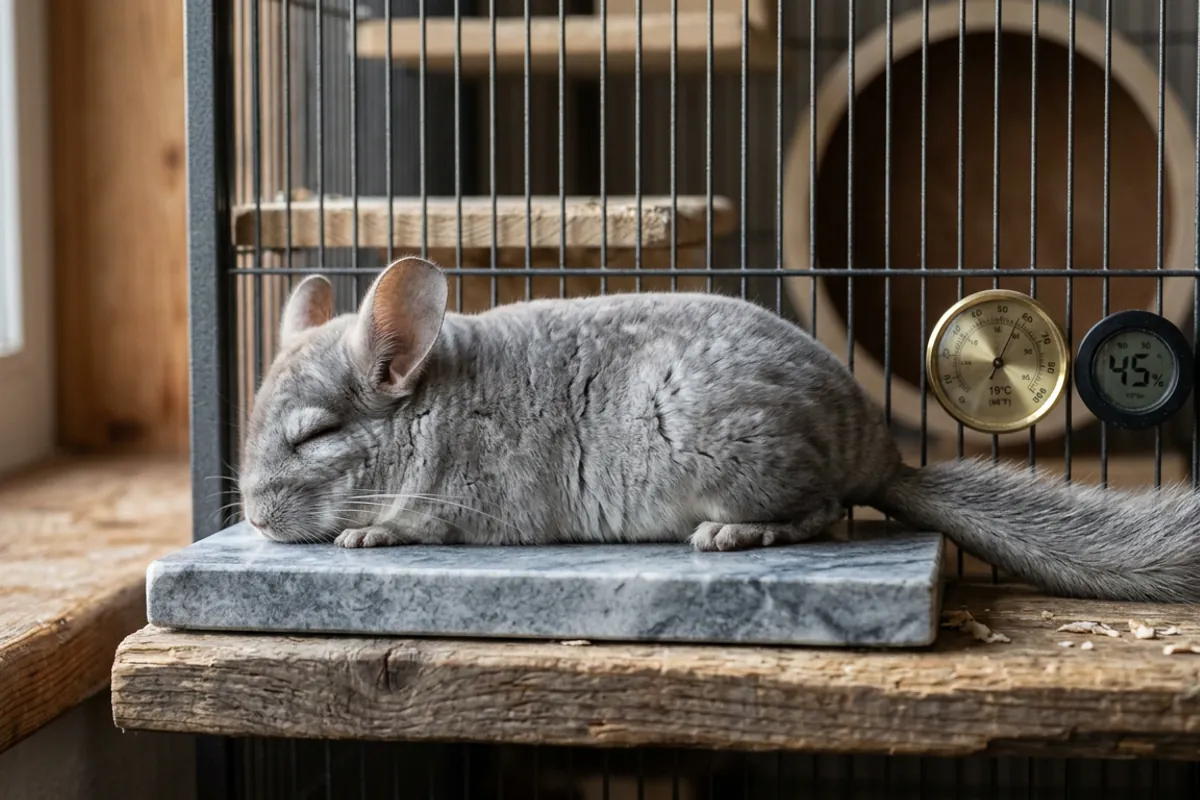
The numbers first, because they do not move: chinchillas are comfortable at 60 to 70°F (15 to 21°C). Above 75°F (24°C) is getting risky, and 80°F (27°C) and up is an emergency, faster still in humid air where they cannot shed heat. A chinchilla in heat distress lies flat, breathes with its mouth open, and has bright red ears; if you see that, cool the animal and call an exotics vet immediately. I keep the signs in one place in chinchilla heat stroke warning signs, and the whole temperature picture in chinchilla temperature.
The accessory that helps most is the one that tells you the truth about the room. A thermometer and hygrometer sitting at cage height, not across the room, tells you what the chinchilla actually experiences, and the humidity reading matters because humid heat is worse than dry heat at the same temperature.
digital thermometer and humidity gauge with remote probes As an Amazon Associate I earn from qualifying purchases.
A cooling stone gives the chinchilla a cold surface to stretch out on, and mine use theirs when the room warms.
Kaytee Chinchilla Chiller granite stone As an Amazon Associate I earn from qualifying purchases.
But be honest about what a cooling stone is: it is comfort at the margins, not air conditioning. It does not make an 80°F (27°C) room safe. Nothing hung in the cage replaces actually cooling the room. If you cannot hold the room in the safe range with air conditioning, the chinchilla is in the wrong room, and no accessory fixes that. You can pressure-test your own setup with the chinchilla heat danger calculator.
DIY chinchilla cage accessories, done safely
You do not have to buy everything, and some of the best accessories in my cages are homemade. Done right, diy chinchilla cage accessories save real money and let you size things to your exact cage. Done wrong, they are the fastest way to swallow the plastic-and-glue rule I opened with. So here are the lines I hold.
For hides and houses, I use untreated kiln-dried pine or a safe hardwood, screwed together with the screw heads countersunk and covered so no metal is exposed to teeth. No glue, no paint, no varnish, no pressure-treated lumber. A simple open-bottomed wooden box makes a better hide than most bought plastic igloos, and the chinchilla can chew it without harm. Ledges are the same story: a length of safe untreated wood, sanded, mounted with hardware the animal cannot reach, gives you a better shelf than a wire one for the cost of a board.
Fleece is the one soft material I trust, and only under supervision at first. A fleece hammock or a fleece-lined tunnel is fine as long as the chinchilla is a fleece-safe individual and does not eat the fabric; some do, and a fleece-eater needs it removed, because swallowed fabric blocks the gut just like plastic. Watch a new fleece item closely for the first week before you trust it overnight.
What I will not DIY: the wheel and anything load-bearing that a fall depends on. A homemade wheel that is the wrong diameter or not truly solid is worse than no wheel. Buy the wheel. Everything else, the ledges, the hides, the hay racks, the tunnels, you can build from safe wood and fleece for a fraction of the shelf price, as long as every piece passes the same test: could the animal chew a piece off and swallow it, and is every material safe if it does. If the answer is yes and yes, it goes in. If not, it stays out, no matter how good it looks. For how all of this fits together into one cage, I lay out the full build in how to build a chinchilla cage setup that keeps the animal healthy.