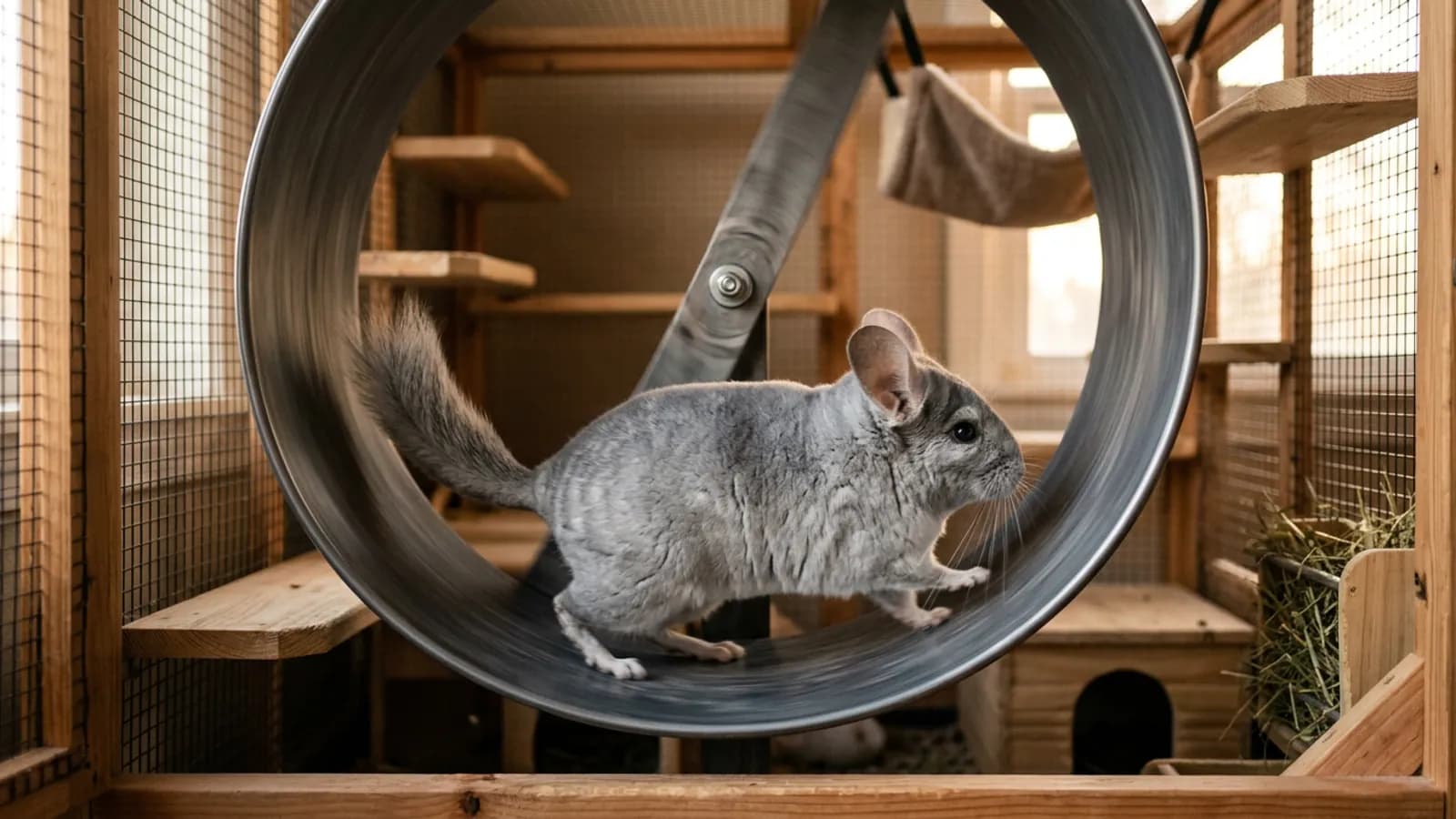
A chinchilla on a wheel is one of the few pieces of cage equipment I get genuinely excited about, and also one of the easiest to get dangerously wrong. Done right, a wheel gives a caged animal a way to burn off the frantic, springloaded energy chinchillas are built for. Done wrong, with the wrong surface or the wrong size, it is a broken leg waiting to happen. I have watched Pebble sprint on hers at two in the morning like she is training for something, and I have also pulled a wheel out of a friend's cage and dropped it straight in the bin. So before you buy anything with a chinchilla stamped on the box, here is what actually matters, from someone who has kept these animals for about ten years.
The running surface has to be solid
The single most important rule about a chinchilla wheel is the surface they run on, and it is not negotiable: it must be solid. No rungs, no wire, no mesh, no crossbars. A wheel built from wire or spaced metal bars is the classic pet-store mistake, and it is the one that ends in an emergency vet visit. A chinchilla's foot is small and their toes are fine. At speed, a toe or a whole leg slips between the rungs, the wheel keeps turning, and the result is a fracture or a nasty degloving injury. Even when nothing catches, running on bars all night grinds at the footpads and can set up sore, infected feet.
A solid running surface, usually rolled or stamped metal, spreads the load and gives nothing to fall through. My test is blunt: if you can poke a finger between the parts your chinchilla stands on, it is the wrong wheel. This is the same reason I will not use wire shelves or wire flooring anywhere in a metal cage. Feet were not built for gaps, and a wheel is the one place a foot moves fast enough for a gap to break something.
Size is spinal mechanics, not preference
Size is the next thing people get wrong, and it is not a matter of taste, it is spinal mechanics. A wheel that is too small forces a running chinchilla to arch its back into a tight C the entire time it moves. Do that night after night, in an animal that should live 10 to 20 years, and you are inviting back and joint trouble down the line.
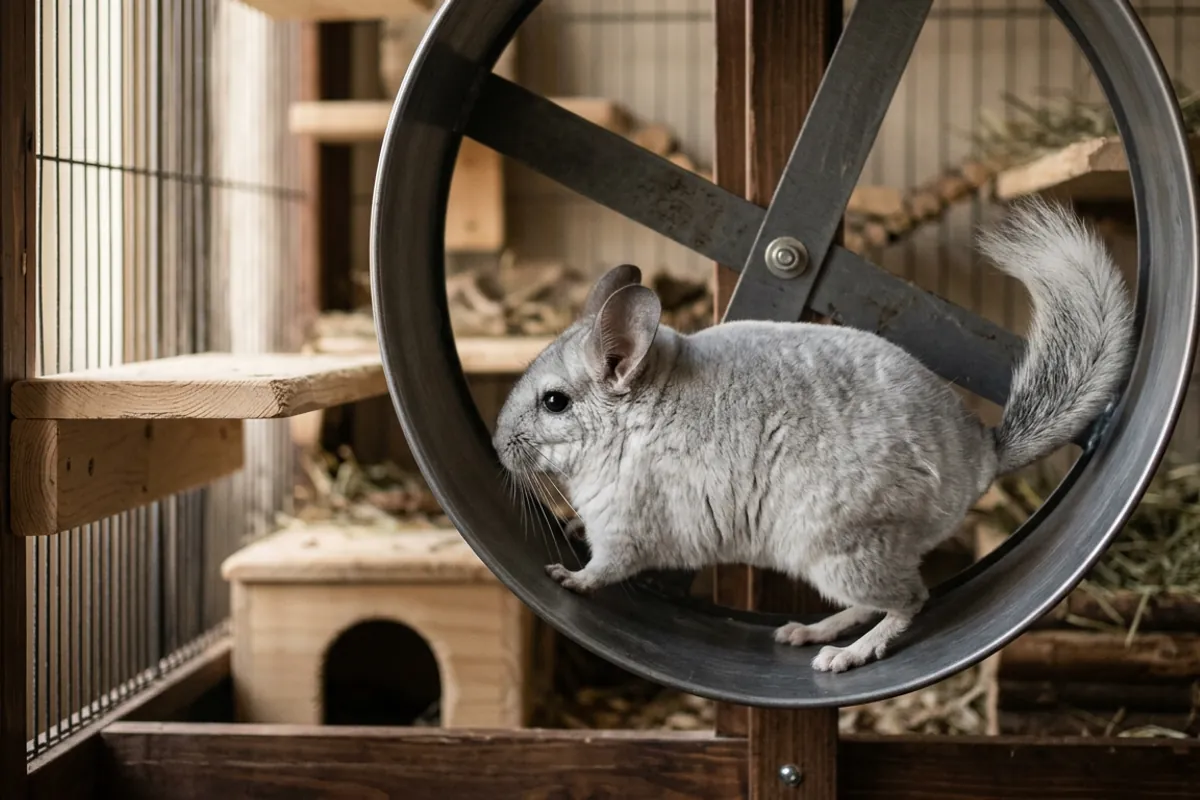
For an adult chinchilla, treat 15 inches of diameter as the practical floor and 16 inches as the more comfortable choice. A 16 inch chinchilla wheel lets a full-grown chin run with a much flatter back, and that single extra inch matters more than it sounds. You will see 11 and 12 inch wheels sold "for chinchillas" online. They are sized for rats and hamsters, and they do not belong in a chinchilla cage. If you have a big male or a long-bodied chin, buy the 16 inch and do not look back. A young kit can manage a 15 inch chinchilla wheel, but they grow into the larger one anyway, so I buy the 16 inch wheel once and skip the second purchase.
A quick word on saucer or flying-saucer wheels, the tilted discs. Some chinchillas use them happily, but the angled surface twists the spine sideways instead of curving it, and most of the ones sold are too small for a chinchilla regardless. It is genuinely debated among keepers, and I will not pretend it is settled. What is not debated is that a correctly sized upright wheel is a safe bet, so that is what I use.
Metal over plastic, every time
Now the material. Chinchillas chew. It is not a bad habit you can train away, it is how they keep constantly growing teeth worn down, and it is the whole reason I am relentless about hay and a real variety of chews for Juniper, whose dental disease I manage day to day. Hand a chinchilla a plastic wheel and they will gnaw the edges, swallow slivers, and eventually crack the thing into sharp pieces. Plastic in the gut can cause a blockage, and a blockage in an animal this size is life-threatening.
So the wheel goes metal, the same rule as the cage itself. A solid metal running surface on a metal frame gives them nothing worth chewing and nothing that shatters. When people ask me for a specific metal chinchilla wheel, the Chin Spin is the one most keepers, myself included, tend to land on: it is all metal, sized for adults, and built to outlast the chinchilla using it. I am not sponsored to say that and there is no chin spin chinchilla wheel deal in it for me, it is just the honest consensus. Any genuinely all-metal, correctly sized solid-surface wheel will do the job. 15 inch Chin Spin solid surface chinchilla wheel As an Amazon Associate I earn from qualifying purchases.
If a wheel is marketed as chinchilla-safe but has plastic panels, a plastic hub, or a plastic running track, it is not built for an animal whose survival strategy is chewing. Read the material list, not the label on the front.
The quiet part matters more than you expect
Here is the part new owners underestimate: noise. Chinchillas are crepuscular, most active at dawn and dusk, and plenty of them run hardest in the dead of night. The wheel you buy is therefore a wheel you will hear at 3 a.m., every night, from the next room over. A cheap wheel with a bare bolt for an axle squeals, rattles, and wobbles, and a wobbling wheel is both maddening and less safe.
A good wheel runs on real bearings and stays close to silent even at a full sprint. A silent chinchilla wheel is not a luxury feature, it is the difference between a wheel that lives in the cage and a wheel that ends up in a cupboard because you could not sleep. Quiet also tells you something useful about build quality: a wheel silent enough to ignore is usually one balanced and mounted well enough to be safe. And if a chinchilla wheel that ran silent for months starts to squeak, do not just shrug at it. That is grit in the bearing or a loosening mount, and it is worth a proper look before something works loose entirely.
Mounting the wheel so it stays safe
A wheel is only as safe as the way it is fixed to the cage. It needs to bolt firmly to the bars of a proper metal-and-wood cage so it cannot swing, tip, or wobble loose while a half-pound animal is flinging it around at speed. Mount it at a height where the chinchilla can step on and off from a ledge without a long drop, and leave clearance so nothing, not a tail, a foot, or a cage-mate's paw, can be pinched between the spinning wheel and the nearest ledge or wall.
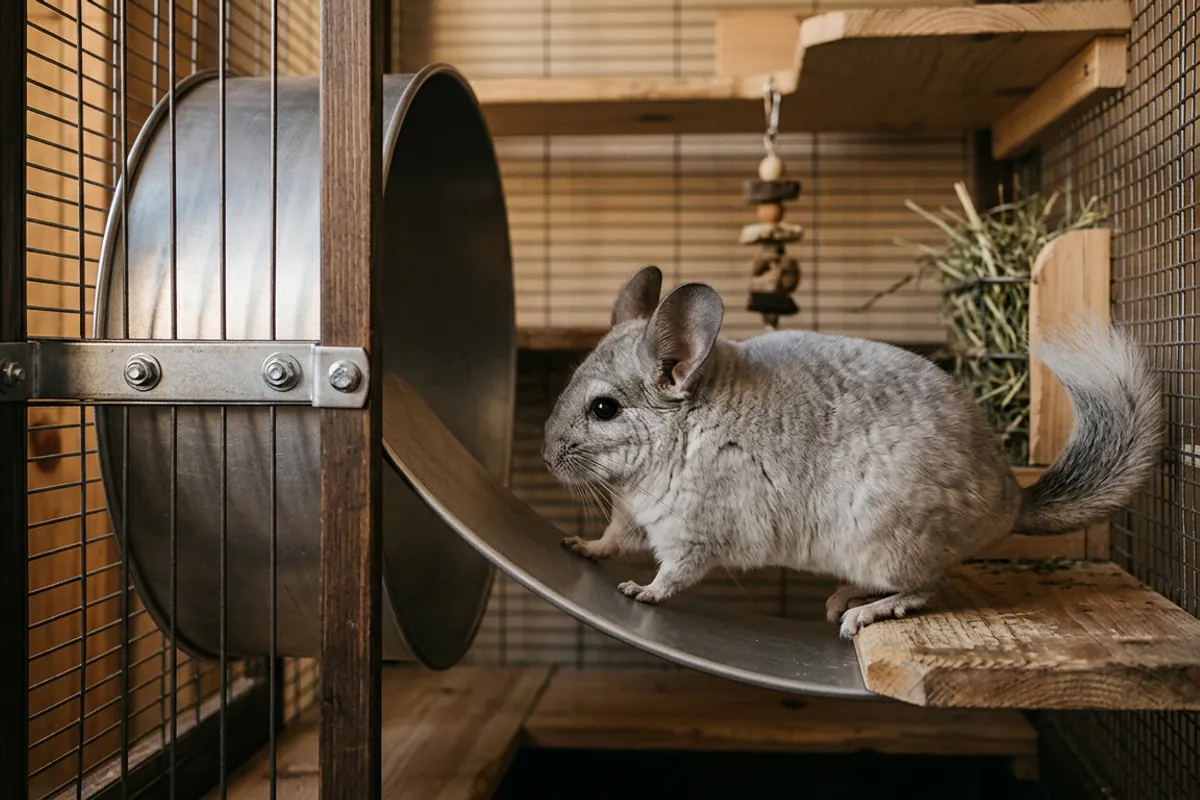
Give the back of the wheel room too. The mechanism should not sit flush against a shelf where a tail can be dragged into it. I set the wheel over a solid wooden ledge rather than open air, so a mid-run dismount lands on wood, not on the cage floor two levels down. If you are still choosing the cage itself, buy the tall metal-and-wood kind with the wheel already in mind, because you need a clear vertical stretch of bars to bolt it to and enough internal height that the wheel does not crowd the ledges. Critter Nation double unit small animal cage As an Amazon Associate I earn from qualifying purchases.
Getting the whole layout right, wheel included, is easier when you plan it once. If you are building the enclosure from scratch, my full walkthrough on setting up a chinchilla cage covers where the wheel fits alongside ledges, the water bottle, and the dust bath.
Should you build a chinchilla wheel yourself
People ask me about a chinchilla wheel DIY build regularly, usually to save money, and I understand the impulse, because a good metal wheel is not cheap. But a safe DIY chinchilla wheel is far harder than the tutorials make it look, and the failure modes are exactly the ones that hurt an animal.
To do it right you need a truly solid running surface with no gap a foot can slip into, a running diameter of a full 15 to 16 inches, an axle on real bearings so it neither wobbles nor seizes, a mount that holds against a sprinting chinchilla's force, and not one single component that is chewable or toxic. Miss any one of those and you have rebuilt the wire-wheel injury with extra steps. I have watched DIY chinchilla wheel attempts fail on chewable wood surfaces, on a gap at the seam, and on an axle that worked loose inside a week. If you honestly have the metalworking skill to hit every one of those marks, you already know it. For everyone else, the real math is that a bin full of failed attempts costs more than the wheel you should have bought the first time. This is one of the few places where I tell people flatly not to make it themselves.
When your chinchilla ignores the wheel
Here is the thing no product page will tell you: some chinchillas never take to a wheel at all, and that is completely fine. Pebble runs on hers most nights. Juniper has looked at a wheel exactly once in her life and decided it was beneath her. Neither of them is doing it wrong.
A wheel is a supplement to exercise, not a replacement for it. Every chinchilla still needs regular time out of the cage in a safe, chinchilla-proofed, cool room to actually stretch, jump, and wall-bounce, and every chinchilla needs a cage big enough to move in whether or not a wheel is bolted inside. If yours ignores the wheel, pour that energy into out-of-cage time and into things they will genuinely use. A real variety of safe wood chews does more for a bored, dentally healthy chinchilla than any wheel, because it works the teeth as well as the mind. emours apple wood chew sticks, 40 count As an Amazon Associate I earn from qualifying purchases.
One last thing, and it is the Pebble rule I never bend. A hard run warms an animal that already cannot shed heat well. A chinchilla sprinting on a wheel in a room drifting toward 75°F is a worse idea than it looks, and above 80°F it is dangerous fast, faster still in humid air. Keep the room in the safe 60 to 70°F (15 to 21°C) band whether the wheel is spinning or not, and put a real thermometer where you can see it rather than trusting how the room feels. digital thermometer and humidity gauge with remote probes As an Amazon Associate I earn from qualifying purchases.
If you keep the room cool and the heat under control, a solid, correctly sized, all-metal wheel is one of the best pieces of enrichment you can give a caged chinchilla. Get the surface, the size, and the material right, mount it well, and let the animal decide how much it wants to run.