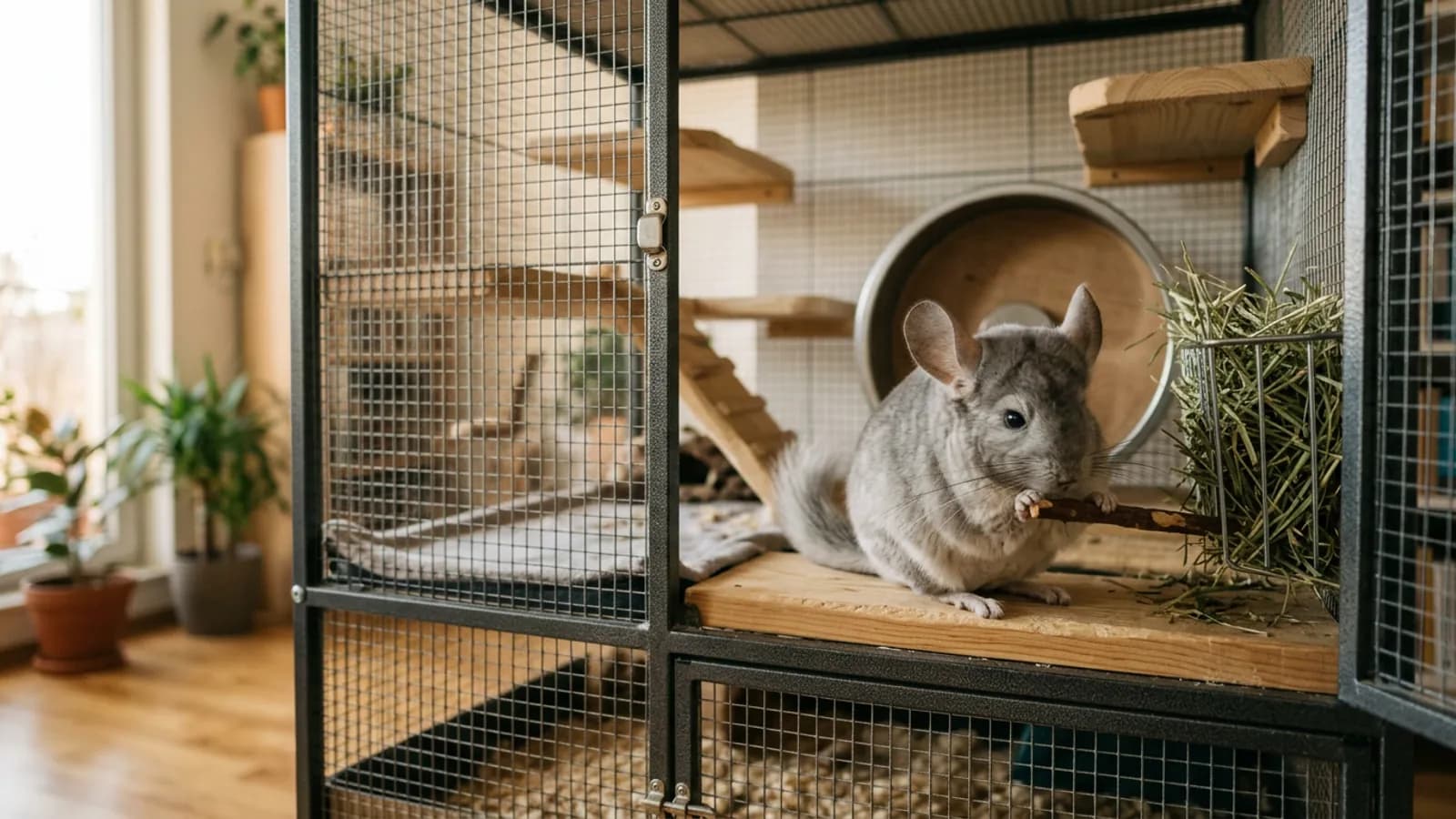
If you have typed "petsmart chinchilla cage" into a search bar, you are probably standing in one of two places: in the small animal aisle with your phone out, or at home the night before your chinchilla arrives, trying to work out whether the cage on the shelf is the right one. I have stood in both spots. So here is the honest version, owner to owner, of what you actually get when you buy a chinchilla cage from a big chain like PetSmart: what those cages get right, what they get wrong, and how to tell the difference before your money is gone.
The short version is that a store like PetSmart is a fine place to buy hay, dust, and chews, and a hit or miss place to buy the cage itself. Inventory changes constantly, and the model on the shelf this month may be gone the next, so I will not pretend to review a specific product I cannot see. What I can hand you is the set of rules I use to judge any cage, chain store or not, so you can walk in able to reject the wrong one on sight and recognize the rare good one. If the animal itself is coming from the same store, read what a PetSmart chinchilla really costs first.
What people are really asking when they search "petsmart chinchilla cage"
When someone searches this, they almost never care about PetSmart the company. They are asking a practical question: is the cage I can buy today good enough for a chinchilla, or am I about to make a mistake I will pay for later? A few are asking whether the store even sells a proper chinchilla cage at all, because the small animal section lumps hamsters, gerbils, guinea pigs, rats, and chinchillas together, and those animals need wildly different housing.
That lumping is the root of most of the trouble. A cage labeled for small animals, or even one with a chinchilla printed on the box, is not automatically sized or built for a chinchilla. The label is marketing; the dimensions and the materials are the facts. So the rest of this article is about reading the facts, not the label, and about what to do with whatever you end up buying. If you want the full decision walk through, I wrote it up separately in how to pick the best chinchilla cage without buying the wrong one twice, and this is the store aisle version of the same thinking.
The size a cage has to clear before anything else
A chinchilla is an athlete. In the wild these are rock dwelling animals that leap, climb, and change direction in the air, and a cage that does not let them move like that is a cage they slowly go stir crazy in. Floor space matters, but height matters more, because the vertical is where a chinchilla actually lives.
For a single chinchilla I want a minimum footprint of roughly 3 feet wide by 2 feet deep, and at least 3 feet tall, and honestly more is better on every axis. Two chinchillas need more again. The reason store cages fail here is simple: many of the cages sitting in the small animal aisle were designed for a rat or a hamster, and they are shorter and narrower than a chinchilla needs. If a cage cannot clear that rough minimum, it does not matter how nice the door latches are or how pretty the finish is, it is the wrong cage, and no amount of clever fitting out fixes a box that is too small. I have written about why cramped housing is such a problem in the honest truth about a small chinchilla cage if you want the longer argument.
The one bright spot at a chain store is that the taller multi level cages, the ones marketed for ferrets, are often close to right or exactly right for a chinchilla. So do not restrict yourself to the shelf tag that says chinchilla. Read the dimensions on every cage in the aisle, and bring a tape measure if you are the type who trusts numbers over boxes, which you should be.
Wire shelves and plastic pans, the two things that make me put a cage back
Here is where most store cages lose me. Two features show up again and again, and both are genuine hazards, not preferences.
The first is wire shelving and wire ramps. A chinchilla stands and moves on those thin bars all day, and over time that constant pressure on the bottom of the foot leads to sore, cracked footpads, the condition keepers call bumblefoot. Wire ramps also catch a leg when a startled chinchilla bolts. If a cage comes with wire shelves, that is not a dealbreaker on its own, because you can pull them and replace them, but you have to actually do it, not mean to do it someday.
The second is plastic. Plastic pans, plastic shelves, plastic ramps, plastic hides. Chinchillas chew everything within reach, and they do not spit out the pieces, they swallow them. Swallowed plastic can jam the gut, and a gut blockage in an animal this small is a life threatening emergency that ends at an exotics vet, if it ends well at all. A deep plastic base pan that the chinchilla cannot reach from inside is usually tolerable, because the bars keep their teeth off it. Plastic they can actually touch is not. This is the whole reason a chinchilla cage has to be built mostly from metal, and I go through it in detail in why a chinchilla cage has to be metal, and how to fit it out.
So when I pick up a store cage, my hands go straight to two questions: can the chinchilla reach any plastic from inside, and are the shelves wire? Those two answers tell me most of what I need to know before I have even looked at the price tag.
What a chain store cage does get right
I do not want to leave you thinking every cage at a big pet chain is junk, because that is not true either. The better ferret and small animal cages sold at these stores are built on a coated metal frame with bar spacing narrow enough that a chinchilla cannot squeeze through or get a head stuck, and some of them are genuinely tall with wide front doors that make it easy to reach every corner. Easy access matters more than people expect, because a cage you dread opening is a cage you clean less often, and a dirty cage is its own health problem.
The double door multi level cages in particular, the style many keepers know by name, are a real option and one plenty of chinchilla people use happily. I have written a whole piece on whether one popular model fits, in is the Critter Nation cage right for a chinchilla, and the short answer is that the frame is excellent and the shelves that come with it are the part you swap out. That pattern, good bones and bad accessories, is common to most of the decent store cages. You are buying the metal box, not the plastic and wire it happens to ship with.
The other thing a store like PetSmart genuinely does well is the consumables. Their grass hay, their dust, their plain pellets, and their safe wood chews are easy to restock on the same trip, and those are things you will buy again every few weeks for the entire life of the animal. Do not let a weak cage selection put you off the store for everything else.
Fitting out a store cage so it actually works
Say you have brought home a tall metal cage with a deep plastic base and a couple of wire shelves. Here is how I turn that into something a chinchilla thrives in, rather than merely survives in.
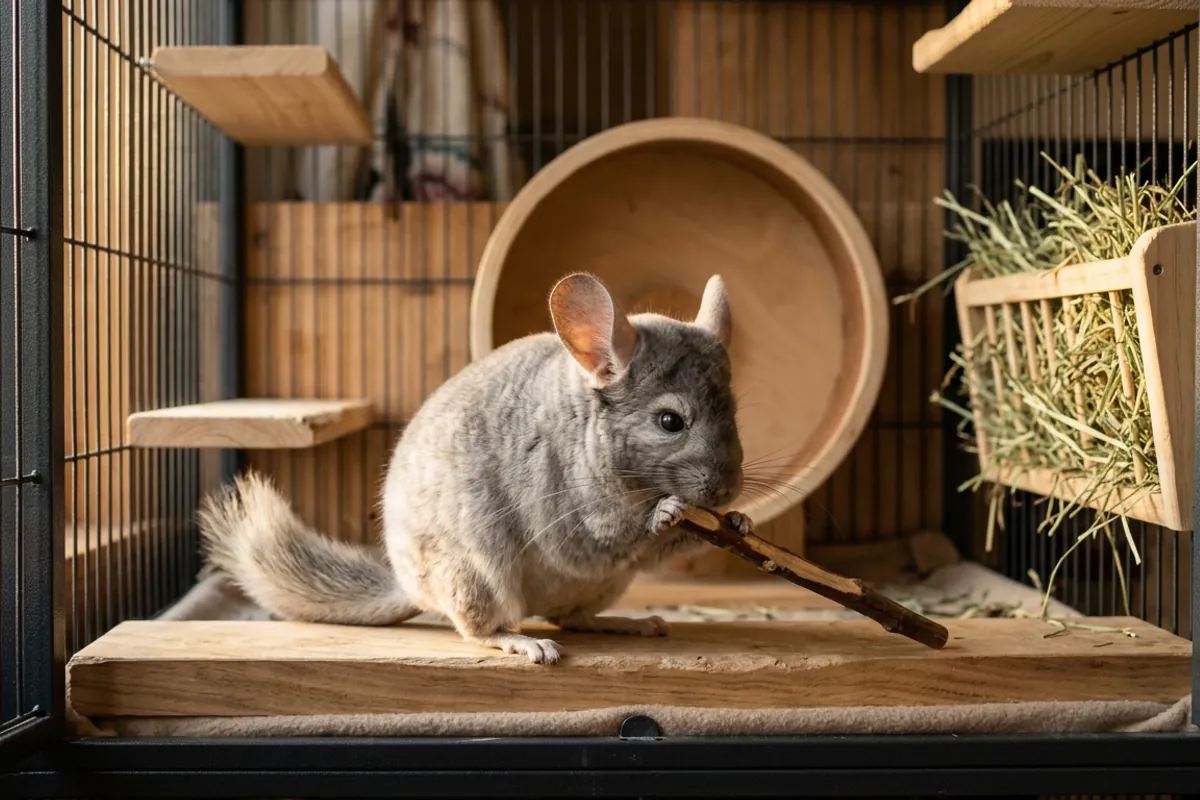
Pull the wire shelves and replace them with solid wooden ledges, mounted at staggered heights so the chinchilla can hop from one to the next. Kiln dried pine or a safe hardwood is what you want, and ledges do double duty as chew surfaces. Give the cage a real jumping course, not one lonely shelf near the floor.
Add a solid surface running wheel, never a wire rung one, because a foot or a tail slips between wire rungs and breaks. A solid running surface of at least around 15 inches across, so the back is not forced into a tight curve, is what a chinchilla needs. 15 inch Chin Spin solid surface chinchilla wheel As an Amazon Associate I earn from qualifying purchases.
Mount a hay source they can reach without climbing over their own droppings, and keep it full, because grass hay is the entire foundation of the diet and it should never run out. I buy timothy in bulk so I am never tempted to ration it. Oxbow Western Timothy Hay, 9 lb box As an Amazon Associate I earn from qualifying purchases.
Give them wood to chew, and give it variety, because teeth that never get worn down grow into the kind of dental trouble I manage in one of my own chinchillas every single day. A mix of apple, willow, and other safe woods keeps it interesting enough that they keep coming back to it. emours apple wood chew sticks, 40 count As an Amazon Associate I earn from qualifying purchases.
And set up a dust bath they use a few times a week, not a water bath, ever. Chinchillas clean that dense fur by rolling in fine volcanic dust, and water soaks into the coat and does not dry, which invites fungal skin trouble. A heavy dust bath house they cannot tip over is what I use. Lixit Blue Beauty chinchilla dust, 3 lb As an Amazon Associate I earn from qualifying purchases.
If you want the full room by room version of this, how to build a chinchilla cage setup that keeps the animal healthy walks through every piece.
When to skip the store cage and just buy the right one once
Sometimes the honest advice is to not buy the cage in front of you. If the only chinchilla labeled cage in the store is short, narrow, and wrapped in plastic you cannot remove, walking out and ordering a purpose built cage is the cheaper choice in the long run, because you will not be buying a second cage in six months when the first one clearly does not work.
What I would rather you buy once is a tall cage built from a metal frame and wire with wooden ledges, no plastic within reach, the kind of thing that lasts the fifteen or so years a chinchilla can live. Critter Nation double unit small animal cage As an Amazon Associate I earn from qualifying purchases.
Buy once is not me talking you into the expensive option for its own sake. It is that a good chinchilla cage genuinely outlives several cheap ones, and the cheap ones cost you in vet visits and stress along the way. Spend the afternoon reading dimensions and materials, and buy the last cage first. Your future self, the one not shopping for a replacement, will thank you.
Where the cage sits matters as much as the cage
The best cage in the world in the wrong spot will still cook your chinchilla, and no store sells a fix for that, so I will not let this article end without it. Chinchillas carry one of the densest coats of any mammal, they cannot sweat, and they overheat fast.
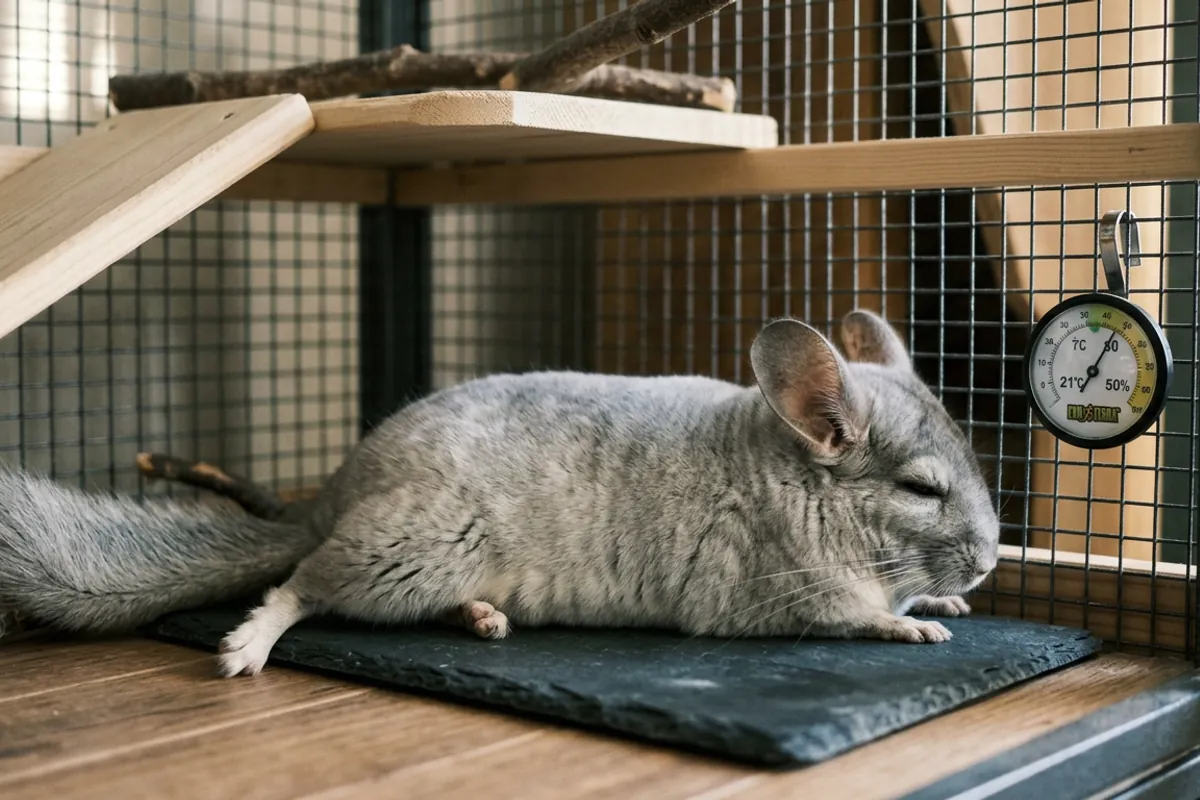
Keep the room between 60 and 70°F (15 to 21°C). Above 75°F (24°C) is getting risky, and 80°F (27°C) and up is an emergency, faster still when the air is humid, because damp air strips away what little cooling they manage. My whole obsession with heat comes from one of my own chinchillas nearly dying of it during her first summer, a night at the emergency vet I do not want you to repeat. So put the cage on an inside wall, out of direct sun, away from radiators and the afternoon window, and keep a thermometer with a humidity reading on the cage where you will actually glance at it. digital thermometer and humidity gauge with remote probes As an Amazon Associate I earn from qualifying purchases.
In summer a chilled stone gives them somewhere to lie and dump heat, and it is one of the few genuinely useful hot weather tools rather than a gimmick. Kaytee Chinchilla Chiller granite stone As an Amazon Associate I earn from qualifying purchases.
If your chinchilla is ever flat out, breathing hard, with red ears, that is heat stroke, and it is a vet emergency, not something to wait out. I keep the whole heat picture in one place at chinchilla heat safety, and it is the one part of chinchilla keeping I refuse to soften for anyone.
A cage from PetSmart can be part of a perfectly good setup. Just buy it with your eyes open: read the dimensions, reject the plastic and wire your chinchilla can reach, swap in wood and a solid wheel, and put the whole thing somewhere cool. Do that, and it does not much matter whose name is on the box.