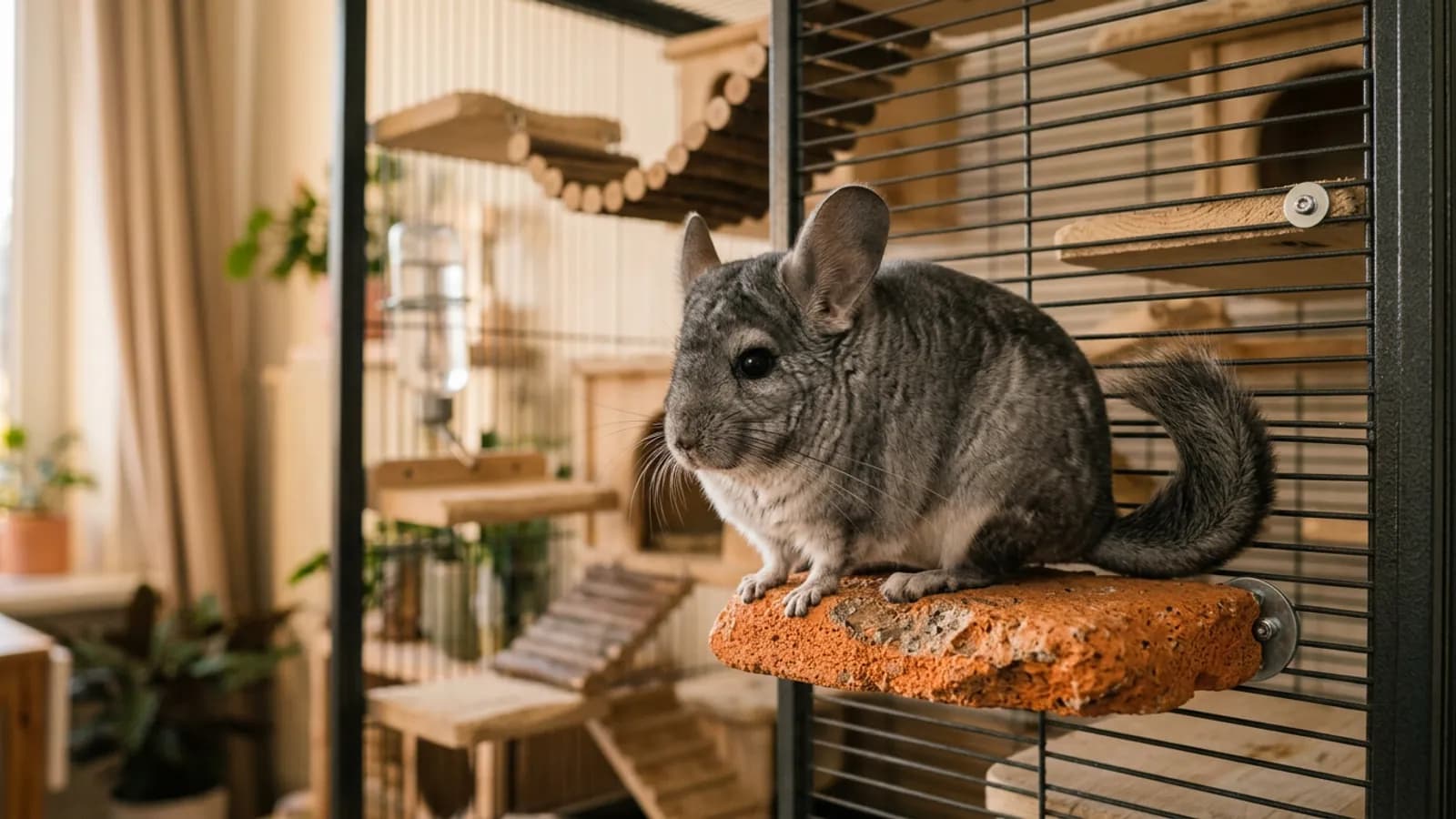
Lava ledges show up in almost every chinchilla starter kit and on every pet store shelf, usually sold as a chewable perch that files nails and teeth while your chinchilla climbs. I have used them for years alongside Pebble and Juniper, and they earn a place in the cage, but not for all the reasons the packaging gives you. A lava ledge is a good, cheap climbing surface with some genuine chew value. It is not a dental care tool, and it is not the perch to build a whole cage around. Here is what these things actually are, where they help, and how to fit them into a setup without believing the marketing.
What a lava ledge actually is
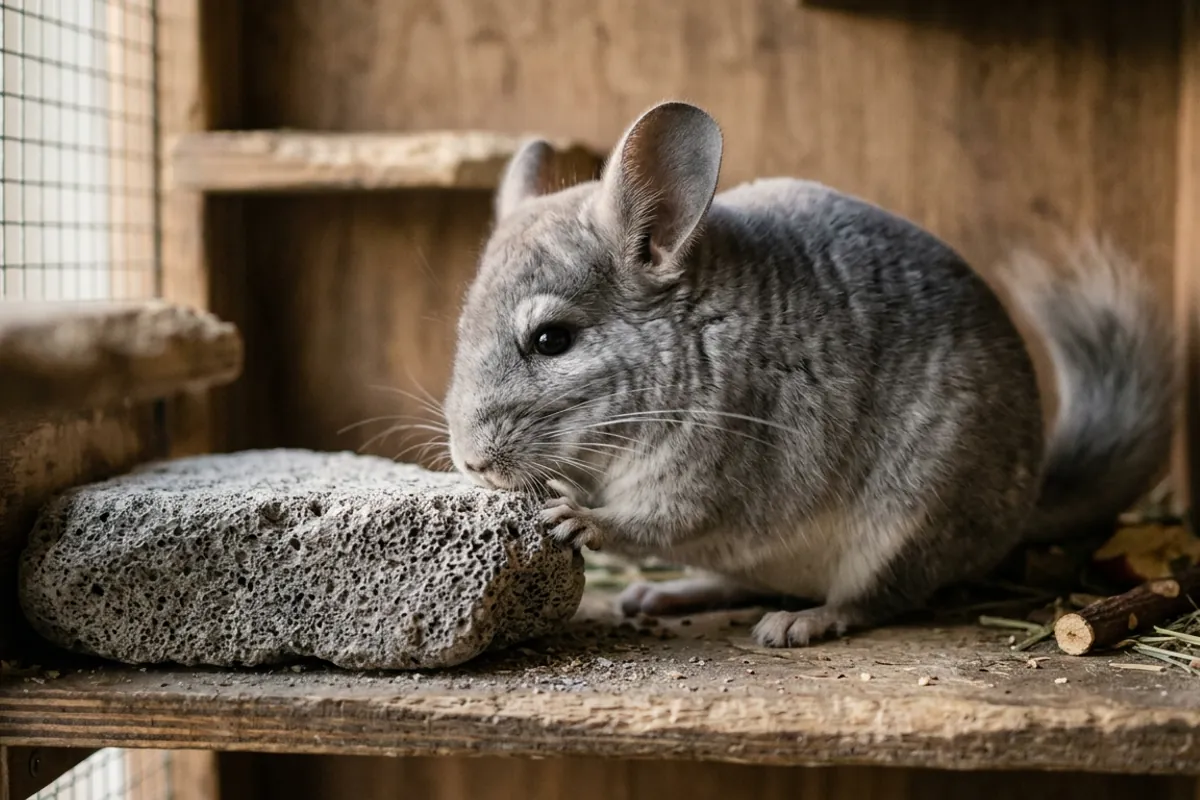
A lava ledge is a slab of pumice, the light, porous volcanic rock that is full of tiny air holes, mounted on a bolt so it clamps to the bars of the cage as a shelf. Pumice is soft as rock goes, gritty to the touch, and light enough that a chinchilla can gnaw pieces off the edge over time. That grittiness is the whole selling point. The rough surface gives good footing, and the softness means it is one of the few hard cage fixtures a chinchilla can safely chew without cracking a tooth on it.
Most of them are dyed in bright colors, which is purely for the human buying it. The dye used on reputable brands is non-toxic and the chinchilla eating small amounts of pumice grit will pass it without harm, but do not let a chinchilla treat the whole ledge as food and grind it down to the bolt in a month. A chinchilla lava ledge is a perch first and an occasional chew second. If yours is disappearing fast, that is a sign the animal is short on better things to gnaw, not a sign the ledge is doing its job.
The bolt matters as much as the rock. You want the exposed threaded end capped or seated flush against the bars, because a chinchilla will climb, jump, and land near it constantly, and a protruding bolt is a real injury risk to a foot or an eye.
Why a chinchilla needs ledges at all
Chinchillas are built to move up, not just across. In the wild they live in rocky ground in the Andes, scrambling over ledges and into crevices, and a healthy captive chinchilla will use every inch of vertical space you give it. That is the case for a tall cage in the first place, and it is why ledges for chinchillas are not optional decoration. They turn a plain box into something the animal can actually navigate.
Good ledges do three honest things. They break the cage into levels so a chinchilla can climb, jump, and choose its height, which is real exercise. They give the animal safe landing spots instead of one long drop to the floor. And they let a chinchilla get up off the wire or the cage pan and rest somewhere it can grip. A cage with a solid wheel and a couple of ledges at staggered heights will get more use than a cage with nothing to climb, and a bored chinchilla is a chinchilla that chews bars and paces.
The other reason is foot health. A chinchilla standing all day on bare wire or a single hard surface can develop sore, irritated hocks over time. Varied surfaces at varied heights spread the load. That is exactly why I never build a cage out of one material. Lava, wood, and a solid resting shelf together give the feet a break from any single texture. If you want the full picture of how the levels, wheel, and hides fit together, I go through it in the chinchilla cage setup guide.
What lava ledges do, and the claims that go too far
Here is where I get blunt, because the packaging on a lava ledge for chinchillas usually oversells it. The two claims you will read are that it files down nails and that it wears down teeth. Both are half true at best.
Nails first. Chinchillas, unlike some rodents, very rarely need their nails managed at all. A healthy chinchilla on varied surfaces keeps its own nails in shape, and I have never once trimmed Pebble's or Juniper's. A lava ledge does add a gritty surface that helps, but if your chinchilla's nails are actually overgrowing, that is a husbandry or health issue to look at, not something a rock in the corner fixes on its own.
Teeth are the claim that actually worries me, because it is the one that gets animals hurt through neglect. A chinchilla's teeth grow continuously for its whole life, and they are worn down almost entirely by the side-to-side grinding of chewing coarse grass hay, not by gnawing hard objects. Juniper has dental disease, and I manage it every single day with unlimited hay and constant chewing, so I do not take this lightly. A lava ledge gives a chinchilla a hard thing to gnaw, which is enrichment and helps with the front incisors a little, but it does nothing meaningful for the back molars where malocclusion actually kills. Do not let a lava ledge convince you the teeth are handled. Unlimited grass hay handles the teeth. Everything else is a bonus.
If you want to understand what real dental wear depends on and how to catch trouble early, read chinchilla teeth problems. Treat the lava ledge as one more thing to chew, in the same bucket as wood, not as dental care.
Kaytee lava ledge and what to check before you buy
The Kaytee lava ledge is the one most people find first, because Kaytee is stocked nearly everywhere and the price is low. It is a perfectly serviceable pumice ledge, and I have no quarrel with the material. What I check on any of these, Kaytee or otherwise, is the same short list.
Check the size. A ledge that is too small forces a chinchilla to perch awkwardly on the edge; you want enough surface for the animal to sit squarely with all four feet. Check the mounting hardware for the capped or recessed bolt I mentioned, and confirm the wing nut tightens hard against the bars so the ledge does not spin or sag under weight. Check that the pumice is a single solid piece with no deep cracks, because a cracked ledge can break loose mid-climb.
The thing the Kaytee packaging leans on, again, is the nail and tooth filing pitch. Buy it for what it is: a cheap, grippy, chewable shelf that adds a level and a texture to the cage. At that job it is fine. I would not build a cage entirely out of them, and I cover why in the materials section below.
One more practical note. Because pumice is abrasive, a chinchilla that only ever sits on lava can get its feet a bit dry and rough. Give it that break from lava by pairing it with wood, which brings me to the comparison that actually matters.
Wood ledges, lava, and the metal ones to avoid
If I had to keep only one type of shelf, it would be wood, every time. Chinchilla wood ledges made from a safe hardwood like kiln-dried pine, or from chinchilla-safe woods such as apple or willow, give good footing, hold up to climbing, and are fully chewable in a way that is genuinely useful. A chinchilla that gnaws the edge of a wood ledge is doing exactly the kind of constant, varied chewing that keeps its whole mouth working. That is chew value with a real payoff, not just a novelty. Pair the ledges with a rotation of loose chews so the animal always has fresh wood to work on. A simple apple wood chew variety pack covers that. emours apple wood chew sticks, 40 count As an Amazon Associate I earn from qualifying purchases.
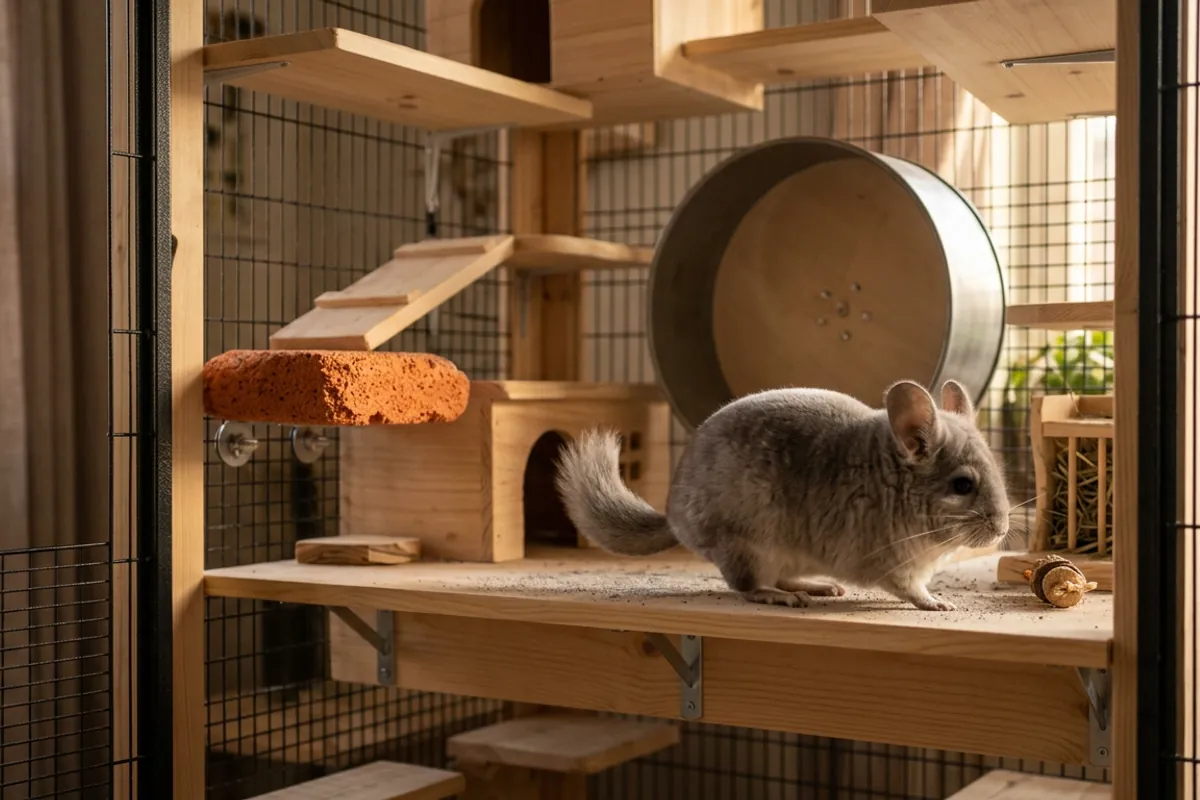
Lava sits a rung below wood for me. It is a fine second texture, cheap, and grippy, and its chewability is real if limited. I use lava ledges as accents, one or two in a cage, to add a different surface and a spot the chinchilla clearly enjoys climbing. I do not use them as the main perches.
Metal chinchilla ledges are the ones I tell people to get rid of. A lot of cages, especially the older or cheaper ones, ship with bare metal shelves or wire mesh platforms. They offer nothing to chew, they are slippery, they are hard on the feet, and metal swings with the room temperature. In summer a metal shelf in a warm room heats up, and in a species where 75°F (24°C) is already risky and 80°F (27°C) is an emergency, I do not want any surface adding heat. If you want to actively cool a chinchilla, that is a job for a proper chinchilla cooling stone of marble or granite, kept in the shade, not a hot metal ledge. Kaytee Chinchilla Chiller granite stone As an Amazon Associate I earn from qualifying purchases.
If your cage came with metal shelves, cover them with a wood tile or swap them for wood outright. My own cages are built on a metal-and-wood frame with wooden ledges throughout, which is the setup I would point anyone toward. Critter Nation double unit small animal cage As an Amazon Associate I earn from qualifying purchases.
Making your own: DIY chinchilla ledges
You do not have to buy every shelf. DIY chinchilla ledges are one of the easier and cheaper things to make, and homemade wood ledges are honestly better than most store shelves because you control the wood and the size.
The core of any chinchilla ledges DIY project is the wood itself. Use a chinchilla-safe wood: kiln-dried pine is the common workhorse, and apple, willow, and pear are all safe. Never use cedar or fresh green pine, both of which release oils that are bad for a chinchilla's airways, and never use pressure-treated, painted, stained, or glued-together lumber, because the chinchilla will chew it and swallow whatever is on it. That last rule is the whole game with anything DIY: assume it goes in the mouth.
The build is simple. Cut a solid piece of safe wood to the depth and width you want, sand the edges so there are no splinters, and mount it to the bars with a stainless steel bolt and washers, capping the exposed thread on the inside. A common approach is a hanger bolt, threaded into the wood on one end and through the cage bar with a wing nut on the other. Keep the exposed metal to a minimum and always on the outside of the cage where you can.
For a lava version, you can drill a pumice block and mount it the same way, but honestly the store-bought lava ledges are cheap enough that I rarely bother making my own lava; I make wood and buy lava. Whatever you build, inspect it often. A ledge that a chinchilla has chewed down to a thin lip, or one where the bolt has worked loose, gets replaced before it fails under a climbing animal. If you want the wider view of building a cage that lasts, setting up a chinchilla cage the right way walks through the whole thing once.
Arranging ledges so they help instead of hurt
Having the right ledges is half of it. Where you put them is the other half, and a badly arranged cage of good ledges can hurt a chinchilla.
Stagger the heights. Chinchillas jump and climb constantly, and you want them able to move up and down in short, manageable hops rather than facing one long fall. Offset the ledges left and right at different levels so there is always a landing point below, never a straight vertical drop to a hard pan. A young, spry chinchilla will fling itself around; an older one, or one that is a bit stiff, needs the closer spacing more.
Mix the materials on purpose. I put wood ledges as the main resting and chewing spots, add a lava ledge or two as extra texture and climbing interest, and keep at least one solid flat surface where the animal can lie out and rest its feet. That variety is what keeps hocks healthy. Do not tile the whole cage in lava, and do not leave a single bare metal or wire shelf as the only place to sit.
Keep ledges clear of the wheel's path and out from directly under each other where droppings and urine would rain down onto the shelf below. A solid running surface wheel, mounted where a chinchilla can reach it from a ledge, rounds out the movement side of the cage. 15 inch Chin Spin solid surface chinchilla wheel As an Amazon Associate I earn from qualifying purchases.
And do the boring maintenance. Ledges get soiled, chewed, and loosened. I wipe them down at cage cleaning, check every bolt with a hand, and pull anything cracked, wobbling, or gnawed thin. A ledge is a load-bearing part of a climbing animal's home. Treat it like one, keep wood in the majority, use lava ledges as the useful accent they are, and skip the metal, and you will have a cage the chinchilla actually lives in from top to bottom.