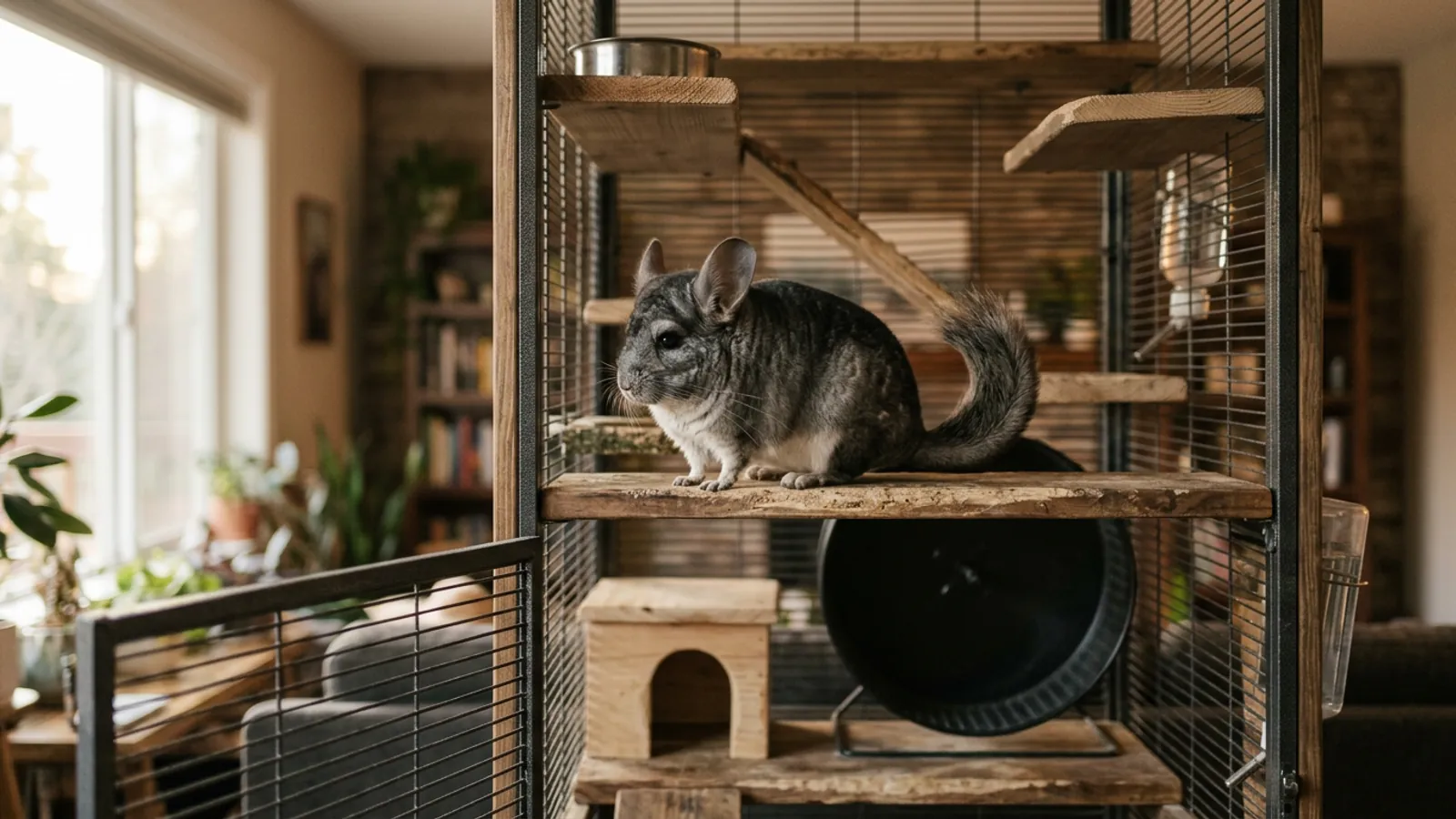
If you spend a week reading chinchilla forums, the phrase "critter nation cage chinchilla" turns up in half the threads, and there is a reason for that. The Critter Nation, made by Midwest, was built for ferrets and rats, not chinchillas, and yet it has quietly become the cage a lot of long-time keepers settle on. I run one at home for Pebble and Juniper, and I have opinions about it that go well past the tidy marketing photos. In brief: it is a genuinely good frame, but it ships with a plastic problem that will hurt your animal if you set it up straight out of the box and walk away. This is the plain account after living with one, including what the Critter Nation gets right, what you have to fix before a chinchilla ever touches it, and where a smaller cage like the Prevue rat and chinchilla model earns its place.
Why the Critter Nation keeps coming up
Walk into a big-box pet store and most of the cages sold for chinchillas are wrong. They are too short, the bar spacing is too wide, or half the structure is molded plastic. So keepers go looking elsewhere, and they keep arriving at the same answer.
The Critter Nation gets recommended because the bones are right. The frame is powder-coated steel, it is tall, and the full-width double doors on each level swing wide open so you can reach every corner instead of wrestling an arm through a tiny hatch. That access matters more than it sounds. A cage you can clean easily is a cage you keep clean, and a chinchilla you can lift out without a fight is a chinchilla that stays tame. It sits on casters, so you can roll the whole thing away from an afternoon sun-warmed window, which is not a small thing in summer. And it is modular, so a single unit and a double unit share the same width and depth and stack into each other.
None of that is chinchilla-specific engineering. It is just a well-made cage that happens to suit them once you correct a few things. If you want the full framework for judging any cage on its merits, I wrote it up in how to choose a chinchilla cage without buying the wrong one twice, and the Critter Nation scores well against most of it.
The dimensions and bar spacing that matter
Two numbers decide whether a cage is safe for a chinchilla: the bar spacing and the usable height. The Critter Nation gets both right for the wrong species and it works out in our favor.
The bar spacing is half an inch. That is well inside the safe range. Chinchillas are compact and fast, and wide bars are a real hazard: a young or slim animal can push its head through a gap that is too big and panic, or slip through entirely. I look for spacing no wider than about half to five-eighths of an inch, and the Critter Nation lands right at the tight end of that.
The footprint of each level is roughly 36 inches wide by 24 inches deep. The double unit stands around 62 inches tall on its stand, with each level giving something close to 20 inches of interior height. That vertical room is the point. Chinchillas are built to jump and climb, not to run laps on the floor, so height and well-placed ledges beat raw floor area every time. A single tall space with good ledges will serve a chinchilla better than a wide, shallow box. If you want the full interior plan, I laid it out in the chinchilla cage setup guide.
Single or double, and what the second level buys you
The Critter Nation comes as a single (one level) or a double (two levels stacked). People agonize over this and I think the answer is usually the double.
The double gives you two enclosed levels connected by a middle opening you can leave open or close off. Left open, it becomes one tall cage with genuine climbing height, which is what a chinchilla wants. Closed, you have two separate enclosures, which is quietly useful: quarantining a new arrival, separating a bonded pair that has stopped getting along, or giving a recovering animal a calm space without buying a second cage. That flexibility is worth the extra cost to me.
The single is fine as a starter or for a tight room, but you will feel the ceiling fast. If money is the deciding factor, be straight with yourself about whether you are saving anything or just delaying the second purchase. I go into that trap in what a chinchilla really costs, because buying the small thing twice is how the cheap option ends up expensive.
The plastic problem nobody puts on the box
Here is the part that gets skipped, and it is the part that matters most. The Critter Nation ships with plastic pans at the base of each level and, depending on the configuration, plastic shelves and ramps with plastic covers. A chinchilla will chew every one of them.
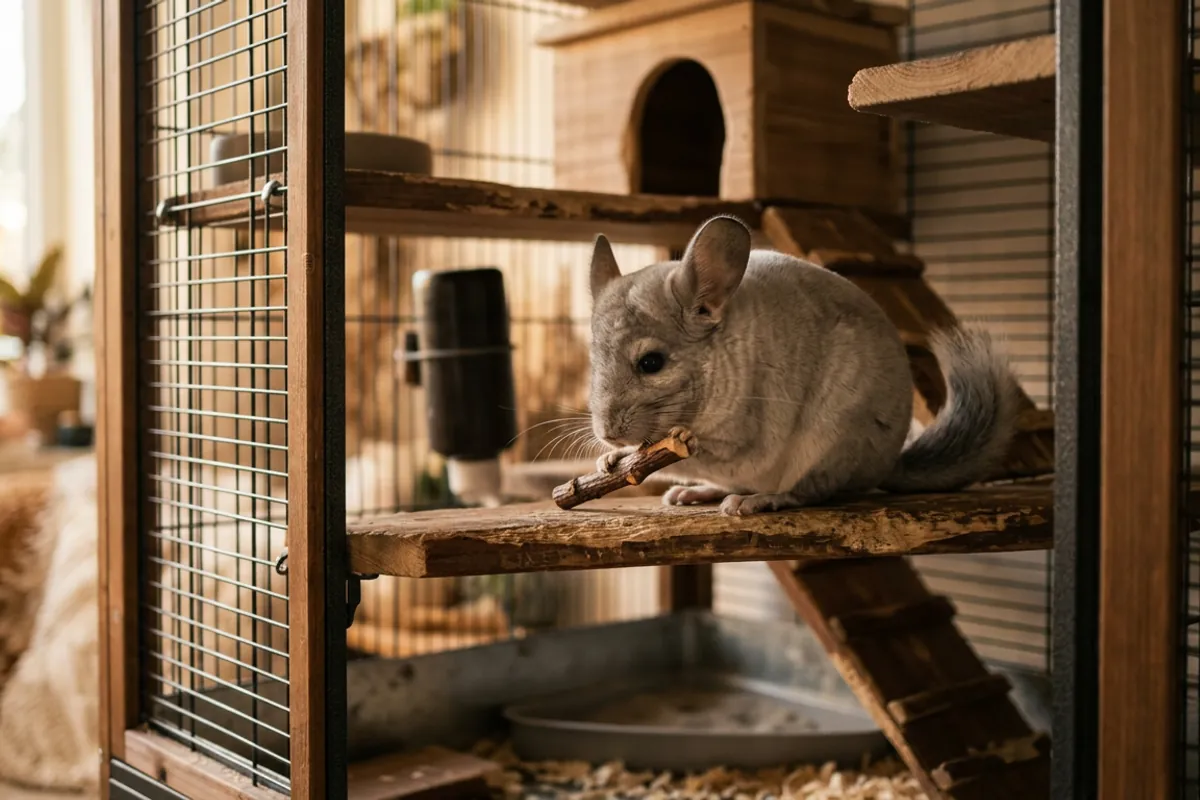
This is not a maybe. Chinchillas chew constantly because their teeth never stop growing, and they do not distinguish between a safe wood chew and the edge of a plastic pan. Swallowed plastic does not pass cleanly; it can cause a gut blockage, and a blockage in an animal this small is a genuine emergency, not an inconvenience. I manage Juniper's dental disease every single day, and watching what happens when teeth are not worn down properly is exactly why I refuse to leave a chinchilla alone with anything chewable and dangerous. If you have not read up on why their mouths run the whole show, chinchilla teeth and health is the background, and spotting malocclusion before it turns serious is the warning list.
So before a chinchilla goes in, the plastic has to be dealt with. There are a few honest options, and none of them is "hope for the best." You can pull the plastic shelves and ramps out entirely and replace them with wooden or metal ledges. You can cover the base pans so the chewable edges are not exposed, using metal replacement pans, or kiln-dried pine over the pan, or fleece liners with the understanding that some chinchillas chew fleece too and have to be watched. Whatever you choose, the goal is the same: no exposed plastic edge within reach of those teeth. And give them something better to chew so the drive has somewhere to go. A rotating set of safe woods does that job, and a variety pack means they do not get bored of a single texture.
emours apple wood chew sticks, 40 count As an Amazon Associate I earn from qualifying purchases.
Set up this way, the Critter Nation is safe. Set up out of the box, it is a chewing hazard with good reviews. The difference is entirely on you.
What I put inside it
An empty Critter Nation is a shell. The furnishing is where a chinchilla's day is decided, and the same rules apply here as in any cage.
The wheel comes first because it is the one people get wrong. It must be a solid running surface. Wire wheels and mesh wheels catch toes and legs and cause real injuries, and I will not have one in the house.
15 inch Chin Spin solid surface chinchilla wheel As an Amazon Associate I earn from qualifying purchases.
Ledges go in next, wooden ones, arranged so the chinchilla can hop from level to level in stages rather than dropping the full height. Wood also gives the feet a break from the wire flooring and doubles as something to gnaw. A hidey house made of untreated wood gives them somewhere to feel safe during the day, since they are most active at dawn and dusk and want to sleep undisturbed.
Then the food. Unlimited grass hay is the foundation of the whole diet, not a side dish. Timothy or another grass hay should be in front of them at all times, because the long chewing is what keeps those teeth worn down and the gut moving. Plain pellets are a measured supplement on top of the hay, not the main meal.
Oxbow Western Timothy Hay, 40 oz bag As an Amazon Associate I earn from qualifying purchases.
If you go through hay as fast as we do with two animals, buying it in bulk is cheaper and means you never run short.
Oxbow Western Timothy Hay, 9 lb box As an Amazon Associate I earn from qualifying purchases.
I keep the treats boring on purpose; what a chinchilla can and cannot eat covers where people go wrong there. And the dust bath is not optional and is never water. Chinchillas clean their fur by rolling in fine dust, and their dense coat holds water so badly that a wet chinchilla is a sick chinchilla waiting to happen.
Lixit Blue Beauty chinchilla dust, 3 lb As an Amazon Associate I earn from qualifying purchases.
I offer the bath a few times a week rather than leaving it in the cage full-time, and the chinchilla dust bath done right walks through the schedule and how much dust to use.
Where the Prevue rat and chinchilla cage fits in
The other name that comes up in this bracket is the Prevue Pet Products Rat & Chinchilla Critter Cage, and it is worth being clear-eyed about it. This is the Prevue Pet Products Rat & Chinchilla Critter Cage 31 in, and that "31 in" is the whole story: it stands about 31 inches tall, which is short for a chinchilla meant to live in it long-term.
I want to be fair to it. It is a smaller, cheaper cage, and there are real jobs it does well. As a hospital cage for an animal recovering from something, where you want to limit jumping, the low height is a feature, not a flaw. As a quarantine cage for a new arrival before it meets your existing herd, or as a travel or backup setup, it is useful. For those roles I would not hesitate.
What I would not do is treat it as a forever home for a healthy adult chinchilla. The name puts "chinchilla" on a cage that is really sized for rats, and 31 inches does not give a bouncing, climbing animal the vertical room it needs. It also has a plastic base, so the same chewing fix from the Critter Nation applies here too. If you want a purpose-built primary cage rather than repurposing something, a tall metal-and-wood enclosure designed for the species solves the height and the plastic in one purchase.
Critter Nation double unit small animal cage As an Amazon Associate I earn from qualifying purchases.
Think of the Prevue as a supporting cage, not the main event, and it will not let you down.
Placement, heat, and the boring safety work
Where you put the cage matters as much as which cage you buy, and this is the part I refuse to make friendly, because it nearly cost me Pebble. She came to me from a rehome out of an overheated attic, and her first summer brought a heatwave and a night at the emergency vet. Everything I say about heat is that scare turned into rules.
Chinchillas are built for cold mountains and they do not shed heat well. The comfortable range is 60 to 70°F (15 to 21°C). Above 75°F (24°C) you are into risky territory, and 80°F (27°C) and up is an emergency, and it comes on faster in humid air because they cannot cool themselves the way we do. A metal cage does not make this better or worse on its own, but the casters help: you can roll the whole Critter Nation away from a window, out of the afternoon sun, and off any spot near a heat vent or the warm ceiling of a room. Keep it out of direct sunlight, away from radiators and kitchens, and not tucked into a stuffy corner with no airflow.
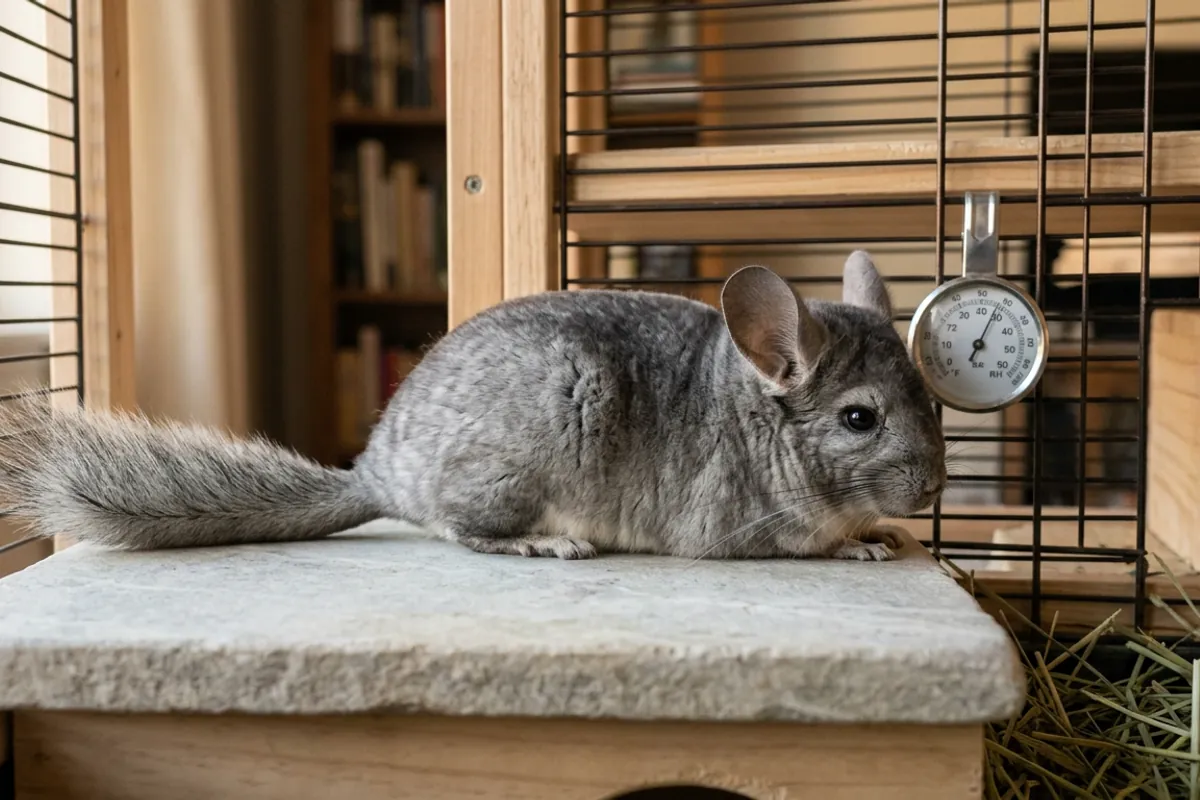
Measure, do not guess. A thermometer and humidity gauge on the cage tells you the truth about the animal's actual air, which can be several degrees warmer than your thermostat across the room.
digital thermometer and humidity gauge with remote probes As an Amazon Associate I earn from qualifying purchases.
When the room creeps up, a chilled stone gives them a cool surface to stretch out on, which buys you margin but is not a substitute for cooling the room.
Kaytee Chinchilla Chiller granite stone As an Amazon Associate I earn from qualifying purchases.
If you are ever unsure how close to the line a given temperature and humidity puts you, run the numbers through the chinchilla heat danger calculator, and read the heat stroke warning signs every owner should know so you recognize trouble early. Panting, lying flat and listless, bright red ears: that is a vet call right now, not a wait-and-see. The full framework lives on the chinchilla heat safety page.
Is the Critter Nation worth it
Yes, with the fixes. The Critter Nation is not a chinchilla cage in a marketing sense; it is a well-built ferret and rat cage with the right bar spacing, real height, and access that makes daily care easy, and it becomes an excellent chinchilla home the moment you remove or cover the plastic and furnish it properly.
It is not cheap. But the cheap route, a too-small cage bought twice, or a vet bill from swallowed plastic, costs more in the end and costs the animal more than money. Buy the frame that lasts, spend an afternoon making the interior safe, and you have a cage that will hold a chinchilla comfortably for its whole long life. For how long that life is when the basics are right, see how long chinchillas really live. Get the cage right and you have set the floor under everything else. The rest of the routine is in the broader chinchilla care guide.