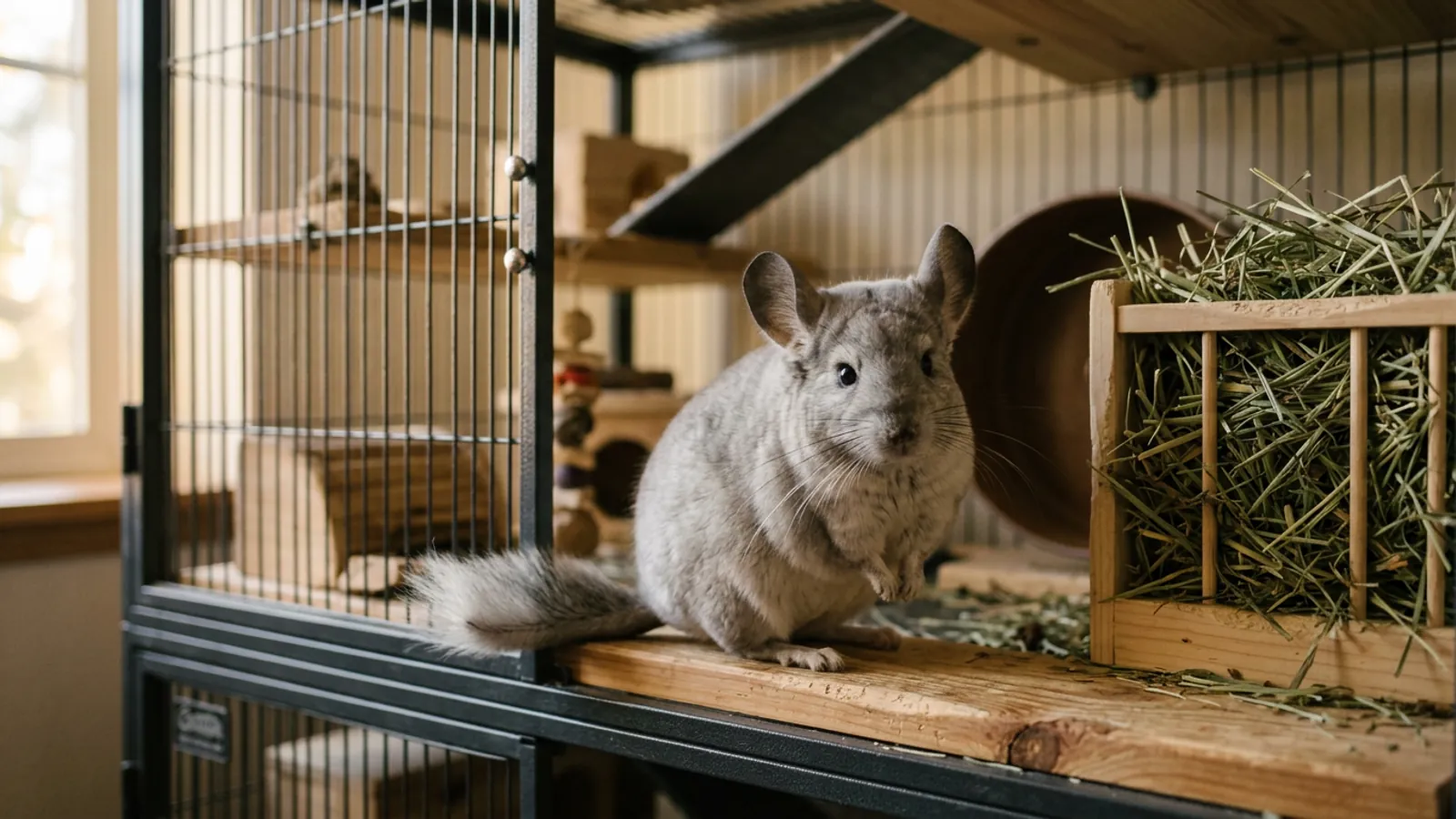
When people ask me how long their chinchilla will live, they usually want a single number, and I understand why. But chinchilla life expectancy is one of those figures that sounds simple and isn't. A well-kept chinchilla commonly lives 10 to 20 years, and a fair number cross fifteen. That is a long time for a small rodent, longer than most dogs, and it is the first thing I want a new owner to sit with before they bring one home. You are not adopting a two-year pet. You are signing up for something closer to raising a child through to college, and the length of that life is not fixed at birth. It is bought, year by year, with temperature, hay, teeth, and attention. I have kept chinchillas for about ten years, and almost everything I have learned pushes in the same direction: the number at the end is mostly the sum of the choices you made along the way.
How long chinchillas live
The plain range for a pet chinchilla is 10 to 20 years, and I want to be careful about how I hold that range. The bottom of it, around ten, is what a chinchilla reaches with basically decent care and ordinary luck. The top of it, into the high teens and occasionally past twenty, is what you see in animals that were kept cool, fed right, and had their teeth and health watched closely for their whole life. Both numbers are real. Neither is a promise.
I say all of this plainly because the internet loves to quote "up to 20 years" as if it were the default, and it is not. It is the ceiling, not the floor. Plenty of chinchillas die younger than ten, and when they do it is rarely old age. It is heat, or dental disease, or a diet that quietly wrecked their gut over years. Those are the three things I keep coming back to on this site, and they are the three things that decide whether your animal lands near ten or near twenty.
If you want the deeper version of this, I have written a companion piece on chinchilla lifespan that walks through the biology in more detail. Here I want to focus on what moves the number, because knowing the range is far less useful than knowing what you personally control.
Why the wild-versus-captive gap is so wide
Wild chinchillas, the ones still clinging to the high, cold slopes of the Andes, tend to live something closer to eight to ten years. Pet chinchillas can double that. When a captive animal reliably outlives its wild cousin by that much, it tells you something important: the wild is hard, and a good home removes most of what kills them early.
In the wild a chinchilla faces predators, food scarcity, cold nights without a warm room to retreat to, and no vet when something goes wrong. In your home, none of those apply. You have taken away the predators and the famine. What you have to manage instead is the small list of things a house can do to them that the mountains never would: overheat them, feed them the wrong food, and let a dental problem go unseen because it is happening inside a mouth you cannot easily look into.
That is the game, really. The wild-versus-captive gap exists because good husbandry is genuinely powerful. But it swings both ways. A chinchilla in a hot apartment on a sugary diet can live a shorter, more miserable life than one on a mountainside. The potential for a long life is there in the biology. Whether it gets realized is on you. If you are still deciding whether to bring one home at all, my piece on what a chinchilla really is lays out how this animal's biology sets every care rule, and it is worth reading before the emotional decision gets made.
Heat is the number one thing that shortens a life
If I could make every chinchilla owner remember one sentence, it would be this: your chinchilla is built for the cold and it cannot cool itself down the way you can. It does not sweat effectively. It is wearing the densest fur of almost any land mammal, roughly fifty to eighty hairs from a single follicle where you and I grow one. That coat is a miracle of insulation, and in a warm room it becomes a trap.
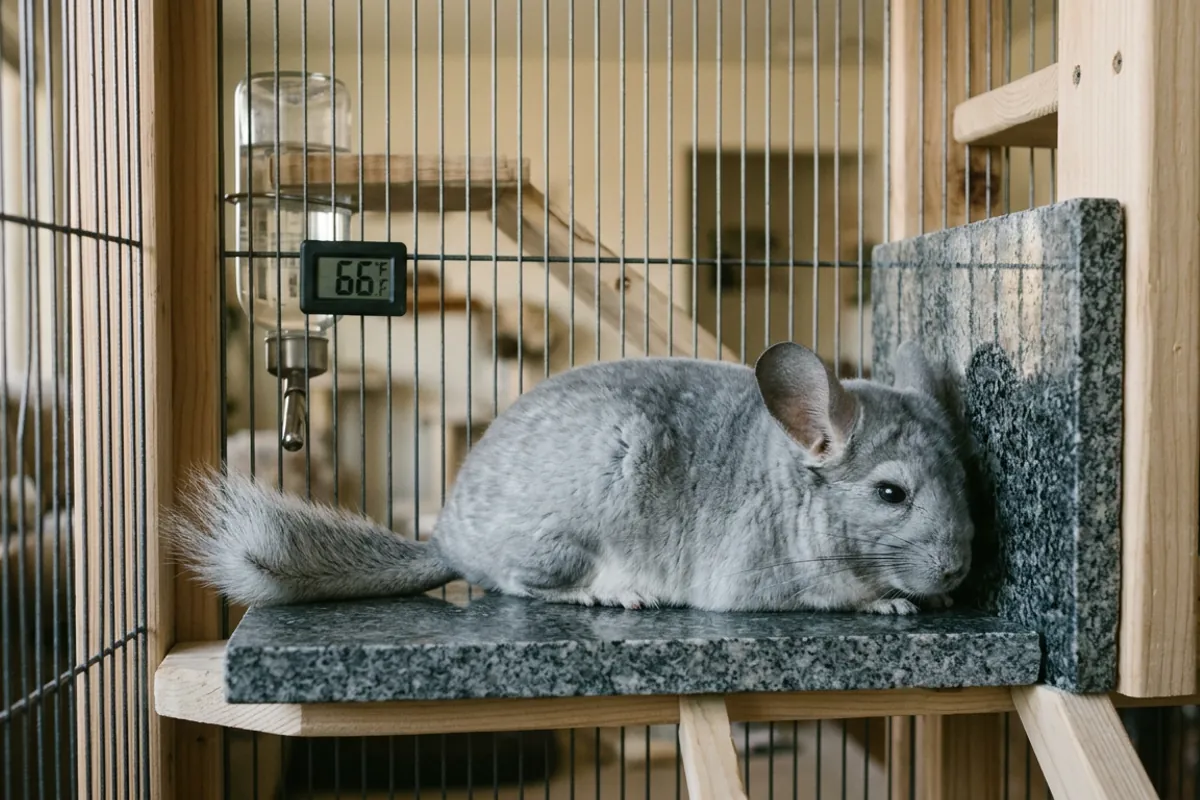
The comfortable range is 60 to 70°F, which is 15 to 21°C. Above 75°F, or 24°C, you are into risky territory. At 80°F and up, which is 27°C, you have an emergency, and it gets worse faster when the air is humid because humidity strips away what little cooling the animal can manage. These are not numbers I softened to sound reasonable. They are the numbers I run my own home by, and I run it cold on purpose.
I am relentless about this because of Pebble. I adopted her out of an overheated attic, and her first summer with me brought a heatwave that nearly killed her. We spent a night at the emergency vet with a chinchilla in early heat stroke, and I have never once let a room get warm since. That scare is the reason the heat guidance on this whole site reads the way it does. It is Pebble's near-miss turned into rules.
Practically, that means air conditioning is not optional in a warm climate, a thermometer sits on the cage so you are reading the temperature at the animal, not guessing from across the room, and you learn the early signs before they become the late ones. Red ears, lying flat and stretched out, drooling, labored breathing: those are your warnings, and I have written them all out in detail in chinchilla heat stroke warning signs. If you are not sure whether your room is safe, I built a chinchilla heat danger calculator that takes temperature and humidity together, because the two matter together. A granite or ceramic cooling slab in the cage gives them a cold surface to press against, and it is cheap insurance.
Kaytee Chinchilla Chiller granite stone As an Amazon Associate I earn from qualifying purchases.
Heat is first on this list for a reason. A dental problem takes years to end a life. Heat can do it in an afternoon. More chinchillas are lost to a hot day than to almost anything else, and every one of those deaths was preventable.
Teeth are the slow killer
If heat is the fast way to lose a chinchilla, teeth are the slow one. A chinchilla's teeth never stop growing, all of them, for its entire life. In a healthy animal that constant growth is worn down by constant chewing on coarse, abrasive hay. When the wear does not keep up with the growth, the teeth overgrow, and the roots can push in the wrong directions. That is malocclusion, and it is one of the most common serious health problems in this species.
I watch this up close every single day with Juniper. She came to me as a neglected rescue with dental disease already established, and managing it is part of our routine now. I have seen what happens when teeth do not get worn down: the animal drops weight because eating hurts, drools until the fur under the chin is wet and matted, paws at its mouth, and slowly starves in front of you while still technically having food available. It is grim, and it is why I am uncompromising about hay and chews.
The tragedy of dental disease is that it is largely a lifespan problem hiding inside a diet problem. A chinchilla that chews enough coarse hay for its whole life mostly avoids it. A chinchilla fed too many soft pellets and too little hay is far more likely to develop it. And once malocclusion is established, you do not fix it at home. Filings under anesthesia, done by an exotics vet, become a recurring part of the animal's life and its cost. If you see weight loss, drooling, dropping food, or a change in what your chinchilla will eat, that is an exotics vet visit, not a wait-and-see. I have written up the early signs in chinchilla teeth problems, because catching malocclusion before it turns serious is one of the few times you get to change the trajectory.
Diet is a lifespan decision, not a daily one
People think of feeding as a daily task. I think of it as a slow lever on how long the animal lives, because it is. The gut and the teeth are both built around one thing: unlimited coarse grass hay, available all the time, forever.
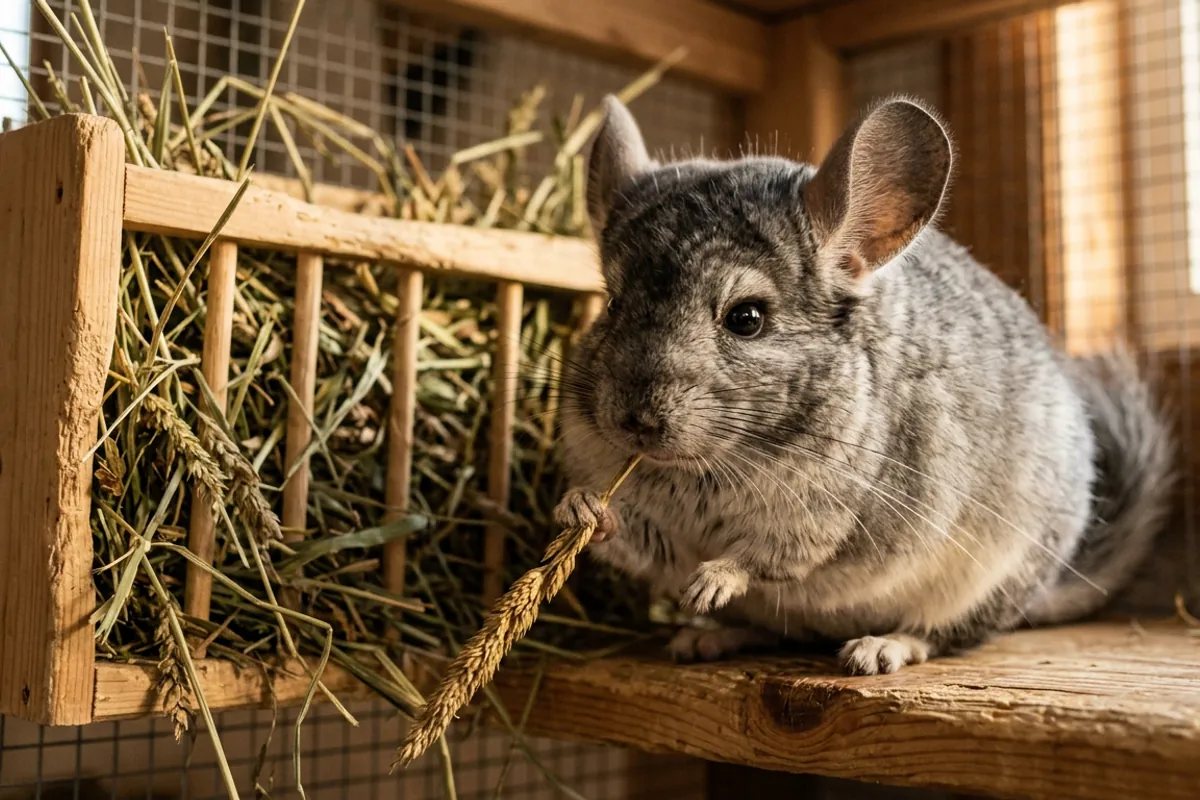
Hay is not a side dish. It is the main event and it should make up the large majority of what your chinchilla eats. Timothy hay, orchard grass, meadow hay, the plain coarse grass hays are what wear the teeth and keep the gut moving. On top of that, a measured amount of plain pellets gives the nutrients hay alone does not, and "measured" matters: a tablespoon or two a day for an adult, not a bowl left permanently full. Free-fed pellets crowd out hay, and a chinchilla that fills up on pellets does not chew enough to wear its teeth.
What ruins chinchillas is the stuff that looks like kindness. The colorful commercial mixes with dried fruit, seeds, and corn are, bluntly, junk. Chinchillas have a low tolerance for sugar and fat, and those treat-heavy foods cause bloat, soft stool, and long-term gut trouble. Even "natural" dried fruit is too sugary. If you want to give a treat, a single plain rose hip or a small piece of dried herb is plenty. I keep a good plain pellet and good hay in the house and almost nothing else.
Oxbow Western Timothy Hay, 9 lb box As an Amazon Associate I earn from qualifying purchases.
The full version of how I feed lives in my chinchilla diet, food, and hay guide. But the one-line version is the one that saves years: unlimited hay, measured plain pellets, no sugary mixes, and never, ever water for bathing. Chinchillas clean that dense coat by rolling in fine dust, and water gets trapped against the skin and causes fungal problems. A dust bath uses volcanic pumice dust, a few times a week, and never a soak.
The cage and daily care that quietly add years
None of the big three, heat, teeth, diet, happens in a vacuum. The cage they live in and the way you handle them day to day either support all three or undermine them.
A chinchilla needs a tall cage with room to jump, made of metal and wood, with wooden ledges at different heights. Solid wooden ledges give the feet something better than wire to land on, and they double as things to chew, which helps the teeth. Wire-floored cages cause sore feet, a condition called bumblefoot, that turns into a chronic problem over a long life. Plastic anything is a hazard because chinchillas chew it and swallow it. If you are shopping for a cage, do it once and do it right, because the wrong one costs you twice; I walk through exactly what to look for in how to choose a chinchilla cage.
The exercise wheel matters more than people expect over a fifteen-year span. It has to be a solid running surface, never wire. A wire wheel catches toes and tails and causes injuries that, over years, add up. A large solid wheel lets the animal run without wrecking its feet or its spine.
15 inch Chin Spin solid surface chinchilla wheel As an Amazon Associate I earn from qualifying purchases.
Beyond the equipment, the daily habit that adds years is simply looking. Weigh your chinchilla regularly, because weight loss is often the first sign of dental or gut trouble and a scale catches it before your eyes do. Watch how much hay disappears. Notice the droppings. Chinchillas hide illness well, the way prey animals do, so the owner who pays attention buys early warning, and early warning is the difference between a vet visit that fixes things and one that only manages the damage.
What gets a chinchilla to twenty
Put all of it together and the picture is not complicated, just relentless. The chinchillas that reach the top of the range, the ones that hit the high teens and beyond, are almost never the product of luck. They are the product of a cool room held cold on purpose, a hay rack that is never empty, plain food in measured amounts, a safe cage, and an owner who noticed the small change in week two instead of week twenty.
I want to be straight about the parts I do not control and neither do you. Genetics play a role. Some animals are simply dealt a weaker hand, and a chinchilla that came from careless breeding may carry problems, dental ones especially, that no amount of good care fully erases. Juniper is proof of that. I cannot undo the neglect she came from, only manage it well, and she will likely not reach the ages a chinchilla raised right from birth would. That is not a failure on my part or yours. It is a reason to source your animal carefully in the first place, which I cover in how to buy a chinchilla without getting hurt or ripped off.
So when someone asks me what chinchilla life expectancy really is, my answer is that it is a range you help write. Ten to twenty years, and where in that range your animal lands is mostly up to the things I have laid out here. Keep it cool, keep the hay coming, watch the teeth, and pay attention. Do that for fifteen or more years and you get an animal that grows old with you, which is the whole point and, if you asked Pebble, worth every cold room.