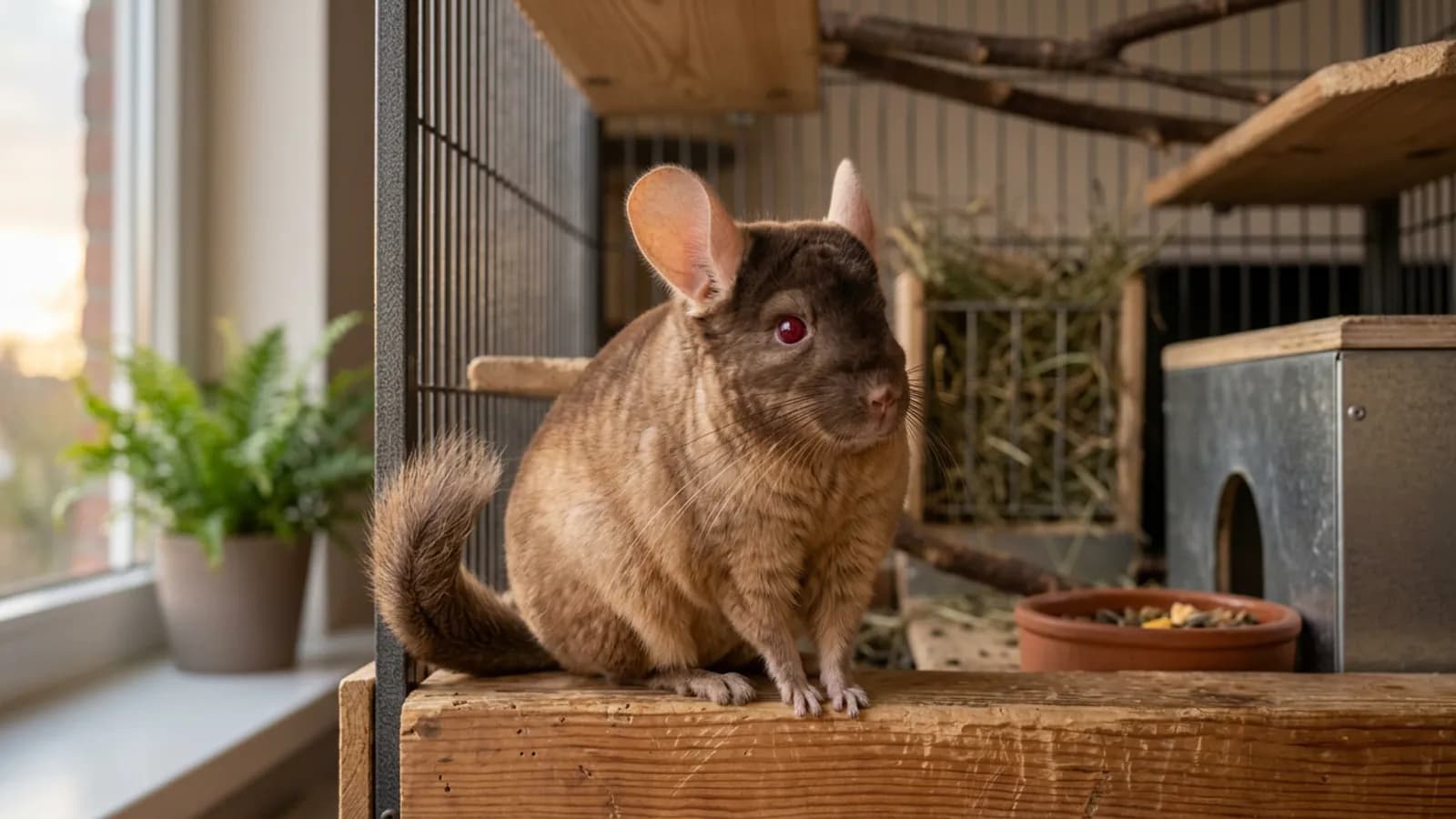
A brown velvet chinchilla is not a separate kind of animal. It is the same chinchilla I keep, wearing two colour mutations stacked on top of each other: the beige gene that warms the coat to a soft tan, and the velvet gene that lays a darker veil across the head and back. Put those two together and you get the warm-brown body with a shadowed cape that people call a brown velvet chinchilla, or sometimes chinchilla brown velvet if they are working off a breeder's price list. It looks striking, and I understand why it draws people. But before you fall for the coat, I want to be honest about what the colour is, what it is not, and the one thing about it that actually matters for the animal's welfare rather than its looks.
I have kept chinchillas for about ten years, and the single most useful thing I can tell you about colour is that it is paint on the outside of an animal whose needs were fixed long before any breeder started selecting for shades. A brown velvet needs exactly what my standard-grey Pebble needs and exactly what my rescue Juniper needs. Same temperature limits, same unlimited hay, same dust, same everything. The genetics are genuinely interesting, and I will walk you through them, but keep that grounding in mind the whole way down.
What a brown velvet chinchilla actually is
Wild chinchillas are grey. That agouti grey, dark slate at the back fading to a white belly, is the baseline every colour mutation is measured against. A brown velvet is that baseline animal carrying two separate dominant mutations.
The first is beige, sometimes called Tower beige after the line it came from. Beige is a dominant colour mutation that lightens and warms the coat, turning the grey into a soft tan or fawn and usually giving the animal red or ruby eyes and pinkish ears. On its own, a beige chinchilla is what the site covers in what a brown chinchilla really is, and the two words brown and beige get used almost interchangeably in the hobby.
The second mutation is velvet, more properly the touch of velvet or TOV gene. This is the same gene that produces the black velvet chinchilla. It adds a darker veiling over the top of the animal, heaviest on the head and along the spine, with characteristic dark bars down the front legs. Lay TOV over a beige animal instead of a grey one and the veil comes through brown rather than black. That combination, beige plus touch of velvet, is the brown velvet.
So the honest one-line definition is this: a brown velvet chinchilla is a beige chinchilla that also carries the velvet gene. Nothing more exotic than that. It is two well-documented mutations sharing one animal.
Where the velvet in the name comes from
People sometimes assume velvet describes the fur's texture, as if a brown velvet has a plusher or softer coat than an ordinary chinchilla. It does not. Every healthy chinchilla already has that astonishingly dense fur, roughly fifty or more hairs growing from a single follicle, which is the densest fur of any land mammal. The velvet in the name is not about touch at all. It is about the veiling pattern the TOV gene lays down.
If you look at a black velvet, the effect is obvious: a glossy dark hood over the head and shoulders that fades into the paler flanks, like the animal is wearing a cape. The gene got its name because that darkened, sheened veiling looks velvety to the eye. On a beige body the same veil reads as brown, so the pattern is softer and warmer but structurally identical. Understanding that velvet is a pattern gene, not a fur-type gene, saves you from a common mistake, which is thinking the coat needs different grooming. It does not, and I will come back to that.
One more thing worth knowing: the veiling is often uneven from animal to animal. Some brown velvets carry a heavy, clearly defined cape, others show only a faint smudge over the head. That variation is normal and does not tell you anything about the animal's health. It is just how strongly the pattern expressed on that individual.
What a brown velvet looks like up close
Colour names in this hobby are slippery, so let me describe what you are actually looking at rather than lean on the label. A typical brown velvet has a warm tan or fawn body, a browner veil concentrated over the head and running down the back, and dark bars on the front paws where the veiling reaches the legs. The eyes are usually red or ruby, a giveaway of the beige gene underneath, and the ears tend toward pink rather than the dark grey of a standard.
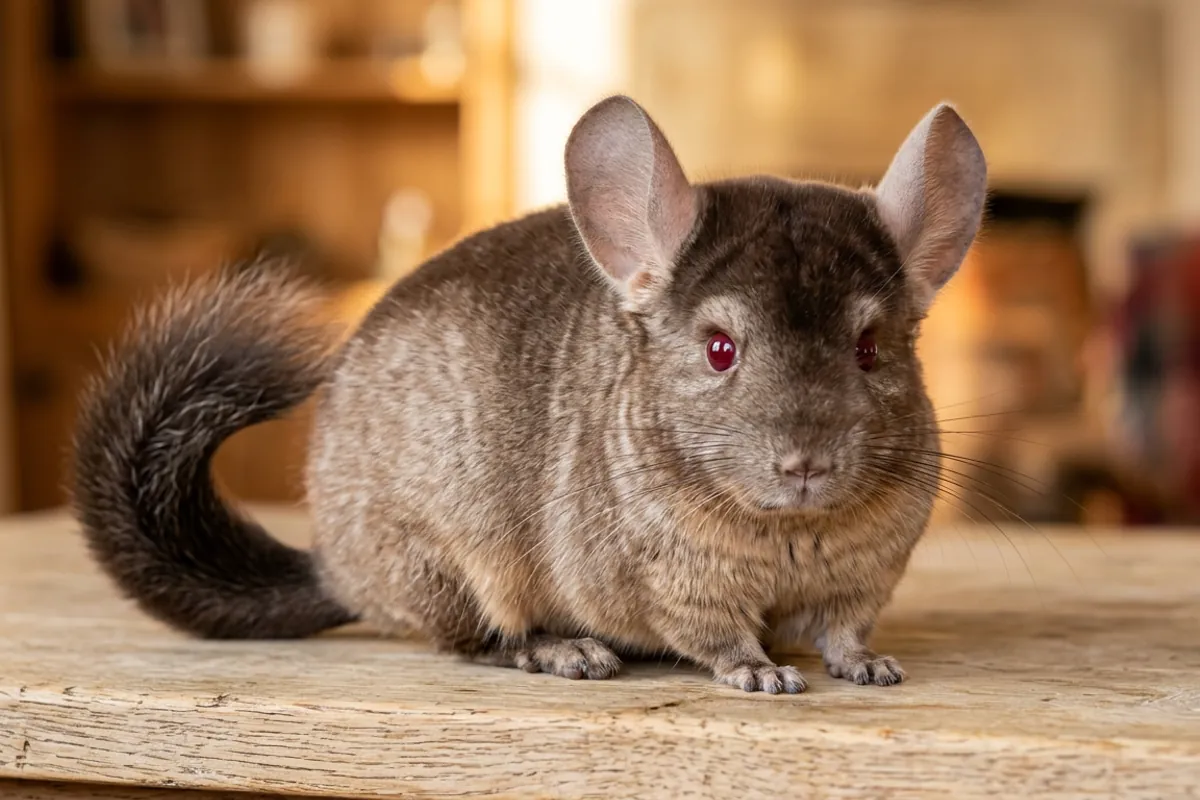
Here is where I have to admit some uncertainty honestly, because the naming is genuinely inconsistent. Beige is what geneticists call incomplete dominant, which means one copy of the gene and two copies look different. A chinchilla with two beige genes, homozygous beige, is paler than one with a single copy. So when you add velvet on top, you can get a lighter or a darker brown velvet depending on how many beige genes are in play, and different breeders and registries draw the line between brown velvet and what a chinchilla tan really is in different places. Some call the homozygous-beige velvet a tan and reserve brown velvet for the single-beige version. Others use brown velvet for both. I would not lose sleep over which camp a given breeder sits in. Ask them plainly what genes are behind the animal, and judge the chinchilla in front of you, not the word on the cage card.
What the colour never signals, in any of these naming schemes, is quality, temperament, or health. A brown velvet is not calmer, not friendlier, not hardier, and not more delicate than a standard grey. The mutations touch pigment and pattern. They do not touch the animal's personality or its constitution.
The lethal factor, and why you never breed velvet to velvet
This is the part of brown velvet genetics that actually has consequences, so pay attention here even if you never intend to breed. The velvet gene carries what breeders call a lethal factor. TOV is dominant, so a single copy gives you the veiling. But an animal that inherits two copies of the velvet gene, one from each parent, does not survive. The embryos carrying a double dose are lost before birth.
In practice that means you must never pair a velvet with another velvet, brown velvet included. If you breed two velvets together, on average a quarter of the expected kits are the double-velvet combination and simply never arrive, so you shrink already small litters for no reason and put strain on the female for a smaller result. Responsible breeders always cross a velvet to a non-velvet partner, which keeps every kit viable while still passing the veiling to roughly half the litter.
I am not a breeder and I do not encourage casual breeding at all. Chinchillas have small litters, long pregnancies of around 111 days, and real risks to the female, and what breeding a chinchilla actually asks of the animal is more than most people bargain for. I raise the lethal factor here mainly so you understand why brown velvets are priced the way they are and why a careful breeder will tell you the exact genetic pairing behind a litter. If someone is selling brown velvet kits and cannot explain that they never pair two velvets, that tells you something about how carefully they work. For anything touching an actual pregnancy or a struggling kit, that is exotics-vet territory, not something to manage off a forum thread.
What the colour never changes about care
Now the part I care about most. Whatever the coat is doing, the care underneath is identical to every other chinchilla, and the numbers are not negotiable.
Temperature comes first, because heat is what kills these animals, and a brown velvet has no more tolerance for it than any other. The comfortable range is 60 to 70°F (15 to 21°C). Above 75°F (24°C) you are in risky territory, and 80°F (27°C) and up is an emergency, faster still if the air is humid, because a chinchilla cannot shed heat through that dense fur the way a thinner-coated animal can. My convictions about this are not theoretical. Pebble came out of an overheated attic, and her first summer brought a heatwave near-miss and a night at the emergency vet that I still think about. That scare is why I keep a thermometer and hygrometer on the cage and check it like a habit rather than a chore.
digital thermometer and humidity gauge with remote probes As an Amazon Associate I earn from qualifying purchases.
A cage thermometer with a humidity reading costs almost nothing and takes the guesswork out of the one number that matters most. Pair it with a hard cooling surface for hot afternoons, a slab the animal can stretch out on to dump heat.
Kaytee Chinchilla Chiller granite stone As an Amazon Associate I earn from qualifying purchases.
If you want the full logic behind the numbers, the chinchilla temperature guide and the heat danger calculator both lay it out, and none of it changes because the coat is brown.
Diet is the next thing the colour does not touch. A brown velvet eats unlimited grass hay first, all day, every day. Timothy or another good grass hay should be in front of the animal constantly, because the whole digestive system and the constantly growing teeth depend on that endless chewing.
Oxbow Western Timothy Hay, 40 oz bag As an Amazon Associate I earn from qualifying purchases.
Pellets are a measured supplement on top of the hay, a tablespoon or two of a plain chinchilla pellet, not the main meal and never a colourful muesli mix. Juniper, my dental rescue, is the reason I am uncompromising about this. I watch every day what happens when teeth do not get worn down properly, and unlimited hay plus real chewing is the only thing that keeps a mouth healthy. Give a brown velvet a proper variety of safe wood chews for the same reason.
emours apple wood chew sticks, 40 count As an Amazon Associate I earn from qualifying purchases.
The chinchilla diet and teeth and health pages go deeper, and again, the beige and velvet genes are irrelevant to all of it.
Grooming, dust, and the coat itself
Because velvet sounds like it should mean special fur, people ask whether a brown velvet needs different grooming. It does not. You never bathe a chinchilla of any colour in water. That dense coat traps water against the skin, takes far too long to dry, and invites fungal infection and worse. Chinchillas clean themselves by rolling in fine dust, which is really a very fine volcanic pumice powder, not sand and not dirt. The chinchilla dust bath works the same way on a brown velvet as on a standard.
Lixit Blue Beauty chinchilla dust, 3 lb As an Amazon Associate I earn from qualifying purchases.
Two or three dust baths a week is a reasonable starting point for most animals, offered for a few minutes and then removed so the chinchilla does not sit in a dusty bath house all day. If anything, keep an eye on how the dust suits a darker-veiled coat and adjust frequency to the coat and the season rather than to a rigid rule.
The one grooming note that is genuinely about the fur is fur slip, and it is not colour-specific either. Chinchillas can release a patch of fur when grabbed or frightened, a defence mechanism that leaves a clean bald spot which grows back. A velvet's veiling can make a regrowing patch look mismatched for a while as the colour fills back in, but it is the same fur slip every chinchilla is capable of, and the fix is the same: handle gently and do not grab.
Buying a brown velvet, and what to check
If a brown velvet is the animal you want, buy the animal and not the colour. The coat should never be the deciding factor over health and temperament. Watch for clear bright eyes, a dry chin with no drool staining that could hint at dental trouble, steady breathing, clean and dry droppings around the cage, and an animal that is alert rather than hunched. A good breeder will happily talk you through the genetics behind the litter, including that they never paired two velvets, and will let the chinchilla settle rather than pushing a sale.
Expect a brown velvet to cost more than a standard grey, because mutation colours command a premium and the velvet lethal factor keeps litters smaller. Pay the colour premium if you want to, but do not let a pretty coat distract you from a thin, watery-eyed, or nervous animal. My how to buy a chinchilla guide covers the full checklist, and it applies here without a single change for the colour.
And budget for the setup before the animal, not after. A brown velvet needs a tall metal-and-wood cage with solid wooden ledges and no plastic, room to jump, a solid-surface wheel rather than a barred one that can catch a foot, unlimited hay, dust, and a real vet fund for the exotics care these animals eventually need.
Critter Nation double unit small animal cage As an Amazon Associate I earn from qualifying purchases.
None of that changes because the fur is brown with a darker cape. The colour is the one part of a chinchilla that is purely cosmetic. Everything that keeps the animal alive and well sits underneath it, identical in a brown velvet, a black velvet, and a plain grey. Get the temperature, the hay, and the dust right, and the beautiful coat takes care of itself.