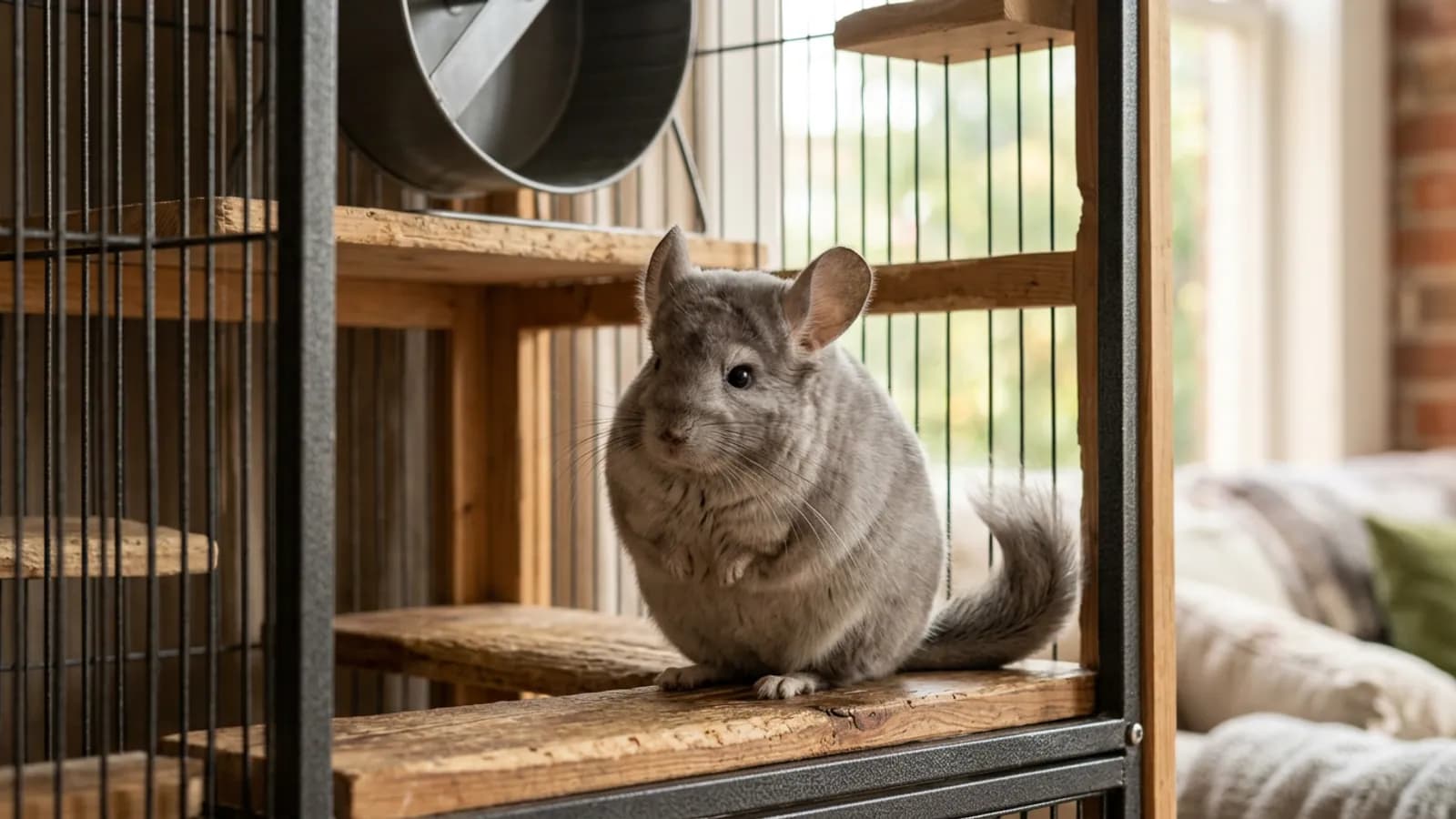
People type chinchilla small into a search bar for a few different reasons. Some want to know how big the animal actually gets before they commit to one. Some just met a chinchilla, watched it puff up to twice its real size, and want to know what is fur and what is body. And some heard a tiny sound come out of one and want to know what it meant. I have kept chinchillas for about ten years, and the honest answer to all three is the same: a chinchilla is a small animal wrapped in a coat that lies about its size, with a personality and a set of needs that are not small at all. Here is what small really means for this species, measured, not guessed.
How small a chinchilla actually is
Strip away the fur and a chinchilla is a modest little rodent. An adult body runs roughly 9 to 15 inches long, or about 23 to 38 centimeters, and the bushy tail adds another 3 to 6 inches on top of that. Weight is the number I trust most, because fur cannot fake it: a healthy adult usually lands between 400 and 600 grams, which is about 14 to 21 ounces, or a little less than a bag and a half of sugar in your hand.
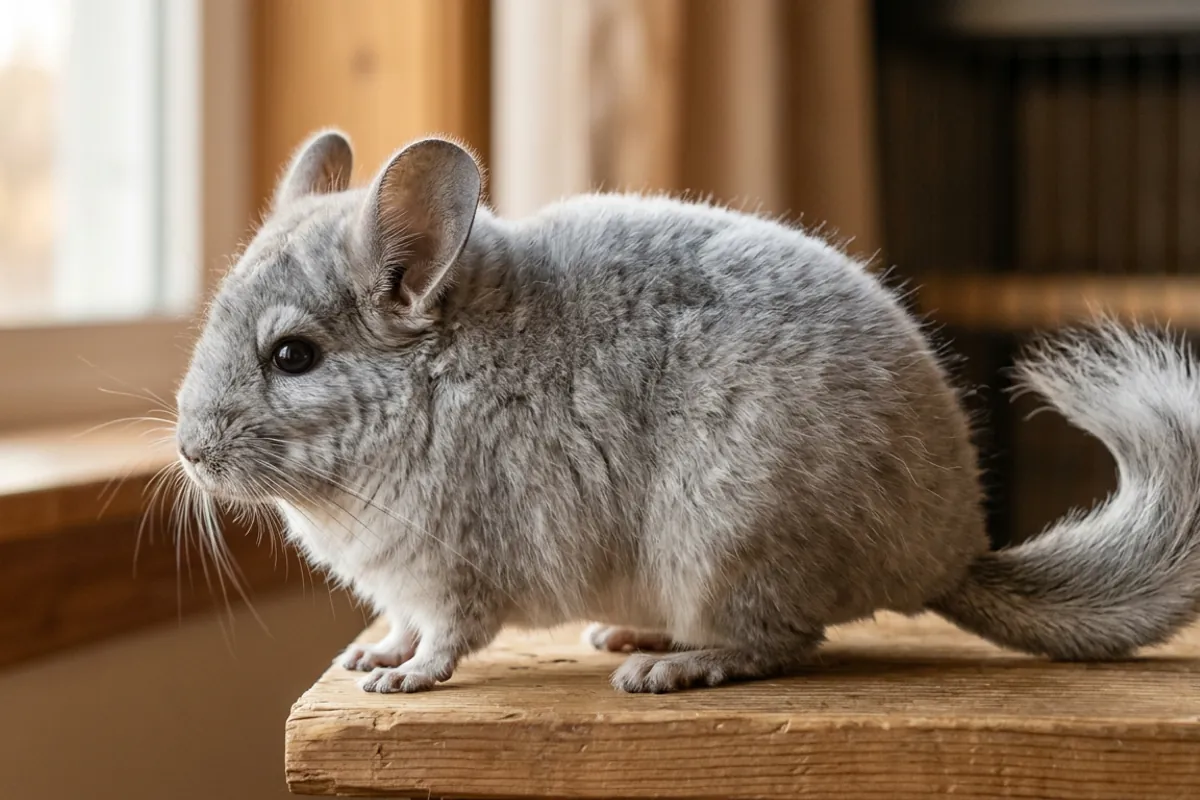
Females run larger than males, which surprises people who expect the opposite. A big female can push past 600 grams; a small male might sit closer to 400. Neither is wrong. What matters is that the number stays steady week to week once the animal is grown. I weigh mine on a cheap kitchen scale that reads in grams, and I write it down, because a chinchilla losing weight is often the first and only sign that something is off before the animal ever looks sick. Their fur hides a shrinking body for a long time. The scale does not.
So yes, a chinchilla is small. It is roughly the footprint of a very fat guinea pig or a smallish rabbit in body, but lighter than either because so much of the volume you see is coat, not flesh. Which brings me to the coat.
Why a small chinchilla looks twice its size
The single most misleading thing about this animal is its fur, and the fur is not decoration. Chinchillas grow one of the densest coats of any land mammal. The often cited figure is somewhere around fifty or more individual hairs sprouting from a single follicle, where a human grows one hair per follicle, and the result is a pelt so thick that parasites like fleas cannot really live in it. There is not enough room down at the skin for them.
That density is why a calm chinchilla sitting still looks like a soft gray cloud and a startled one looks even bigger, because the muscles at the base of the coat let it fluff. It is also why the whole husbandry rulebook exists. A coat that dense does not shed water. If a chinchilla gets wet to the skin, that plush undercoat holds the damp against the body, and it does not dry easily on its own, which is exactly why these animals never bathe in water. They bathe in fine volcanic dust that rolls through the fur and pulls oil and moisture out of it. If you want the mechanics of that, I wrote them out in the chinchilla dust bath, done right. The short version: dust in, water never.
The same coat is why heat is the thing that kills chinchillas fastest, and I will come back to that, because a small body under a heavy blanket has almost no way to dump warmth.
Small body, not a small commitment
Here is where the word small gets people into trouble. A small animal reads, to a lot of buyers, as a small responsibility, a small cage, a small cost, a small life. None of that is true of a chinchilla.
Start with space. A body this size still needs a tall cage, because chinchillas are built to leap and climb, and a cramped floor plan wears down their feet and their minds. I mean a metal cage with wooden ledges at different heights, no plastic anywhere inside it, and enough vertical room for real jumps. Critter Nation double unit small animal cage As an Amazon Associate I earn from qualifying purchases. If you are weighing sizes, I went through the honest tradeoffs in how to pick the best chinchilla cage, and separately in the honest truth about a small chinchilla cage, because the cages marketed for small pets are usually the wrong call for this one.
Then there is time. A chinchilla can live 10 to 20 years with good care, which is not a small number for a small animal. That is a decade or two of daily hay, weekly dust, an exotics vet who actually sees chinchillas, and a house you keep cool through every summer. I am blunt about this with anyone who asks, and I laid the whole picture out in chinchilla as pets, the honest version. The body is small. The commitment is a long one.
The squeaks: what a small chinchilla is telling you
The sounds are the part people fall in love with, and the part they most often misread. A chinchilla has a real vocabulary, and the small squeaks are the everyday end of it.
The soft, gentle chinchilla small squeaks you hear when the animal is pottering around, being handed a chew, or settling near you are contentment noises. They are conversational, low stakes, the sound of an animal that feels safe. Mine make them at me when I come to the cage in the evening, and it is one of the small pleasures of keeping them.
A sharp, repeated squeak is a different message. That is alarm or complaint, the chinchilla saying it does not like what is happening, whether that is being cornered, being held too long, or a cage mate crowding it. Listen for the rhythm and the edge. Contentment is round and soft; a warning is sharp and insistent.
Then there is the bark, a loud, staccato call that a frightened or angry chinchilla throws out to say back off, and the scream, which you hope never to hear, because it means real pain or terror. I go through the whole range, including the courtship and the fussing, in chinchilla sounds and what your chinchilla is telling you. The thing to hold onto is that even a small squeak is information. This is not a silent pet. It talks, and it expects you to learn the language.
Small chinchilla like animal: what people confuse them with
A lot of searches for a small chinchilla like animal are really people trying to place the chinchilla among the pets they already know, or trying to decide between it and something similar sized. It is worth sorting out, because the lookalikes need genuinely different care.
The closest relatives people meet are degus and guinea pigs, both South American rodents in the same broad neighborhood. A degu is smaller and more of a daytime social digger. A guinea pig is heavier, ground bound, and eats a diet that needs added vitamin C, which a chinchilla does not. Then there are the animals a chinchilla only resembles by accident. A hamster is a much smaller, shorter lived rodent with cheek pouches and a solitary streak; I compared the two directly in chinchilla and hamster, what they share and where they split. And the name causes real confusion with rabbits, because there is a rabbit breed called the chinchilla, named for its coat color, that is a completely different animal with opposite dietary details. I untangled that in bunny chinchilla, the rabbit, the rodent, and why they need opposite care.
The one thread that runs through all of them: do not assume care transfers. A cage, a diet, or a bath routine that suits a hamster or a rabbit can hurt a chinchilla. The plush coat and the heat sensitivity make this animal its own case.
The smallest a chinchilla ever is: the newborn
If you want to see a chinchilla at its genuinely smallest, look at a newborn. Kits are born after a long pregnancy for a rodent, around 111 days, and they arrive remarkably finished. Unlike a baby hamster or rat, which is born pink, blind, and helpless, a chinchilla kit comes out fully furred, with its eyes open and its teeth already in, and it can move around within hours. Biologists call that precocial, and it is one of the more striking facts about the species.
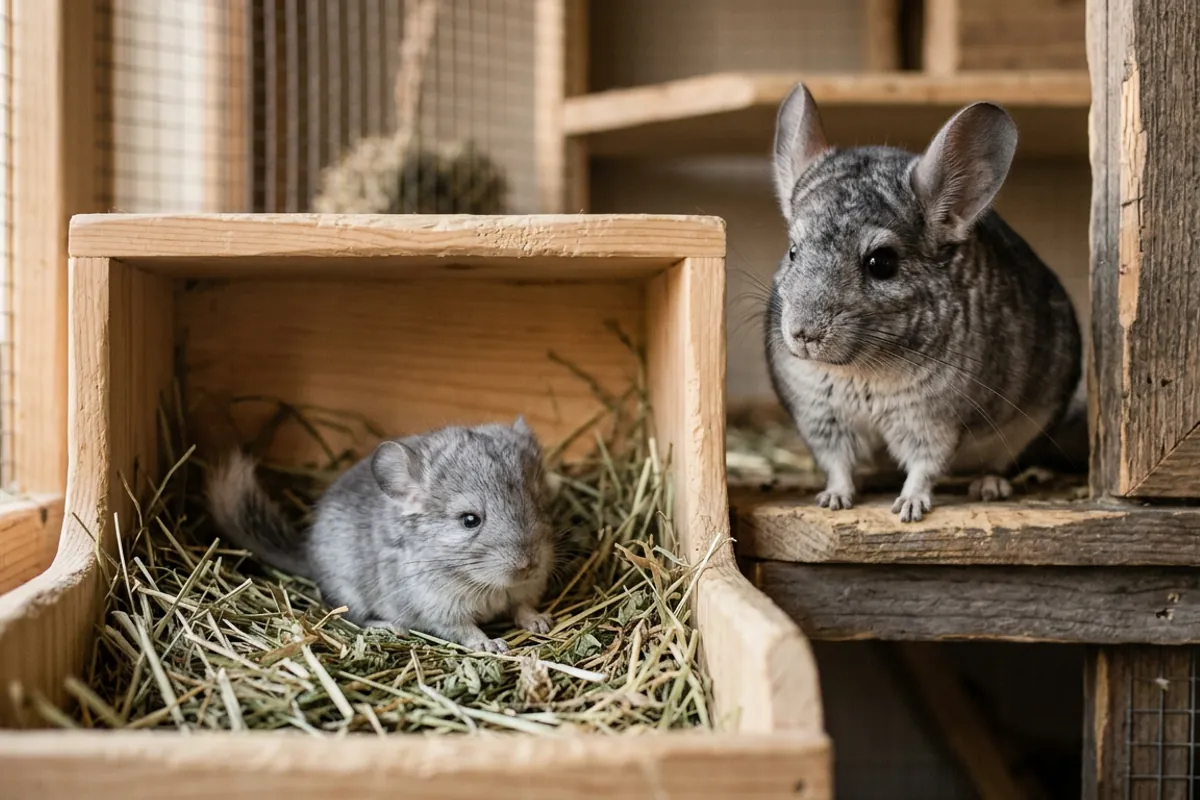
Small, though, they are. A newborn kit weighs somewhere around 30 to 60 grams, roughly the weight of a slice of bread, and a litter is usually one to three of them. That tiny body loses heat even faster than an adult, which is why a chilled or ignored kit is an emergency, and why breeding is not something to drift into. I am honest about what it costs the mother in what breeding a chinchilla actually asks of the animal, and I would rather you read that before you ever consider it. For most keepers, the smallest chinchilla you will meet is a rehome or a young one from a responsible source, not one you bred yourself. There is no dwarf breed either, whatever a listing says, and I wrote up what a chinchilla mini really means.
Caring for a small body: heat, hay, and handling
A small mammal has a small margin. That phrase governs almost everything I do with mine, and it comes down to three things.
Heat first, always. Chinchillas are comfortable at 60 to 70°F, which is 15 to 21°C. Above 75°F, or 24°C, they start to struggle. At 80°F, 27°C, and up you are in emergency territory, and humidity makes it arrive faster because a coat that dense cannot shed warmth through evaporation the way a thinner animal can. A small body overheats quickly and does not recover on its own. This is not me being cautious for the sake of it; my first chinchilla, Pebble, came out of an overheated attic and spent a night at the emergency vet in her first summer, and I have kept a thermometer on the cage ever since. digital thermometer and humidity gauge with remote probes As an Amazon Associate I earn from qualifying purchases. A cage thermometer with a humidity reading is not optional gear to me, and neither is a chunk of chilled stone the animal can lie against on a hot afternoon. Kaytee Chinchilla Chiller granite stone As an Amazon Associate I earn from qualifying purchases. If you want the temperature question laid out on its own, it is the number that keeps yours alive.
Diet second. A small chinchilla runs on grass hay, and it needs an unlimited supply of it in front of the animal at all times. Timothy or another grass hay is the whole foundation, both for the gut and for the teeth, which grow continuously and only stay the right length through the constant grinding that hay demands. Oxbow Western Timothy Hay, 40 oz bag As an Amazon Associate I earn from qualifying purchases. Plain pellets are a measured supplement on top of the hay, not a replacement for it, usually a tablespoon or two a day, and treats stay tiny and rare. I keep this simple on purpose; the full version is in chinchilla diet, food, and hay. My rescue Juniper came to me with dental disease from a life short on hay and chewing, and watching her manage it day to day is why I will not soften this point. Give a chinchilla hay and give it hard things to gnaw, like plain apple wood, and you are doing the single most important thing for its teeth. emours apple wood chew sticks, 40 count As an Amazon Associate I earn from qualifying purchases.
Handling third. This is a light, quick, delicate animal. Their bones are fine, their fur slips loose if you grab wrong, a defense that leaves a bare patch where you held too hard, and they do not enjoy being restrained. I support the body from underneath, keep sessions short, and let the animal come to me. A small frame does not forgive a rough grip.
What small really adds up to
Put it all together and the picture is honest. A chinchilla is a small animal, 400 to 600 grams of body under a coat that makes it look bigger, roughly a foot of length plus a bushy tail, with a soft squeak for contentment and a sharp one for complaint. It is easy to confuse with other small pets and easy to underestimate because of its size.
But small here does not mean simple, and it does not mean cheap, brief, or low effort. It means a narrow margin: less body to buffer against heat, against a missed meal, against a rough hand. It means a decade or two of a cool room, unlimited hay, dust instead of water, and a vet who knows the species. If you meet all of that, a small chinchilla is one of the most rewarding animals I have ever kept. If you were hoping small meant easy, this is the wrong animal, and I would rather tell you that now than have you learn it the hard way.