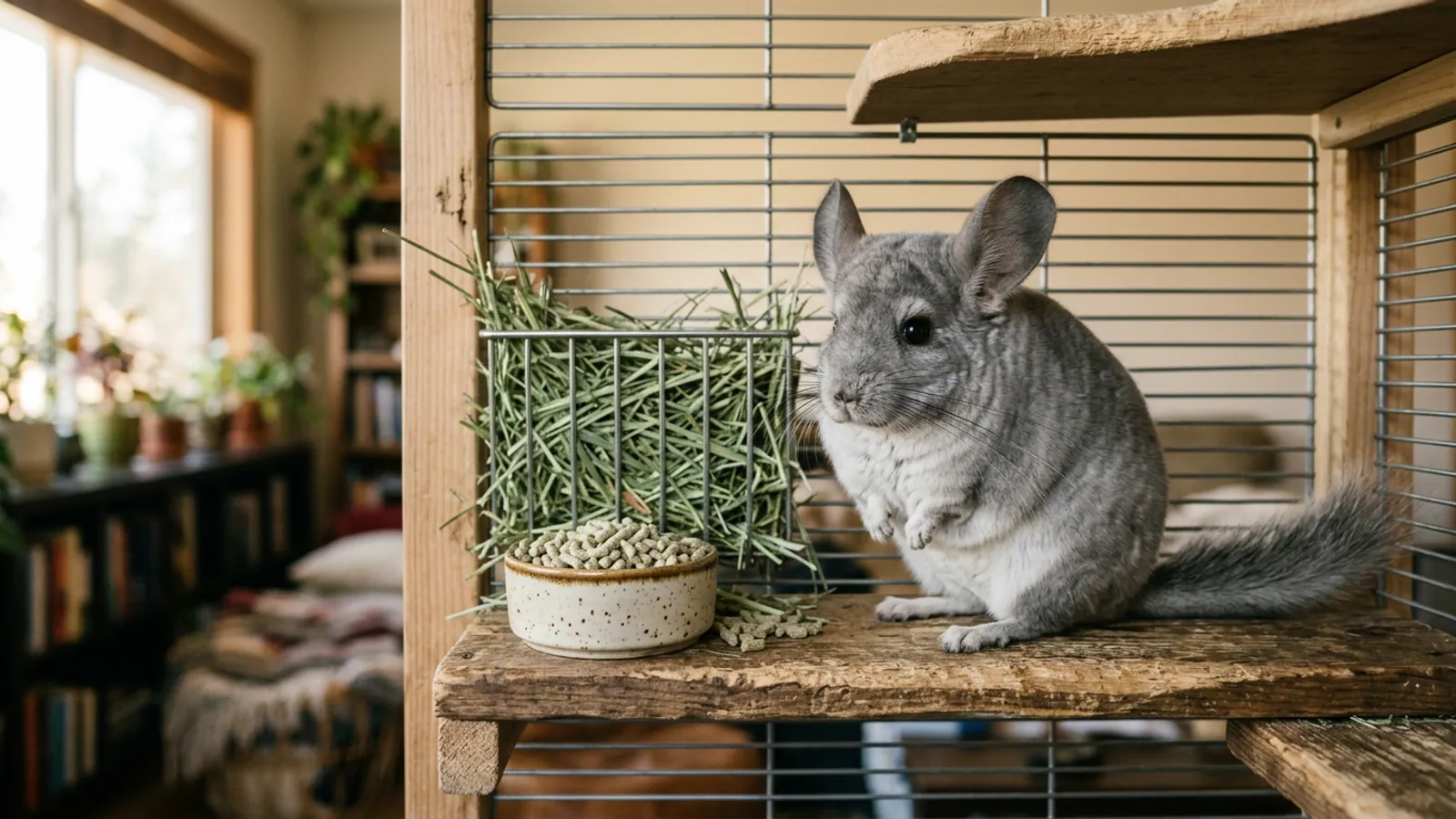
If you have searched chinchilla degu, you have probably met the two animals sold as a matched set: one bag of food with both names on the front, a cage listing that claims it suits either, a care sheet that treats them as one project. I keep chinchillas, not degus, so I will be plain about where my hands-on experience stops and the well-documented facts take over. Here is the gist. A chinchilla and a degu share a shelf in the pet trade for real reasons, they overlap enough that one food brand can chase both wallets, and they are still different enough that they should never share a cage. This is the plain owner-to-owner version of what the two have in common, where they part ways, and whether that combined food belongs in my chinchilla's bowl.
Why a chinchilla and a degu end up on the same shelf
Both animals belong to the same broad group of South American rodents, the one that also includes the guinea pig. Chinchillas come from the high, dry, rocky slopes of the Andes. Degus come from lower scrubland in central Chile. Neither evolved on a diet of sugar or soft food, both grew up gnawing tough, fibrous plants, and both keep their coats clean by rolling in fine dust rather than washing in water. When a pet company writes a care sheet, a lot of the lines come out identical: unlimited grass hay, a dust bath, chew wood, a tall metal cage, no fruit. That overlap is exactly why you see a bag labeled for both, and it is why the phrase degu and chinchilla gets typed into a search bar as if they were one animal with two names.
They are not. The overlap is real but partial, and the places where they differ are the places that get animals hurt when an owner assumes the care sheet is interchangeable. So it is worth walking through both halves honestly: what carries across, and what absolutely does not.
What the two share
Start with the digestive tract, because it drives most of the care. Both are hind-gut fermenters built to process a steady stream of coarse fiber. That means grass hay is not a side dish for either species, it is the meal. A chinchilla and a degu both want unlimited timothy or other grass hay in front of them at all times, with pellets as a small measured supplement and nothing sugary. Get the hay right and most of the rest of the diet falls into place.
Both animals also have continuously growing teeth, front and back. The molars keep erupting for life, and the only thing that keeps them worn to a safe length is chewing tough material for hours a day. My rescue Juniper came to me with dental disease, and watching her taught me that hay and hard chews are not enrichment, they are dental care. That is as true for a degu as it is for a chinchilla.
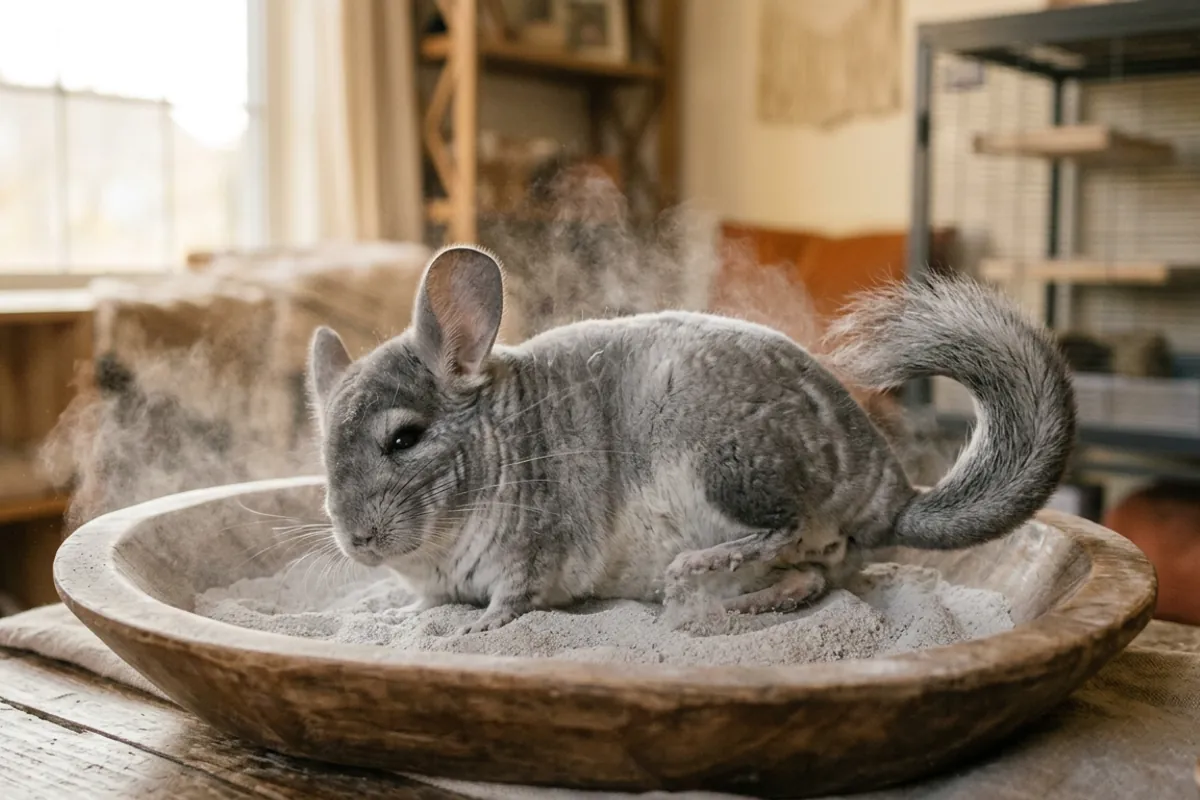
Both bathe in dust, never water. A chinchilla's coat is far denser, but the principle is identical: a shallow bowl of fine volcanic pumice dust, a few minutes of rolling, then the bowl comes out so the coat does not dry out. A soaked coat on either animal is a genuine problem, not a bath. If you want the detail on getting that right, I wrote it all up in the chinchilla dust bath guide, and the same fine dust works for either animal.
And both need space that goes up, not just across, in a cage made of metal and wood rather than plastic. Both are gnawers who will destroy a plastic pan and can swallow the pieces. A tall wire-and-wood cage with solid wooden ledges works for either. Critter Nation double unit small animal cage As an Amazon Associate I earn from qualifying purchases.
Where a degu and a chinchilla split
This is the half of the comparison that matters most, because these are the differences that turn "the care sheet said they were the same" into a sick animal.
Their days run opposite
A degu is diurnal. It is awake and busy in daylight, and it wants an owner around during the day. A chinchilla is crepuscular, most alive at dawn and dusk and often rattling around the cage well into the night, sleeping through the middle of the day when you are most likely to be home. This is not a small scheduling quirk. Two animals on opposite clocks in one cage means one is always being woken by the other, and chronic disturbed sleep is a real welfare cost.
Size, build, and lifespan
A chinchilla is the bigger, softer animal, usually somewhere around 400 to 600 grams, with a short face and enormous rounded ears. A degu is smaller, roughly 170 to 300 grams, leaner, with a longer face and a long thin tail tipped with a tuft. Both tails are fragile in the same way: grab a chinchilla wrong and it sheds a patch of fur, grab a degu by the tail and the skin can strip clean off, a wound that does not grow back. Neither animal is ever handled by the tail. Lifespan splits too. A well-kept chinchilla often lives 10 to 20 years, which is a genuine long-term commitment. A degu more commonly lives around 6 to 8 years. That gap changes what you are signing up for before you even get to daily care.
Sugar is a degu emergency
Here is the single fact that should stop anyone treating the two as interchangeable at the food bowl. Degus are strongly prone to diabetes. Their bodies handle sugar badly, and a diet with fruit, sweet treats, or sugary commercial mixes can tip a degu into diabetes that damages its eyes and shortens its life. Chinchillas do not tolerate sugar well either and should not get fruit, but for a degu the stakes are higher and better documented. This is the reason a food built for both has to be low in sugar, and it is why a treat that would merely be a bad idea for my chinchilla can be dangerous for a degu.
Heat is a chinchilla emergency
The mirror-image risk runs the other way. A chinchilla carries the densest fur of almost any land mammal, dozens of hairs from every follicle, and that coat is a survival trait for a cold mountain night that becomes a liability in a warm room. Chinchillas are comfortable at 60 to 70°F (15 to 21°C). Past 75°F (24°C) the room is dangerous, and 80°F (27°C) and above is an emergency, and damp air makes it strike faster. My Pebble came out of an overheated attic and had a heatstroke near-miss her first summer, and that night is why I am relentless about temperature. A degu handles a warmer room far better than a chinchilla can. Put the two together and you cannot keep one at a safe temperature without stressing the other. If your room runs warm, read the chinchilla temperature guide and keep a thermometer on the cage. digital thermometer and humidity gauge with remote probes As an Amazon Associate I earn from qualifying purchases.
Can a chinchilla and a degu share a cage
No. I want to be blunt here because the shared shelf gives people the wrong idea. The opposite activity cycles alone would rule it out, but stack the rest on top and it becomes an easy call. They have different temperature needs, so no single room setting keeps both safe. They are different sizes, and a chinchilla can badly injure a smaller degu in a squabble. They do not speak the same body language, so normal introductions that might work within a species do not apply across species, and cross-species fighting is common. On top of that, mixing species raises the risk of one passing a bug the other is not adapted to.
Both are social and both do best with company, but the company has to be their own kind. A degu is a colony animal that suffers kept alone, and a chinchilla does best with a bonded same-sex partner. If you want two pets, get two chinchillas or two degus, in separate setups, and give each the room its own species needs. A chinchilla and a hamster is the same story with different names: shared shelf, separate cages.
Versele Laga Chinchilla and Degu Complete, and where it fits my bowl
The most common reason people land on this comparison is a bag: versele laga chinchilla & degu complete, an extruded nugget food with both animals on the label. So here is my read of where a food like that fits.
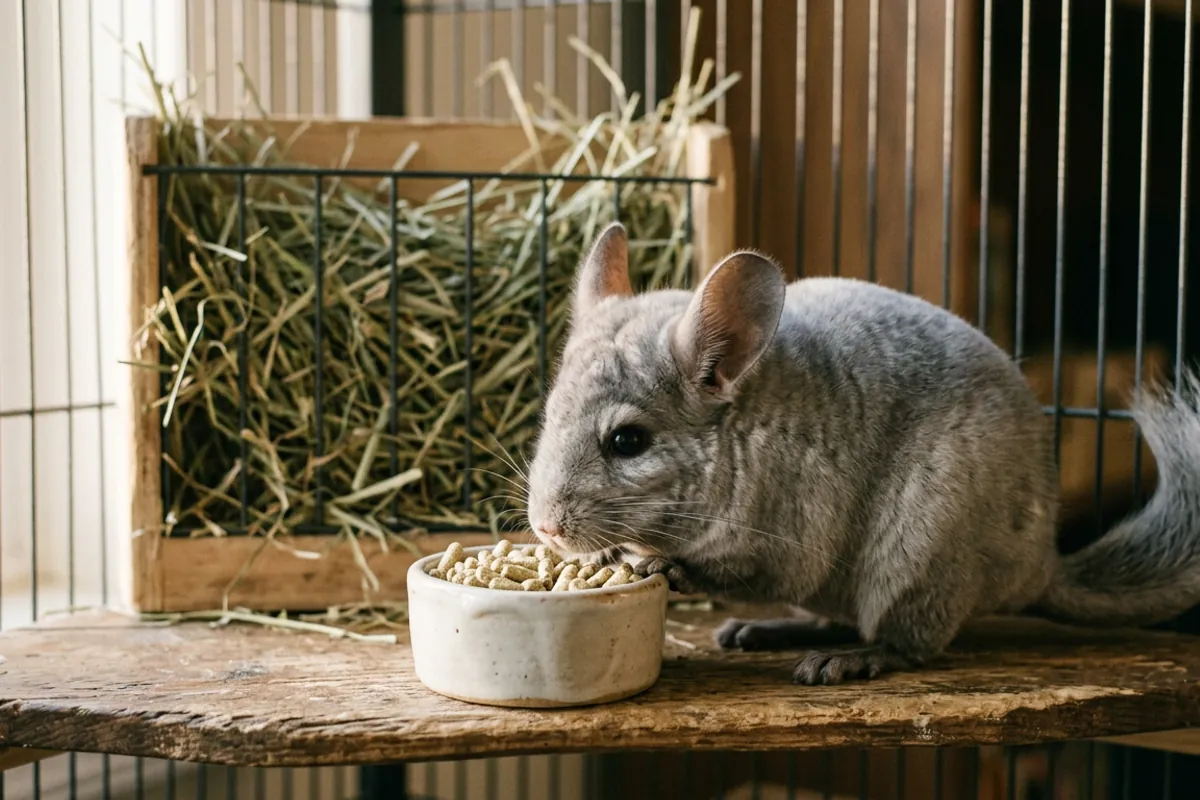
First, the good part. It is an extruded nugget, meaning every piece is the same milled-and-formed pellet rather than a muesli mix of seeds, flakes, and colored bits. That matters, because with a loose mix a clever animal picks out the sugary, fatty pieces and leaves the fibrous ones, which is exactly the wrong way round. A single uniform nugget removes that choice. And because the food has to be safe for a diabetes-prone degu, it is formulated to be low in sugar, which happens to suit a chinchilla fine.
Now the part the word "complete" hides. No bagged food is the complete diet for either animal, whatever the front of the bag says. The complete diet is grass hay, unlimited, all day, and the nugget is the small measured supplement on the side. For my chinchilla that is a tablespoon or two of pellet a day, not a full bowl. A dual-species nugget can absolutely be that pellet portion, and a plain single-species chinchilla pellet does the same job just as well. What no pellet does, combined or not, is replace the hay. If the "complete" label ever tempts you to cut back the hay, that is the moment the food is doing harm. Whichever bag you buy, check the ingredients for added sugars and molasses and put it back on the shelf if they sit near the top of the list.
The rules that hold for both animals
Strip away the differences and the daily care rests on the same short list, which is the real reason the two get sold together in the first place.
Hay first, always. Unlimited grass hay such as timothy is the whole meal for both animals, and it is the cheapest, most important thing in the room. I buy it in bulk so I never run low and never have an excuse to lean on pellets instead. Oxbow Western Timothy Hay, 9 lb box As an Amazon Associate I earn from qualifying purchases. A hay feeder keeps it off the cage floor and cleaner for longer. Oxbow Western Timothy Hay, 40 oz bag As an Amazon Associate I earn from qualifying purchases.
Chews next, because teeth never stop growing. A rotation of untreated apple wood and similar safe woods gives the molars something to work against, and variety keeps a bored animal using them. emours apple wood chew sticks, 40 count As an Amazon Associate I earn from qualifying purchases. If you want the reasoning in full, the chinchilla chew toys piece walks through what is safe and what is not.
A dust bath a few times a week, with fine volcanic dust and no water, keeps either coat healthy. Lixit Blue Beauty chinchilla dust, 3 lb As an Amazon Associate I earn from qualifying purchases.
And if you give either animal a wheel, it must have a solid running surface. A wire or barred wheel catches feet and tails and causes real injuries, and a chinchilla's long feet and a degu's fragile tail are both exactly what a rung traps. 15 inch Chin Spin solid surface chinchilla wheel As an Amazon Associate I earn from qualifying purchases.
For a chinchilla specifically, add a way to shed heat on a warm day, like a chilled stone slab to lie against. Kaytee Chinchilla Chiller granite stone As an Amazon Associate I earn from qualifying purchases.
Which one is right for you
I am not neutral, because I keep chinchillas and love them, but I will be fair about the trade. A degu is the more visibly interactive pet if you are home in the day. It is awake when you are, it is highly social and busy, it is smaller and usually cheaper to buy, and it lives a shorter life, which for some people is the plain right answer rather than a downside. Its hard line is sugar and its need for real company.
A chinchilla is the quieter, softer, longer-lived animal that keeps opposite hours to yours and demands a cool room without compromise. It is a decade-plus commitment, the fur is a genuine responsibility, and the heat rule is not negotiable. Its hard line is temperature.
What neither of them is, is half of a pair you buy together to keep each other company. If the phrase chinchilla degu had you picturing one cage with one of each rattling around happily, put that picture down. Pick the animal whose needs match your home and your hours, give it its own kind for company, and let the other species belong to someone whose life fits it better. The shared food bag was never a promise that the animals are the same.
It also helps to step back and ask what kind of animal a chinchilla really is before comparing it to anything else.