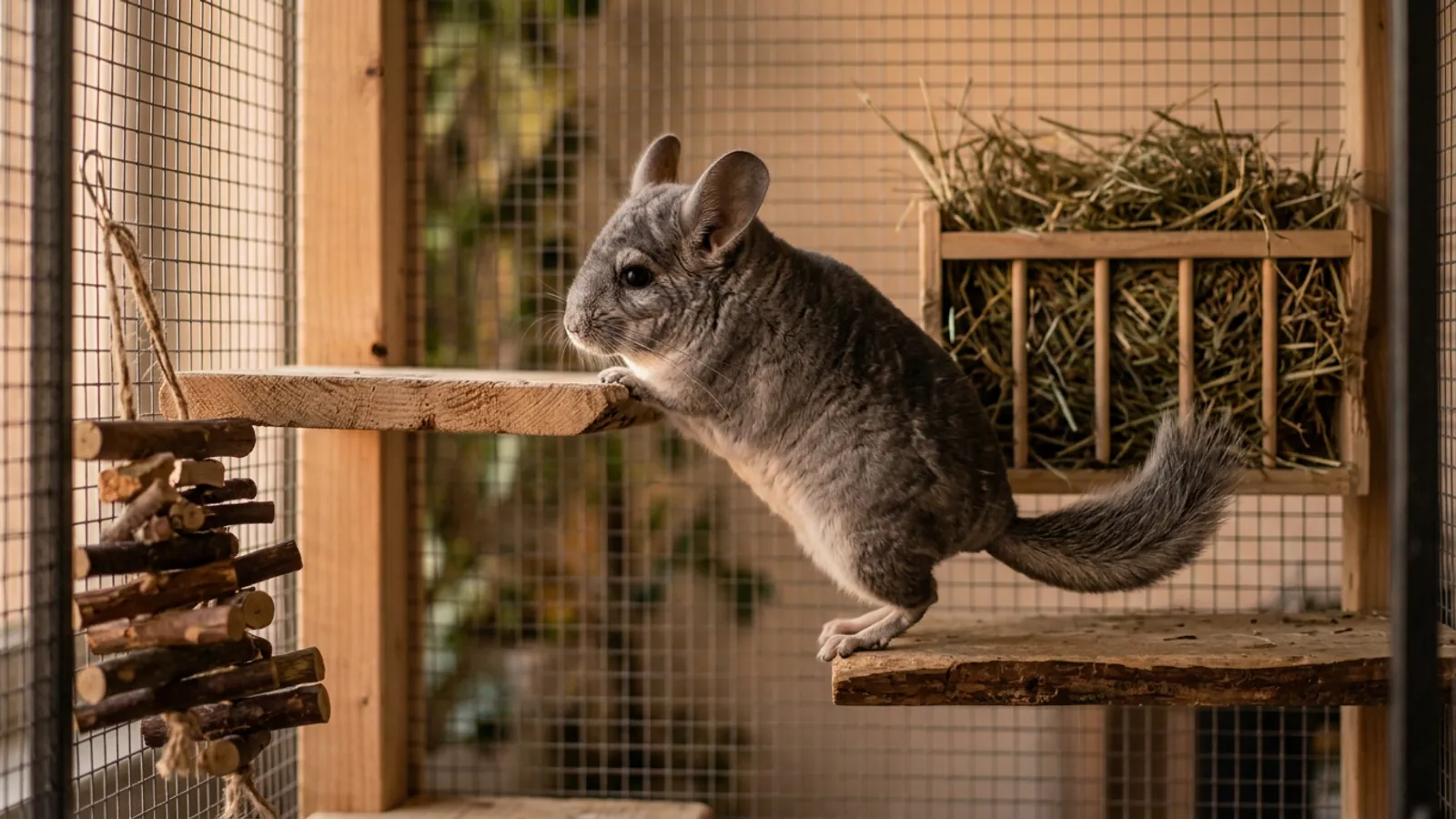
Chinchilla enrichment is usually the last thing on the shopping list, somewhere after the cage, the hay, and the dust. I had it in that order too for my first year with Pebble, and I was wrong. A chinchilla is a crepuscular prey animal built to climb rock faces at speed and grind tough, dry plants for most of the night, and that body and that jaw do not switch off because you bought a nice cage. Give a chinchilla nothing to work on and she works on what is there: the bars, the ledge she was not meant to strip. Enrichment is not decoration and it is not a treat you hand out when you feel guilty. It is the part of husbandry that gives a fast, chewing, climbing animal somewhere legitimate to put all of that.
What chinchilla enrichment means
Strip away the pet aisle marketing and enrichment for chinchillas has three jobs. It wears the teeth down. It uses the legs vertically, the way they were built to be used. It occupies the brain during the hours the animal is genuinely awake, which is dusk, dawn, and a good chunk of the night, not two in the afternoon when you want to play.
Everything else is a variation on those three. A hanging apple wood chew is dental care that happens to be fun. A staggered set of wooden ledges is exercise equipment that happens to look like furniture. A cardboard tube stuffed with hay is a foraging puzzle that happens to be free.
This matters because most products sold as chinchilla toys fail all three tests. Plastic huts, plastic tunnels, plastic anything: a chinchilla will chew it, swallow the pieces, and plastic does not pass through a gut designed for grass. Soft rope, glued and painted wood, anything with a bell or a mirror stuck on it: same problem, different packaging. I have watched too many owners buy a full cage of enrichment that has to come straight back out again. My working rule is that if I cannot picture the material passing safely through a chinchilla, or being spat out unchanged, it does not go in the cage.
If you want the broader picture of what normal behavior looks like first, what chinchilla behavior is really telling you is the companion piece to this one. Enrichment is easier to plan once you know what you are aiming at.
Chewing is the enrichment that keeps the teeth working
Juniper came to me as a neglected rescue with dental disease I now manage day to day, and she is the reason I refuse to treat chews as optional. Chinchilla teeth grow continuously for life, incisors and the molars behind them, and the only thing that keeps them at a workable length is grinding. Not gnawing on a plastic ledge. Grinding coarse, dry, fibrous material for hours.
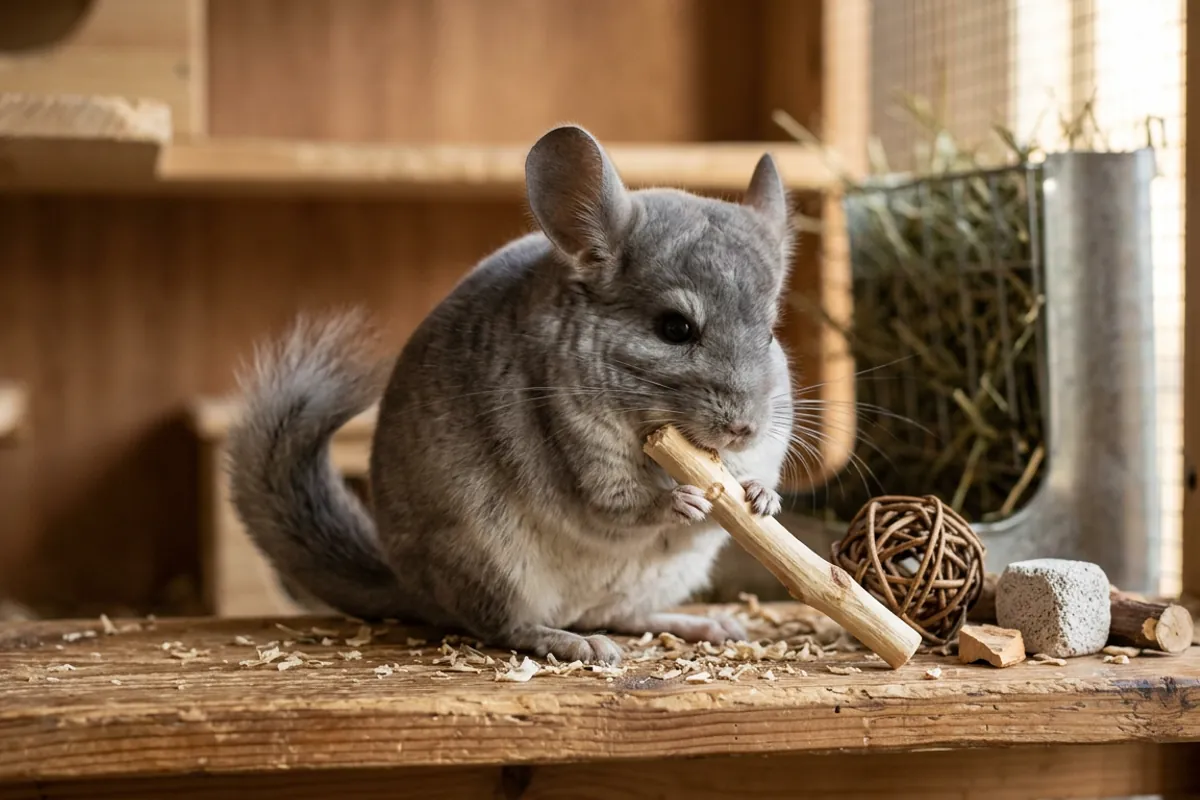
So the first and largest piece of chinchilla enrichment is not a toy at all. It is unlimited grass hay, available every hour of the day, which is where the bulk of the chewing happens. Pellets are a measured supplement, hay is the meal, and no chew stick in the world compensates for a skimpy hay rack.
On top of that, variety. A single kind of wood gets boring and works the jaw in one direction. I keep several textures going at once: apple wood sticks, which nearly every chinchilla will take, plus pear and willow, and pumice or lava for a harder surface that scrapes rather than splinters.
emours apple wood chew sticks, 40 count As an Amazon Associate I earn from qualifying purchases.
Woods I trust: apple, pear, willow, aspen, hazel, mulberry, kiln dried pine. Woods I refuse outright: cherry, plum, peach, apricot and other stone fruits, because their wood and bark carry cyanogenic compounds, plus cedar and fresh pine for their oils, and anything treated, painted, glued, or pulled off a tree that might have been sprayed. Chinchilla safe wood has the longer list, and lava ledges covers where the abrasive stuff helps.
Watch the chewed ends. If a chew stick is still pristine after two weeks, either your chinchilla has better options elsewhere or she has stopped eating properly, and the second possibility is a vet conversation. Drooling, wet chin fur, dropped food, or weight loss means an exotics vet with dental experience, not a new toy.
Build the cage so it does most of the work
The cage is the piece of enrichment that is working at three in the morning when you are asleep, which is exactly when it counts. Chinchillas are vertical animals. They do not pace a floor, they launch. So height beats floor space, and a tall metal cage with wooden ledges at staggered heights gives more usable life than a wide one with a single flat floor.
Critter Nation double unit small animal cage As an Amazon Associate I earn from qualifying purchases.
What makes ledges good enrichment rather than just shelves is the arrangement. Stagger them so no jump is a straight vertical climb and no fall is a long drop onto bare metal. Vary the depth so she has both wide landing platforms and narrow perches. Leave a genuine clear run of open cage on at least one side, because a cage packed wall to wall with accessories takes away the very thing they most want to do, which is jump.
Give her at least one solid hide she can get inside and disappear into. A wooden house with two openings is better than one with a single door, because a prey animal does not like a dead end. Kiln dried pine or aspen is fine, and it will get chewed, which is the point; a chewed house is a house doing its job.
Skip fabric hammocks unless you have watched your own chinchilla ignore fleece completely, and skip anything plastic no matter how it is marketed. Full details on the build are in how to build a chinchilla cage setup that keeps the animal healthy and why a big chinchilla cage is the baseline, not a luxury.
The wheel, and why the running surface decides everything
A wheel is the single best piece of chinchilla enrichment you can buy, and the single easiest one to buy wrong. The rule that matters is the running surface. It must be solid metal, with no rungs, no mesh, no wire crossbars. Wire wheels catch feet and tails, and a chinchilla running at full speed into a trapped foot breaks a leg. I will not put one in a cage, and I would take one out of somebody else's.
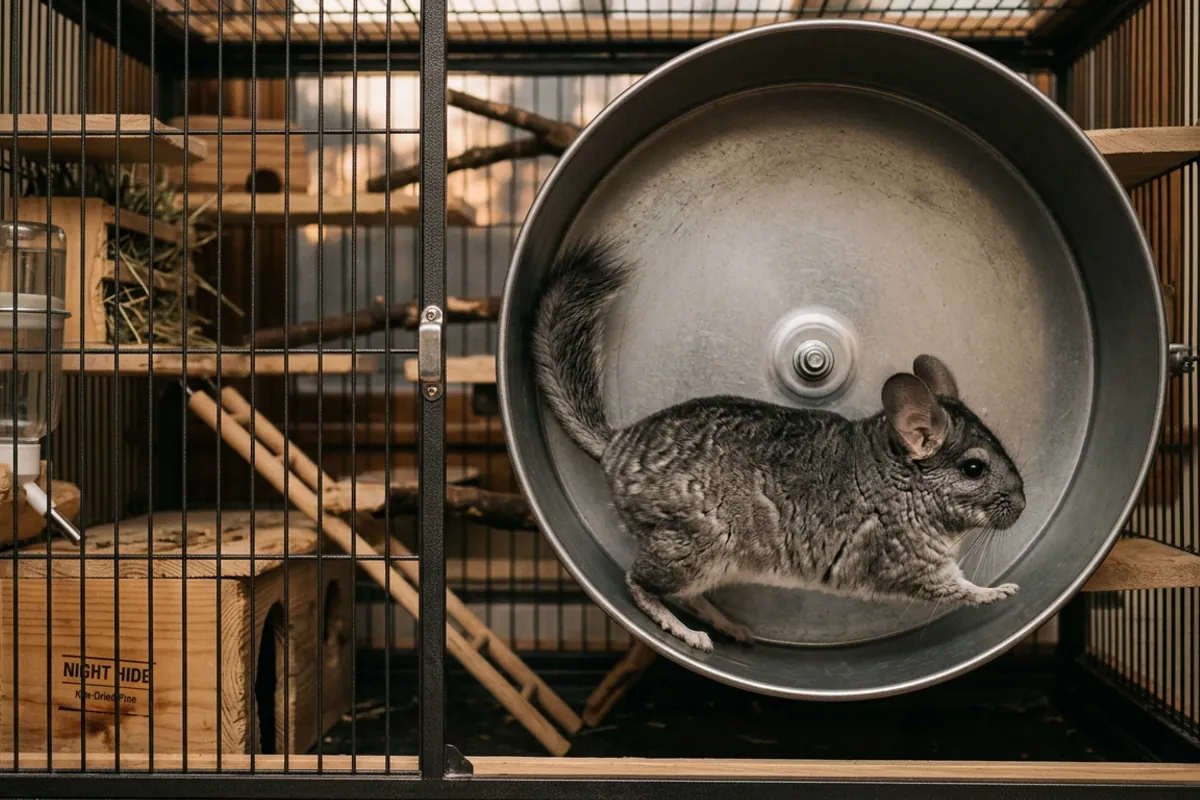
Size is the second rule. A chinchilla should run with her back roughly level, not curved upward, which in practice means a diameter of at least 14 inches, and 15 or 16 inches is better. Anything smaller arches the spine. Plastic saucers and plastic wheels fail on both material and the chewing problem.
15 inch Chin Spin solid surface chinchilla wheel As an Amazon Associate I earn from qualifying purchases.
Mount it firmly to the cage bars rather than standing it on a ledge, both so it cannot tip and so the wobble does not put her off it. Expect the wheel to be silent for the first week or two while she decides what it is, then loud at two in the morning forever after. That noise is a chinchilla exercising, and it is the sound of the enrichment working.
Some chinchillas simply never take to a wheel. Pebble uses hers most nights, Juniper barely touches hers and would rather climb. That is fine, and it is not a training failure. It does mean the animal who ignores the wheel needs more of everything else: more ledges, more chews, more out of cage time. The chinchilla exercise wheel that is safe, and the ones that are not goes through the specific designs.
Foraging and food based enrichment ideas
In the wild a chinchilla spends most of her waking hours finding and processing food. At home the same food arrives in a bowl in four seconds, and that gap is where a lot of boredom lives. Foraging enrichment closes it without adding a single calorie.
The easiest version costs nothing. Take a plain cardboard tube, no ink, no tape, no glue, stuff it with timothy hay, and pinch the ends. She has to work the hay out. Same idea with a small paper bag, or hay pushed into a wooden hay rack she has to pull through rather than a loose pile she can sit in.
Oxbow Western Timothy Hay, 40 oz bag As an Amazon Associate I earn from qualifying purchases.
For a household that goes through hay quickly, buying in bulk keeps the quality consistent and the cost sane, and consistent hay matters more than any toy in the cage.
Oxbow Western Timothy Hay, 9 lb box As an Amazon Associate I earn from qualifying purchases.
Scatter feeding works too. Instead of tipping the measured daily pellets into a bowl, put them in twos and threes on different ledges so she has to travel the cage to collect them. This is enrichment with no extra food, which is the important part: pellets are a measured supplement, not a free resource, and the hidden calories in food puzzles are how chinchillas get fat.
Treats are the smallest lever here and the one most often overpulled. One dried rose hip, or a few plain rolled oats, is a whole treat for a whole day. No nuts, no seeds, no fresh fruit, no yoghurt drops. Their gut is built for dry, high fiber, low sugar plant material, and sweet treats cause real digestive trouble. My guide to chinchilla treats has the full list of what stays in my house.
Out of cage time is enrichment, not a break from it
Even a tall, well fitted cage has limits, and out of cage time is where a chinchilla gets to run flat out, wall bounce, and behave like the animal she is. I aim for 30 to 60 minutes most days, in the evening when she is naturally awake, in one small room I have made safe rather than the run of the house.
Safe means specific things. Every electrical cord out of reach or boxed in, because a chinchilla chews first and a live cable is a fatal mistake. No gaps behind or under furniture that she can get into and you cannot. No houseplants, most of which are either toxic or unproven. No other pets in the room, ever, including the calm dog. Doors closed, and eyes on her the entire time, because unsupervised free roaming is how chinchillas disappear into sofas.
A playpen is a useful containment tool but it is not a substitute for a chinchilla proofed room, and most panels sold as playpens are jumpable. If you use one, use it as a boundary inside an already safe space, not as the only thing between her and the wiring. What chinchilla out of cage time should look like covers the setup properly.
The dust bath belongs in this window too. Two or three baths a week, 10 to 15 minutes, then the bath house comes out again so she does not sleep in it or use it as a toilet. Chinchillas never bathe in water; the dust is fine volcanic pumice, and rolling in it is both coat maintenance and one of the more obviously joyful things they do.
Lixit Blue Beauty chinchilla dust, 3 lb As an Amazon Associate I earn from qualifying purchases.
Rotation, novelty, and how to tell if it worked
Chinchillas notice change, and they are suspicious of it. That cuts both ways. A cage that never changes stops registering as interesting, but a cage that changes completely overnight can put a nervous animal off her food.
What I do is rotate a portion and leave the rest alone. Every week or two I swap out two or three chews and move one ledge, and I leave the hide, the hay rack, the wheel, and the water bottle exactly where they are. Those four are anchors. Items that come out go into a box and come back a month later, by which point they read as new again.
Signs it is working are easy to read once you know them. Popcorning, that stiff legged vertical bounce, is a chinchilla with energy she is happy to spend. Wall surfing, sprinting between ledges, chewed down chew ends, hay pulled everywhere: all good. So is a chinchilla who greets you at the bars in the evening rather than staying flat in her hide.
Signs it is not working are just as readable. Persistent bar chewing, especially in one spot, usually means an animal with nothing better to grind. Sitting motionless in a corner during her active hours is worth watching closely. Fur chewing, where a chinchilla barbers her own coat into a short, uneven patch, gets blamed on boredom and stress a lot; the causes are debated and genetics likely plays a part, so I treat it as a prompt to fix the environment and to rule out skin disease or pain with an exotics vet rather than as proof of any one thing.
One caution: a chinchilla who is lethargic, hunched, off her food, or producing fewer and smaller droppings is not bored. That is a sick animal, and it is a same day vet call, not an enrichment problem. What a lethargic chinchilla is telling you covers where that line sits.
The enrichment I refuse, and the nights I skip it
Some popular items are simply not going in my cages. Exercise balls, the clear plastic spheres, are dangerous for chinchillas: no ventilation, no escape, forced running, and a heat trap on an animal that cannot shed heat. Harnesses and leashes risk a spine and cause fur slip. Wire wheels break legs. Plastic anything gets eaten. Scented, painted, or glued wooden toys bring in compounds nobody has tested on a small herbivore. Water play of any kind is off the table, because a soaked dense coat takes a very long time to dry and invites fungal infection.
And there is one condition under which I stop enrichment entirely, which is heat. Pebble came to me from a rehome out of an overheated attic, and her first summer brought a near miss and a night at the emergency vet. That night is why I am blunt about this. Chinchillas are comfortable at 60 to 70°F (15 to 21°C). Above 75°F (24°C) is risky. At 80°F (27°C) and up you are in an emergency, and humid air makes all of it happen faster.
Exercise generates heat. So on a warm evening, out of cage time is canceled, the wheel comes off the cage if she is using it hard, and the only enrichment is hay, chews, and cool still air. A bored chinchilla is a problem you can fix tomorrow. An overheated one may not have tomorrow.
Keep a thermometer with a humidity reading at cage height, not on the far wall, because the number that matters is the one where she sits.
digital thermometer and humidity gauge with remote probes As an Amazon Associate I earn from qualifying purchases.
A cooling stone is a small comfort measure, not a cooling system, and it does not replace air conditioning.
Kaytee Chinchilla Chiller granite stone As an Amazon Associate I earn from qualifying purchases.
If you are unsure where your room sits, chinchilla temperature is the number that keeps yours alive and the chinchilla heat danger calculator will tell you plainly.
Good enrichment is unglamorous in the end. Unlimited hay, a tall metal cage with wooden ledges arranged for jumping, a rotating set of safe chews, a solid surface wheel, an hour out in a proofed room, and the discipline to call all of it off when the thermometer says so. Do those, and you get a chinchilla who spends her nights busy instead of chewing the bars.
Enrichment is mostly about keeping stress low, and what stresses a chinchilla names the things worth removing from the room.