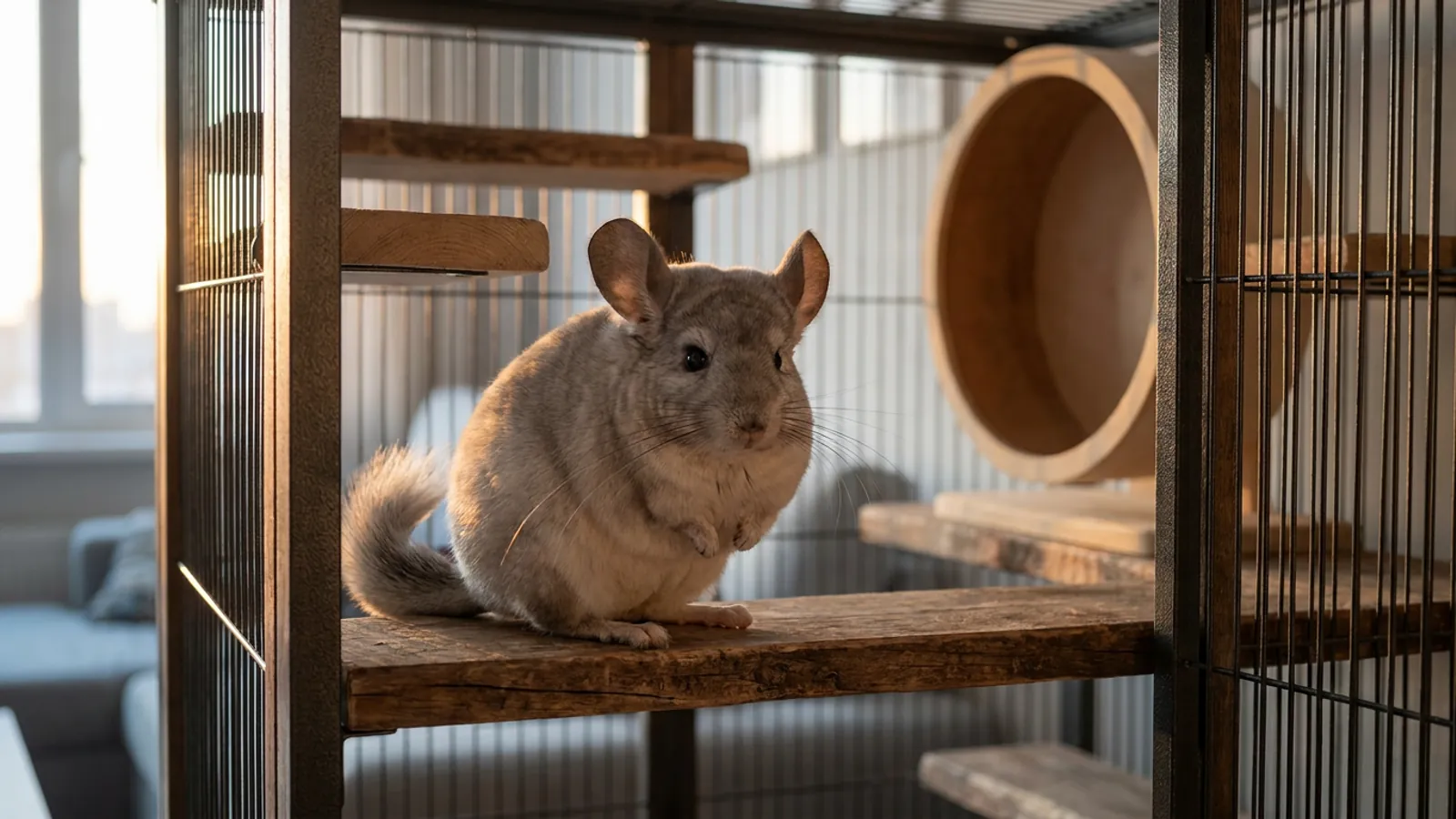
A chinchilla is one of the strangest small pets you can bring home, and I mean that as a compliment. After about ten years of living with them, I still catch myself surprised by what these animals are: high-altitude rodents wearing the densest fur on land, built for a cold dry mountain and dropped into our warm humid houses. If you want to keep one well, it helps to understand what the chinchilla really is under that cloud of fur, because almost every care rule that matters comes straight out of its biology. Get the biology, and the husbandry stops feeling like a list of arbitrary rules and starts making obvious sense.
Where the chinchilla comes from
Chinchillas come from the Andes mountains of South America, from the cold, dry, rocky slopes of Chile and neighboring countries. That single fact explains most of what follows. Up there the air is thin and cool, the days are moderate and the nights are cold, and the humidity is low. There is no standing water to swim in and nothing warm to hide from. An animal that evolved in that world is superbly equipped for cold and completely unequipped for heat, and it never developed any tolerance for damp.
There are two species. The pet you meet almost everywhere is the long-tailed chinchilla, Chinchilla lanigera. Its short-tailed cousin is rarer. Both were hunted close to the edge for that famous fur, and wild populations are still fragile. The animal in your living room is only a few generations removed from that mountain, which is why the mountain still sets the rules for the chinchilla in a way that is easy to forget when you are looking at a tame, hand-raised kit.
The densest coat on land, and why water is the enemy
What makes a chinchilla a chinchilla, more than anything, is the coat. Where a human or a dog grows one hair from each follicle, a chinchilla grows a dense bundle, as many as fifty or more hairs from a single point. The result is the densest fur of any land mammal. It is so tightly packed that parasites like fleas cannot move through it or breathe in it, which is why chinchillas do not get fleas the way a cat does.
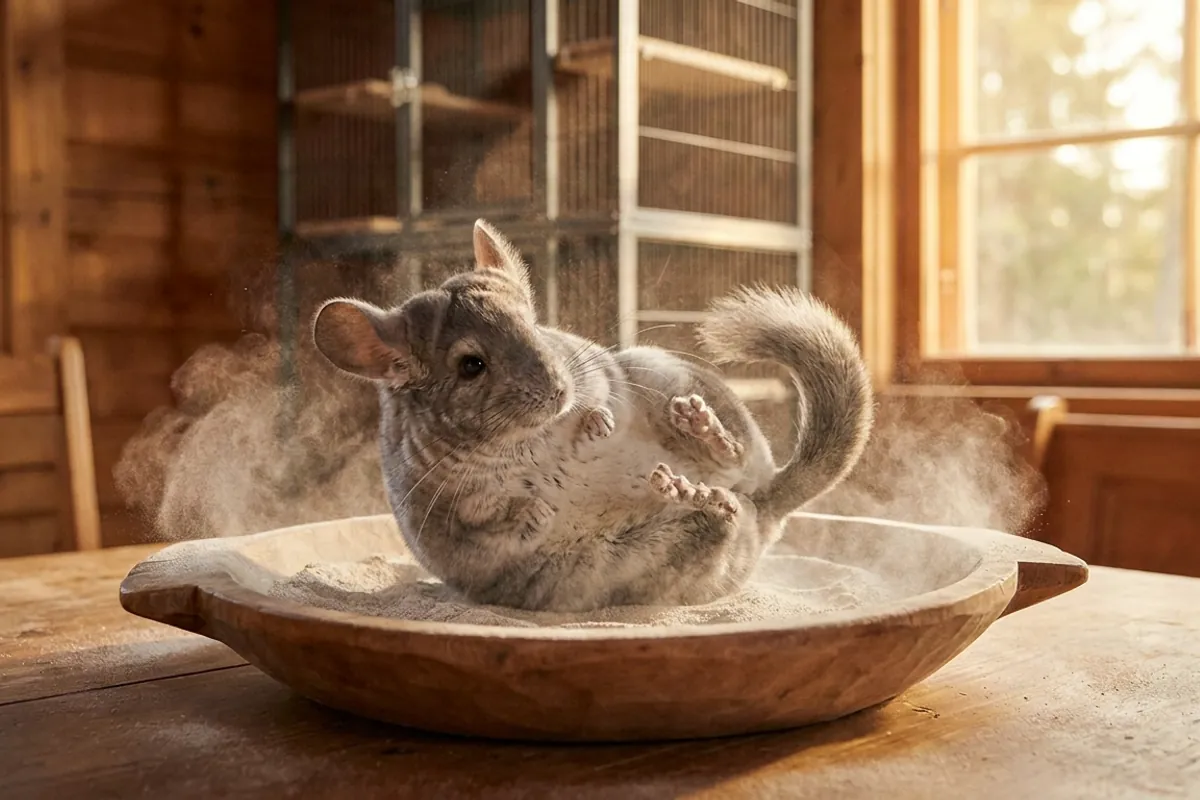
That same density is exactly why water is dangerous. If a chinchilla gets soaked, the coat holds water down against the skin and takes a very long time to dry. Damp fur chills the animal and grows fungus, and a wet chinchilla can develop skin infections and worse. This is not a preference or a quirk. You never bathe a chinchilla in water. They clean themselves by rolling in fine dust, which is really volcanic pumice powder that slips between the hairs and pulls oil and moisture out. A dust bath a few times a week, using proper chinchilla dust rather than sand, keeps the coat healthy. Lixit Blue Beauty chinchilla dust, 3 lb As an Amazon Associate I earn from qualifying purchases. Give the bath for ten or fifteen minutes and then take it away, because leaving dust in all day dries the eyes and skin.
Why heat is the thing that kills them
Because they are built for cold, heat is the single most dangerous thing in a pet chinchilla's life. Their brilliant insulation runs one direction. It holds warmth in beautifully and lets very little out, and a chinchilla cannot sweat. It sheds heat mainly through its large ears, which is not nearly enough on a hot day. This is the conviction I am most relentless about, and it comes from Pebble, who came to me out of an overheated attic and gave me a heatwave near-miss and a night at the emergency vet in her first summer. I do not soften this.
The comfortable range is 60 to 70°F (15 to 21°C). Above 75°F (24°C) you are into risky territory, and 80°F (27°C) and up is an emergency, faster in humid air because a chinchilla cannot lose heat into air that is already saturated. Heat stroke can kill in a matter of hours. Learn the early signs, keep the room cool with air conditioning rather than hope, and never park a cage in a sunny window. I built a heat danger calculator so you can check your own room against these numbers, and the warning signs of heat stroke are worth memorizing before you ever need them. For the full picture, see chinchilla heat safety.
Teeth that never stop growing
A chinchilla has twenty teeth, and every one of them grows for its entire life. They are open-rooted, which means they never stop erupting and there is no final length they reach. I have seen growth figures quoted with confident-looking numbers attached, and I am not going to repeat one, because the rate is not the part that matters here. In the wild, grinding tough mountain grasses wears them down at the same rate they grow. In our homes, if that wearing does not happen, the teeth overgrow, and this is where a lot of pet chinchillas quietly get into trouble.
I watch this up close every day with Juniper, a rescue whose dental disease I manage. When the cheek teeth do not wear evenly they form sharp spurs and points that cut into the cheek and tongue, and the front teeth can grow the wrong way inside the mouth. It is called malocclusion, and it is painful, progressive, and one of the most common serious problems keepers face. The signs are subtle at first: dropping food, drooling, weight loss, pawing at the mouth, eating less hay.
The prevention is simple to say and non-negotiable to do. Unlimited grass hay, always available, plus a real variety of safe wood chews. Hay is not a snack, it is the tool that keeps the teeth ground down. But once teeth are overgrown, no chew fixes it. That is a vet job, and specifically an exotics vet who can file the teeth under sedation. Learn to spot teeth problems early and read the full teeth and health guide, because caught early this is manageable and caught late it is miserable.
A gut that runs on hay
The chinchilla gut is built to run on one thing: high-fiber, low-nutrient grass hay, eaten more or less constantly. They are hindgut fermenters. Fiber moves through in a steady stream and the digestive system depends on that flow never stopping. This is why the foundation of the diet is unlimited grass hay, timothy or orchard or a similar grass hay, available at all times. Oxbow Western Timothy Hay, 40 oz bag As an Amazon Associate I earn from qualifying purchases. Plain pellets come second, as a measured supplement rather than the main meal. A tablespoon or two of good quality chinchilla pellets a day covers what the hay does not, and that is it.
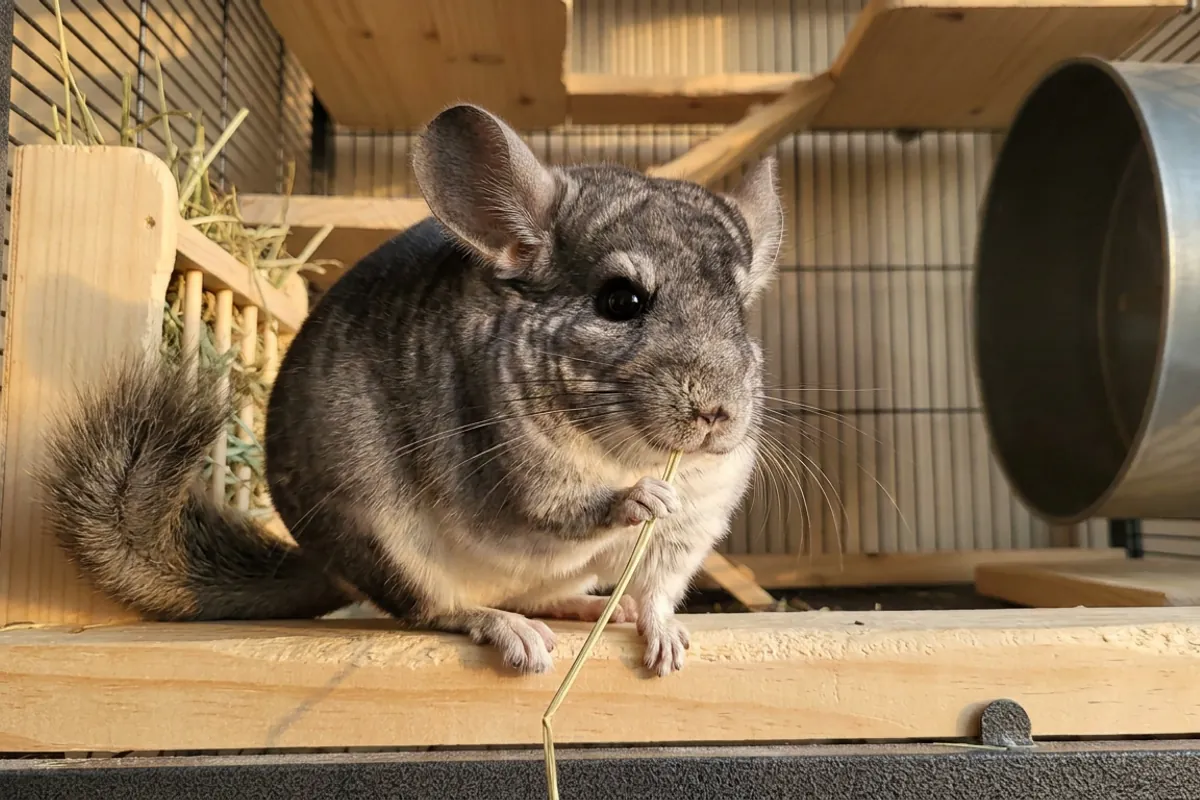
What gets chinchillas into trouble is sugar and fat and sudden change. Their systems are not built for fresh fruit, most vegetables, nuts, seeds, or the colorful commercial treats sold at pet stores. Too much sugar disrupts gut bacteria and can cause bloat, which is dangerous. If you want to treat, a single plain rosehip or a small piece of plain dried herb is plenty. Introduce any new food slowly and in tiny amounts, and if my chinchilla ever goes off its hay or stops producing droppings, I treat that as an urgent problem, not a wait-and-see one. A gut that stops moving is an emergency. The full diet and hay guide goes deeper, but the summary is boring on purpose: hay, hay, measured pellets, water, and very little else.
Size, color, and the myth of the huge chinchilla
People are often surprised by how small a chinchilla is in the hand and how big it looks in the cage. Most of that bigness is fur. A typical adult weighs somewhere around 400 to 600 grams, with the body running roughly nine to fifteen inches plus the bushy tail. If you have seen photos of a huge chinchilla online and expected a rabbit-sized animal, that is the coat and the camera talking. A huge chinchilla is usually just a well-fed, densely furred one in a flattering pose. Some lines do run larger than others, but there is no giant breed.
Color is where it gets fun. The wild type, and still the most common, is the standard gray chinchilla: dark slate on top fading to a white belly. Breeders have developed color mutations from there, including beige, ebony, violet, sapphire, and white and mosaic patterns, along with various lighter shades. A light gray chinchilla might be a specific mutation or simply a paler standard, and the color under all that fur has nothing to do with how good a pet the animal is. Personality and health matter, coat color does not. What every one of them shares is the same body plan: dense silver-gray-based fur, large rounded ears, big dark eyes for a crepuscular animal that is most active at dawn and dusk, a bushy tail, and strong back legs built for jumping.
Males, females, and what a pregnancy involves
Chinchillas are social animals and generally happier with company, though introductions have to be done carefully and slowly. If you are keeping a same-sex pair to avoid breeding, know the basics of the sexes. Females are usually the larger and often the more dominant of the two. A male chinchilla is typically a bit smaller, and males have one specific maintenance need worth knowing: a fur ring can form around the penis from grooming, and if it is not noticed and gently removed it can cause real harm. It is a quick check, not a scary one, but you have to know to do it.
Breeding is not something to wander into, and I do not recommend it for beginners. But the biology is remarkable. A chinchilla pregnant with kits carries them for about 111 days, which is a very long gestation for such a small rodent. That long pregnancy pays off at birth: chinchilla kits are precocial, born fully furred, with their eyes open, able to move around within hours. Litters are small, usually one to three, most often two. If you are wondering whether your chinchilla is pregnant, that long timeline and the risks involved are exactly why an exotics vet, not a guess and a home kit, is the right call. Unplanned litters from a mixed-sex pair are common and easy to prevent by simply not housing males and females together.
Bringing a chinchilla home
If all of this makes the chinchilla sound demanding, it is more accurate to say it is specific. Meet the requirements that come out of its biology and it is a hardy, long-lived companion. Chinchillas commonly reach ten to twenty years, and some pass twenty, so choosing a chinchilla for your household is a real commitment, not an impulse.
The living space follows directly from what the animal is. It needs to be tall, because chinchillas climb and jump, and made of metal and wood with solid wooden ledges. Skip plastic entirely, because they chew everything and plastic can cause a fatal blockage if swallowed. If you use an exercise wheel, it must have a solid running surface. Wire wheels catch feet and legs and break them. This is one of the few places I name products bluntly: wire wheels, plastic huts, and tiny cages are how good intentions injure animals. 15 inch Chin Spin solid surface chinchilla wheel As an Amazon Associate I earn from qualifying purchases.
A lot of first-time owners start with an all-in-one starter box, and I want to be clear about those. I do not recommend one. They are a convenient way to get a food dish, a bottle, and a few basics in one purchase, but the cage that comes with most starter kits is too small for a full-grown chinchilla, and some include plastic pieces you should not use. Treat a kit as a starting point, not a finished home. Plenty of keepers go the diy chinchilla habitat route instead, building out a tall wire-and-wood enclosure with wooden ledges and safe hides, which gives far more space for the money. Whichever way you go, get the cage setup right first, read the general chinchilla care guide, and remember that the animal you are setting up for is still, underneath the tame temperament, a mountain creature that needs cool air, endless hay, and room to leap.