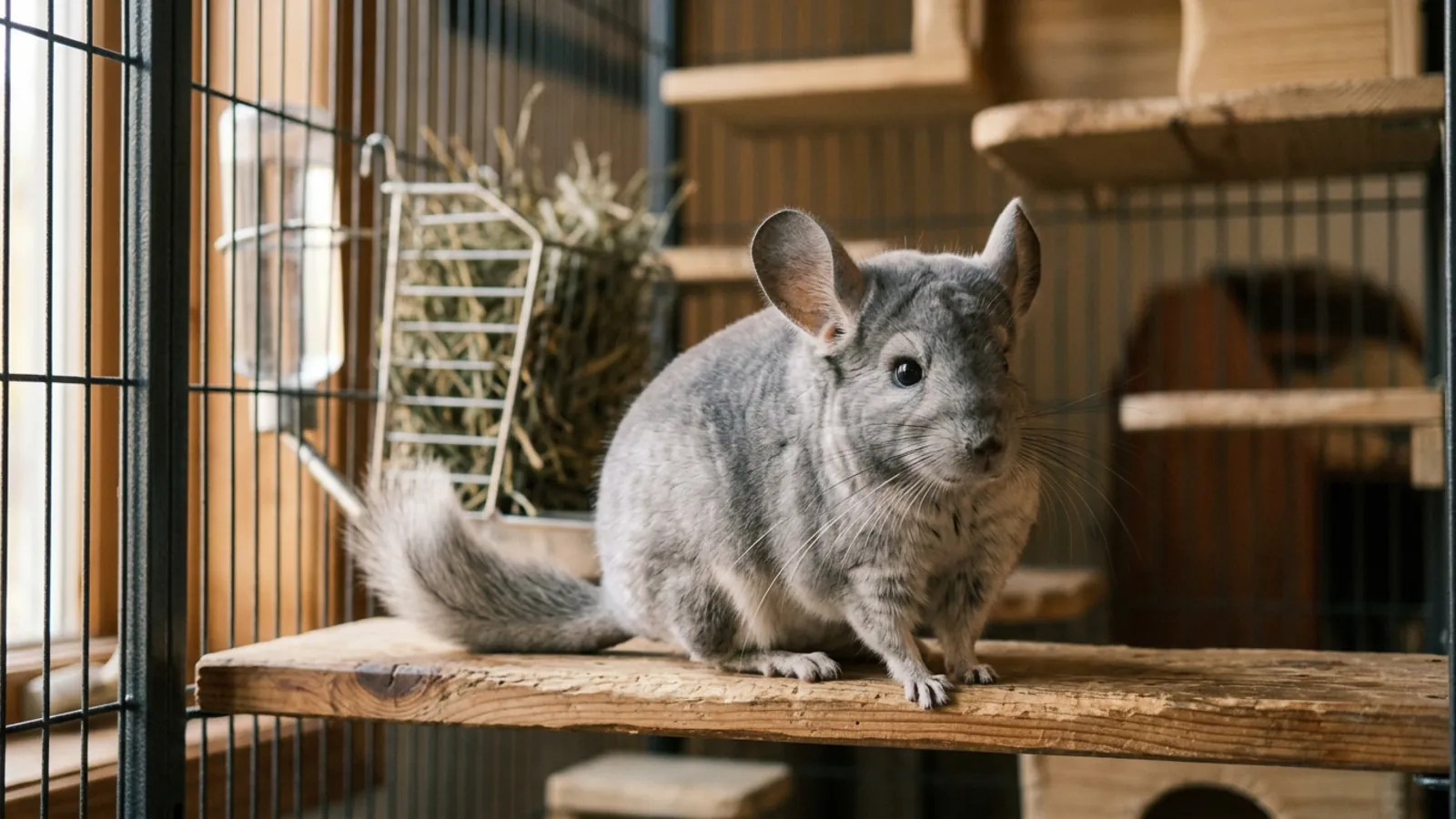
A good chinchilla care guide has to open with the truth that a chinchilla is not a low-maintenance pocket pet, whatever the shop told you. I have kept them for about ten years, and most of the trouble I see owners run into is not exotic or rare. It is heat, it is the wrong food, and it is a cage that was never big enough. Get those three right and the rest gets much easier. What follows is the version I wish someone had handed me before I brought Pebble home: owner to owner, backed by what keeps these animals alive rather than the promises printed on the box.
What owning a chinchilla asks of you
Start with the commitment, before the shopping list: a chinchilla can live 10 to 20 years, so a guide to owning a chinchilla is really a guide to the next decade or two of your life. They are most awake at dawn, at dusk, and through the night, which means the cage belongs somewhere their thumping and chewing will not wake you at three in the morning. They do not enjoy being held by most people, and they are fragile in ways a hamster is not: a rough grip, a short fall, or one hot afternoon can each be fatal. They are also clever, funny, and long-lived enough to become a real part of the household.
None of that is a reason to walk away. It is a reason to go in with open eyes. Budget for the setup, which is not cheap once you buy a cage worth owning, and budget for the part people skip, a vet fund. Exotics care costs more than a routine cat or dog visit, and a chinchilla hides illness until it is serious, so that money needs to be sitting there before you ever need it.
If you want a book alongside the web, Chinchillas: A Guide to Caring for Your Chinchilla by Donna Anastasi is the title most keepers point new owners toward, and it holds up. Read widely, though. No single chinchilla guide, mine included, replaces watching your own animal closely and finding a vet before an emergency finds you. If you are still deciding whether to bring one home at all, I wrote a straight answer at is a chinchilla a good pet.
Temperature is the number that keeps yours alive
I lead every chinchilla pet care guide with heat because Pebble taught me why. She came to me from a rehome out of an overheated attic, and her first summer brought a heatwave that put us in the emergency vet overnight. That scare is why I am relentless about this, and this is not negotiable.
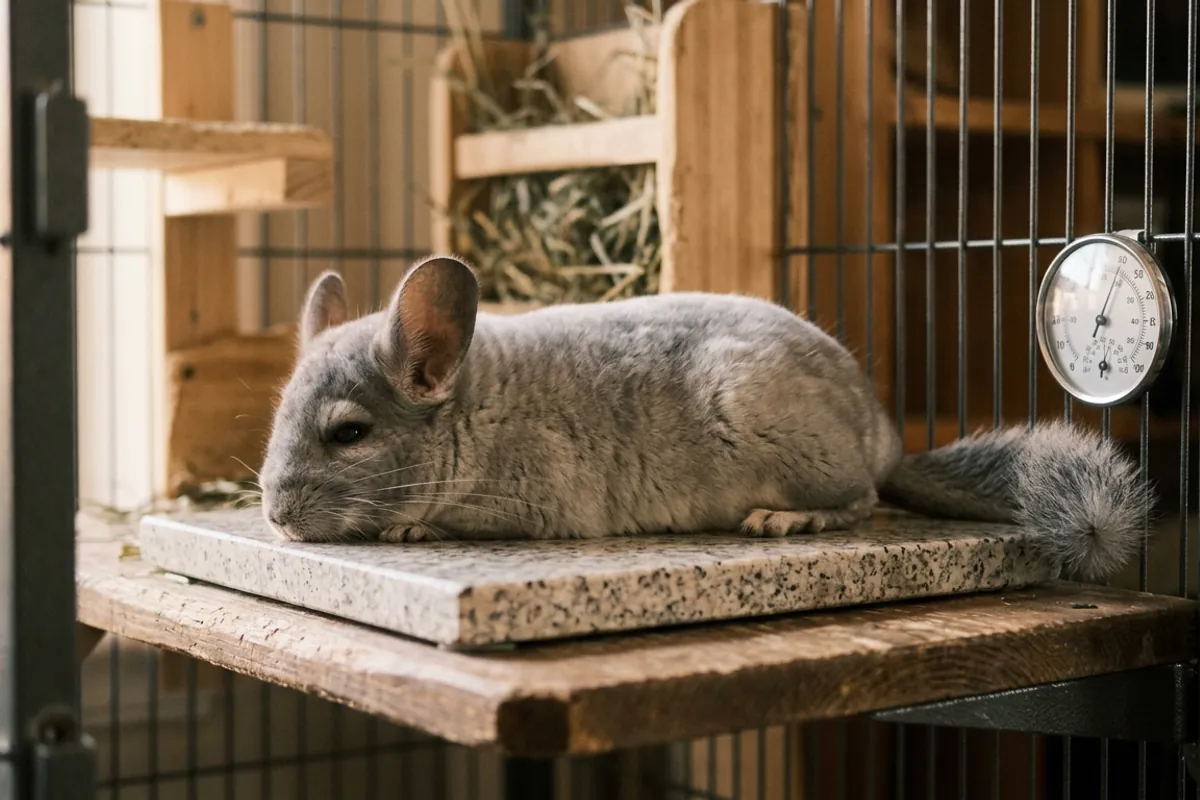
Chinchillas evolved in the cool, dry high Andes and carry the densest fur of nearly any land mammal. The same coat that makes them so soft means they cannot shed heat the way we do. The comfortable range is 60 to 70°F, which is 15 to 21°C. Above about 75°F, roughly 24°C, you are into risky territory. At 80°F, about 27°C, and up, you are in an emergency, and humid air makes every one of those numbers worse because it strips away what little cooling they can manage.
Put a combined thermometer and humidity gauge on or beside the cage and read it. digital thermometer and humidity gauge with remote probes As an Amazon Associate I earn from qualifying purchases. Guessing at the room temperature is how animals die in July. Keep the cage out of direct sun and away from radiators, and cool the room with air conditioning on hot days rather than trusting a fan, because a fan mostly just moves warm air around. A chewable granite or marble cooling stone gives them a cold surface to lie against and is cheap insurance. Kaytee Chinchilla Chiller granite stone As an Amazon Associate I earn from qualifying purchases. If your chinchilla is lying flat, breathing hard, with bright red ears, treat it as heat stroke and get to a vet. I keep the full rundown at chinchilla heat stroke warning signs, and there is a heat danger calculator if you want to check your own room against the numbers.
The cage: tall, metal, and bigger than you think
A chinchilla cage has to be metal and wood. Plastic is not something to merely avoid, it is a hard no, because a chinchilla will gnaw any plastic it can reach and swallow pieces that can block its gut. The bars and pan must be metal, and the ledges, shelves, and hideout wooden. Skip anything coated or painted where they can chew it. Bar spacing should be narrow, around half an inch to one inch, so a chinchilla cannot push its head through and get stuck.
Go tall before you go wide. Chinchillas are climbers and jumpers, and vertical space with staggered wooden ledges gives them far more usable room than a low, sprawling footprint. A cage built on a solid multi-level metal frame is usually a better buy than something sold as a "chinchilla cage" that is really a glorified hamster box. Critter Nation double unit small animal cage As an Amazon Associate I earn from qualifying purchases. I have written the long version at how to pick the best chinchilla cage without buying the wrong one twice.
If you add a wheel, and I think you should, it has to have a solid running surface. 15 inch Chin Spin solid surface chinchilla wheel As an Amazon Associate I earn from qualifying purchases. Wire and mesh wheels catch toes and tails and cause real injuries, and I will name them as the bad products they are. Give it a diameter of at least 15 inches so an adult is not forced to run with a curved spine. Fit the cage out with wooden ledges at staggered heights, a hidey house, a hay feeder, a water bottle, and a heavy dish for pellets, and leave real floor space to move. Keep the whole thing somewhere cool and out of the sun, spot-clean droppings often, and do a full bedding change weekly, because a dirty cage is both a smell problem and a health one.
Hay first, pellets second, treats almost never
Here is the single most important line in any chinchilla care guide about food: unlimited grass hay is the whole meal, not a side dish. Everything else is a supplement to it. Juniper, my dental rescue, is why I am uncompromising here. Her teeth were already a mess when she came to me, and I watch every day what happens when a chinchilla does not get enough coarse fiber to grind them down.
A chinchilla's teeth grow continuously for its entire life. Chewing tough, stalky hay for hours on end is what keeps the back teeth worn to the right length. Take that away and the teeth overgrow into spurs that cut the tongue and cheeks, and that road ends in pain, weight loss, and a vet bill. So the hay never runs out, ever. Timothy hay is the standard grass hay to build the diet on, and it should be fresh, green, and dry rather than yellow and dusty. Oxbow Western Timothy Hay, 40 oz bag As an Amazon Associate I earn from qualifying purchases. If you keep more than one chinchilla, or simply go through a lot, buying hay in bulk works out cheaper and you can portion it yourself. Oxbow Western Timothy Hay, 9 lb box As an Amazon Associate I earn from qualifying purchases. I go deeper on all of this at why timothy hay is the whole meal, not a side dish.
On top of the unlimited hay, give a measured amount of plain, hay-based pellets, usually somewhere around one to two tablespoons a day for an adult, and skip the mixes studded with dried fruit, seeds, and colored bits, which are junk they will pick through for the sweet parts. Fresh water in a bottle, changed daily. Treats are where owners do the most quiet damage. A chinchilla gut is built for dry, high-fiber food, and sugary or fatty snacks, including most fruit and any nuts, can upset the whole system. A tiny piece of plain dried rose hip or a single plain oat now and then is plenty. When in doubt, feed more hay. There is a longer diet walkthrough at chinchilla food, hay first and pellets second.
The dust bath, and why it is never water
Chinchillas never bathe in water. I mean never. That dense coat holds water against the skin, takes a very long time to dry, and a damp chinchilla can end up chilled or with a fungal skin infection. To stay clean they roll in fine dust, which is really powdered volcanic pumice, and it lifts oil and moisture out of the fur in a way water never could.
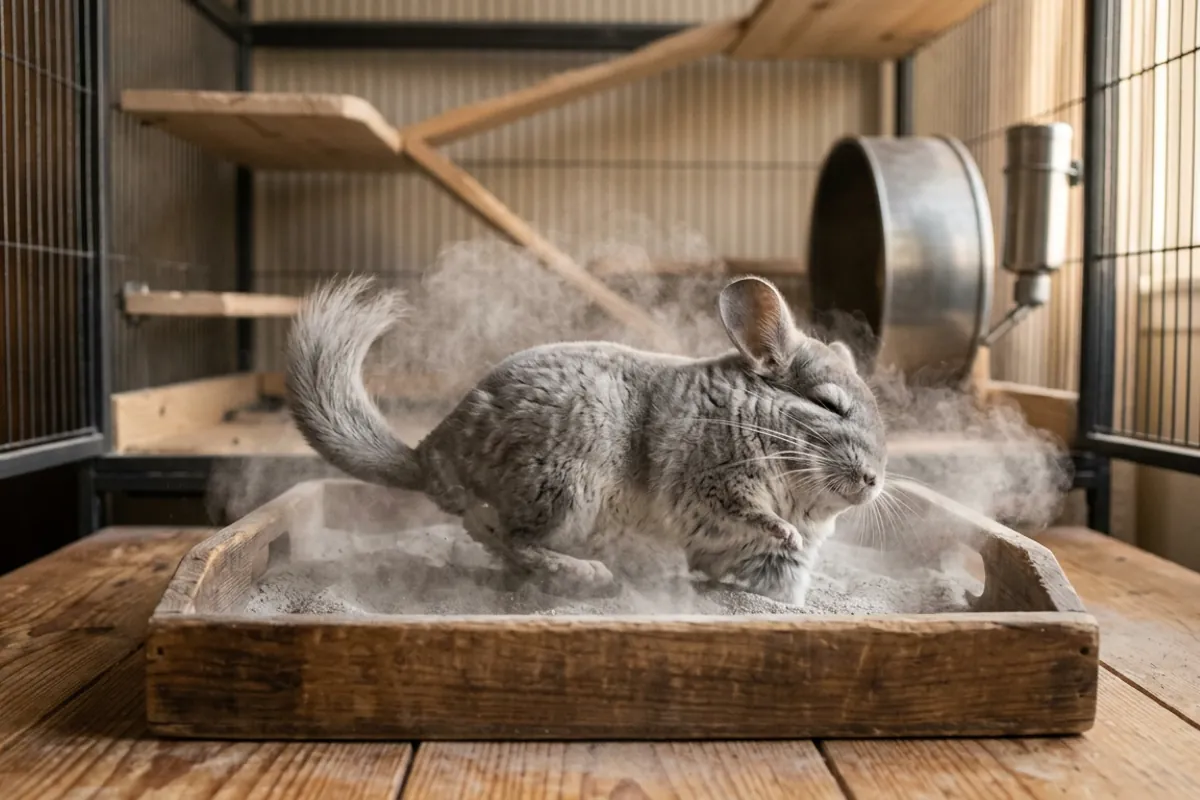
Offer a dust bath two or three times a week in a container big enough to roll in, with an inch or two of dust, and take it back out after ten or fifteen minutes so they are not sitting in a dirty bath or overdoing it and drying out their skin. Lixit Blue Beauty chinchilla dust, 3 lb As an Amazon Associate I earn from qualifying purchases. Use proper chinchilla dust, not play sand, which is too coarse and abrasive for that coat. In very humid weather I bathe a little more often, since that is exactly when the fur struggles most. The full method is at the chinchilla dust bath, done right from dust to schedule.
Chewing is dental care, not decoration
Because those teeth never stop growing, chewing is not a hobby you are indulging, it is medical maintenance. Alongside the hay, a chinchilla needs safe wood and other hard, gnawable things to wear its teeth and occupy its mind. Untreated apple, pear, and willow branches are the classics, and a variety pack saves you sourcing each one separately. emours apple wood chew sticks, 40 count As an Amazon Associate I earn from qualifying purchases. Pumice stones and plain loofah add a different texture to work against.
Avoid softwoods like pine and cedar, avoid anything treated, painted, or glued, and avoid cheap dyed chews. If you are not certain a wood is safe, leave it out. Juniper's dental disease means I stay on top of her chews harder than most, but every chinchilla benefits, and a bored chinchilla with nothing to gnaw will turn to the cage bars and even its own fur. I keep a running list of what earns its place at chinchilla chew toys, and why they are dental care, not decoration.
Handling, bonding, and reading behavior
A chinchilla is a prey animal, and it reads a hand coming down from above the way it would read a hawk. Bonding is slow, and it is worth it. Start by just sitting near the cage, then offering a still hand, then a piece of hay through the bars, and let the animal choose to come to you. Most chinchillas never turn into cuddly lap pets, and that is normal, not a failure on your part.
On the subject of company, chinchillas are social and many do well in same-sex pairs or small groups, but pairing has to be done slowly and carefully, and two that do not get along will fight. A single chinchilla can be perfectly happy as long as you give it real daily attention. Whichever way you go, never house a male and female together unless you want an accidental litter, which is hard on the female and on you.
When you do handle one, be gentle and support the whole body, and understand fur slip before it happens: grab a chinchilla too hard or too suddenly and it will release a clean patch of fur to escape, leaving a bald spot that takes months to grow back. Learn the sounds and postures too, because they tell you plenty once you pay attention, from contented chatter to the sharp bark of a chinchilla that has had enough. I unpack it at what chinchilla behavior is really telling you and chinchilla sounds, and what your chinchilla is telling you. Give daily out-of-cage time in a chinchilla-proofed room, supervised, with no exposed cords, no gaps behind furniture, and nothing toxic within reach.
When to call an exotics vet
I am an experienced keeper, not a vet, and the most useful thing any care guide can teach you is where that line sits. Find an exotics vet before you have an emergency, because the chinchilla that stops eating on a Sunday night cannot wait while you start searching for a clinic that sees them.
Call the vet if your chinchilla stops eating or stops passing droppings, because a gut that goes quiet is an emergency that can turn fatal within a day. Call for drooling, a wet chin, or steady weight loss, which usually points at the teeth. Call for labored breathing, red ears, and lethargy in the heat. Call for any wound, any discharge, or a coat that suddenly looks rough and unkempt. Watching droppings, appetite, and weight is most of home monitoring, and a small kitchen scale is one of the cheapest, most useful tools you can own. When something is off and you cannot say what, that uncertainty is precisely the moment to phone the vet rather than wait and see. A decade in, I still make that call, and I have never once regretted it.