If you typed chinchilla orange into a search bar hoping to meet a little tangerine-colored rodent, I have to tell you plainly, owner to owner: there is no such animal. In roughly ten years of keeping these animals, I have never seen a genuinely orange chinchilla, and there is no color mutation in the species that produces one. What is real, and what surprises most new keepers, is that the single most orange thing on a perfectly healthy chinchilla is not its coat at all. It is its front teeth. So the word "orange" attached to a chinchilla is worth untangling, because depending on what you are actually looking at, it points either to normal biology, to the warmest corner of the coat colors, or to a stain that is quietly telling you something is wrong.
Let me walk through all three, because they matter for very different reasons. One is a health signal you want to see. One is a color you can buy on purpose. And one is a warning you should not ignore.
Why there is no orange chinchilla color
Chinchillas come in a fixed set of coat colors, and every one of them traces back to the wild animal. In the mountains of South America the standard chinchilla is silver-gray: a dark slate undercoat, a band of lighter fur, and black-tipped guard hairs. That gray is not an accident. It is camouflage against rock, and it is the baseline that every captive color mutation modifies.
The named mutations keepers breed for are things like beige, ebony, black velvet, violet, sapphire, and white, plus combinations of those. Each is a change to how pigment is made or laid down in the fur. None of them adds orange pigment, because chinchillas simply do not carry the genetics to produce a bright warm coat the way a ginger cat or a golden hamster does. The whole palette runs from near-black through gray and brown to white, warming slightly in the beige family and cooling in the violets and sapphires. If you want the honest tour of how these labels work, the pieces on the violet chinchilla, the sapphire chinchilla, and the brown chinchilla each explain what one gene actually changes and, just as importantly, what it never changes.
So when a listing advertises an "orange chinchilla," treat it the way I would: with suspicion. Either the seller is describing a beige animal in flattering language, or they are describing staining on the coat, or they do not know their colors. None of those is a new breed, and none of them should carry a premium price. This is the same trap I describe in the piece on what a chinchilla price actually tells you: an exotic-sounding color name is often just marketing stapled to an ordinary animal.
The beige family, and the warmest a coat honestly gets
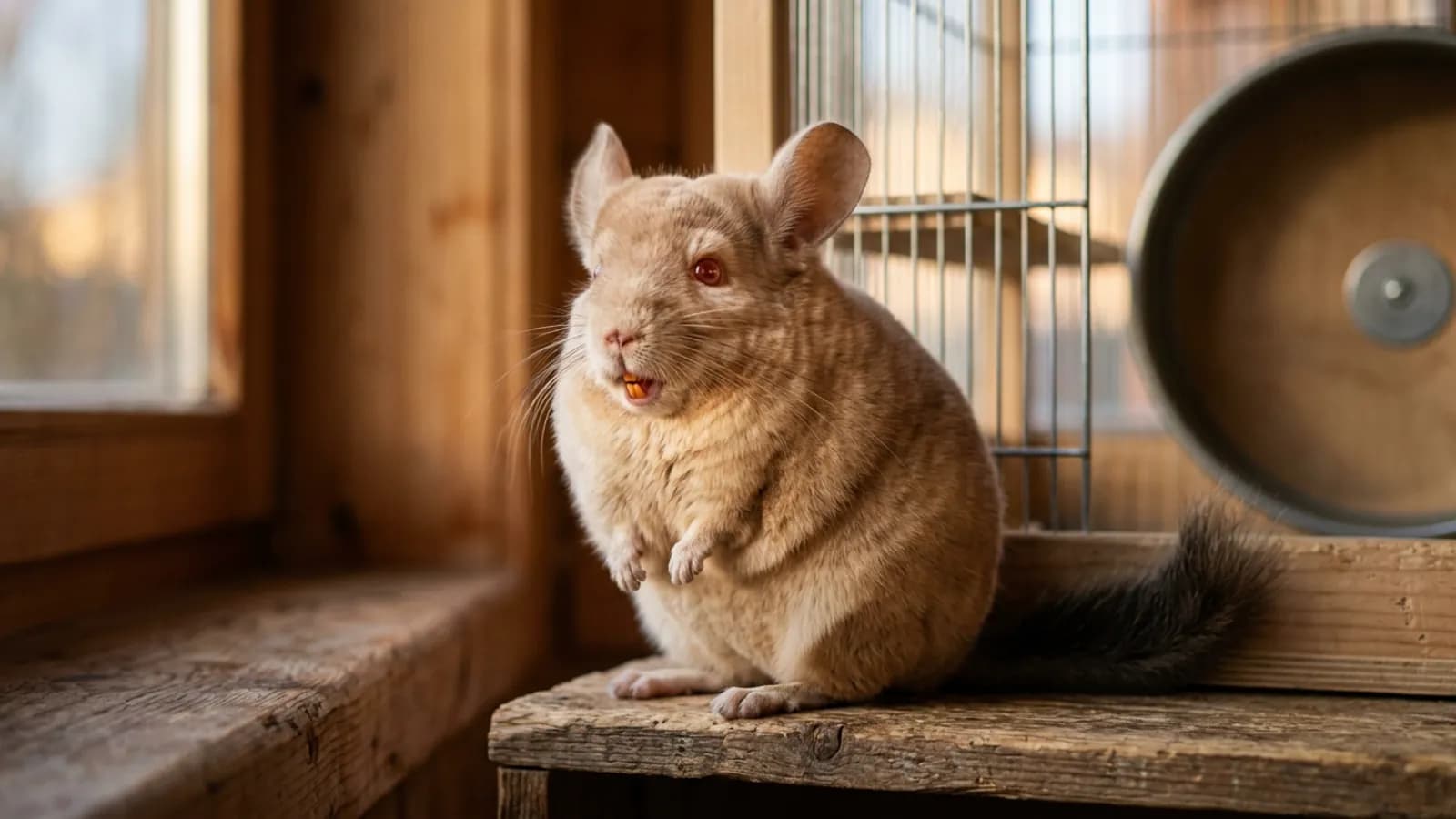
If any real chinchilla comes close to reading as warm or faintly orange, it is the beige. Beige is a dominant mutation that lightens the standard gray into a tan or sandy tone. In person, a good beige has a soft caramel back that fades to a cream belly, pink-tinged ears, and reddish eyes rather than black ones. Under warm light, especially, that caramel can pick up a golden or apricot cast that a hopeful eye rounds up to orange.
There is more than one shade in the family. A heterozygous beige, carrying one copy of the gene, tends to be the tan animal I just described, often with small darker freckles on the ears. A homozygous beige, carrying two copies, is much paler, almost pinkish-cream, with even lighter eyes. Cross beige with other mutations and you get names like champagne or a beige-and-white pink white, which the article on the chinchilla pink white covers properly. The warm tone is genuine, it is just gentle. Nobody standing in front of a beige chinchilla would reach for the word "orange" without wanting it to be true first.
Here is the part that matters more than the shade: the color changes nothing about care. A beige chinchilla needs the same temperature control, the same unlimited hay, the same dust baths, and the same dental attention as a standard gray. Coat mutations are cosmetic. They do not make an animal hardier or more fragile, and the warm ones are not a separate pet with separate rules. If you find yourself drawn to a color, buy the animal, not the label, and read how to buy a chinchilla before you hand over money.
The real orange on a chinchilla is its teeth
This is the fact I most want new keepers to carry away, because it reverses an instinct almost everyone has. A healthy chinchilla's front teeth, the incisors you glimpse when it yawns or gnaws, should be yellow to deep orange. Not white. Orange is correct. Orange is the color you are hoping to see.
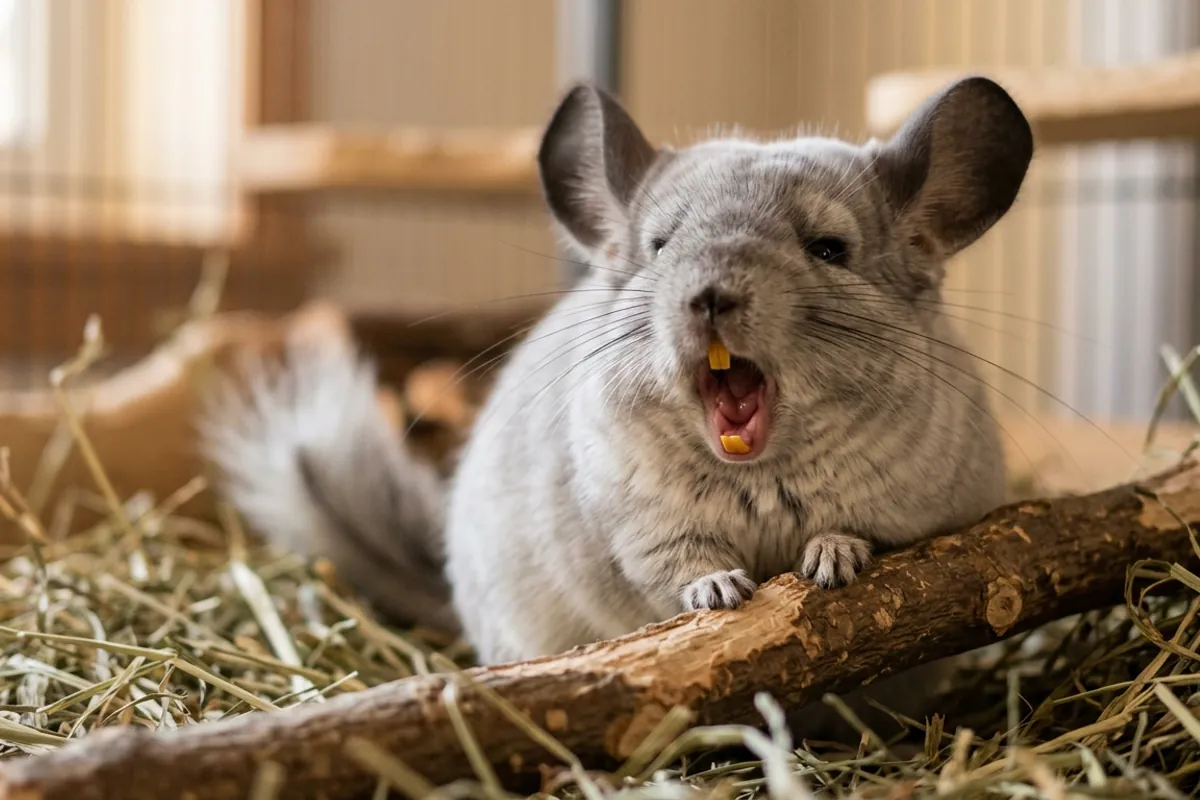
The reason is in the enamel. Rodent incisor enamel, chinchillas included, is pigmented with iron, and that iron gives the outer surface its yellow-orange stain. Strong, well-mineralized enamel holds that pigment, so a rich orange front tooth is a sign the enamel is doing its job. Pale, chalky, or white incisors are the opposite. In a chinchilla, white teeth often signal a problem with mineralization or dental health, and they are a reason to look closer, not to relax.
I learned to watch this the hard way through Juniper, one of my two girls, a rescue who came to me with dental disease I now manage every single day. When I lift her lip to check her, I am not looking for white teeth to reassure me. I am checking that the orange is even, that the two incisors meet and wear against each other, that neither is overgrown or angled or chipped. Color is only one piece. But a chinchilla whose incisors have gone pale, alongside drooling, dropped food, weight loss, or a wet chin, is a chinchilla that needs an exotics vet, not a wait-and-see. The signs to act on are laid out in chinchilla teeth problems, and the full picture of why these teeth rule the animal's health is in the chinchilla teeth and health hub.
Why those orange teeth never stop growing
The orange color makes sense once you understand what those teeth are for. A chinchilla's teeth, all of them, grow continuously for the animal's whole life, on the order of several centimeters a year. In the wild that constant growth is matched by constant grinding on tough, abrasive mountain plants. The teeth and the diet evolved together. Take the abrasion away and the teeth keep growing into a problem.
That is the entire reason I am relentless about hay. Grass hay, timothy or another coarse grass, has to be in front of a chinchilla at all times, without limit. The long chewing motion it forces is what wears the back teeth against each other and keeps the whole mouth in balance. Pellets do not do this job; they are a small measured supplement, not the main event, as the piece on chinchilla pellets explains. Hay is the main event. I keep it flowing from a bulk supply so I never run short. Oxbow Western Timothy Hay, 9 lb box As an Amazon Associate I earn from qualifying purchases.
Chewing also has to happen on hard surfaces beyond hay, which is where safe wood chews earn their place. Not as toys, as dental care. Plain untreated apple wood and similar keeper-safe woods give the incisors something to work against between meals, and rotating a few shapes keeps a bored chinchilla actually using them. emours apple wood chew sticks, 40 count As an Amazon Associate I earn from qualifying purchases. Juniper is the reason I will not compromise on any of this. Watching, up close, what happens when teeth do not get worn down is a strong cure for casualness. If you want the honest rundown of what actually wears teeth versus what just looks fun, chinchilla chew toys covers it.
When orange on the fur is a stain, not a color
Now the version of "orange" you do not want to see: a warm patch on the coat itself, usually on the belly, the rear, or the fur around the genitals, and most obvious on a pale or white animal. That is not a color. That is a stain, and the usual culprit is urine.
Urine can tint fur yellow to orange where it soaks in and dries, especially if an animal is sitting in a soiled corner or a damp spot in the cage. On a standard gray it hides in the coat. On a white chinchilla or a pale beige it shows plainly, which is exactly why some sellers can pass off a stained animal as an unusual "orange" one. A one-off faint tint from a dirty patch of bedding is a cleaning problem. But orange or brown staining that keeps coming back, particularly around the rear, can point to something worth a vet's eye: urine scald, a urinary issue, or an animal that is not moving normally to keep itself clean.
The fix for the ordinary version is prevention. Keep the cage dry and spot-clean the wet corners often, and let the animal do what it evolved to do, which is bathe in dust. A chinchilla never bathes in water, ever, because a soaked dense coat cannot dry properly and invites fungal skin trouble. It cleans itself by rolling in fine volcanic pumice dust, which lifts oil and moisture out of that incredibly dense fur. Lixit Blue Beauty chinchilla dust, 3 lb As an Amazon Associate I earn from qualifying purchases. A few dust baths a week keeps the coat bright and makes staining far easier to spot early, because a clean coat has no other reason to look orange. If you find genuinely wet or matted fur rather than a dry stain, read chinchilla wet before you do anything else, and never reach for water to "rinse" a stain out.
Telling the three apart, and what to do about each
So you are looking at something orange on or around your chinchilla. Here is how I sort it, quickly, before deciding whether to worry.
If the orange is on the front teeth, and it is even and rich, that is health. Leave it alone and keep feeding hay. If those same teeth have gone pale or white, or the orange comes with drooling, dropped food, or weight loss, that is the one orange story that sends you to an exotics vet, and soon.
If the orange is a warm overall tone to the coat, soft and consistent across the whole animal, you almost certainly have a beige chinchilla. That is a color, it is cosmetic, and it changes nothing about care. Enjoy it and do not pay a novelty premium for it.
If the orange is a patch, concentrated on the belly or rear, worse on pale fur, and it smells or reappears after cleaning, that is a stain. Clean the cage, keep dust baths regular, and if it keeps returning or the skin underneath looks sore, get it checked.
Notice that none of these three is a new breed of pet, and only one of them is a color you can choose. That is the honest shape of chinchilla orange: mostly biology, partly the palest warm end of the color range, and occasionally a warning wearing a pretty name. The label on its own tells you almost nothing. What you actually see, once you know where to look, tells you everything, and it is one of the small pleasures of keeping these animals that a healthy mouth announces itself in a color most people would never expect. For the wider picture of how a chinchilla's biology sets every one of these rules, the overview at what a chinchilla really is ties the color, the teeth, and the coat back together.