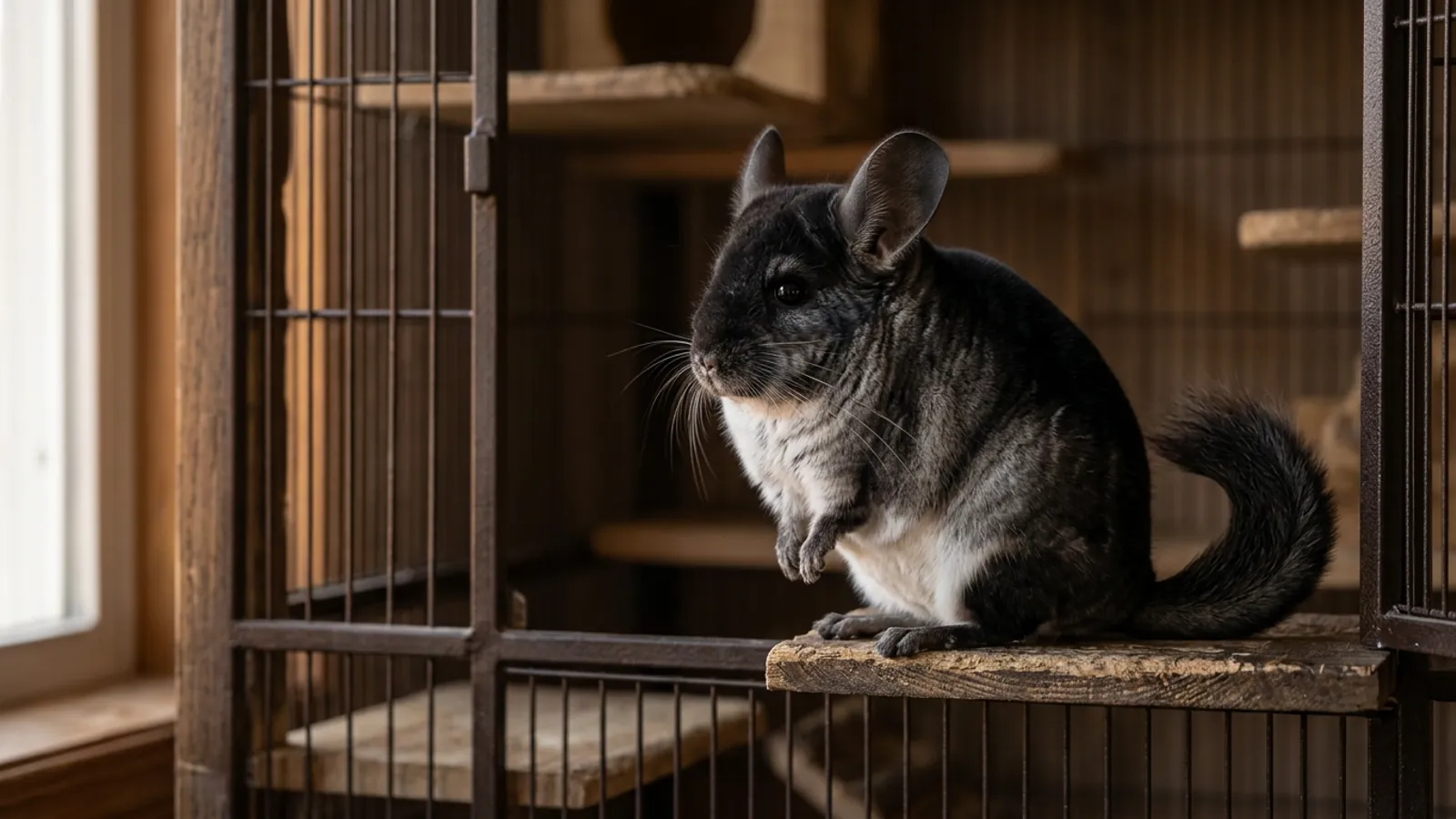
A black chinchilla is one of those phrases that promises more than the animal delivers, and I mean that kindly. When most people picture a black chinchilla, they have a solid ink-dark rodent in mind, the flat black of a house cat or a black rabbit. That animal does not exist. What breeders sell under the name is a chinchilla carrying one of a small handful of dark color mutations, laid over the very same gray animal that has always lived in the Andes. I have kept chinchillas for about ten years, and I have watched people fall for the label and then get confused when the pet in the carrier is charcoal and silver rather than pure black. So let me walk through what is really going on with the color, what the different dark chinchillas are called, and the one thing that matters most: the color changes nothing about how you keep the animal alive.
What people mean by a black chinchilla
When someone says black chinchilla, they are almost always pointing at one of two recognized mutations, or a cross of the two. The first is black velvet, sometimes written as TOV for "touch of velvet." The second is ebony, which is less a single color than a whole scale of darkness. Cross a velvet with an ebony and you get the very darkest chinchillas most keepers will ever see, sold under names like TOV ebony or black ebony.
None of these produce a truly solid black coat, and I will get to why in a moment. What they do produce is a spectrum, from a gray animal with a dark saddle over its back, to a smoky charcoal creature that is dark almost everywhere. All of it starts from the standard gray chinchilla, the wild-type coat, and adds pigment on top through selective breeding. If you want the wider map of how these mutations relate to each other, I keep a fuller guide to rare chinchilla colors and what each one does and does not change. For now, the gist is that black is a direction, not a destination.
Why there is no all-black chinchilla
People ask me for an all black chinchilla the way they might ask for a black cat, and I have to gently take the idea apart. The color genetics of this species simply does not hand you a uniform jet-black coat.
Two things get in the way. First, the standard chinchilla is an agouti animal, which means each hair is banded, dark at the tip and paler underneath, with a slate-gray base. The dark mutations pile pigment onto that banded structure, but the underfur stays pale, so blow into the coat of even the darkest chinchilla and you will find gray down at the roots. Second, and most visibly, a true black velvet keeps a clean white belly. The dark veiling covers the back, the head, and the flanks, then stops, and the underside stays as white as any standard. So the classic "black" chinchilla is really a black and gray chinchilla when you look at the whole animal, dark on top and pale beneath.
Ebony is the mutation that comes closest to wrapping the color all the way around, because it removes that white belly and carries the dark tone underneath too. Even then, a high-grade ebony reads as deep charcoal rather than pure black, and a lower-grade one is plainly a blend of dark and silver. The pigment a chinchilla can lay down over that pale banded fur has a ceiling, and true solid black sits above it.
Black velvet, the dark veil that started it
Black velvet is the mutation most people are buying when they go looking for a black chinchilla, and it is one of the older established dark colors in the hobby, worked up decades ago from a single standard line and named for the smooth, dense look of the coat. It is a dominant mutation, which means an animal only needs one copy to show it, and a velvet parent passes the color to roughly half its litter.
You can spot a good black velvet by a few marks. The veiling is darkest over the spine and head and grades softly down the sides into lighter gray, the belly is white, and the front legs carry dark pigment, often with a distinctive diagonal stripe across the front feet. That leg marking is one of the cleaner ways to tell a genuine velvet from a merely dark standard. The coat, when it is bred well, has a depth to it that photographs beautifully and, frankly, sells a lot of chinchillas.
There is one breeding note worth stating plainly, because it is the kind of fact that gets lost in a sales chat. Many breeders treat black velvet as carrying a lethal factor, and avoid pairing two velvets together, on the understanding that the doubled velvet gene does not produce a viable animal. That is a concern for the person planning litters, not for you as a pet keeper, but it is exactly why a responsible breeder pairs a velvet with a standard or another non-velvet color. If you are thinking past keeping and into pairing animals, read what breeding a chinchilla asks first, because good intentions and two dark chinchillas are not a plan.
Ebony, and how black and gray blend
Ebony is the mutation I find people understand least, and it is the one that makes the phrase black and gray chinchilla so slippery. Ebony is not a fixed shade. It runs on a scale from light, where the animal looks like a standard with a slightly dirty belly, through medium, up to what breeders call extra dark ebony, where the whole coat is a deep even charcoal with no white anywhere. The trait builds up over generations. Breeders stack ebony on ebony to intensify it, so a very dark ebony is usually the product of a deliberate line, not a one-off.
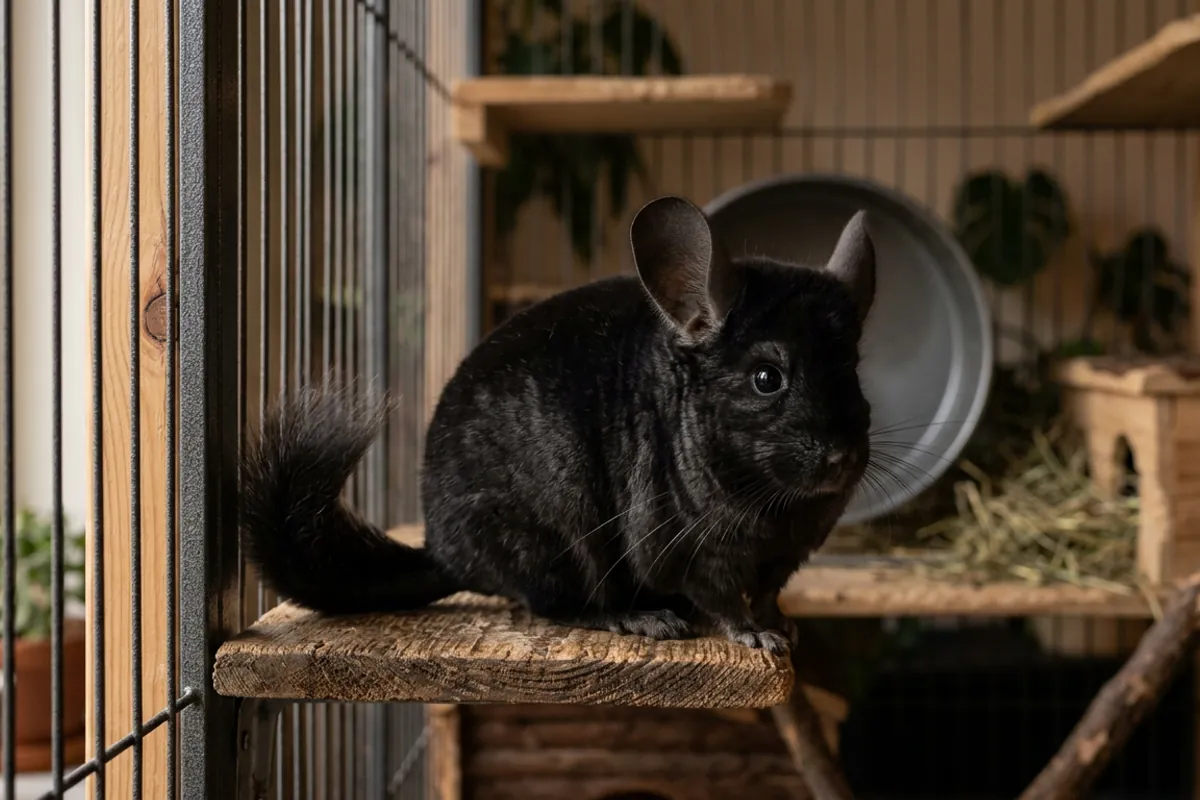
The defining feature is that ebony removes the white belly. Where a black velvet is dark on top and white beneath, an ebony carries its color underneath too, wrapping the tone around the belly and the insides of the legs. A light or medium ebony genuinely looks like gray and dark mixed together, which is where a lot of the "black and gray" listings come from. Combine ebony with the velvet veiling and you get TOV ebony, the darkest coat commonly available, an animal that in ordinary room light can pass for black until you part the fur.
You will occasionally see the word charcoal used for very dark chinchillas too. It is not consistently defined across breeders, and some use it loosely for a dark ebony while others mean something more specific, so I treat it as a description to ask about rather than a guarantee. When a term is fuzzy, I say so rather than pretend precision I do not have.
Black silver and the names in the ads
Then there are the names that live mostly in classified ads. A black silver chinchilla is the one I get asked about most, and I want to be clear: it is not a standard mutation name in the way black velvet and ebony are. It usually describes the look of an animal rather than a defined genetic line, a dark coat with silvery guard hairs catching the light, which in practice is often a velvet, an ebony, or a cross of the two dressed up in a nicer-sounding label.
That does not make the animal fake. It makes the label unreliable. So when a listing says black silver, or all black, or any other color word doing marketing work, I ask the seller one plain question: what mutations are in this animal's pedigree? A breeder who knows their lines can tell you whether you are looking at a velvet, an ebony, an ebony cross, and roughly what grade. A seller who cannot answer is telling you something too, and it is usually that the color name was picked to move the animal rather than to describe it. Buy the chinchilla in front of you, not the adjective on the card, and remember that a rarer-sounding color is not a healthier or better pet. If you want the wider argument, I have written about what a chinchilla's price tells you, and color is near the top of the list of things people overpay for.
What the color never changes
Here is the part I care about most, because a dark coat has a way of making people think they have a special animal with special needs. They do not. A black chinchilla pet eats, drinks, bathes, and overheats exactly like every gray one I have ever kept. The color is on the surface. Everything underneath is standard chinchilla biology, and that biology writes the care rules.
Heat is the one place people expect color to matter, and it barely does. Yes, a dark surface absorbs a little more radiant heat in direct sun, but that is a rounding error next to the real problem, which is the coat itself. A chinchilla's fur is extraordinarily dense, tens of hairs from every follicle, and that density is a blanket the animal cannot take off. They cannot pant or sweat their way cool, they dump heat mainly through those big ears, and it is nowhere near enough on a warm day. My Pebble came out of an overheated attic and gave me a near-miss and an emergency vet night in her first summer, and that scare is why this is not negotiable: keep any chinchilla, black or gray, between 60 and 70°F (15 to 21°C). Above 75°F (24°C) you are into risk, and 80°F (27°C) and up is an emergency, faster in humid air. Buy a thermometer and hygrometer for the room and watch it. digital thermometer and humidity gauge with remote probes As an Amazon Associate I earn from qualifying purchases. On the hottest days a chilled stone the animal can lie against buys real margin. Kaytee Chinchilla Chiller granite stone As an Amazon Associate I earn from qualifying purchases. If you want to see how fast the numbers turn dangerous, my heat danger calculator does the math.
The rest is the ordinary chinchilla checklist, unchanged by a shade of coat. The diet is unlimited grass hay first, which is the whole meal and not a side dish, with a measured spoon of plain pellets as backup. Oxbow Western Timothy Hay, 40 oz bag As an Amazon Associate I earn from qualifying purchases. Juniper, my dental rescue, is the reason I never bend on this: I watch every day what happens when teeth do not get worn down, and hay plus a real variety of hard chews is the only thing keeping her mouth working. emours apple wood chew sticks, 40 count As an Amazon Associate I earn from qualifying purchases. They bathe in dust, never in water, rolling in fine volcanic pumice to keep that dense coat clean and dry. Lixit Blue Beauty chinchilla dust, 3 lb As an Amazon Associate I earn from qualifying purchases. And they live in a tall cage of metal and wood with wooden ledges to climb, no plastic to gnaw and swallow, no wire wheel to catch a foot. Critter Nation double unit small animal cage As an Amazon Associate I earn from qualifying purchases. A black coat earns none of these an exemption.
Bringing home a black chinchilla
If you have your heart set on a dark chinchilla, there is nothing wrong with the preference, and a well-bred black velvet or ebony is a striking animal to live with. Just shop for the animal and the source, not the color word. Ask what mutations are in the pedigree, ask to see the parents if you can, and watch the chinchilla move: bright eyes, dry nose and chin, steady breathing, even teeth wear, and a coat with no bald slipped patches. A dark coat can hide a thin or unwell animal a shade better than a pale one can, so look with your hands, not just your eyes.
Expect the color to carry a small premium, because darker mutations take generations of deliberate breeding and rarer-sounding names attract buyers. Pay it if you want the look, but know you are paying for appearance, not for a better pet, and never let a color markup pull you toward a careless seller with a prettier animal. The wider walk-through on how to buy a chinchilla without regretting it applies here without a single change. A black chinchilla is a chinchilla in a darker coat: same fragile relationship with heat, same bottomless appetite for hay, same dust baths, same long life if you do right by it. Get the husbandry right and the color is simply the nice part, the thing you notice across the room while the real work goes on underneath.