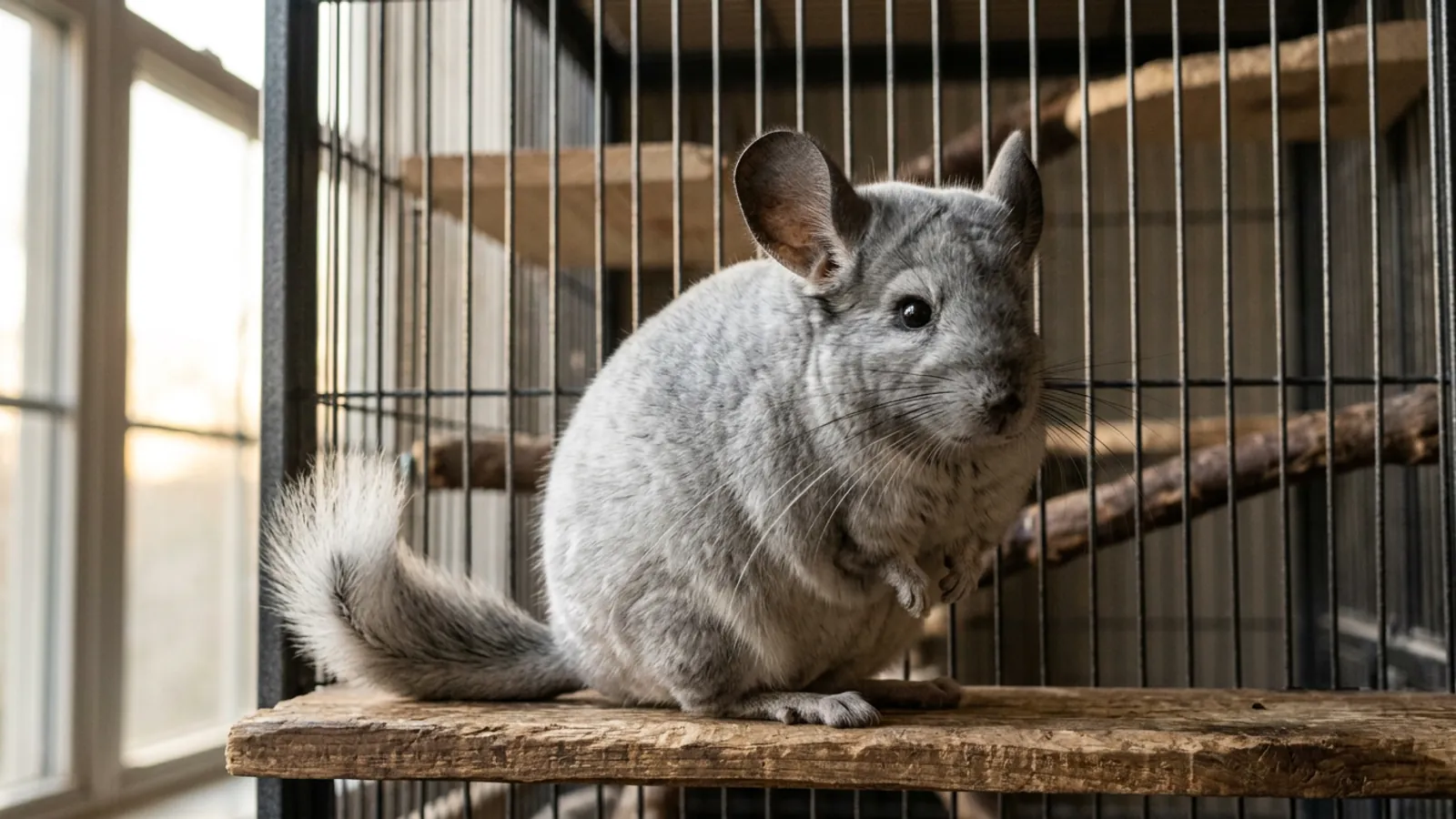
If you have typed hairless chinchilla into a search bar, let me save you some time and maybe save an animal some misery. There is no established hairless chinchilla breed. Nobody deliberately raises bald chinchillas the way breeders raise Sphynx cats or skinny pigs, and the naked, wrinkled photos that come up are almost never a variety anyone can sell you. They are chinchillas that have lost their fur to something gone wrong. I have kept chinchillas for about ten years, and the single most defining thing about the animal in my lap is its coat. A chinchilla without one is not a rare find or a hypoallergenic upgrade. It is a symptom, and usually a distress signal. So treat this less as an article about a breed and more as a guide to what is happening when a chinchilla loses its fur, and what to do about it.
Why a hairless chinchilla is not a breed you can buy
The hairless animals people know are all deliberate genetics. The Sphynx cat, the skinny pig, the hairless rat: each is a recessive coat mutation that breeders found, kept, and multiplied on purpose, with lines and show standards behind them. Chinchillas have their own long list of deliberate mutations, but they are all about color, not the absence of fur. You can read what those colors change, and mostly do not, in the pieces on rare chinchilla colors and the albino chinchilla label. There is no recognized hairless line sitting alongside them.
So when a listing offers a hairless chinchilla, one of two things is true. Either the seller is passing off a sick or fur-damaged animal as a novelty, which is worse than dishonest because it hides a health problem you are about to inherit, or the picture is not a chinchilla at all. I would walk away from both. Some people imagine a bald chinchilla would be low-allergen, or would sidestep the overheating problem the breed is famous for. Neither holds up. A chinchilla stripped of its fur is not better adapted, it is exposed, with no barrier against cold or sun and a body that evolved around having that coat. The chinchilla you want is one with a full, dense, even coat, and the only reason to look closely at bald skin is to work out what went wrong and fix it.
The densest fur on land, and the cold it was built for
To understand why a bald patch matters so much, you have to understand the coat. A chinchilla's fur is often called the densest of any land mammal. The figure repeated most is more than fifty hairs growing from a single follicle, where a human grows one, which packs something on the order of twenty thousand hairs into each square centimeter of skin. I would not stake my life on the exact count and sources vary, but the order of magnitude is not in dispute. This is an extraordinary coat, and it exists for a reason.
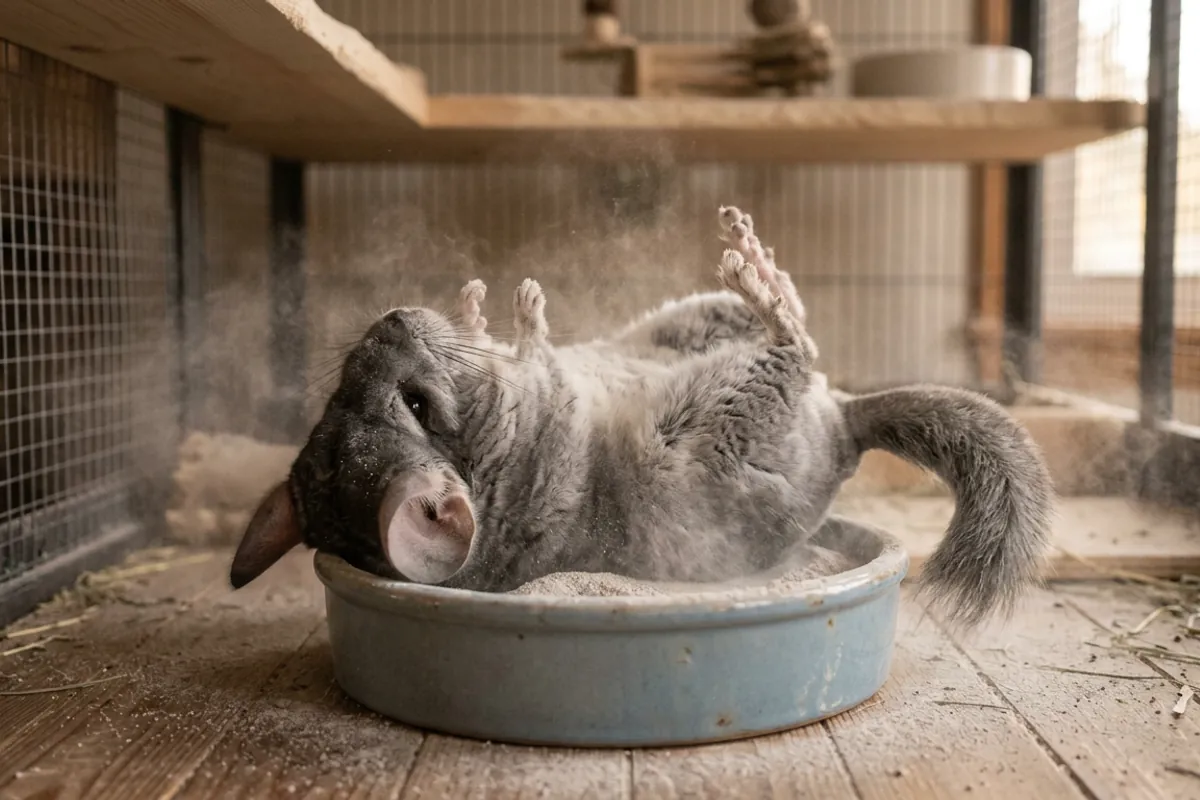
Chinchillas come from the high Andes of South America, cold, dry, thin-aired mountains where the nights bite hard. That density is insulation against real cold, and you can read more about the environment that shaped them in what a chinchilla in the wild is really like. The same coat that keeps them warm up there cannot shed water or heat easily down here, which is why two rules follow straight from the fur. They never bathe in water, because a dense coat traps moisture against the skin and takes an age to dry, which invites fungus and chilling. Instead they roll in fine dust, which slips down to the skin and lifts away oil. A proper bath dish and the right pumice dust are not optional gear, they are how the coat stays healthy. Lixit Blue Beauty chinchilla dust, 3 lb As an Amazon Associate I earn from qualifying purchases. If you want the how and the how often, I wrote it up in the chinchilla dust bath done right.
What a bald patch on a chinchilla really means
A healthy chinchilla is furred evenly from nose to tail, with no bare skin showing through. So the first thing to know is that any real bald patch is abnormal and worth investigating. It is not a coat variety, it is a change, and changes in an animal this well insulated are information. Bare skin also has no protection, so a patch that stays open is a small problem that can turn into a bigger one.
The common causes sort into a short list. Fur slip is a stress reflex where the animal releases a clean patch of fur on purpose. Fur chewing, sometimes called barbering, is the chinchilla or a cage mate trimming the coat down to stubble. Ringworm is a fungal infection that eats circular holes in the fur. A wet or matted patch can come from a dripping water bottle, a drooling mouth, or spilled liquid, none of which a chinchilla can dry off on its own. Poor diet, heavy shedding at the wrong time, and, rarely, parasites round it out. Each of these looks a little different up close, and telling them apart is most of the job. The next sections walk through the ones you are most likely to meet.
Fur slip, the bald spot that is not a disease
The one kind of bald patch that is not really an illness is fur slip. When a chinchilla is grabbed too hard, badly startled, or caught by a predator in the wild, it can release a whole tuft of fur at once and bolt, leaving the attacker holding a clump and the chinchilla running free. It is a deliberate escape trick, and it leaves a clean, smooth bald spot with no broken skin, no scabbing, and no redness.
If you find a tidy round patch like that after a rough handling session, a vet chase, or a scuffle between cage mates, fur slip is the likely answer. The patch regrows, though it can take weeks to a few months, and the new fur sometimes comes in a slightly different shade before it blends back in. There is nothing to treat. What there is to do is prevent the next one, by handling gently, supporting the whole body instead of grabbing a fistful, and giving a nervous animal time to settle. I go deeper into the mechanism and the handling fixes in chinchilla fur slip. Fur slip is the reassuring diagnosis on this list, but do not assume it, because the other causes are not so patient.
Ringworm and the skin problems you have to treat
Ringworm is the one that most often gets mistaken for some mysterious hairless chinchilla, and it is the one you cannot ignore. Despite the name it is a fungal infection, not a worm. It shows up as circular patches of hair loss, often around the eyes, nose, ears, and feet, and the skin underneath tends to look flaky, reddened, or crusty rather than clean. It spreads to other chinchillas, to other pets, and to people, so it is a vet visit, not a wait and see.
An exotics vet can confirm it, usually by culture, and prescribe treatment, which often runs for weeks because fungus is stubborn. Alongside treatment, the environment matters. Fungus loves warm, damp, dirty conditions, so a dry cage, good airflow, and a regular dust bath all work against it, while damp bedding, a leaking bottle, or a cage tucked somewhere humid make it worse. Mites and other skin parasites are genuinely rare in pet chinchillas kept clean, so do not reach for parasite treatments on a guess. If the skin under a bald patch looks angry in any way, red, scaly, weeping, or scabbed, that is your line to call the vet rather than experiment. This is the point where I stop being useful as a keeper and an exotics vet takes over, and I mean that plainly.
Fur chewing, boredom, and the teeth underneath it
Fur chewing looks different from both fur slip and ringworm. Instead of a clean bald patch or an angry circle, you get an uneven, chewed-down coat, often along the flanks, shoulders, or wherever the animal can reach, with the fur cut to a short, ragged stubble. Sometimes a chinchilla barbers itself, sometimes a dominant cage mate does the trimming. The skin underneath is usually intact, which is the tell.
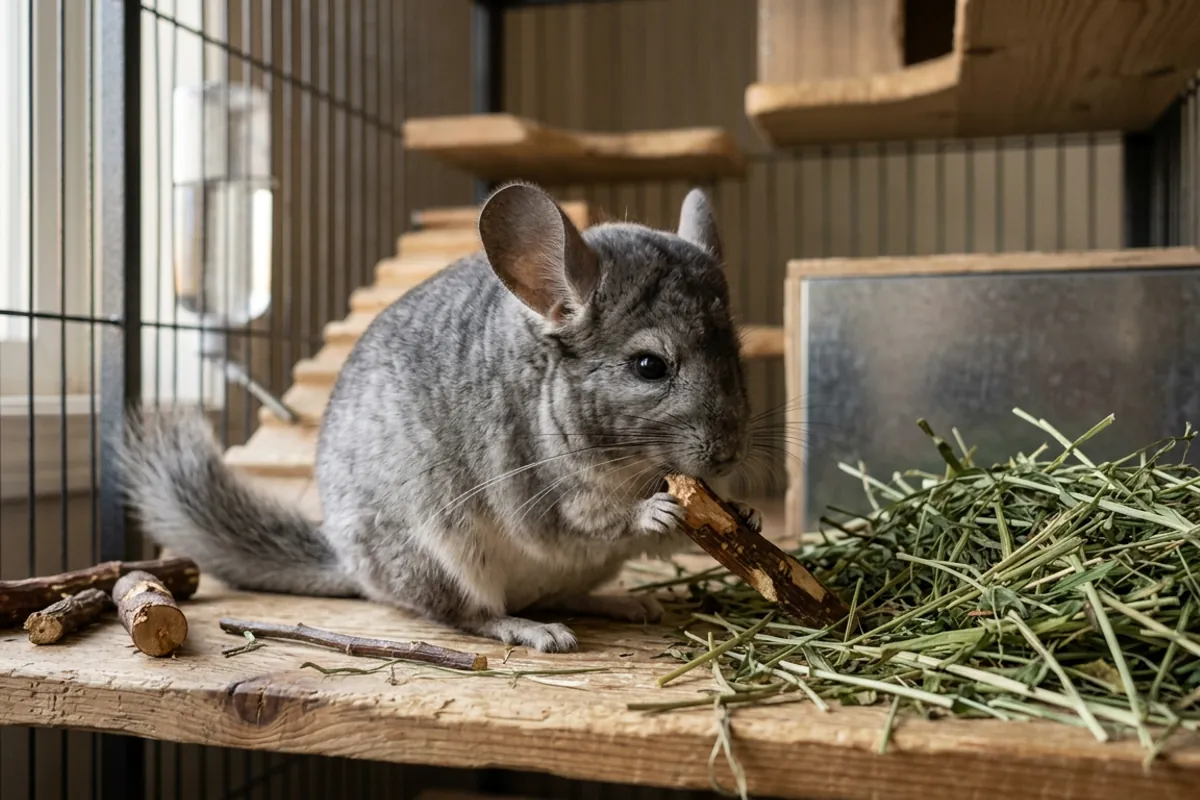
Why they do it is debated, and no keeper has it solved. Boredom and stress are the usual suspects, and there is a plausible thread connecting it to diet and dental discomfort too. That last one I take seriously because of Juniper, my rescue who came to me with dental disease. When teeth are not being worn down properly, everything about a chinchilla can go sideways, and a mouth that hurts is a stressed animal. The defenses are the same ones that keep the whole animal healthy. Unlimited grass hay comes first, because the long, grinding chew it demands is what wears the constantly growing teeth down. Oxbow Western Timothy Hay, 40 oz bag As an Amazon Associate I earn from qualifying purchases. More on why in timothy hay for chinchillas. On top of that, a real variety of safe wood to gnaw gives the teeth work and the mind something to do. emours apple wood chew sticks, 40 count As an Amazon Associate I earn from qualifying purchases. And a large cage with a solid-surface running wheel, never a wire one that can catch a foot, burns off the energy that would otherwise go into the coat. 15 inch Chin Spin solid surface chinchilla wheel As an Amazon Associate I earn from qualifying purchases. If the chewing is spreading or the coat is not recovering, loop in a vet to rule out a dental root, and read chinchilla teeth problems so you know the early signs.
When a bald chinchilla needs a vet, not a forum
I am an experienced keeper, not a vet, and there is a clear line where a bald patch stops being something you manage at home. Call an exotics vet when patches are spreading, when the skin is red, scaly, crusty, or itchy, when the loss circles the eyes or mouth, or when it comes with weight loss, drooling, or an animal that has gone quiet and off its food. Any of those is a real problem hiding under the fur, and forums will only cost you time the animal may not have.
There is one more reason the coat is worth guarding, and it is the conviction I hold hardest. That same dense fur that makes a chinchilla so soft also makes it terrible at dumping heat. They cannot sweat it off or pant it away, so they overheat fast. The comfortable range is 60 to 70°F (15 to 21°C). Crossing 75°F (24°C) is dangerous, and 80°F (27°C) or more is an emergency, brought on faster by humidity in the room. I keep a thermometer and hygrometer on the cage so the number is never a guess. digital thermometer and humidity gauge with remote probes As an Amazon Associate I earn from qualifying purchases. A cool stone the animal can lie against helps too on a warm afternoon. Kaytee Chinchilla Chiller granite stone As an Amazon Associate I earn from qualifying purchases. I learned this the hard way with Pebble, adopted out of an overheated attic, whose first summer ended at the emergency vet after a heatwave near-miss. If you take one thing from a search that started with hairless chinchilla, let it be this: the fur is not a flaw to breed out, it is the animal, and your job is to keep it whole, dry, dense, and cool. When it starts to go, that is the chinchilla telling you something is wrong, and the kindest thing you can do is listen. For the full heat playbook, see chinchilla temperature.