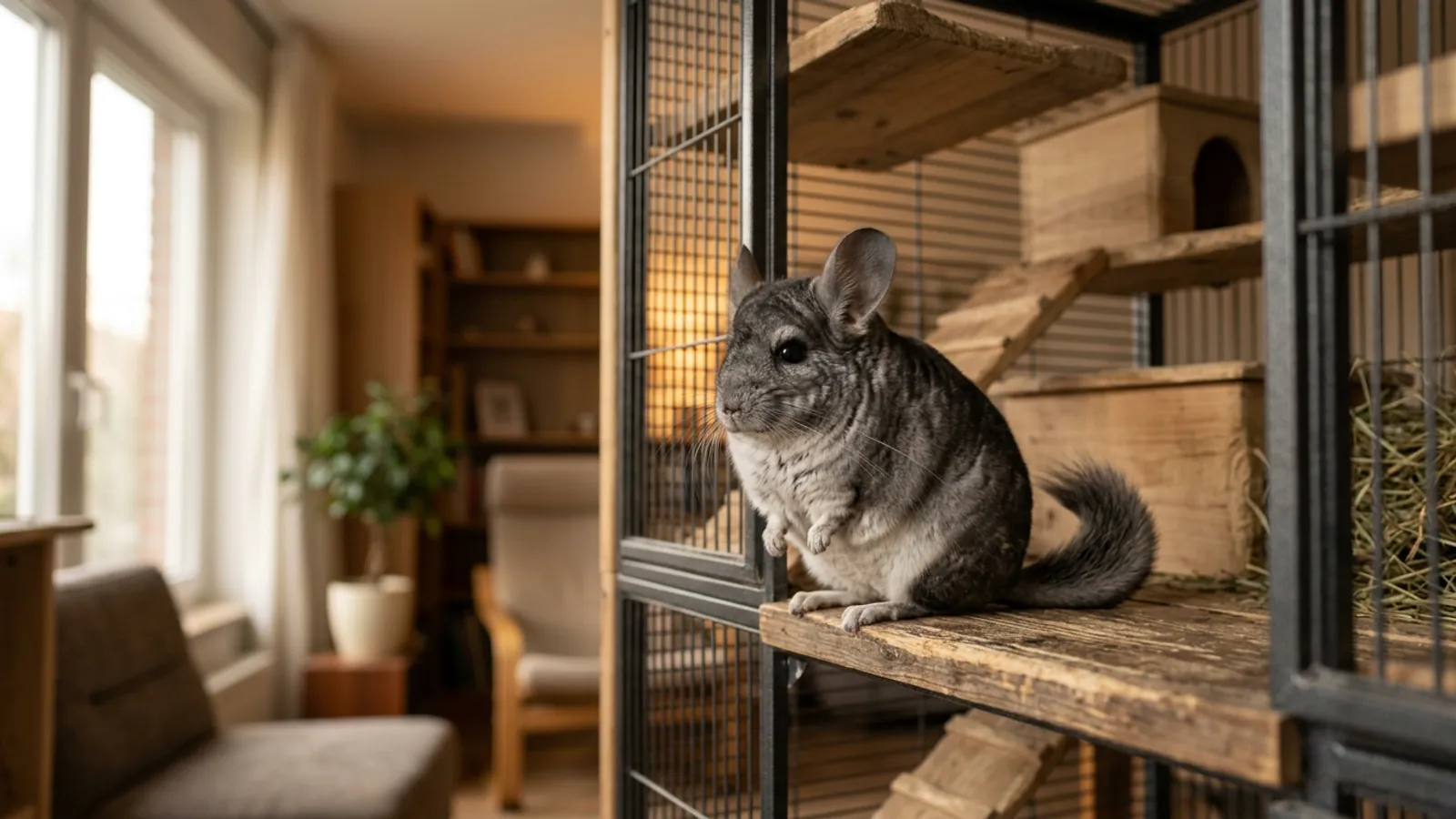
When people ask me about chinchilla age, they are usually asking one of two very different questions: how old their animal already is, or how old it can get. The two get tangled together constantly, and the answers pull in opposite directions. To the first, I often have to say "I cannot tell you exactly." To the second, I get to give a number long enough to make a first-time owner sit up straight. A chinchilla is not a hamster or a gerbil that shares your life for a couple of years. Bring one home and you may be signing up for a companion that outlasts a car, a phone contract renewed five times over, or a child's entire stretch of living at home. I have kept chinchillas for about ten years, and both of mine, Pebble and Juniper, came to me as rescues with no birthday on file. They taught me early that the number on the calendar matters far less than what you do with the years you are given.
What a chinchilla age span really is
Let me give you the range first, because it is the part people most often get wrong. In the wild, in the cold, dry mountains of northern Chile, chinchillas live roughly 8 to 10 years. Predators, drought, and hard winters cut lives short there. In a home, with those pressures removed, the chinchilla age span stretches out considerably: 10 to 15 years is the everyday expectation for a well-kept pet, and reaching 18 to 20 is uncommon but real. I have known keepers whose animals passed 20. That "up to 20 years" figure you see quoted is genuine, but it is the ceiling, not the middle of the range, and it is earned by years of steady care rather than luck alone.
Put that number next to the animals people compare chinchillas to and the gap is startling. A hamster is gone in two or three years. A rat, three at best. A chinchilla can be with you longer than a large dog, sometimes much longer. If you want the full picture of what decides the figure, I have written it up in more detail in how long chinchillas really live and in the pet chinchilla lifespan. The short answer is that the span is long, and most of what shortens it is preventable.
Why you usually cannot tell a chinchilla's age
Here is the part that frustrates new owners: once a chinchilla is grown, there is no reliable way to read its age off its body. There is no equivalent of counting rings on a tree or reading a horse's teeth with any precision. A chinchilla reaches close to its full size somewhere between eight months and a year, and after that a three-year-old and a ten-year-old can look practically identical: same dense fur, same bright eyes, same bounce off the walls.
People try to guess from a few signs, and I will tell you honestly how little each one gives you. Weight and body size plateau early, so a heavy adult only tells you it is an adult. Teeth wear over a lifetime, but you cannot see the back molars without a vet's scope, and the front incisors keep growing regardless. Coat quality can dull with age or with poor care, so a rough coat tells you something is off without telling you what. Cataracts, a cloudiness in the eye, show up more in older animals but are not a clock. When I took Pebble in as a rehome out of an overheated attic, and later Juniper as a neglected rescue, nobody could give me a real age for either. My vet's best estimate was a wide bracket, and I have simply kept a "gotcha date" for each of them and counted from there. If a seller tells you a rescue's age to the month with total confidence, be a little skeptical.
The life stages from kit to senior
Even without a precise number, the life stages are clear enough to plan around, and knowing them changes how you feed, handle, and house an animal.
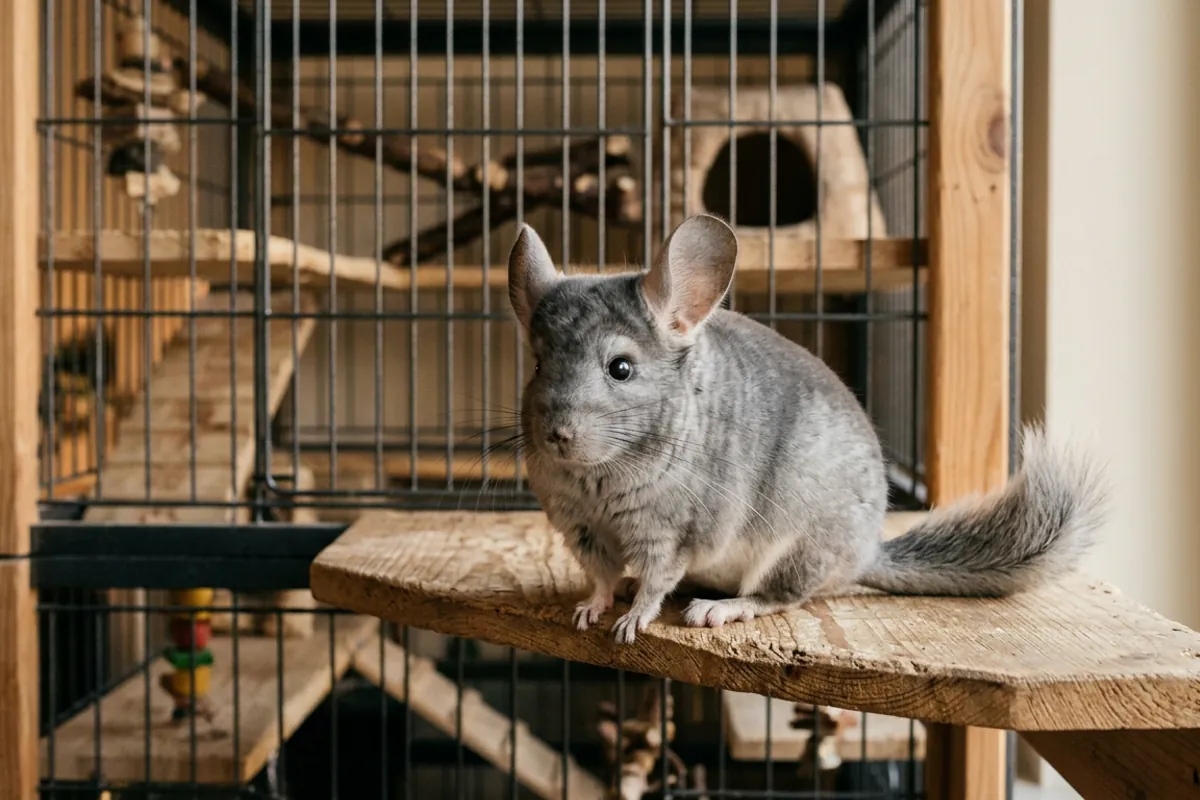
A newborn chinchilla is called a kit, and kits are one of the small marvels of the species. They are born fully furred, with their eyes open, able to move around within hours. That is nothing like the blind, hairless pink jellybeans most rodents produce. Kits nurse for roughly six to eight weeks before weaning, and I cover that stretch in what to expect from a chinchilla newborn. From weaning to about eight months a chinchilla is a juvenile, growing fast and, importantly, becoming sexually mature somewhere around eight months, sometimes earlier. That maturity timing matters enormously if you keep a mixed-sex pair and do not want kits, and it is one reason I point people to what breeding a chinchilla asks before they house two together.
From about eight months to three years you have a young adult in its prime, all energy and acrobatics. Three to roughly ten years is a mature adult, still active but settling into habits. Past ten, you are into the senior years, and I call an animal in that stretch an old chinchilla, which comes with its own care shifts that I have gathered in what an old chinchilla really is. None of these boundaries are sharp lines. A robust twelve-year-old can behave like a young adult, and a poorly kept four-year-old can seem worn out. The stages are a map, not a stopwatch.
What decides how long a chinchilla lives
If age itself cannot be read off the body, what moves the number at the end? After ten years of this, I would put heat at the very top of the list, ahead of everything else.
Chinchillas evolved for cold, thin mountain air, wrapped in the densest fur of almost any land mammal. That fur is wonderful and it is also a trap, because they cannot shed heat the way we do. The comfortable range is 60 to 70°F, which is 15 to 21°C. Above 75°F, that is 24°C, you are in risky territory, and 80°F, or 27°C, is an emergency, faster still when the air is humid. Pebble's first summer brought a heatwave that nearly killed her and put us in an emergency vet's waiting room overnight. That night is why I am relentless about temperature, and why I keep a thermometer with a humidity readout on the cage rather than trusting how the room feels to me.
digital thermometer and humidity gauge with remote probes As an Amazon Associate I earn from qualifying purchases.
I also keep a chilled stone in the cage on hot days so there is always a cool surface to stretch out on.
Kaytee Chinchilla Chiller granite stone As an Amazon Associate I earn from qualifying purchases.
None of that replaces air conditioning, but it buys margin, and margin is what keeps an animal alive through the years. If you want the numbers laid out plainly, chinchilla temperature and the heat danger calculator are where I keep them, and the warning signs of heat stroke are worth learning by heart.
The second great decider is teeth, and it runs straight into diet. A chinchilla's teeth grow continuously for its whole life, and the only thing that keeps them the right length is chewing tough, fibrous grass hay for hours a day. Get that wrong and the teeth overgrow, the animal stops eating, and a preventable dental problem quietly takes years off its life. Juniper came to me with dental disease I now manage day to day, and she is the reason I never compromise on unlimited grass hay.
Oxbow Western Timothy Hay, 9 lb box As an Amazon Associate I earn from qualifying purchases.
Alongside the hay I keep a rotation of safe wood chews so there is always something worth gnawing.
emours apple wood chew sticks, 40 count As an Amazon Associate I earn from qualifying purchases.
Plain pellets are a measured supplement on top of the hay, never the main meal, and treats stay tiny. I lay the whole feeding plan out in the chinchilla diet. Beyond heat and teeth, the rest of the list is what you would expect: a safe cage with no plastic to swallow and no wire wheel to break a leg, protection from injury during out-of-cage time, and a good exotics vet found before you need one. Genetics play a part too, and that part is the one thing on the list you cannot control.
How age shows up in the body and behavior
Because you cannot read a number, you learn to read changes over time in the animal you know. An aging chinchilla usually slows down gradually. The wild leaps off the top ledge get a little less wild. Sleep stretches get longer. Some older animals lose a bit of muscle and feel lighter when you lift them, which is exactly why I weigh mine on a kitchen scale every week or two rather than eyeballing them. A slow drop of a few grams is easy to miss by sight and obvious on a scale.
The coat can change, sometimes thinning or losing a little of its old density. Eyes may cloud with cataracts in the later years. Appetite can dip, and any dip in appetite in a chinchilla is a flag, not a footnote, because they are prey animals built to hide weakness until it is severe. Behavior shifts too. An older chinchilla may be less tolerant of rough handling, more set in its routines, quicker to want quiet. None of these on its own means something is wrong; together, tracked over months, they are the story of an animal getting older, and they tell you when to adjust care and when to worry.
Caring for a chinchilla through its older years
Good senior care is mostly small adjustments to a setup that was already right. The cage stays tall, metal, and fitted with wooden ledges, but I lower the gaps between platforms so a stiffer animal is not asking its joints to make the jumps it used to.
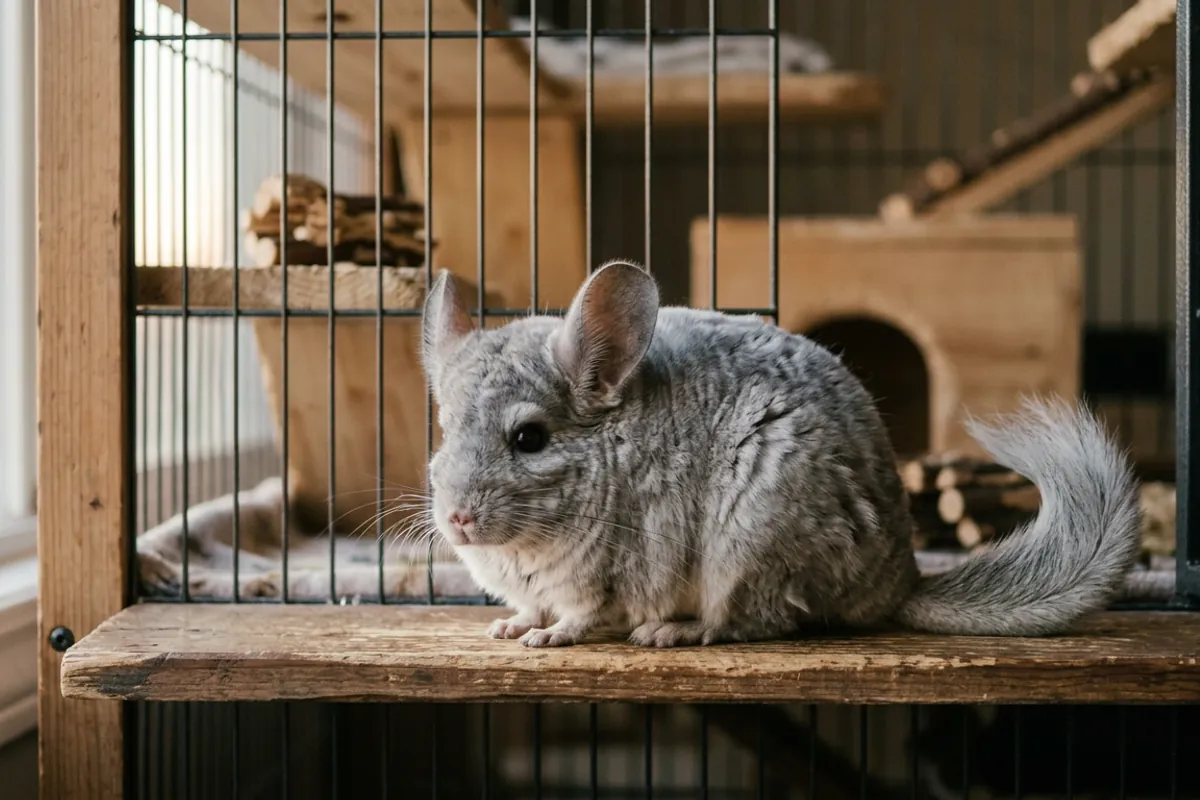
Critter Nation double unit small animal cage As an Amazon Associate I earn from qualifying purchases.
If a solid-surface wheel is in the cage, I keep it, because gentle movement is good for old joints, but I never force it and never use a wire one at any age.
15 inch Chin Spin solid surface chinchilla wheel As an Amazon Associate I earn from qualifying purchases.
Hay stays unlimited, always, because worn teeth need chewing even more than young ones do. Dust bathing continues as normal, a few times a week in fine volcanic dust, never water, and I watch that an older, less flexible animal is still grooming itself thoroughly.
Lixit Blue Beauty chinchilla dust, 3 lb As an Amazon Associate I earn from qualifying purchases.
I weigh more often as the years add up, keep the room temperature squarely in the comfortable band since older animals handle heat even worse, and I schedule a vet check-up on a regular calendar rather than waiting for a problem. An older chinchilla can have wonderful years left. The care that gets it there is patient and unglamorous, and it is the same care that made the long life possible in the first place. I keep the full routine in chinchilla care.
When an age-related change means a vet, not a wait
I am an experienced keeper, not a vet, and there is a line I never let anyone talk me across. If a chinchilla stops eating or its droppings shrink or vanish, that is an emergency, not a wait-and-see. A chinchilla drooling, with a wet chin or matted front paws, is very often a dental problem that needs a scope and a vet, and I walk through those signs in chinchilla teeth problems. Sudden weight loss, labored breathing, a fall that leaves a limp, cloudy eyes appearing quickly, or any collapse in a hot room all send us straight to an exotics vet, the emphasis on exotics, because a cat-and-dog clinic often cannot help a chinchilla the way one that knows the species can.
Age is not a disease, and I want to be clear about that. A slowing, graying, twelve-year-old that is still eating well and grooming itself is not sick, it is old, and old is the goal. The point of watching for these changes is not to panic at every gray hair but to catch the treatable problems early, while an exotics vet still has room to work. Find that vet before you need one, keep your temperatures honest, keep the hay unlimited, and the long end of the chinchilla age span stops being a lottery ticket and starts being something you can aim for.