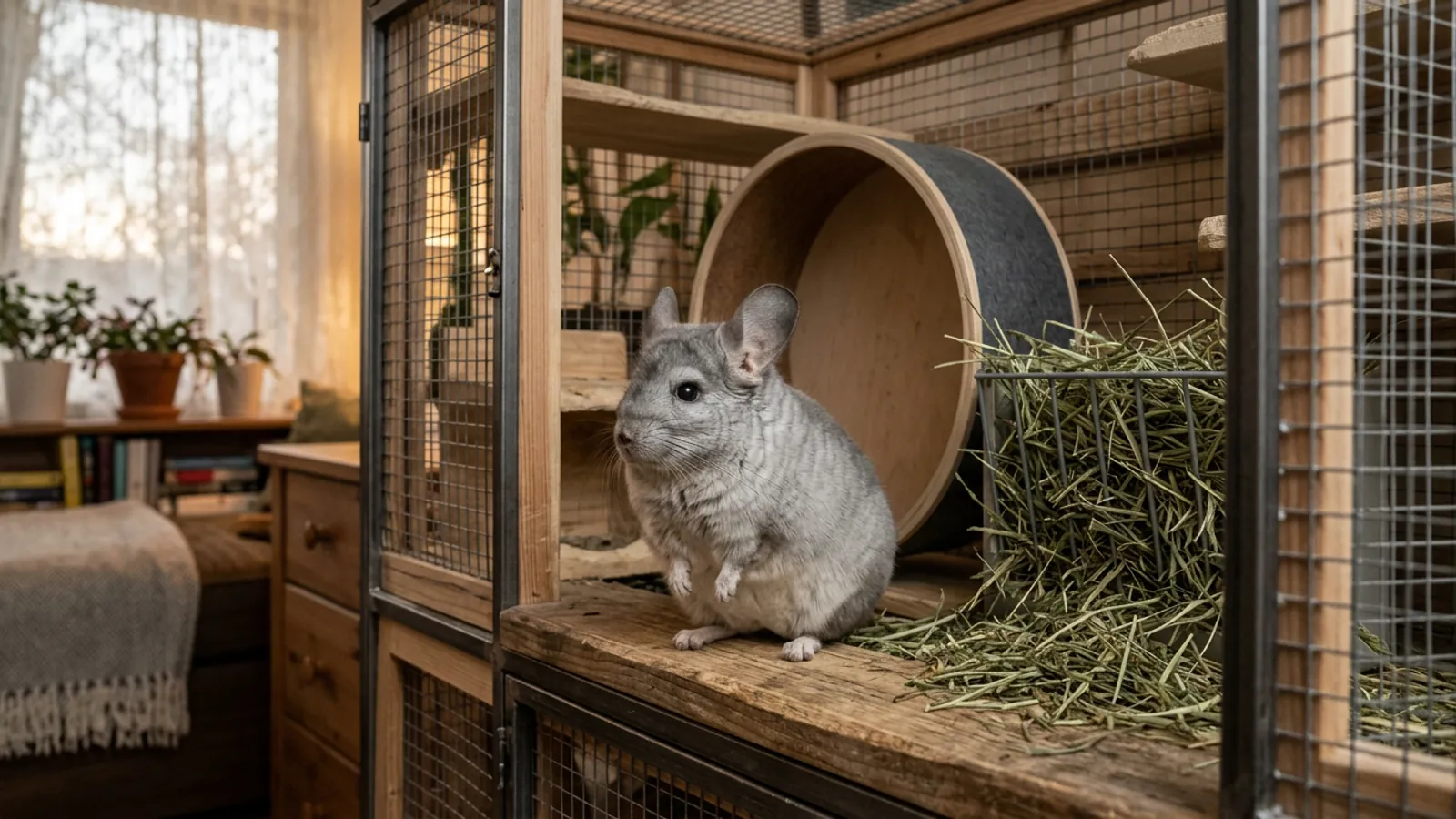
Almost everything written about chinchilla as pets falls into one of two camps: they are sold as cuddly, low maintenance starter animals, or they are written off as impossible. Neither is honest. I have kept chinchillas for about ten years, and what I have learned is that they are unforgiving in a few narrow ways and genuinely easy in most others. Get temperature, hay, and housing right and the daily work is maybe fifteen minutes. Get temperature wrong and nothing else you did will matter. So here is the version I wish someone had given me: what a chinchilla is, what it costs, what it needs every day, and where the line sits that sends you to an exotics vet instead of a forum thread.
What a chinchilla is before it is a pet
A chinchilla is a rodent from the high, dry mountains of South America, and every rule of chinchilla pet care traces back to that address. The air there is thin, cold, and dry. Chinchillas answered that with a coat so dense that more than fifty hairs grow from a single follicle, which is why the fur feels like nothing else you have touched and why fleas cannot live in it.
That same coat is the problem in a centrally heated house. It is insulation built to hold heat in, and it does not switch direction. A chinchilla cannot pant its way out of trouble and does not sweat across its body the way we do. It sheds heat mainly through the blood vessels in those big ears, and beyond that it relies on simply not being hot. That single fact drives more of my routine than anything else.
They are also hindgut fermenters. Their gut is built for a constant, slow flow of coarse, low energy fiber, and it goes wrong when that flow stops or when rich food shortcuts it. Their teeth, all twenty of them, grow continuously for the whole of their lives, and the only thing keeping those teeth at a workable length is hours a day of grinding abrasive plant material.
Add to that a lifespan most new owners underestimate. Ten to fifteen years is common, and reaching the high teens is not unusual with good care. That is a dog's commitment in a body the size of a loaf of bread. If you want the full biology behind the care rules, I wrote it up in what a chinchilla really is, and the lifespan question in how long chinchillas really live.
Is a chinchilla a good fit for your household
This is where I lose people, and I would rather lose them here than after the animal is home.
Chinchillas are crepuscular. They come alive around dusk and again before dawn, and they are loud about it: thumping, wheel running, chewing wood, rearranging everything you carefully placed. A chinchilla cage does not belong in a bedroom unless you sleep like the dead.
They are also not, by default, a lap animal. Most chinchillas tolerate handling rather than seek it. Mine will sit on me on their terms, for a while, and then they are done. If you want an animal that wants to be held, get a rat. Having a chinchilla as a pet is more like keeping a very fast, very opinionated cat that lives in a tower.
They are fragile in the specific way prey animals are fragile. Their ribs and spines do not forgive being squeezed, they can slip their fur when grabbed, and they can drop from a height they were sure they could jump. That makes them a poor match for children under about ten, and a poor match for a house where someone will inevitably chase them.
They need out of cage time in a chinchilla-proofed room, meaning no exposed cables, no reachable houseplants, no gaps behind appliances. And they chew. Everything. Skirting boards, chair legs, the corner of a door frame you did not know was reachable.
Finally, hay and dust are dusty. If someone in the house has asthma or a grass allergy, be realistic about that before, not after.
How much is a chinchilla pet, up front and per month
I will give ranges rather than false precision, because prices move and vary a lot by country. These are US dollar figures and you should treat them as the shape of the cost, not a quote.
The animal itself is usually the smallest line. A chinchilla from a decent small breeder commonly runs somewhere around 150 to 400 dollars depending on color and region, and a rescue adoption fee is typically lower. Standard gray is at the bottom, mutations like violet or ebony sit higher, which I get into in what a chinchilla price tells you.
Setup is where the money goes. A cage that is tall enough, a solid wheel, ledges, a hay feeder, a dust house, and a water bottle will usually land you several hundred dollars all in. Buying a cheap cage first and the right cage six months later is the most common way people pay double, and I say that as someone who did exactly that.
Running costs are modest: hay, plain pellets, dust, and wood chews. For one or two chinchillas that is a small monthly figure, well under what a cat eats. Cooling is the seasonal cost, and in a warm climate that means air conditioning running through summer, which is a real number on your electricity bill.
The line nobody budgets is the vet fund. Exotics vets cost more than small animal general practice, dental work under anesthetic costs more again, and keepers routinely report emergency exotics visits in the hundreds. I keep a dedicated savings pot for this and I treat it as non-optional. The full breakdown lives in what a chinchilla really costs.
Temperature is not a preference, it is the job
Pebble came to me from a rehome out of an overheated attic, and her first summer brought a heatwave that ended with a night at the emergency vet. Everything I believe about heat, I believe because of that night.
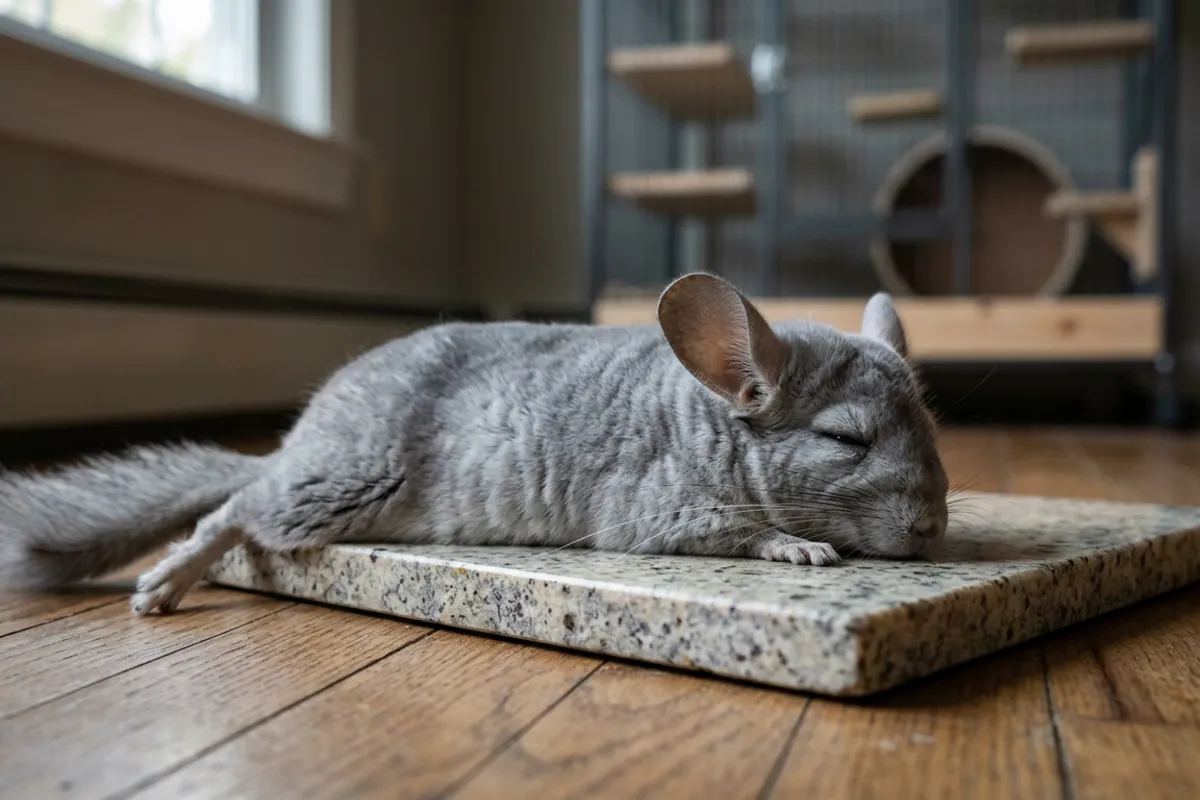
The comfortable range is 60 to 70°F (15 to 21°C). Above 75°F (24°C) you are into risk. At 80°F (27°C) and up you are in an emergency, and humid air makes all of those thresholds arrive sooner because moist air strips a chinchilla's already limited cooling options. I do not soften those numbers for anyone.
What this means practically: you need to know the temperature in the room the cage is in, not the temperature on your phone's weather app. A cheap thermometer that also reads humidity, mounted at cage height, tells you the truth. digital thermometer and humidity gauge with remote probes As an Amazon Associate I earn from qualifying purchases.
Air conditioning is the real answer in any climate with a summer. Everything else is a supplement. A chilled granite or marble slab gives a chinchilla somewhere to dump heat by lying on it, and mine use theirs constantly in warm weather. Kaytee Chinchilla Chiller granite stone As an Amazon Associate I earn from qualifying purchases.
A frozen water bottle wrapped in a towel works in a pinch. A fan alone does not, because moving air across a fur coat that thick does very little. And never, ever wet a chinchilla to cool it down; wet fur against that density traps heat and takes days to dry properly.
Learn what the early signs look like before you need them: red ears, lying flat and stretched out, labored breathing, drooling, unresponsiveness. I go through the whole progression in chinchilla heat stroke warning signs, and there is a heat danger calculator that takes humidity into account so you are not guessing. Overheating is a same-day emergency vet call, not a wait and see.
The cage, and why most people buy twice
Chinchillas climb, so the useful dimension is height. You want a tall multi level cage with metal bars and solid wooden ledges, bar spacing of about 1 inch (2.5 cm) or less, and a solid floor rather than wire. Wire floors cause sore feet, and I have never seen a good argument for them.
Critter Nation double unit small animal cage As an Amazon Associate I earn from qualifying purchases.
Plastic has no place in a chinchilla cage. Not plastic ledges, not plastic bases, not plastic hides. They will chew it, they will swallow it, and it does not pass. Wood and metal only. Kiln dried pine and apple wood ledges are both fine and replaceable when they get chewed down, which they will.
A wheel matters more than people expect, because these are animals that cover ground. It must have a solid running surface and it must be big: at least 14 inches (35 cm) across, and larger is better, because a small wheel forces the spine into a curve. Wire mesh wheels and the plastic saucers sold for hamsters are how chinchillas break toes and legs. This is the one piece of equipment where I will name the bad product plainly and refuse to hedge. 15 inch Chin Spin solid surface chinchilla wheel As an Amazon Associate I earn from qualifying purchases.
Beyond that: a heavy ceramic or glass food dish that cannot be tipped, a glass water bottle with a metal spout, a hay feeder that does not let them get their heads stuck, and a wooden hide. Put the cage in the coolest room you have, out of direct sun, away from radiators and away from windows that bake in the afternoon. My longer walkthrough is in how to choose a chinchilla cage and the layout details in chinchilla cage setup.
Hay first, pellets second, treats almost never
Juniper came to me as a neglected rescue with dental disease I now manage day to day, and she is the reason I am rigid about this section. When teeth are not worn down properly, the roots grow the wrong way, the crowns develop spurs that cut the tongue and cheek, and the animal stops eating. It is painful, it is progressive, and a lot of it is preventable with boring food.
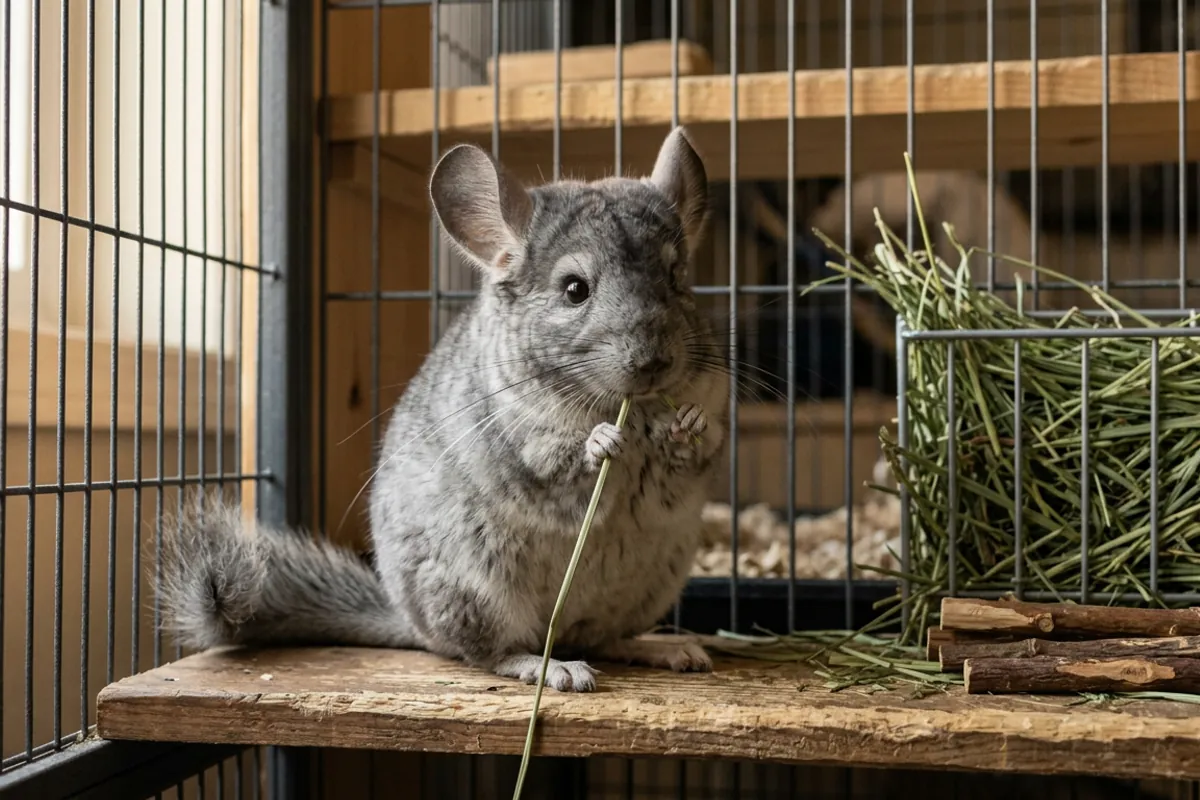
So: unlimited grass hay, available at all times, refreshed daily. Timothy is the standard and a good default. Orchard grass and meadow hay work too and give variety. Alfalfa is a legume, too rich in protein and calcium for routine adult feeding, so keep it as an occasional item at most. Hay is not the side dish, it is the diet.
Oxbow Western Timothy Hay, 40 oz bag As an Amazon Associate I earn from qualifying purchases.
If you have somewhere dry to store it, buying hay in bulk is significantly cheaper and lets you go through it fast enough that it stays fresh and green rather than yellow and dusty. Oxbow Western Timothy Hay, 9 lb box As an Amazon Associate I earn from qualifying purchases.
Pellets are a measured supplement, not a meal. A plain, high fiber, chinchilla specific pellet, roughly one to two tablespoons a day for an adult, adjusted to body condition. Avoid every mix with colored bits, seeds, corn, or dried fruit in it; chinchillas pick out the sugary pieces and leave the fiber, which is exactly backwards.
Treats should be tiny and rare. A single plain rose hip or a couple of oats a few times a week is plenty. No nuts, no seeds, no fresh fruit, no vegetables, no yoghurt drops. Their gut does not handle fat and sugar, and the damage shows up as bloat or diarrhea, both of which are serious.
Chews are the other half of dental care. Apple, pear, willow, hazel, and kiln dried pine are all safe; stone fruit woods like cherry and plum are not. Variety matters because they get bored of one texture and stop using it. emours apple wood chew sticks, 40 count As an Amazon Associate I earn from qualifying purchases.
The full safe and unsafe list is in what can a chinchilla eat, and the dental side in chinchilla teeth problems.
Dust baths, never water
A chinchilla never bathes in water. Their coat is too dense to dry out in any reasonable time, and damp fur down at the skin leads to fungal infection and, in the worst case, to a chilled or overheated animal. There is no exception to this and no "quick rinse" that is fine.
What they use instead is fine dust, essentially a very light volcanic pumice powder, which they roll in vigorously to strip excess oil and moisture out of the coat. It is not sand, and it is not dirt from the garden; sand is too coarse and abrasive and will damage the fur.
Offer the bath in a container heavy enough not to tip, with enough depth for a proper roll, two to three times a week for ten to fifteen minutes, then take it out. Leaving dust in the cage full time leads to over-dried skin and irritated eyes, and they will also use it as a toilet. In a humid climate you may need it more often; watch the coat, and if it starts to look greasy or clumped, increase frequency.
Lixit Blue Beauty chinchilla dust, 3 lb As an Amazon Associate I earn from qualifying purchases.
Watching a chinchilla bath is one of the best parts of owning a chinchilla. I go into dust quality, depth, and scheduling in the chinchilla dust bath done right.
Vets, insurance, and knowing where your line is
I am an experienced keeper, not a vet, and the most useful thing I can tell you is where my competence stops.
Find an exotics vet who sees chinchillas before you have an emergency. Call around, ask directly how many chinchillas they see, and write the out of hours number somewhere you will find it at two in the morning. A general small animal practice may be excellent with dogs and still have very little chinchilla experience.
Go, same day, for: not eating or not passing droppings, labored breathing, drooling or wet chin, an eye that waters or bulges, a head tilt, obvious heat distress, any bleeding, or an animal that is sitting hunched and still when it should be active. Chinchillas hide illness until they cannot, so by the time it is visible you are already late. Weighing weekly on a kitchen scale is the cheapest early warning system there is; a steady drop is a signal long before behavior changes.
On insurance: availability varies a lot by country, and plenty of insurers do not cover exotics at all. Where policies do exist the exclusions are the whole story, and dental is the single most likely expensive thing you will face. I went through the actual policy wording in what chinchilla pet insurance covers, including the clauses that decide whether a chronic dental case is covered at all. What I do here is self insure with a dedicated savings account, and having several hundred available on the day is what determines the outcome.
That is all of it. Chinchilla information as pets tends to get padded out with charm, but the real list is short: keep them cool, keep hay in front of them, give them height and wood and a solid wheel, dust instead of water, and have an exotics vet on speed dial. Do those five things and you have an animal that will be bouncing off the walls of your living room in fifteen years. The rest is watching them, which is the good part. If you want the structured version of all of it, start at chinchilla care, and if you are still at the decision stage, read how to buy a chinchilla for sale without getting hurt or ripped off before you contact anyone.