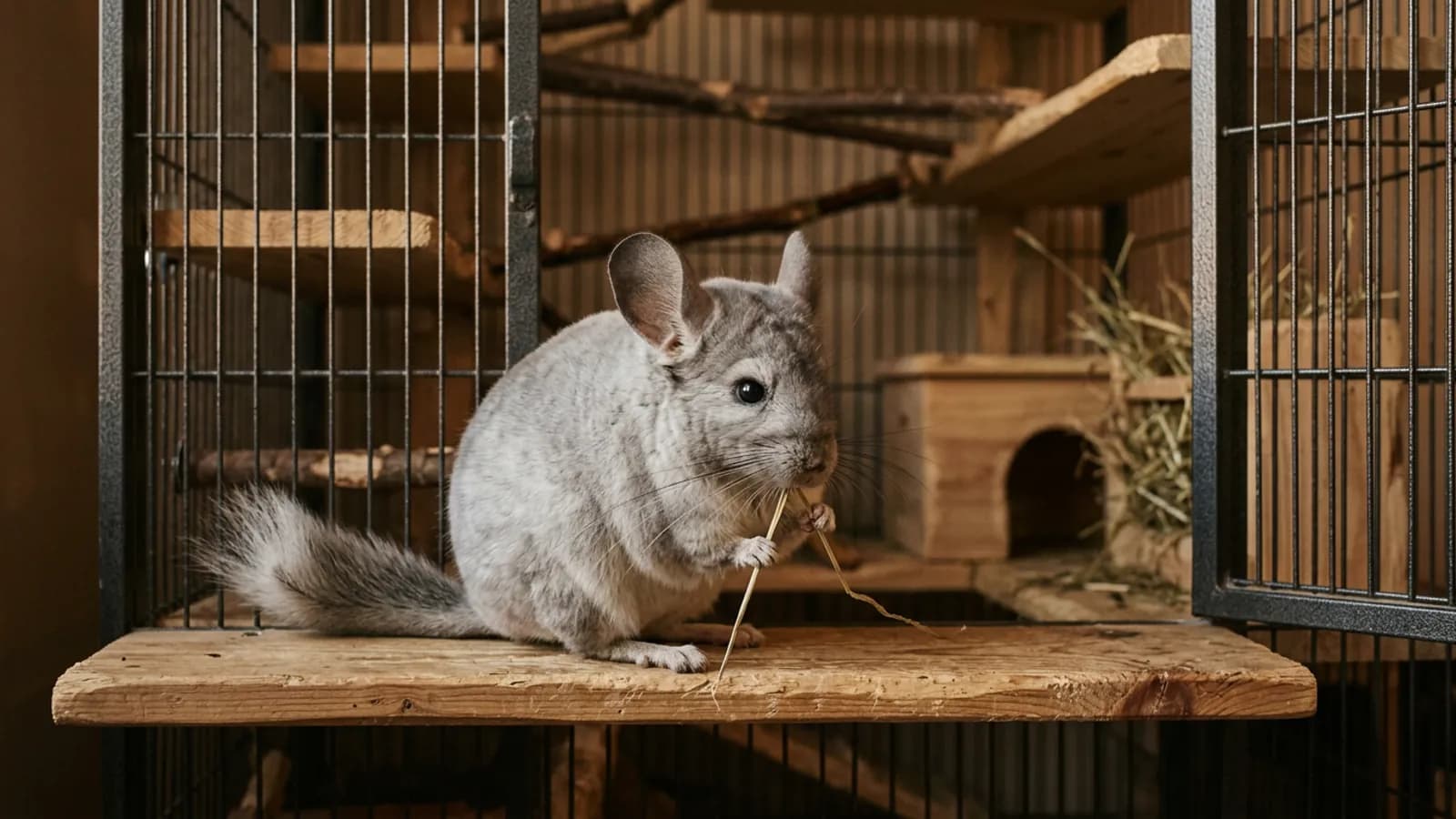
Chinchilla care is mostly a handful of non-negotiables done every single day, and the rest is detail. I have kept chinchillas for about ten years, and in that time I have learned that these animals do not forgive shortcuts the way a cat or a dog might. Pebble came to me out of an overheated attic, and Juniper came to me with dental disease already set in. Between the two of them, they taught me what actually matters and what is just noise. This is the version of chinchilla care I wish someone had handed me on day one, written owner to owner, with the reasons attached so you can tell the good advice from the bad. The chinchilla care tips below are the ones that actually move the needle, not the filler.
Temperature comes before every other rule
Pebble came to me from an attic that ran too hot, and her first summer nearly ended at an emergency vet during a heatwave. That night rewired how I think about proper care for chinchillas, so temperature is where I start every time. A chinchilla wears one of the densest coats of any land mammal, dozens of hairs growing from a single follicle, and that coat is built for the cold, high Andes. It traps heat beautifully and sheds it poorly, which means your chinchilla cannot cool itself the way you can. There is no panting it off, no sweating it out.
Keep the room at 60 to 70°F (15 to 21°C). Above 75°F (24°C) you are into risky ground, and 80°F (27°C) and up is an emergency, faster still when the air is humid, because moisture in the air blocks the little cooling a chinchilla can manage. I keep a thermometer that also reads humidity right on the cage, not across the room, so I see what the animal actually feels. digital thermometer and humidity gauge with remote probes As an Amazon Associate I earn from qualifying purchases. A chewable granite cooling stone gives Pebble somewhere to dump heat on a warm afternoon, though it buys minutes, not hours, and it is no substitute for air conditioning. Kaytee Chinchilla Chiller granite stone As an Amazon Associate I earn from qualifying purchases. If you learn one thing from me, learn this one. There is more in chinchilla temperature, the number that keeps yours alive, the warning signs of heat stroke worth memorizing, and the heat danger calculator if you want to see where your room sits.
The cage has to be tall, metal, and free of plastic
A chinchilla needs vertical space to climb and jump, so a tall cage beats a wide one, and it has to be built from metal bar and solid wood, not plastic. Chinchillas chew everything they can reach, and swallowed plastic passes through the gut as sharp fragments that can block or cut. I run a cage with a metal frame and wooden ledges set at different heights, so there is always somewhere to leap to. Critter Nation double unit small animal cage As an Amazon Associate I earn from qualifying purchases. Skip the coated wire shelves that come with a lot of cages and replace them with kiln-dried pine or apple wood ledges, which are kinder on the feet and safe to gnaw. Bar spacing should be tight enough that a head cannot push through, roughly half an inch or less for a full-grown animal and tighter for a kit.
Put solid metal pans on the bottom, deep bedding of kiln-dried pine or paper, and no wire floor anywhere. Wire floors cause bumblefoot, the painful foot sores you never want to treat. For the full walkthrough, see how to build a chinchilla cage setup and why the cage has to be metal, and if you are shopping, how to choose a chinchilla cage without buying the wrong one twice.
Hay first, always, with a measured pellet second
This is the part people get wrong most often, and Juniper is why I will not budge on it. She arrived with dental disease, and I manage it every day by making sure her teeth never stop working. A chinchilla should have unlimited grass hay in front of it at all times, ideally timothy, because the long, side-to-side chewing is what grinds the back teeth down as they grow. Hay is not a side dish. It is the meal, and most of a healthy day is spent eating it. Oxbow Western Timothy Hay, 40 oz bag As an Amazon Associate I earn from qualifying purchases. I buy hay in bulk so I never run short, because the day the hay runs out is the day the teeth start winning. Oxbow Western Timothy Hay, 9 lb box As an Amazon Associate I earn from qualifying purchases. On top of unlimited hay, give a measured amount of plain, uniform chinchilla pellets, roughly a tablespoon or two a day, as a supplement rather than the base of the diet. Skip the colorful mixes with seeds, corn, and dried fruit; a chinchilla will pick out the sweet bits and leave the pellet, and that is how you get a fat animal with bad teeth.
Fresh water from a bottle, checked and refilled daily. Treats stay tiny and rare, a few plain rolled oats or a sliver of dried herb, never nuts, never fresh fruit as a habit, because a chinchilla gut is built for dry, fibrous food and little else. More is in chinchilla food, hay first and pellets second and what a chinchilla can safely eat.
The bath is dust, never water
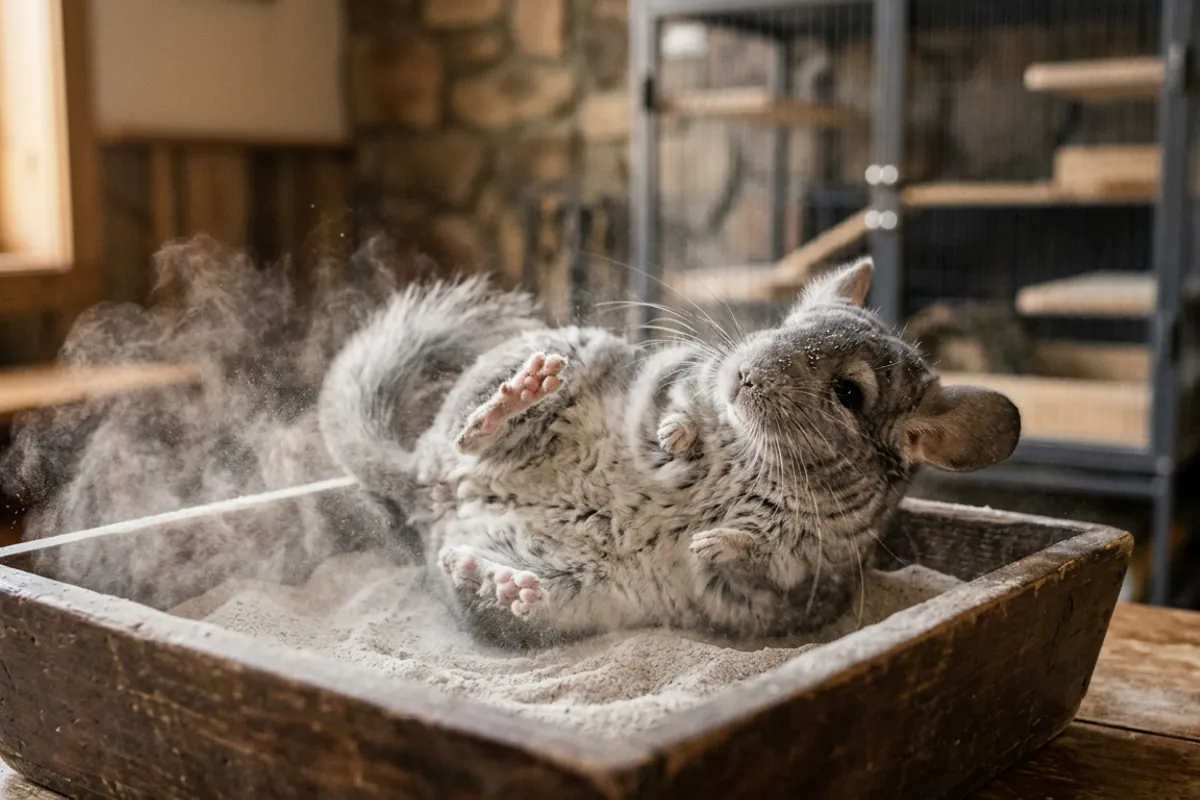
A chinchilla never bathes in water. That coat is so dense that water soaks in, takes days to dry against the skin, and grows fungus in the meantime, which is a real way to make an animal sick. Instead, they roll in fine volcanic pumice dust, which slides between the hairs and lifts oil and dirt out. Give a dust bath two or three times a week in a deep, enclosed container, let it run for a few minutes, then take the dust out so it does not sit and collect droppings between baths. Lixit Blue Beauty chinchilla dust, 3 lb As an Amazon Associate I earn from qualifying purchases. Use a proper chinchilla dust, not play sand, not craft sand, not anything labelled for reptiles, because coarse grit scratches the eyes and skin. If the coat looks greasy or clumped, add a bath; if the skin looks flaky, cut back, because over-bathing dries them out just as surely as skipping baths lets oil build up. The whole routine, from dust to schedule, is in the chinchilla dust bath done right and what bathing dust really is.
Teeth never stop growing, so chews are not decoration
A chinchilla's teeth grow continuously for its whole life, front and back, and the only thing that keeps them at the right length is grinding. Hay does most of that work, but chews matter too, and watching Juniper's mouth up close taught me to offer real variety rather than one lonely wood block that gets ignored. I keep a rotation of safe woods, apple, pear, and kiln-dried pine among them, so there is always something fresh to work on. emours apple wood chew sticks, 40 count As an Amazon Associate I earn from qualifying purchases. Avoid anything soft, painted, glued, or scented, and skip cedar and most citrus woods, which are not safe for a chinchilla. Lava ledges and pumice chews add a different, grittier texture that some chinchillas take to.
Watch for the warning signs that teeth are going wrong: drooling, a wet chin, dropping food, weight loss, or eating hay more slowly than usual. Those are vet signs, not wait-and-see signs, because back-teeth overgrowth is invisible from the outside and only an exotics vet with the right scope can see the spurs forming. Read chinchilla teeth problems and spotting malocclusion early and why chew toys are dental care, not decoration.
Handling, exercise, and the daily rhythm
Chinchillas are crepuscular, most awake at dawn and dusk, so respect that they sleep through much of the day and come alive in the evening. They are prey animals and prickly about being grabbed, so let a new one come to you, offer a flat hand, and build trust over weeks rather than forcing it. Never grab the tail near the base or squeeze the body, because a frightened chinchilla will slip its fur, releasing a whole patch to escape a grip, and that bare spot takes months to grow back.
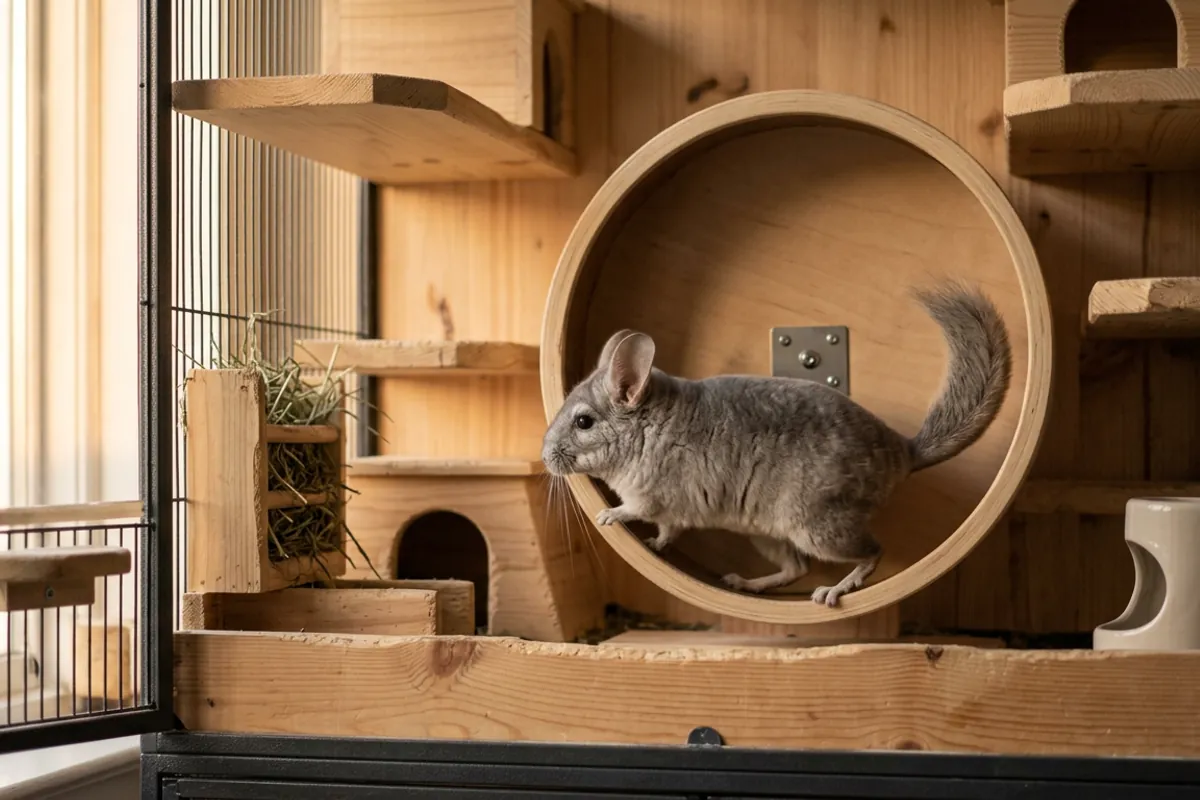
For exercise, a solid-surface running wheel is the only safe kind, at least fifteen inches across so the back does not curve while running. 15 inch Chin Spin solid surface chinchilla wheel As an Amazon Associate I earn from qualifying purchases. Wire and rung wheels catch toes and legs and cause real injuries, so avoid them entirely. Give supervised out-of-cage time in a chinchilla-proofed room where you can, cords hidden and nothing plastic within reach.
One aside, because plenty of people land here searching for chinchilla rabbit care and mean two different things. A chinchilla is a rodent, not a rabbit, and the two need opposite handling in places, so if you meant the rabbit breed, that is a separate animal entirely. Everything on this page is care for the rodent.
When an exotics vet is the right call
Chinchilla veterinary care is not the same as taking a cat to the corner clinic. You want an exotics vet who actually sees small mammals, and you want to find one before you have an emergency, not during it. Line up the name and the after-hours number the same week you bring your chinchilla home, and keep a carrier ready so a crisis is not also a scramble.
Call the vet for any of these without waiting: not eating or not passing droppings for more than a few hours, labored breathing, a limp or a leg held wrong, seizures, or the heat-stress picture of a chinchilla lying flat, drooling, with red ears. On wounds, keep basic chinchilla wound care conservative. You can gently part the fur and clear away bedding to look, but do not apply human ointments, do not use hydrogen peroxide, and cover nothing, because a chinchilla will chew a dressing off and swallow it. A bite from a cage-mate that breaks skin, or any wound that gapes or bleeds steadily, is a same-day vet visit. When in doubt, I call. I have never once regretted calling, and I have regretted waiting.
A basic chinchilla care sheet to keep by the cage
If you want the whole thing on one page, here is chinchilla care 101 in the order that matters, the care sheet I would pin by the cage:
- Keep the room at 60 to 70°F (15 to 21°C); treat 75°F (24°C) as risky and 80°F (27°C) as an emergency, sooner in humid air.
- Unlimited grass hay always; a measured tablespoon or two of plain pellets; fresh water checked daily.
- A tall metal-and-wood cage with wooden ledges, no plastic, no wire floors.
- A dust bath two or three times a week, never a water bath.
- A rotation of safe wood chews, checked and refreshed.
- A solid-surface wheel and daily out-of-cage time you supervise.
- An exotics vet lined up before you ever need one.
None of this is exotic once it is habit. Basic chinchilla care for beginners really does come down to heat, hay, dust, chews, and a vet you trust, done the same way every day. Get those right and the rest of proper chinchilla care, the enrichment, the bonding, the small evening joys, follows on its own. Pebble and Juniper are proof that even a rough start turns into a long, good life when the fundamentals never slip. For a deeper reference, the chinchilla care hub gathers it all in one place.