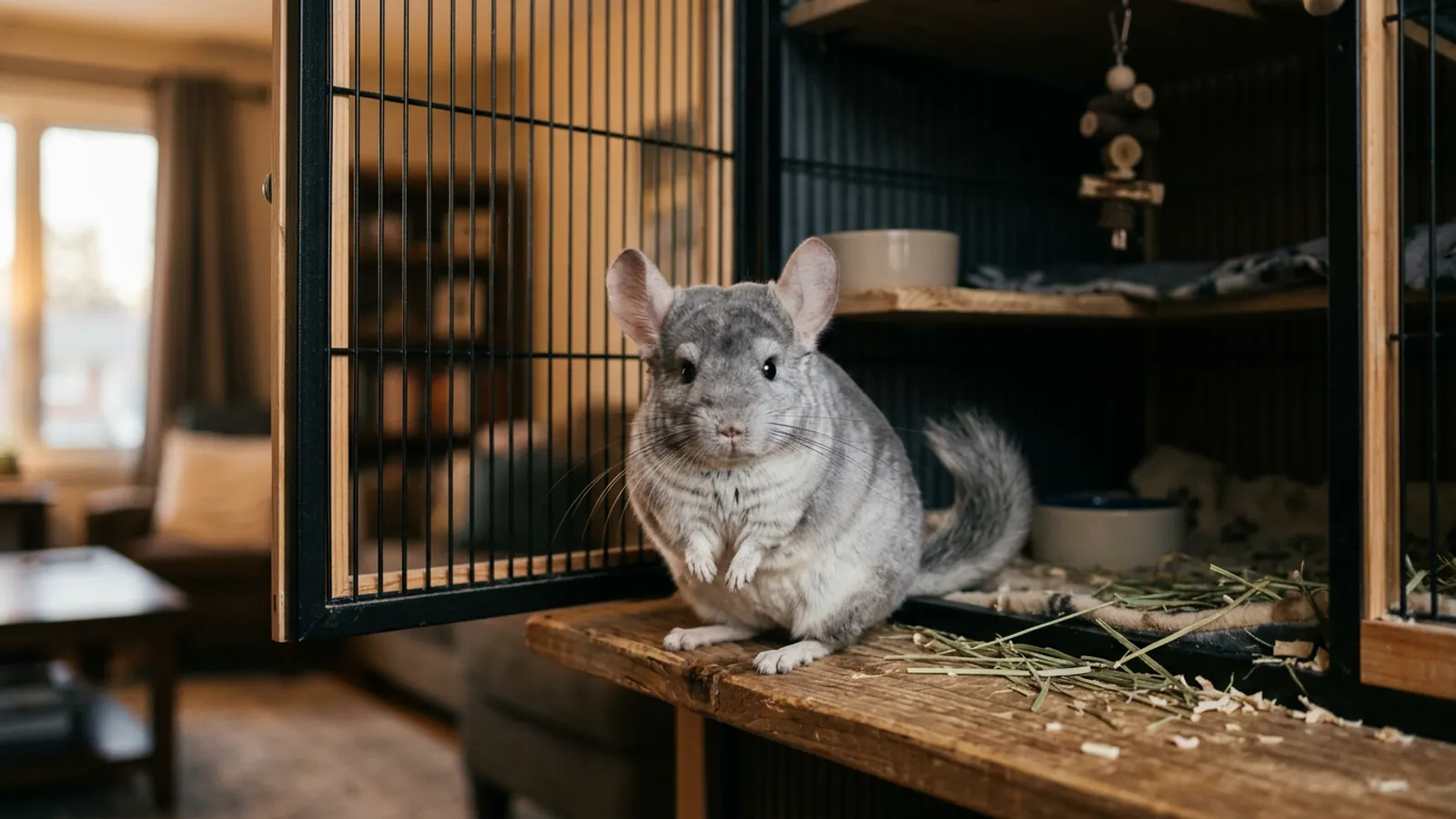
Almost nobody looks up how to tame a chinchilla before they bring one home. They look it up in week two, after fourteen days of an animal pressed into the back corner of the cage, refusing hay from their fingers and barking every time a hand comes near the bars. I have been there. Both of my girls arrived as rescues rather than as babies. Pebble came out of an overheated attic, and Juniper came out of neglect bad enough to wreck her teeth for life. Neither of them wanted anything to do with me for a long time. What follows is what worked across about ten years, and, just as importantly, what the goal should honestly be. Taming is not turning a chinchilla into a cat that naps on your lap. It is building an animal that is not frightened of you, that comes to the front when you sit down, and that steps onto your hand because it has decided you are safe.
What taming means for a prey animal
A chinchilla is a small prey mammal from the high Andes, and everything about its instincts is built around not being eaten. Its defense is distance and speed, not fighting. It bolts, it climbs, it wedges itself somewhere narrow. A hand descending from above is shaped exactly like the thing that kills chinchillas in the wild, and a closing grip is the physical sensation of being caught. That is the problem in one sentence.
So taming a chinchilla is not obedience training and it is definitely not showing the animal who is in charge. It is two boring processes running in parallel. The first is habituation: your presence, your smell, your voice, and your hand stop registering as novel, and novelty is most of what a prey animal fears. The second is association: your hand reliably predicts good things, mostly food, and never predicts being grabbed. Break the second one and you undo months of the first in a single afternoon.
That reframing matters because it tells you what progress looks like. Progress is not how long you can hold your chinchilla. Progress is chosen proximity. Does she come to the bars when you sit down? Does she stay out in the open while you clean? Does she take food from a flat palm without snatching and fleeing? Those are the measurements that mean something, and they move in a straight line if you are patient. Time in your hands, by contrast, can look great one day and collapse the next, because tolerating restraint is not the same as trusting you.
Get the housing right before you try anything
You cannot tame a stressed animal. A chinchilla that is too hot, too crowded, too bored, or woken up all day has no spare capacity for learning that you are harmless, and no amount of hand feeding fixes bad housing.
Start with the cage: tall, metal and wood, with wooden ledges at varied heights so she can climb and get above you. Height is what a chinchilla uses to feel safe, and an animal with somewhere high to sit is far braver about coming down than one with nowhere to retreat.
Critter Nation double unit small animal cage As an Amazon Associate I earn from qualifying purchases.
Plastic bases and plastic shelves are not just chewing hazards, they are the first thing an anxious chinchilla will gnaw through at 3am. If you are still choosing, how to pick the best chinchilla cage covers the sizing in detail.
Then temperature, which is not negotiable. Keep the room at 60 to 70°F (15 to 21°C). Above 75°F (24°C) is risky, and 80°F (27°C) and up is an emergency, faster in humid air, because a dense coat that evolved for mountain nights cannot shed heat. Pebble's first summer put her in an emergency vet at night, and that is why I own a thermometer with a humidity readout for every room a chinchilla is ever in, including the play room.
digital thermometer and humidity gauge with remote probes As an Amazon Associate I earn from qualifying purchases.
The full picture is in chinchilla temperature.
The rest of the setup does the quiet work of a calm animal: unlimited grass hay, a measured portion of plain pellets, a solid running surface wheel, and a real variety of safe wood to chew.
15 inch Chin Spin solid surface chinchilla wheel As an Amazon Associate I earn from qualifying purchases.
Wire wheels catch feet and break legs, so that is the one piece of gear I will name and reject outright. Juniper's dental disease is my daily reminder of why the hay and the chews are not optional either, and a rotation of safe woods is what I keep in the cage for it.
emours apple wood chew sticks, 40 count As an Amazon Associate I earn from qualifying purchases.
The first two weeks, when doing nothing is the work
For the first ten to fourteen days after a chinchilla arrives, I do not try to touch her at all. Not once. She has just lost every landmark she had, and the only useful thing I can do is prove that this new place is dull and predictable.
So I do husbandry and nothing else. Fresh hay and water, spot cleaning, pellets at the same time each evening, and then I sit on the floor a few feet from the cage and read out loud for fifteen or twenty minutes. It feels absurd. It is also the single highest value thing you can do, because it teaches her that a large animal can be nearby and nothing bad happens.
Two practical rules make this stage work. First, respect the clock. Chinchillas are crepuscular, so they are genuinely awake around dawn and dusk and into the evening, and they sleep in blocks through the middle of the day. Waking a sleeping chinchilla to socialize is the fastest way to teach her that you are an interruption. All of my taming work happens in the evening. Second, keep your hands slow and low. When you do need to reach in, come from the side rather than from above, move at a speed that looks almost silly, and never reach directly over her back.
You will see her watching you. She may hop closer and then bolt, several times. That is not failure, that is the animal running the experiment herself, and you want her to run it as many times as she likes.
Hand feeding is what does most of the work
This is the stage that converts a frightened chinchilla into a tame one, and it is almost entirely food.
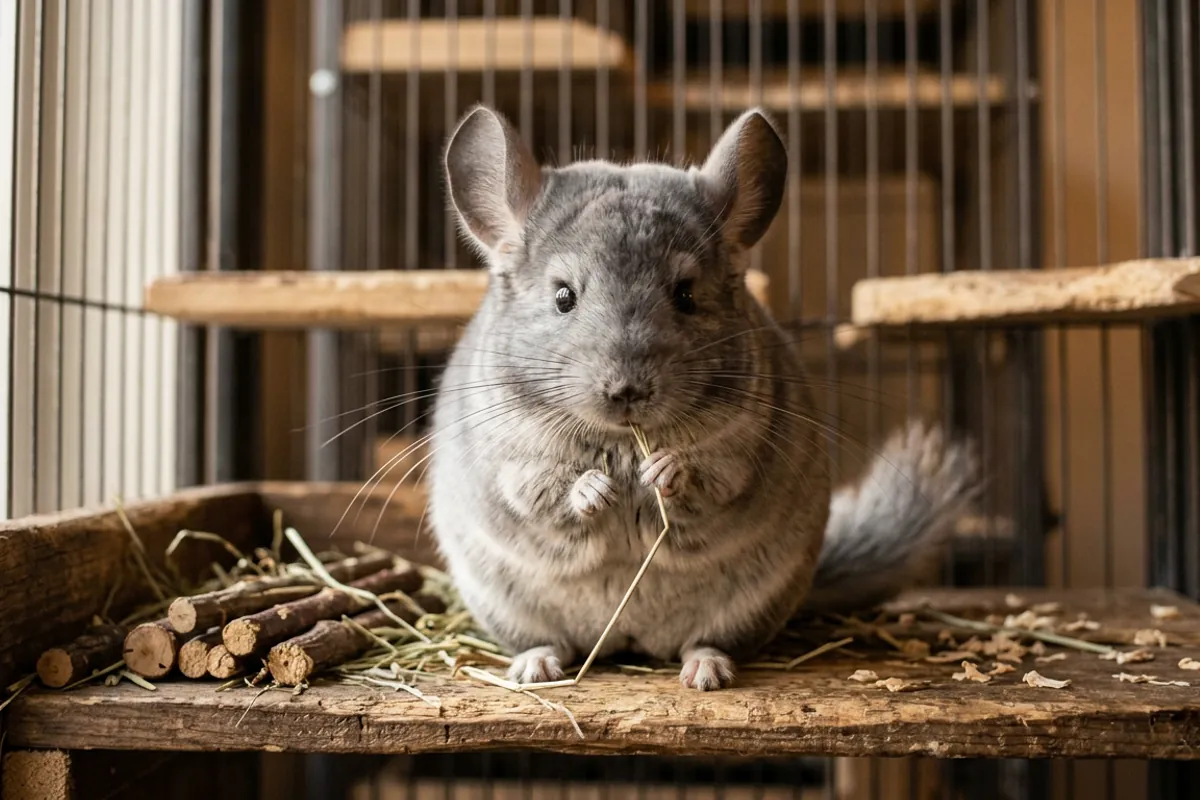
I go in this order, and I do not move to the next step until the current one is boring for both of us:
- A single strand of timothy hay offered through the bars, held still. If she takes it, that is the session. If she does not, leave it woven into the bars and walk away.
- One plain pellet, taken from her normal daily ration rather than added on top, offered the same way.
- The cage door open, my hand resting flat and still on a ledge with a pellet on the palm. No reaching. She has to close the distance.
- My flat hand as a platform she climbs onto to reach the food, which is the moment most people mistake for the finish line. It is closer to halfway.
The hay does double duty here, since it is also the whole meal.
Oxbow Western Timothy Hay, 40 oz bag As an Amazon Associate I earn from qualifying purchases.
On treats, be stingy and be boring. A chinchilla's gut and teeth are built for dry, high fiber plant material, and sugary or fatty food causes real harm: no fruit, no nuts, no seeds, no yogurt drops, no raisins. A plain pellet or a strand of hay is a perfectly good bribe. If you want something more exciting, a small piece of dried rose hip a couple of times a week is what I keep in the house, and dried rose hips for chinchillas explains the portion. More on the wider list is in chinchilla treats.
In my experience this stage takes weeks, and ten minutes an evening beats an hour on Sunday.
Chinchilla holding, and why I do as little of it as I can
Here is the blunt part. Most chinchillas do not enjoy being held. Some tolerate it well, a few seem to like being tucked against a chest, and plenty never accept it beyond the thirty seconds it takes to move them. That is a fact about the species, not a verdict on you. I still teach handling, because a chinchilla who has never been picked up calmly becomes a nightmare on the day she needs a carrier and a vet.
When I do lift a chinchilla, it looks like this. I never chase her around the cage, because a chase resets weeks of work. I wait until she is on a ledge at my chest height or has come to me during floor time. I bring both hands in from the side, slide one under the chest and front legs, and support the hindquarters with the other so her weight is carried rather than gripped. Then she comes against my body, low over a soft surface or while I am already sitting on the floor, so a jump is a short drop.
Never lift a chinchilla by the tail. The skin can strip off, which is a mutilating injury.
Expect fur slip: when a chinchilla is grabbed or badly frightened, she releases a clean patch of fur and leaves it in your hand. It does not hurt her the way a wound does, and the patch regrows over weeks to months, but it is a clear message that you moved too fast. Chinchilla fur slip covers what it looks like.
I keep early holding sessions to well under a minute, and put her down while she is still calm. Ending before she struggles is the entire lesson.
Free range time is where trust grows
Once she takes food from your hand, out of cage time does more for taming than anything you can do through the bars. On the floor she is not cornered, she can approach and leave on her own terms, and she will start using you as furniture. Both of my girls did their real bonding by choosing to jump on me.
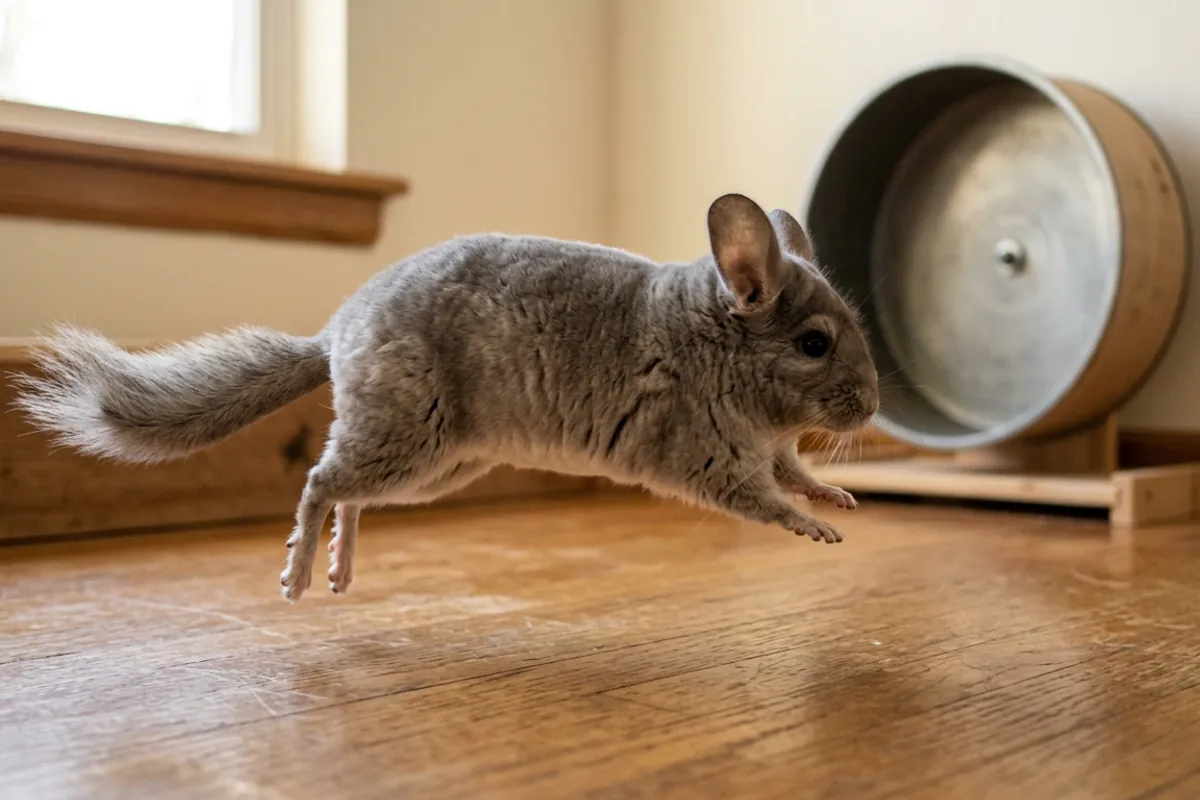
Set it up properly first. Pick one small room or a pen, block the gaps behind and under furniture, get every cable out of reach because chinchillas chew live wires without hesitation, remove houseplants, shut other pets out entirely, and check the temperature is in the same safe band as the cage. A hot spare room is not a safe play room. Chinchilla out of cage time walks through the room and the routine, and chinchilla playpen covers the pen itself.
Then sit down, put a couple of pellets beside you, and be dull. She will explore, popcorn around, and eventually land on your leg or run across your back. Do not grab her when she does. Reaching for a chinchilla who has just chosen to touch you teaches her that choosing to touch you ends the fun.
Getting her back in is the part people get wrong. Never chase. Set the cage door open with a familiar ramp or box leading to it, or teach her that a carrier means a pellet and let her walk in herself. If she also gets her dust bath at the end of play, she will often put herself away for it.
Lixit Blue Beauty chinchilla dust, 3 lb As an Amazon Associate I earn from qualifying purchases.
Dust is the only bath a chinchilla ever gets. Water soaks into that coat, will not dry, and causes fungal skin disease and dangerous chilling, so it is never part of any routine, taming or otherwise. See the chinchilla dust bath for the schedule.
What sets taming back, and how to recover
The setbacks are predictable, which means they are avoidable:
- Waking her in the middle of the day to hold her.
- Reaching over her back and closing your hand from above.
- Chasing her around the cage for any reason, including for her own dust bath.
- Grabbing her during play, which converts floor time from a reward into a trap.
- Dogs, children, or a vacuum at close range with no warning. Keeping a chinchilla and dog under one roof has the boundaries I use.
Punishment has no place here at all. A chinchilla cannot connect a consequence to her own behavior the way a dog can, so shouting or tapping the cage only teaches her that you are unpredictable.
On biting: a soft, exploratory nibble on your fingers is normal social behavior and not aggression. A real bite that breaks skin is fear, pain, or a defended territory, and the fix is to go back two steps and slow down rather than to push through. Chinchilla biting covers the difference in detail.
One thing I want to be firm about, since it is where keepers waste the most time. If a chinchilla who was already tame suddenly starts hiding, biting, or refusing food from your hand, treat that as a health signal first, not an attitude problem. Chinchillas hide illness until they cannot, and dental pain in particular shows up as a personality change. Pair that with any drooling, wet chin, weight loss, or smaller and fewer droppings, and stop taming entirely and book an exotics vet. I manage Juniper's teeth day to day, but the diagnosis and the treatment are never my call, and they should not be yours either.
A realistic timeline for taming a chinchilla
One thing to say before the numbers: there is no study behind any of this. I went looking, and there is no research on handling stress in chinchillas and no tested taming protocol anywhere in the literature, so every timeline you will read, including this one, is somebody's experience rather than a finding. Mine is two rescues over about ten years. Treat it as a rough shape, not a schedule you are behind on.
A hand raised kit from a good breeder may be climbing on you inside two weeks. A pet shop chinchilla who has been grabbed for months usually takes two to three months to reach reliable hand feeding. A neglected rescue can take six months or more, and the first real milestone might be nothing more dramatic than sleeping in the open while you are in the room.
Progress is not linear either. You will get a brilliant week followed by a day where she wants nothing to do with you, often after a loud evening, a cage move, or a temperature swing. Go back one step, hold there for a week, and carry on.
The plain ending is this: how to tame your chinchilla is mostly a question of how well you can leave her alone. She will learn you are safe faster than you think, and she may still never want to be picked up. Pebble comes to the front of the cage every evening and takes hay from my fingers without hesitating, and she still merely tolerates being lifted. That is a tame chinchilla. If you also want to know whether a second animal helps, do chinchillas need a friend covers it, and it is a separate decision from taming, because a bonded pair is calmer but not automatically friendlier toward you.