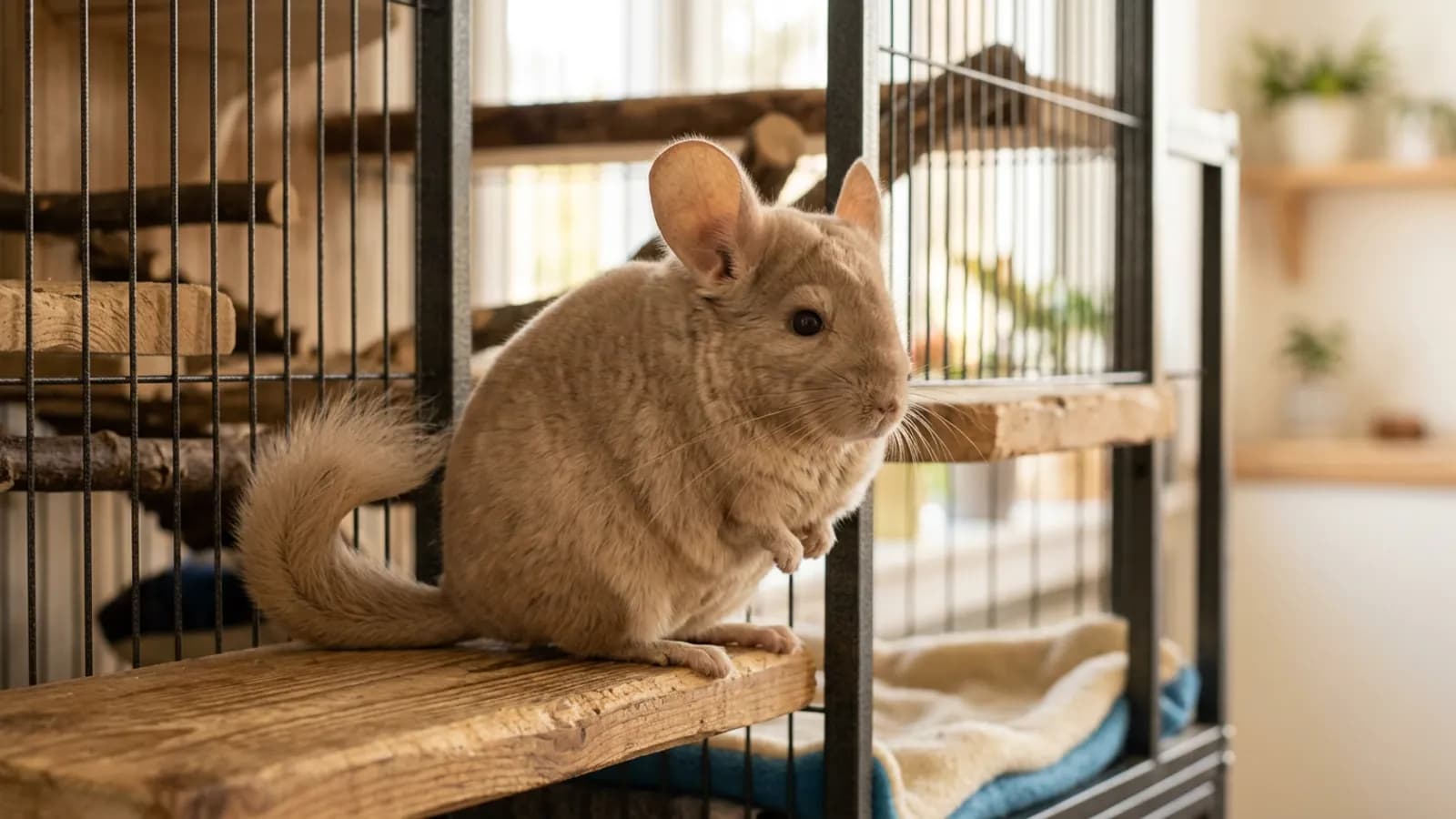
A brown chinchilla is the same animal I have sitting in my living room right now, wearing a different coat. That is the whole answer, and I lead with it because the word "brown" gets sold as if it were a rare breed or a separate species, and it is neither. Every chinchilla you will ever meet is Chinchilla lanigera, the same rodent from the same mountains, whether it is the standard silver gray that Pebble wears or a warm biscuit beige. Colour in a chinchilla is a coat mutation, nothing more, and it changes what the animal looks like without changing one line of how you have to care for it. So this article is really two things at once: an honest look at what makes a chinchilla brown, and a reminder that the price of the colour is about the only thing that is actually different.
What a brown chinchilla actually is
In the wild, chinchillas are gray. That is not a fashion choice, it is a survival one: the standard coat is a mix of a dark slate base, a pale under-band, and black-tipped guard hairs, and on a rock face at altitude that broken gray is close to invisible. That agouti gray is the factory setting, the colour the species carried down from the Andes, and it is what most people picture when they picture a chinchilla. Brown is not in that picture at all.
A brown chinchilla exists because somewhere in ranched breeding stock a colour mutation turned up and got kept. The main one behind almost every brown you will see is called beige, and it does roughly what it sounds like: it strips out much of the dark pigment and leaves a warm, sandy tone instead of slate. Cross beige with other coat mutations and you can push that brown warmer or darker, which is where names like tan and brown velvet come from. None of it is a different breed. It is the same genome with one or two pigment switches flipped.
That matters for how you read a listing. "Brown chinchilla" describes a coat, the way "black cat" describes a cat, and the terminology is genuinely loose. One breeder's "light brown" is another's "beige" is another's "champagne," and there is no kennel club policing the words. So when you see a colour name, treat it as a rough pointer, not a spec sheet, and look at the actual animal. I will walk through the real colours underneath the marketing names below, but hold onto the frame first: colour is cosmetic, and the mountain rodent underneath is unchanged.
Beige, and where the light brown comes from
The beige mutation is the workhorse of the brown family, and it is what people usually mean by a light brown chinchilla. Beige is co-dominant, which is a genetics term worth knowing because it actually shows up in the coat. A chinchilla can carry one beige gene or two, and unlike a simple on or off trait, the dose you get is visible.
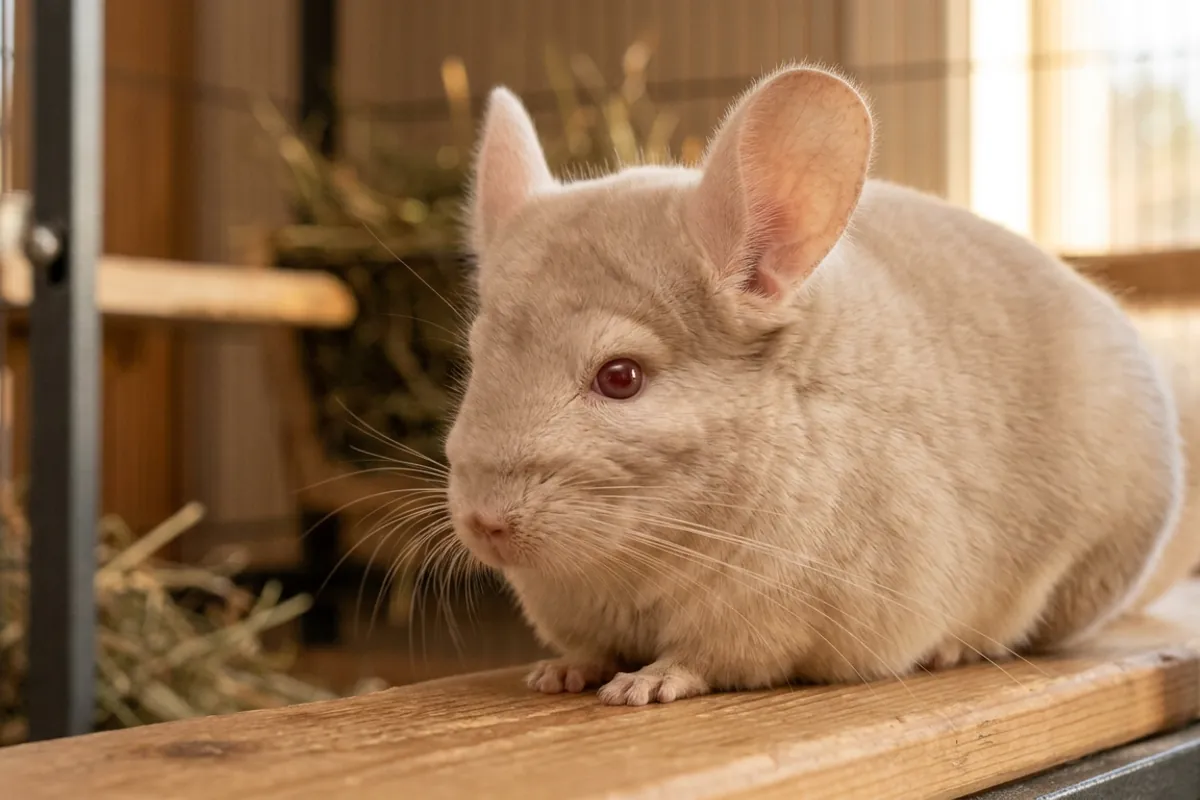
A chinchilla with a single beige gene, what breeders call heterozygous beige, tends to be a medium, honeyed brown, with dark eyes and ears that often carry faint freckling or a mottled edge. A chinchilla with two beige genes, homozygous beige, comes out paler, a creamy, washed-out light brown, and it brings two tells with it: pink ears and eyes that read pink or red rather than black. Those pink eyes are not a defect and they are not a sign of a sick animal. They are simply what happens when you remove enough dark pigment that the blood behind the eye shows through, the same reason a white rabbit's eyes look red.
So the light brown chinchilla someone is selling is usually one of those two: a lighter heterozygous beige, or a homozygous beige with the pink ears. Neither is rarer or more valuable in any way that should move the price much, whatever the listing implies. And a quick, honest caveat, because I would rather admit a gap than paper over it: the exact way these genes stack, and the finer named shades between them, is something breeders argue about, and the naming is not standardised. I can tell you confidently that beige gives you brown and that the pink-eared paler version carries two copies. I would not put hard percentages on the shade you will get from a given pairing, and neither should anyone selling to you.
Tan and brown velvet, the darker end
If light brown is beige on its own, the darker browns are beige stacked with a second mutation. The common one is tan, which is beige combined with the black velvet gene. Velvet lays a darker veil over the top of the coat, mostly along the back and face, so a tan chinchilla reads as a richer, deeper brown with a shaded cast rather than a flat sandy tone. You will also see this sold as brown velvet, and yes, those are usually the same thing described by two different breeders.
Push the combinations further and you get names like pastel and various brown blends, and this is exactly where the vocabulary stops being reliable. There is no authority that says a pastel must look like precisely one thing, so two animals sold under the same word can look noticeably different, and one animal can be sold under two words depending on who is writing the ad. I am not going to hand you a colour chart that pretends to be exact, because it would be inventing precision that does not exist in the hobby.
What I will say is structural and true regardless of the name: every one of these browns is the standard chinchilla plus pigment mutations, and a darker or fancier coat is not a different constitution. A tan chinchilla is not hardier than a beige one, and a beige one is not more fragile than a standard gray. If a seller starts attaching temperament or health claims to a colour, that is a flag, not a feature.
The coat is dense no matter the colour
Here is a fact that outlasts every colour name: a chinchilla's fur is the densest of any land mammal, something like fifty or more hairs growing from a single follicle where you or I grow one. That density is identical in a brown chinchilla and a gray one. The beige mutation changes the pigment in the hair, not the number of hairs or how tightly they pack, and that is the whole reason the colour is cosmetic in the way that counts.
That coat is also why a chinchilla never bathes in water, and a brown one is no exception. Fur that dense does not dry. Water soaks to the skin, stays there, and you get a chilled, miserable animal at best and a fungal skin problem at worst. Chinchillas clean themselves by rolling in fine dust, which is volcanic pumice, not sand and not dirt, and it wicks oil and moisture out of the coat the way water never could. A brown chinchilla needs that dust bath two or three times a week in a proper dust house. Lixit Blue Beauty chinchilla dust, 3 lb As an Amazon Associate I earn from qualifying purchases. It is the same routine for every chinchilla, whatever colour the coat. If you want the longer version of why dust and not water, I wrote it out in what bathing dust for chinchillas really is.
One thing worth watching on a lighter coat specifically: a pale beige shows staining more than a dark gray does, so a urine-soaked corner or a damp spot in the cage will discolour a light brown chinchilla's fur faster and more visibly. That is a cage hygiene issue, not a colour issue, and the fix is the same for every chinchilla, keep the enclosure dry and clean. But it is the one practical way the colour genuinely shows up day to day.
Colour changes nothing about the care that keeps them alive
Strip the colour away and every brown chinchilla needs exactly what every chinchilla needs, and most of that is boring and non-negotiable. The foundation is grass hay, available all the time, never rationed. Timothy or another grass hay should make up the bulk of what your chinchilla eats, and I mean a pile that is always there, day and night. I keep a full hay feeder topped up rather than measuring it, because hay is not a snack, it is the diet. Oxbow Western Timothy Hay, 40 oz bag As an Amazon Associate I earn from qualifying purchases. Plain pellets are a measured supplement on top, a tablespoon or two a day, not the main event.
The reason hay matters this much is teeth, and this is Juniper's lesson, not a textbook's. Juniper came to me as a neglected rescue with dental disease, and I manage her mouth every single day. A chinchilla's teeth grow continuously for its whole life, and the only thing that keeps them worn down to a workable length is grinding through tough, abrasive hay and gnawing on hard wood. Take that away and the teeth overgrow, roots included, and you end up at an exotics vet with an animal that has stopped eating. Colour has nothing to do with any of it. A brown chinchilla with a gorgeous beige coat and untreated malocclusion is a sick animal in a pretty wrapper.
So a brown chinchilla gets the same unlimited hay and the same variety of safe wood chews to keep those teeth busy, something like an apple wood chew assortment rather than a single stick it will ignore. emours apple wood chew sticks, 40 count As an Amazon Associate I earn from qualifying purchases. If you want the full diet breakdown it lives at what can a chinchilla eat, and the dental side is at chinchilla teeth problems. The colour on the outside earns no exemptions.
Heat does not care what colour the fur is
If there is one place I refuse to soften anything, it is heat, and colour buys a brown chinchilla no protection at all. That dense coat I praised is a liability in warmth: it is built to hold heat in on a cold Andean night, which means it traps heat just as well on a hot afternoon, and the animal cannot sweat it off. A brown chinchilla overheats at exactly the same temperatures a gray one does.
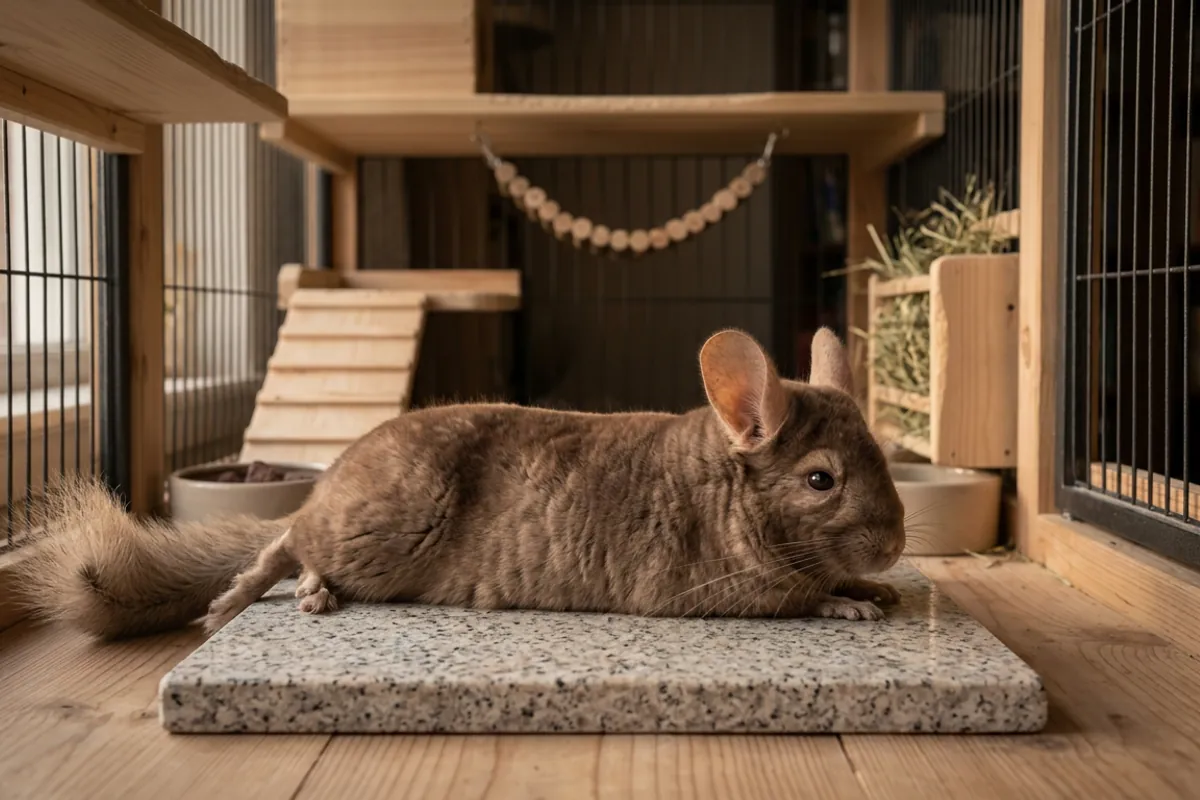
Those temperatures are not a matter of opinion. The comfortable range is 60 to 70°F, which is 15 to 21°C. Above 75°F, about 24°C, you are into risky territory. At 80°F, roughly 27°C, and up, you have an emergency, and it comes on faster when the air is humid because a chinchilla sheds heat partly through its ears and cannot do that into muggy air. This is Pebble's story and the reason the heat guidance on this whole site is as blunt as it is. Pebble came to me from an overheated attic, and her first summer brought a heatwave and a night at the emergency vet that I am not eager to repeat with any chinchilla, whatever colour it wears.
So a brown chinchilla lives in the coolest room you have, out of direct sun, with a thermometer you actually look at. I keep a thermometer and hygrometer on the cage so I am reading the real number where the animal sits, not guessing from how the room feels to me. digital thermometer and humidity gauge with remote probes As an Amazon Associate I earn from qualifying purchases. A chilled granite or marble cooling stone gives them somewhere to dump heat on a warm day. Kaytee Chinchilla Chiller granite stone As an Amazon Associate I earn from qualifying purchases. And if you are ever unsure whether today's numbers are safe, I built a heat danger calculator that takes temperature and humidity together, because the two together are what matters. The colour of the coat never enters that calculation.
Buying a brown chinchilla without paying for the story
The last honest thing to say about brown is what it does to the price, because that is the one place colour reliably changes something. A brown or beige chinchilla is often listed higher than a standard gray, sold as rarer or fancier. Sometimes there is a little truth in it, an uncommon combination coat can genuinely be harder to find, but far more often the colour is just a markup on the same animal. You are paying for a word.
I would rather you spend that money on the things that actually determine whether the animal thrives, and none of them are visible in a coat. Ask how old it is, whether it has ever been seen by an exotics vet, what it eats, and whether you can watch it move and chew before you commit. A healthy standard gray from a careful breeder is worth far more than a stunning light brown from a mill that has never trimmed a tooth. If the seller talks more about the colour than the husbandry, that tells you where their attention has been.
I have written the money side out in full, both what a chinchilla really costs once you count the vet fund, and how to buy a chinchilla for sale without getting hurt or ripped off. Read those before you fall for a coat. A brown chinchilla is a lovely thing to look at, and I understand the pull, I do. Just buy the animal, its health and its history, and let the colour be the free part. Ten years in, the chinchillas I love most are not the ones with the fanciest coats. They are the ones still eating well, teeth worn down, cool and dry and unbothered. That is what you are really choosing.