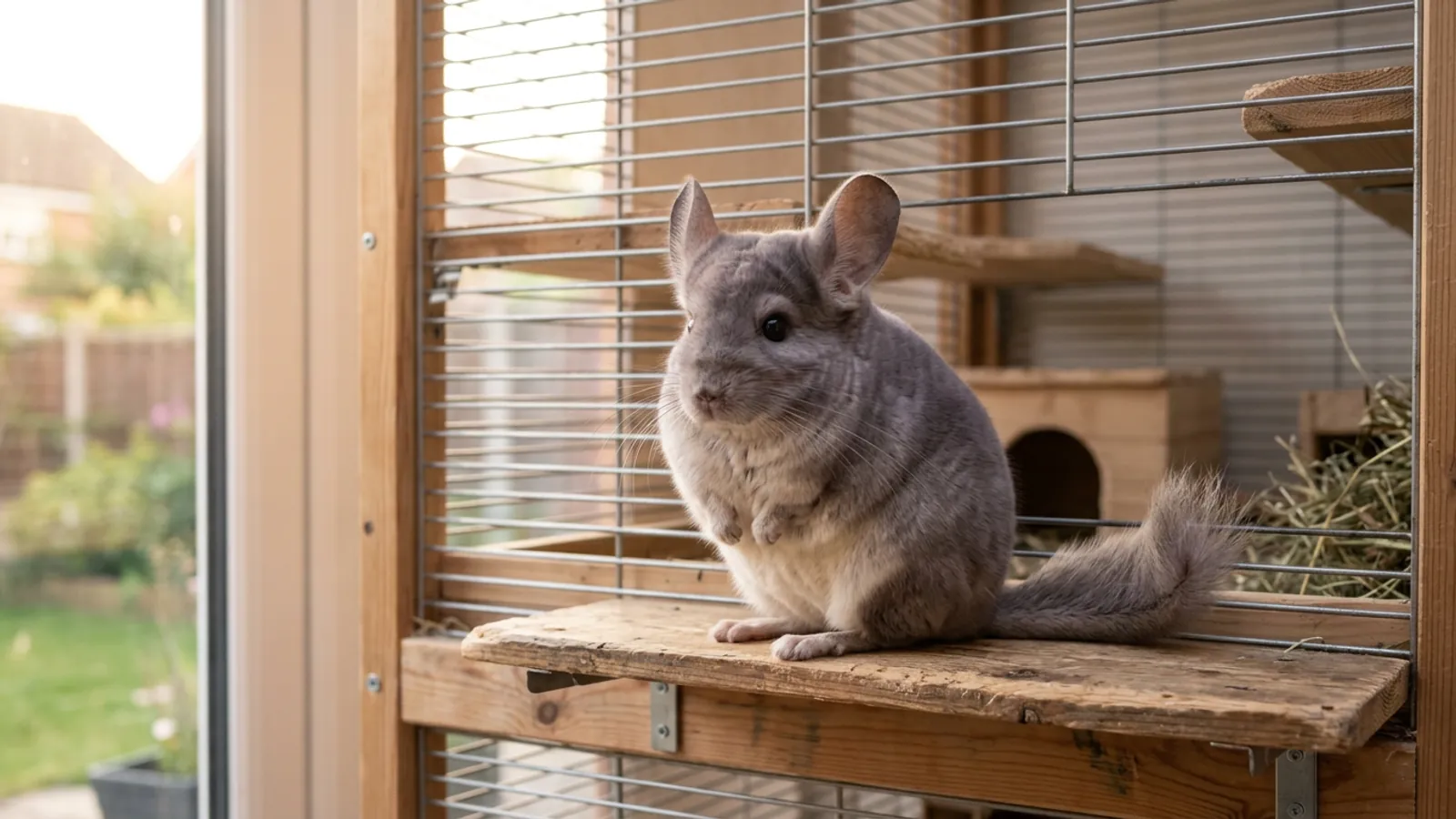
A chinchilla violet is not a different animal from the gray one most people picture. It is the same species wearing a recessive coat color that pulls the fur toward a soft, dusty lavender instead of the standard slate. I get asked about violets more than almost any other color, usually by someone who has fallen for a photo and wants to know whether the color comes with anything special attached. The short answer, which I will spend this whole article backing up, is that violet changes what a chinchilla looks like and nothing about what it needs. The care is the care. A violet still eats unlimited hay, still overheats above 75°F, still bathes only in dust. If you take one thing from this page, take that.
But the color itself is genuinely interesting, and the fancy has built up a small vocabulary around it that confuses newcomers fast: violet, afro violet, violet wrap, pastel violet, and more. So let me walk through what violet is, where the color comes from in the fur, how it is inherited, and why none of it should move your husbandry one inch.
What violet means
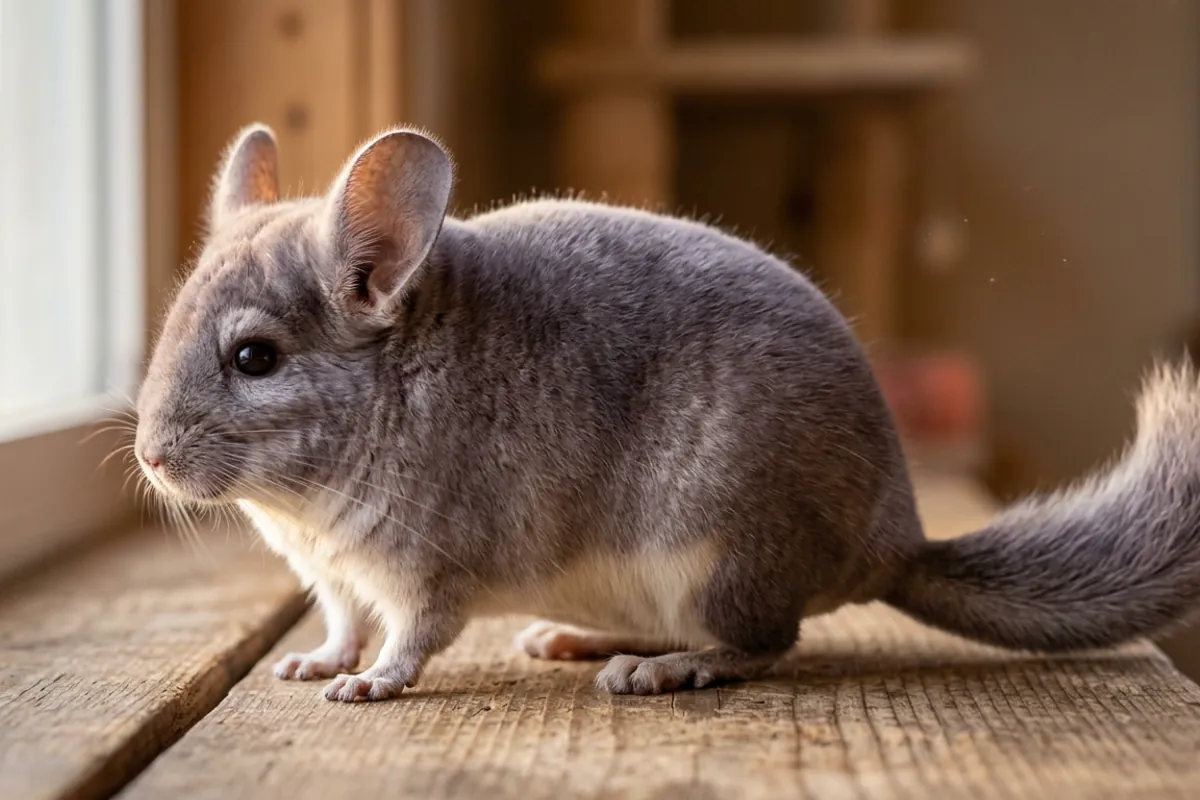
Standard chinchillas are what breeders call standard gray: a slate body, darker along the back, fading to a white belly, with individual hairs banded so the tips carry the dark pigment that gives the coat its depth. Violet is a mutation that changes that pigment. Instead of the neutral black-gray tipping, a violet carries a coat with a purplish, bluish-gray cast to it, and the harsh black is gone. In good light a real violet looks like slate that someone has washed with a thin layer of lavender or dove. The belly usually stays white, and the fur often reads softer and more even than a standard because the sharp dark tipping is not there breaking it up.
I say "usually" and "often" on purpose. Color in chinchillas sits on a spectrum, and the depth of the violet tone varies a lot from animal to animal and even with lighting. A weak violet in a phone photo under warm bulbs can look almost gray; the same animal in daylight shows the cast clearly. This is why buying a color off a single picture is a mistake, and I will come back to that.
What violet is not is purple. There is no purple chinchilla, no matter what a listing says, and I have written a whole piece on that because the myth will not die: is there such a thing as a purple chinchilla. Violet is the closest thing that exists, and it is a muted, grayed lavender, not a saturated color. If someone shows you a vivid purple animal, the color came from a camera filter or a dye, and a dyed chinchilla is an animal that has been abused. Real coat color is subtle.
Where the color comes from, and why it is recessive
Violet is an inherited coat mutation, and the important word for a buyer or a would-be breeder is recessive. A chinchilla has two copies of the gene that governs this trait, one from each parent. Violet only shows when both copies are the violet version. An animal with one violet copy and one standard copy looks like an ordinary gray but quietly carries violet; breeders call that a violet carrier, or "het violet" for heterozygous.
That single fact explains most of what confuses people about violet breeding. Two standard-looking grays can produce a violet kit if both happen to carry the gene. A violet bred to a non-carrier standard produces zero visible violets, only carriers. A violet bred to a violet produces all violets, because each parent has only violet copies to give. And two carriers bred together produce roughly one violet in four on average, with the rest looking standard but half of them carrying the gene invisibly. Those are ordinary Mendelian odds, and "roughly" is doing real work: three kits is a tiny sample, and you can breed two carriers and get no violets at all across a couple of litters purely by chance.
The origin story you will hear is that the violet mutation was developed decades ago from a line traced to Africa, which is why some old-timers still call it the African violet or Sullivan violet. I cannot personally verify that history, and it does not change how you keep the animal, so I treat it as fancy lore rather than something I would state as fact. What matters practically is that violet is a well-established, stable, recessive color that has been in the pet population for a long time.
I want to be blunt about one thing here, because the recessive genetics tempt people. The fact that you can breed for a color does not mean you should. Breeding chinchillas is hard on the female, risky, and easy to do harm with, and chasing a color is one of the worst reasons to start. I laid out exactly what it asks of the animal in what breeding a chinchilla asks, and I would rather you read that and decide not to than romanticise a violet litter.
Afro violet and violet wrap: names, not new animals
Here is where the vocabulary gets slippery. Two terms come up constantly around violets, and both cause more confusion than they need to.
An afro violet chinchilla is a name I see attached to violets with an unusually plush, standing, fluffy coat, the kind that looks like it has extra loft to it. I will be straight with you: naming in the color fancy is inconsistent, and I cannot point you to a single agreed genetic definition of "afro violet" the way I can for violet itself. Some sellers use it purely as a description of a very fluffy violet; some use it as a fancy label to lift a price. My working assumption is that afro violet describes coat texture and density layered on top of the violet color, not a separate color of its own. If a breeder uses the term, ask them plainly what they mean by it and what the parents were. A straight answer tells you a lot about who you are dealing with.
A violet wrap chinchilla is more concrete. "Wrap" describes how far the color extends around the body. A standard violet keeps a clean white belly, with the violet on the back and sides. A violet wrap shows the violet tone wrapping further down the flanks and around the underside, so there is less of that clean white belly and more color all the way around. Breeders often deepen the wrap by crossing ebony into a violet line, because ebony pushes color onto the belly. So a heavy violet wrap is frequently a violet carrying ebony as well, which is really a combination rather than a purer violet. None of this changes the animal's needs; it just changes where the pigment sits.
The lesson under both terms is the same. These are describing appearance, sometimes texture, sometimes a hidden second mutation. They are not describing a different creature with different requirements. A fluffy afro violet and a deep violet wrap and a plain white-bellied violet all get identical food, identical temperatures, identical everything.
Violet crossed with other colors
Because violet is a recessive that mostly just removes the black tipping and adds the lavender cast, it combines cleanly with other chinchilla mutations, and breeders have made a small catalog of these crosses. Violet on top of the beige mutation gives a paler, warmer animal some people call pastel violet. Violet combined with white can produce very light, silvery animals. Add ebony and you push toward the darker, fuller-wrapped violets I mentioned. There is also touch-of-velvet layered in some lines, which darkens the back.
I am deliberately keeping this loose, because the exact names shift from breeder to breeder and country to country, and I would rather admit that than hand you a false taxonomy. What is solid is the underlying logic: violet is one recessive trait, other colors are their own traits, and the "designer" colors are just violet stacked with one or two of them. If you want to understand the pieces separately, what a white chinchilla is covers the white side of these crosses, and it makes the combinations easier to read.
One myth to kill while we are here: none of these color combinations makes an animal hardier, calmer, healthier, or more delicate. Coat color is coat color. A white-spotted or violet or beige chinchilla is not more fragile and not tougher than a standard gray. Temperament comes from the individual animal and how it was raised and handled, not from its pigment.
Color, price, and what you are paying for
Violets cost more than standard grays, often noticeably more, and it is worth understanding why so you can judge whether a price is fair. You are paying for scarcity and for the breeder's work: a violet needs violet genetics on both sides, which means a breeder maintaining violet or carrier lines, and rarer colors simply change hands for more. That is the fair part of the premium.
The dishonest part is when a color label is used to paper over a bad animal. A pricey violet from a mill, sold sick, with no health history and no idea what its parents were, is a worse buy at any price than a healthy standard gray from someone who knows their animals. Color should be near the bottom of your list when you choose a chinchilla, well below health, age, temperament, and the seller's honesty. I broke down what the numbers mean in what a chinchilla price tells you and the fuller what a chinchilla really costs, including the vet fund that matters far more than the color premium. Read those before you let a lavender coat set your budget.
What violet does not change: the care
This is the part I care about most, so I am going to be direct. Everything below is identical for a violet, an afro violet, a violet wrap, and a plain standard gray. The color is on the outside; the animal underneath is the same chinchilla with the same hard requirements.
Heat first, always, because heat is what kills these animals. Chinchillas are comfortable between 60 and 70°F (15 to 21°C). Above 75°F (24°C) you are into risky territory, and 80°F (27°C) and up is an emergency, sooner in humid air because they shed heat through their ears and cannot cool themselves the way we do. My Pebble came out of an overheated attic, and her first summer brought a heatwave near-miss and a night at the emergency vet that I will never forget. That is why I am relentless here. A violet does not tolerate heat any better than a gray. Keep a thermometer where the cage sits, not across the room.
digital thermometer and humidity gauge with remote probes As an Amazon Associate I earn from qualifying purchases.
Give them somewhere to dump heat into on a hot day with a chilled solid stone they can lie against.
Kaytee Chinchilla Chiller granite stone As an Amazon Associate I earn from qualifying purchases.
If you are anywhere near the edge, run the numbers with the heat danger calculator and read the heat stroke warning signs so you recognize trouble before it is a crisis. My full heat safety page is the one I would bookmark.
Food next, and this is where my Juniper comes in. She is a rescue whose dental disease I manage every single day, and watching what happens when teeth do not get worn down is why I am uncompromising: a chinchilla eats unlimited grass hay, first and always, with plain pellets as a small measured supplement, not the main course. The chewing keeps their constantly growing teeth ground down. A violet's teeth grow exactly like Juniper's. Keep the hay coming and keep it clean and dry.
Oxbow Western Timothy Hay, 40 oz bag As an Amazon Associate I earn from qualifying purchases.
If you go through hay fast with more than one animal, buying it in bulk works out cheaper and you are never caught short.
Oxbow Western Timothy Hay, 9 lb box As an Amazon Associate I earn from qualifying purchases.
Back the hay up with hard wood chews so the teeth have variety to work against.
emours apple wood chew sticks, 40 count As an Amazon Associate I earn from qualifying purchases.
The full picture is in my diet and hay page and what can a chinchilla eat; treats are a minefield, so which treats are safe is worth a read before you hand over anything sweet.
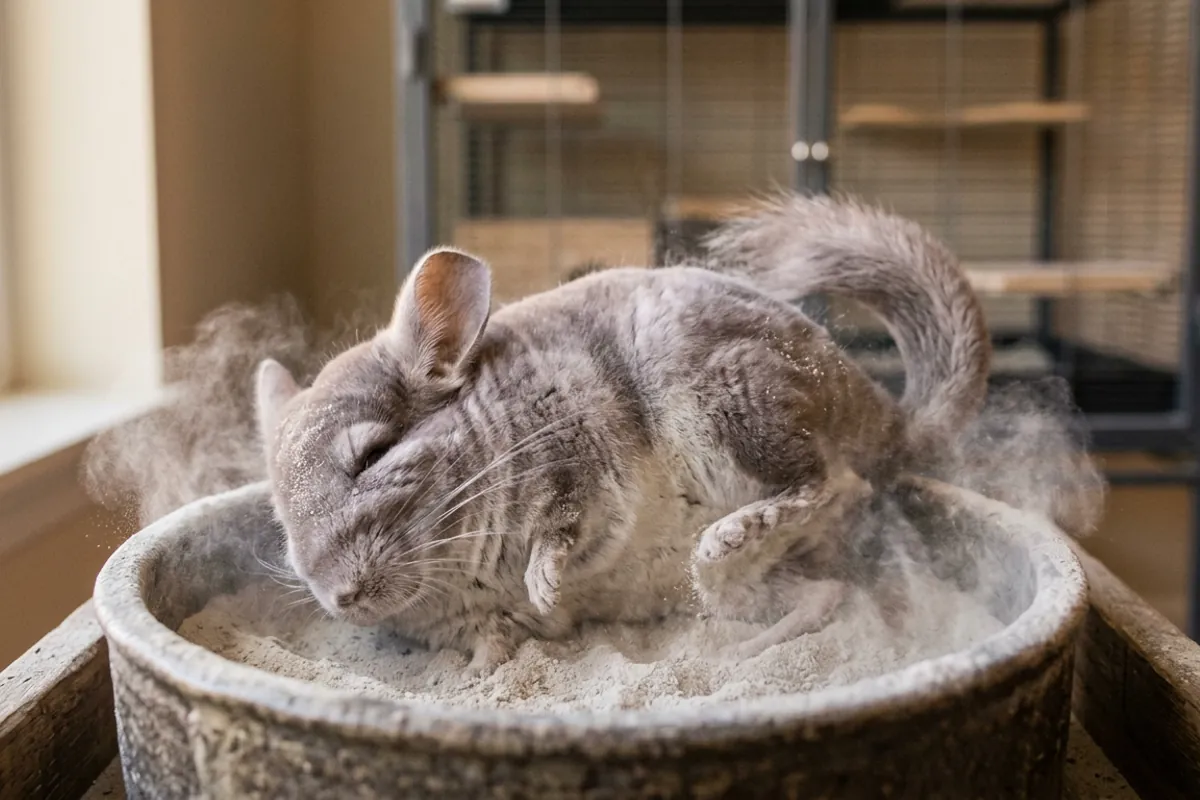
Then the coat itself, which for a violet is the whole point and still needs the same routine. Chinchillas never bathe in water. Their fur is so dense that water gets trapped against the skin and causes fungal rot; they clean themselves by rolling in fine volcanic dust that carries oil and moisture away. A violet's plush coat needs this just as much, and I would argue a fluffy afro violet needs it kept up scrupulously because that loft holds oil. Use proper dust in a deep container a few times a week, not left in permanently.
Lixit Blue Beauty chinchilla dust, 3 lb As an Amazon Associate I earn from qualifying purchases.
I explain the whole thing, dust and schedule, in the dust bath done right.
Housing and exercise round it out. The cage should be tall, made of metal and wood with wooden ledges, no plastic anywhere because they chew everything and plastic in the gut is deadly.
Critter Nation double unit small animal cage As an Amazon Associate I earn from qualifying purchases.
Give them a wheel with a solid running surface, never a wire or barred one, because wire catches feet and breaks legs.
15 inch Chin Spin solid surface chinchilla wheel As an Amazon Associate I earn from qualifying purchases.
My cage setup guide and how to choose a cage without buying the wrong one twice cover the details, and the general care hub ties it all together.
Buying a violet without getting burned
If you have decided you want a violet, buy it the way you would buy any chinchilla, with the color as a bonus and not the deciding factor. See the animal in daylight if you can, because violet reads very differently in warm indoor light. Ask what the parents were and whether the seller keeps records; a real violet breeder can tell you exactly how they got the color and will happily talk genetics. Watch the animal move, check that the eyes are clear and the coat is intact, and be wary of anyone leaning hard on the word violet while dodging questions about health and age.
Skip the pet-store fantasy version entirely. Before you go looking, read how to buy a chinchilla for sale without getting hurt and how to find one near me without bringing home trouble, because a rushed color purchase from the wrong seller is exactly how people end up with a sick animal and a large vet bill. A violet is a lovely thing to look at. It is still, in every way that costs you time and money and worry, an ordinary chinchilla, and that is the best possible news: you already know how to care for it.