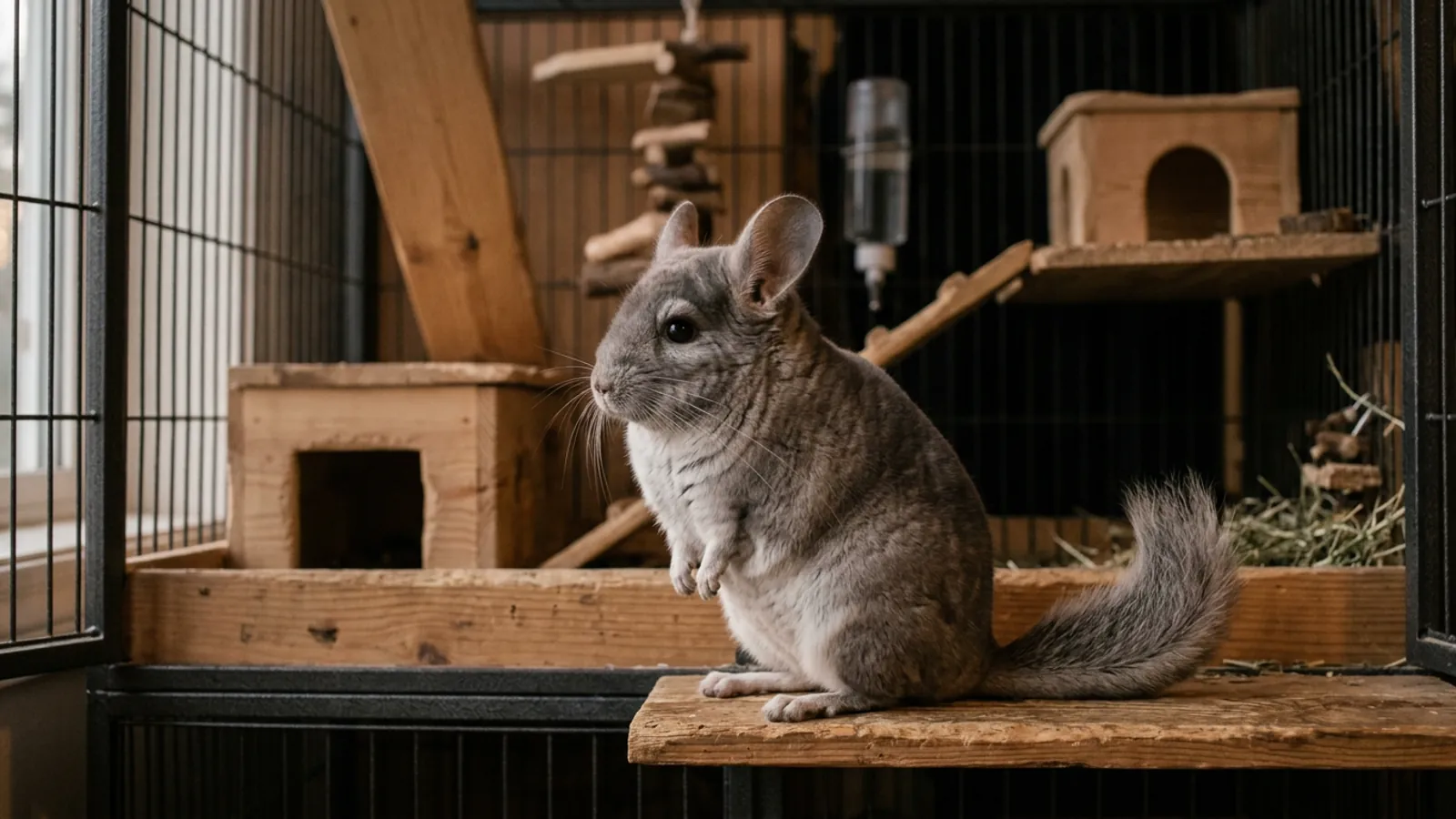
Chinchilla stress is the first thing I look for and the last thing most people notice, because a chinchilla under pressure does not complain, she goes quiet. These animals are prey. The speed, the fur that lets go in your fingers, the way they freeze flat against a ledge and stop blinking: all of it exists so that something with teeth loses interest. That same wiring means they hide fear the way they hide illness, and by the time a stressed chinchilla looks obviously unhappy, you have usually missed weeks of smaller signals. After about ten years of keeping them, nearly everything I know about stress came from learning to read the small stuff instead of waiting for the loud stuff.
What chinchilla stress is
Stress is not a mood, it is a physiological response. The body prepares to run, and running is what a chinchilla is built for. A short spike is normal and harmless. A dog barks at the window, she barks back, she sits stiff on the top shelf for ten minutes, then she goes back to her hay. That is a working animal doing its job.
The kind that does damage is the load that never lifts. A room that runs a few degrees too warm all summer. A cage next to a television. One hiding spot instead of two, so there is nowhere to go when the vacuum starts. Handling that happens on your schedule rather than hers. A cage mate who owns the top ledge and will not share it. None of those looks dramatic on any given day, and all of them together will grind an animal down over months.
It shows up in the gut first. A chinchilla runs on constant fermentation of grass fiber, and that system does not tolerate interruption well. Chronic stress means eating less, eating less slows the gut, and a gut that stops in a chinchilla is a real emergency rather than an inconvenience. It leans on the immune system too, which is why the stressed animal in a household is the one that turns up with a fungal patch or a snuffly nose while the settled one shrugs the same exposure off.
None of this is measurable at home. What you can measure is what goes in, what comes out, and what she weighs. Those three tell you more than any single dramatic moment of chinchilla behavior ever will.
The signs I look for first
Weight is my first number, and it is the one I trust most. Same kitchen scale, same evening each week, written down. Adults sit anywhere from roughly 400 to 800 grams depending on the animal, so the population range tells you almost nothing. Her own trend tells you everything. A chinchilla losing weight over three consecutive weeks has a problem whether or not she is acting strange, and chinchilla weight is often the earliest honest signal you get.
Droppings come next. Fewer of them, smaller, drier, pointed at the ends, or stuck together with a bit of moisture: all of those mean the gut is not running normally. I look at the tray every morning, not because it is pleasant, but because chinchilla poop changes before anything else does.
Then hay. I know roughly how fast the rack empties in my house, and a rack that is still full at the same time the next day gets my full attention.
After that, the behavioral list:
- Fur chewing, where the coat goes short and uneven over the flanks or shoulders, often in a patch she can reach easily.
- Fur slip, a clean patch released after a grab or a fright.
- Pacing the same route on a shelf, or chewing bars in a steady rhythm rather than the occasional exploratory gnaw.
- Not coming out at dusk, when she should be at her busiest.
- Alarm barking through the night, repeated and evenly spaced. That is a warning call, not conversation, and the chinchilla noises she makes are worth learning to tell apart.
- A hunched posture with the ears held back and flat, or half-closed eyes during her active hours.
One of these on one day is usually nothing. Two of them for a week is a pattern, and a pattern is what I act on.
Hiding is normal until it is not
Chinchilla hiding gets reported to me as a problem more often than anything else, and most of the time it is not one. Chinchillas are crepuscular. They sleep hard through the middle of the day, usually wedged into a wooden house or flat along a high ledge, and a new owner watching an empty cage at two in the afternoon is watching a perfectly healthy animal do exactly what chinchilla sleep is supposed to look like.
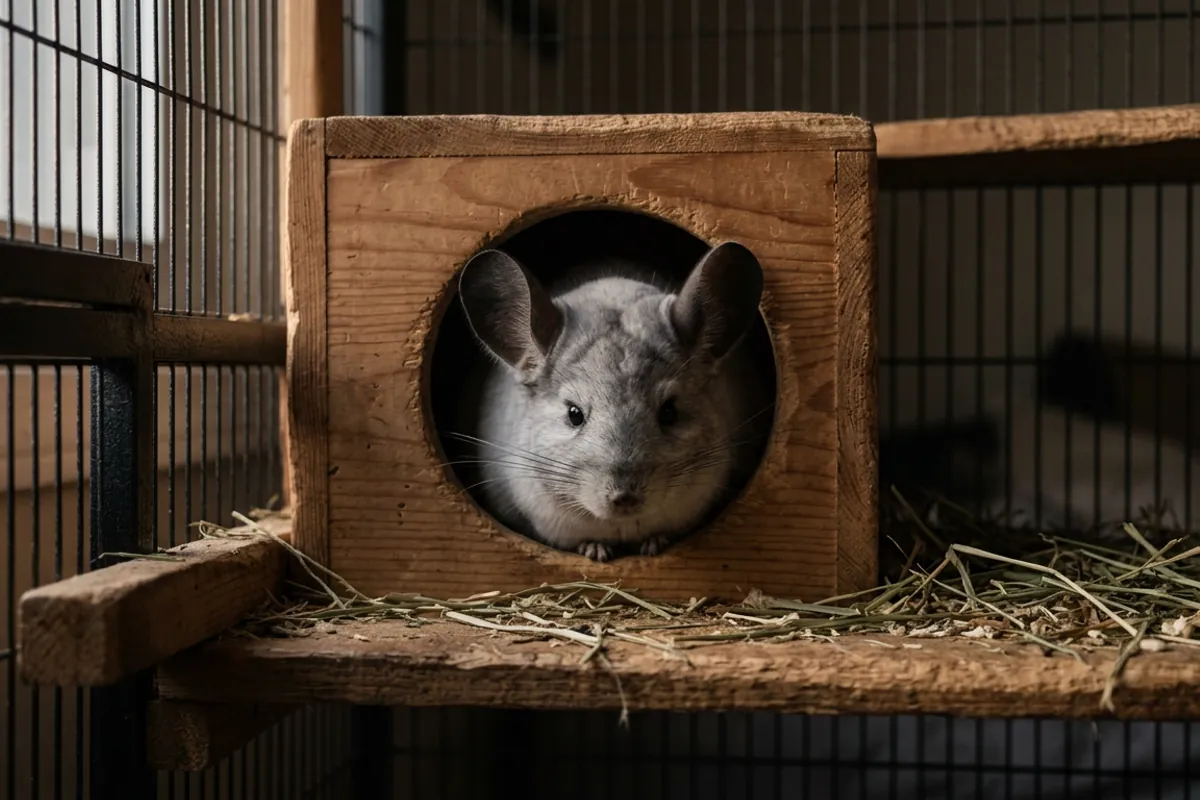
A newly arrived chinchilla hides more than that, and she is entitled to. The first two weeks in a strange room with strange smells are the most stressful of her life so far. I leave a new animal almost completely alone: food, water, dust, quiet, and no attempt at contact beyond talking near the cage. Pushing for interaction in that window buys you months of extra work later.
What is not normal is hiding that changes. The chinchilla who used to come out at dusk and now does not. The one who stays in the house while fresh hay goes in. The one who hides pressed into a bare corner of the cage rather than inside her house, which usually means she is not choosing a safe spot so much as trying to disappear. Hiding paired with a hunched back, or with a full hay rack, or with fewer droppings, is not shyness. That combination is what makes me start checking the room rather than the animal: temperature, noise, a new pet, a new smell, a moved cage.
If she is simply timid rather than unwell, time and routine fix it. Taming a chinchilla is a slow trade where you spend patience and get trust, and there is no version where you spend less and get the same.
What scares a chinchilla
A chinchilla scared by something specific is easier to help than one under a general load, because you can remove the cause. The usual causes are predictable once you think about what a hawk looks like from below.
Hands coming down from above are the big one. A hand descending over the back of a chinchilla is, from her position, a bird. I approach at her level, palm flat, from the front, and I let her make contact first. Ten years in, I still do it that way with Juniper, who came out of a neglect situation and has never entirely stopped checking.
Predator smell is the second. A dog or cat that has simply been in the room leaves scent behind, and the chinchilla does not know your dog is friendly. If you keep both, the dog and chinchilla arrangement needs a door between them, not good intentions.
The rest of the list is short: sudden noise, vibration through the floor or the cage stand, being cornered, being grabbed, and being chased around a room with a towel because it is time to go back in. That last one is worth killing entirely. If you need to move her, put the carrier down and let her walk in, or move the whole hide house with her in it. Chasing turns you into the predator, and you pay for it every time you reach into that cage for the next month.
I also count the room itself. A cage in a hallway, next to a speaker, or on a kitchen counter where someone slams a cupboard at seven in the morning is a low grade fright that repeats forever.
Heat is the stress you cannot negotiate with
Everything above is about comfort and trust. Heat is different, because heat kills, and it kills faster than any of the signs above will warn you.
Pebble came to me from a rehome out of an overheated attic, and her first summer here brought a heatwave and a night at the emergency vet. That night is why I do not soften anything on this subject. A chinchilla wears one of the densest coats of any mammal, evolved for cold, high, dry air. She cannot pant effectively and she cannot sweat. Once she is overheating, she has almost no way back on her own.
The numbers do not move. Comfortable is 60 to 70°F (15 to 21°C). Above 75°F (24°C) is risky. At 80°F (27°C) and above you are in an emergency, and humid air brings all of that forward, because damp air strips a chinchilla's ability to shed heat at all. A hot day at 55 percent humidity is a different animal from the same temperature at 25 percent. The heat danger calculator will do that combination for you, and chinchilla temperature covers the reasoning in full.
Buy a thermometer that also reads humidity and put it at cage height, not on the far wall.
digital thermometer and humidity gauge with remote probes As an Amazon Associate I earn from qualifying purchases.
Room air conditioning is the only real answer in a warm climate, and I treat it as part of the cost of the animal rather than an upgrade. A cooling stone helps at the margins and gives her somewhere to lie down.
Kaytee Chinchilla Chiller granite stone As an Amazon Associate I earn from qualifying purchases.
It is not a cooling system, and I have never seen one save an animal in a room that was too hot. Know the warning signs of heat stroke before you need them: red ears, lying flat and stretched out, fast shallow breathing, drooling, unresponsiveness. That is a same-hour exotics vet call, not a wait and see.
How I lower the stress load in the cage
The cage is where most chronic stress is either created or removed, so this is where I spend the effort.
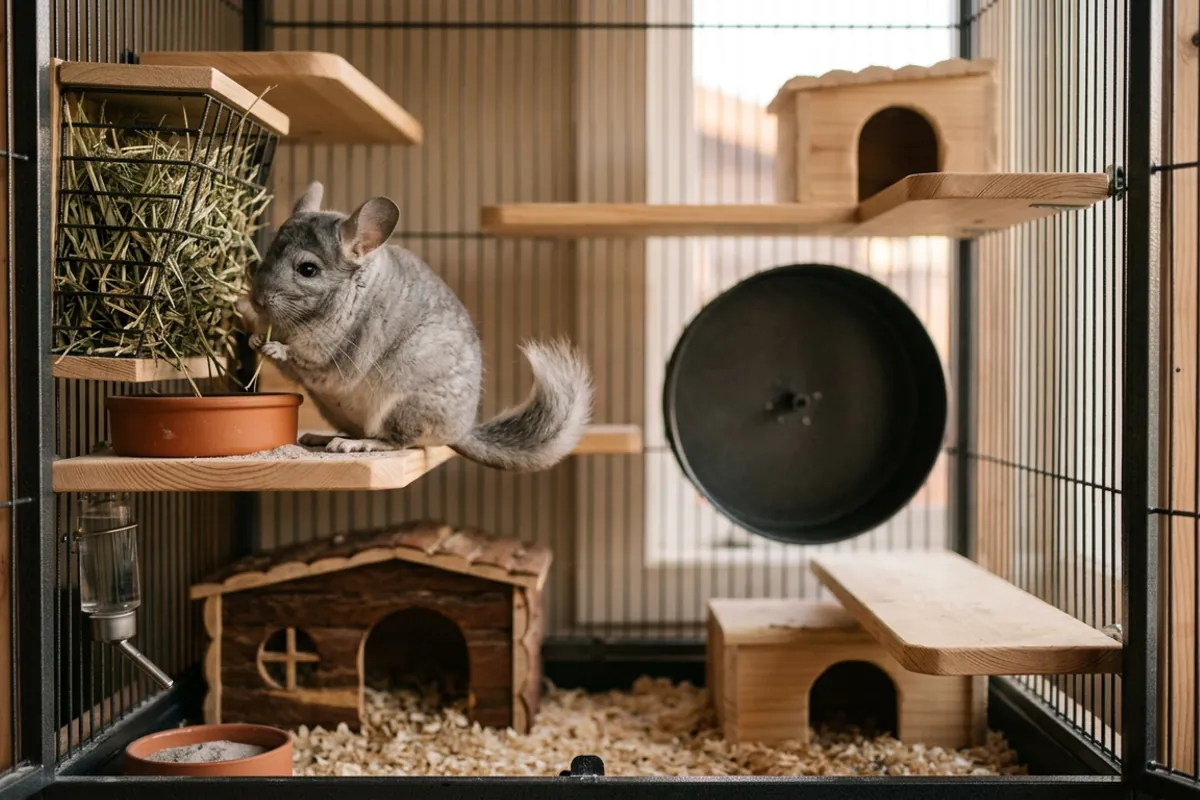
Tall beats wide. Chinchillas move vertically, and a cage with real height and several wooden ledges gives an animal somewhere to go when she wants distance from you, the dog, or her cage mate. Metal and wood only, no plastic anywhere she can reach it, and never a wire-floored cage.
Critter Nation double unit small animal cage As an Amazon Associate I earn from qualifying purchases.
Two hides, minimum, at different heights. One hide means one option, and one option under pressure is no option. Wooden houses, sized so she can turn around inside.
Hay stays available at all times. Unlimited grass hay is the whole meal, not a side dish, and pellets are a measured supplement of a spoonful or two a day rather than the main event. A chinchilla with hay in front of her all day has one fewer reason to be anxious about food.
Oxbow Western Timothy Hay, 40 oz bag As an Amazon Associate I earn from qualifying purchases.
Chews are not enrichment, they are dental care. Juniper's dental disease is the reason I keep a real variety of safe woods in rotation rather than the same block forever, because teeth that grow continuously need constant work and a bored chinchilla chews the cage instead.
emours apple wood chew sticks, 40 count As an Amazon Associate I earn from qualifying purchases.
A wheel is worth it if and only if the running surface is solid. Wire wheels catch feet and break legs, and I will not have one in the house.
15 inch Chin Spin solid surface chinchilla wheel As an Amazon Associate I earn from qualifying purchases.
Dust baths are how a chinchilla resets her coat, and a chinchilla who cannot bathe gets greasy, itchy and irritable. Fine volcanic dust, two or three times a week, ten to fifteen minutes, then take the bath away so she does not sleep in it.
Lixit Blue Beauty chinchilla dust, 3 lb As an Amazon Associate I earn from qualifying purchases.
Water baths are never an option, at any temperature, for any reason.
Last, routine. Feed, dust and play at roughly the same times. Predictability is not a luxury for a prey animal, it is most of what makes a room feel safe.
Handling and out of cage time, on her clock
The fastest way to a relaxed chinchilla is to stop asking her for things she has not agreed to yet. I sit on the floor near the cage with the door open and let her decide. First she comes out, then she comes near, then she climbs on me, and each of those steps can take weeks. Nothing about that timeline is improved by picking her up.
Sessions stay short and end while she is still interested rather than when she has had enough. Out of cage time needs a chinchilla-proofed room with no cables, no gaps behind furniture, and no other pets, because a chinchilla loose in an unsafe room is a stressed chinchilla and a damaged house.
Children need supervision and a rule: no picking up, hands stay low, sitting on the floor only.
Company is worth mentioning here, because it cuts both ways. A well matched pair can be calmer together, and a badly matched pair is a chronic stressor with nowhere to escape to. If you are weighing it up, whether chinchillas need a friend covers what a proper introduction involves. Two animals dumped into one cage is not a friendship, it is a fight waiting for a trigger.
When stress stops being a management problem
I am an experienced keeper and not a vet, and this is the line where that distinction matters.
Call an exotics vet if she has stopped eating, if droppings have stopped or dropped off sharply, if she is lethargic or unresponsive during her active hours, if there is drooling or a wet chin, if she is losing weight steadily, or if she is showing any heat stroke sign at all. A drooling chinchilla who has gone quiet is very often a dental problem, and malocclusion is painful long before it is visible from the outside.
Persistent fur chewing deserves a vet check too. It is often behavioral, but it can also be pain, parasites or a skin condition, and there is no way to tell by looking.
Find your vet before you need one. Not every practice sees exotics, and a heat emergency at eleven at night is a bad time to start searching, which is the whole argument for sorting out a chinchilla vet in advance.
Most stress, though, never gets that far. It gets fixed by a cooler room, a second hide, more hay, a quieter corner and an owner who stops reaching in from above. That covers the large majority of what I have dealt with over ten years, including two animals who arrived here with good reason to be frightened. Chinchillas are not fragile so much as honest: give them a setup that matches what they are, and they settle. Get one thing consistently wrong, and they will tell you, quietly, and usually a long time before you were planning to listen.