I get asked about breeding chinchillas more often than almost any other subject, and the question is almost never really about biology. It is about a pair someone already owns, or a litter that is already on the way, or a half formed plan to make an expensive hobby pay for itself. So here is my answer up front: I do not breed, I do not plan to, and after about ten years with these animals I think most people asking should not either. That is not squeamishness. A breeding chinchilla female is doing something physiologically expensive and genuinely dangerous, in a body built for a cold, thin aired mountainside, and the ways it goes wrong are the kind you cannot fix at home at two in the morning.
What follows is the biology, plainly, plus the husbandry that goes with it. If you read it and decide not to breed, good. If you decide to go ahead anyway, at least go ahead knowing what the animal is signing up for, because she did not get a vote.
The reproductive biology you are signing up for
Chinchillas are seasonally polyestrous. In the wild, and in outdoor colonies in the northern hemisphere, the breeding season runs roughly from November through May. Indoors, under steady artificial light and steady temperature, that seasonality blurs and pairs will produce litters at odd times of year. The estrous cycle is long by rodent standards, commonly given as somewhere around 30 to 40 days, with receptivity lasting only a couple of days inside that window.
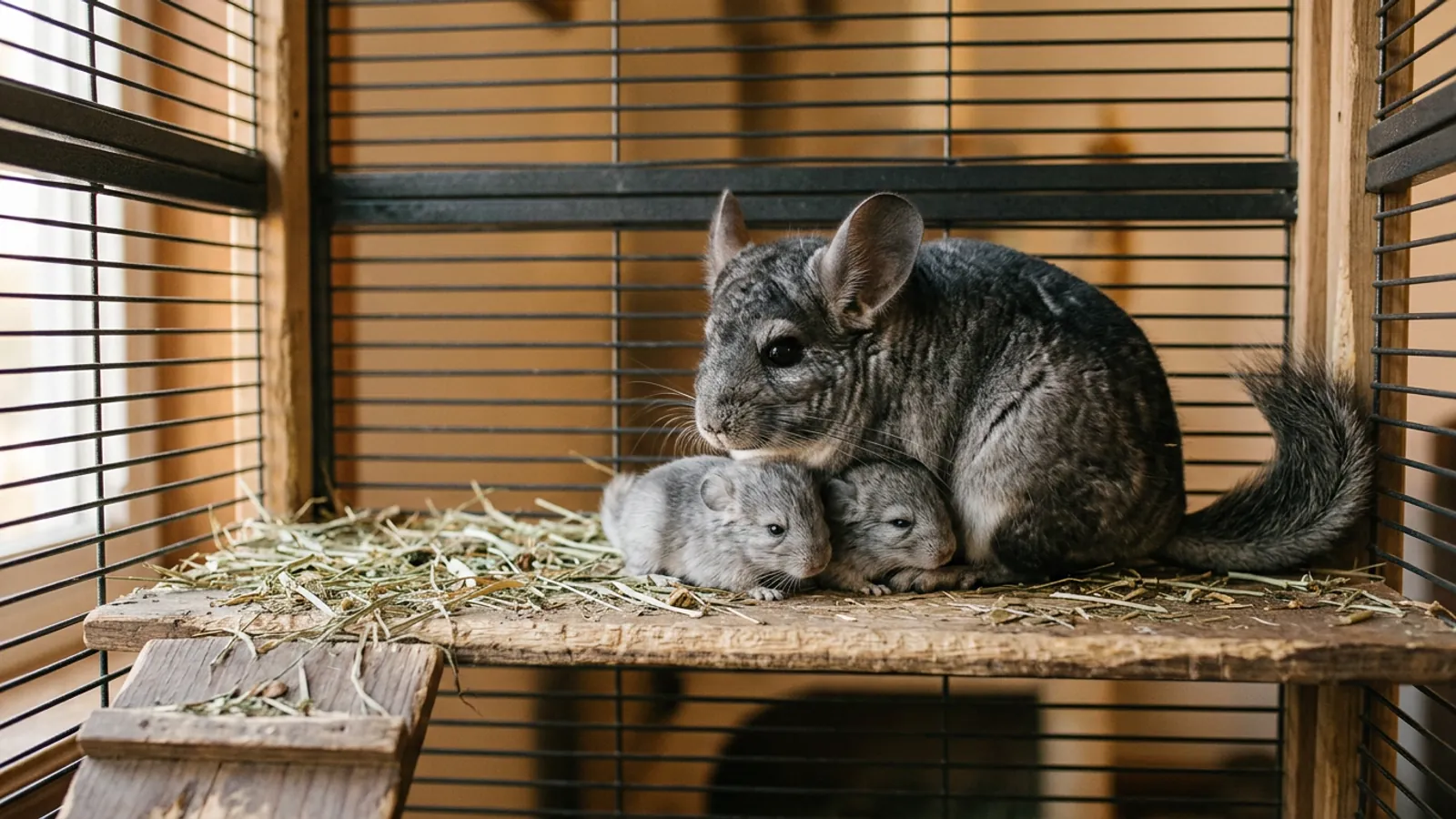
The number that shocks people is gestation. A chinchilla carries her kits for about 111 days. Reported ranges run roughly 105 to 120 days, and that spread is real, not sloppiness. For comparison, a rat is done in three weeks and a guinea pig in about ten. Nearly four months of pregnancy in a one pound animal is an enormous investment, and it exists for one reason: chinchilla kits are precocial. They are born fully furred, eyes open, teeth already erupted, and they are up and moving within an hour or so. There is no blind pink stage. The mother does the developmental work internally, which is exactly why the pregnancy costs her so much.
Litters are small. One to three kits is typical, two is about average, and larger litters of four or more happen but are the exception. Larger is not better here. A female's milk supply is the practical ceiling, and litters of three or more frequently need the keeper to rotate kits or supplement by hand, on a two hourly schedule, for weeks. A female carries kits in a uterus with two horns, and kits can be positioned in both, which is one of the reasons a birth that has stalled is so hard to read from the outside.
Chinchilla breeding age, and why the number matters
Physically capable and ready are two different things, and conflating them is the most common way a first litter goes badly.
Chinchillas can become sexually mature surprisingly early. Some individuals are fertile at around four months old; eight months is the more usual figure. That early end is why male kits left with their mother and sisters past weaning cause accidental litters with dismaying regularity.
Responsible chinchilla breeding age is later than maturity. The guidance I trust, and the one most experienced breeders work to, is not to breed a female before about eight months at the very earliest, with many waiting until closer to a year, and not before she is physically grown, which in practice means a body weight somewhere around 550 to 600 grams. A female bred at four or five months is still growing herself. Pregnancy then competes directly with her own development, and a small, immature female has a narrower pelvis and a higher risk of a birth that stalls. That is not a theoretical risk. A stalled birth in a chinchilla is a surgical emergency.
At the other end, the picture is less settled and I will say so plainly. Fertility declines with age and breeders generally retire females long before the end of their lives, which for a well kept chinchilla can be fifteen years or more. I have not seen good published data pinning down a precise retirement age, so treat anyone quoting one confidently with some skepticism.
What pregnancy does to a female, and what to watch
Confirming pregnancy at home is harder than people expect, because a chinchilla's coat hides everything. The reliable signal is weight. Weigh her weekly on a kitchen scale that reads in grams and write the number down. A steady climb over weeks is your evidence. Around the middle of the pregnancy her nipples typically become more prominent and pink and easier to find under the fur. Palpation and ultrasound are a vet's job, not yours; poking at a pregnant chinchilla's abdomen is a good way to injure kits.
Feeding does not change in kind, only in quantity. Unlimited grass hay stays the foundation of the diet, pregnant or not, and she will eat noticeably more of it.
Oxbow Western Timothy Hay, 9 lb box As an Amazon Associate I earn from qualifying purchases.
Pellets, the measured part of the diet, usually get increased during late pregnancy and lactation, since she is now feeding two bodies and then two mouths. Keep everything else stable. This is the worst possible moment to introduce a new food, a new treat, or a diet change, and the rules in what a chinchilla can and cannot eat apply with less margin than usual. Calcium supplementation during lactation comes up constantly in breeder discussions; the practice is common but the dosing advice floating around is inconsistent, so ask your exotics vet rather than dosing on a forum's say so.
Now the part I refuse to soften. Heat kills chinchillas, and a pregnant or nursing female is carrying extra metabolic load in a coat she cannot take off. The comfortable range is 60 to 70°F (15 to 21°C). Above 75°F (24°C) is risky, and 80°F (27°C) and up is an emergency, and it arrives faster when the air is humid. My first summer with Pebble ended with a night at the emergency vet after a heatwave near miss, and that was one healthy adult chinchilla with nothing else going on. Do not run a pregnancy through a room you cannot hold in range. Put a thermometer and hygrometer inside the room at cage height and read it.
digital thermometer and humidity gauge with remote probes As an Amazon Associate I earn from qualifying purchases.
A cooling stone gives an animal somewhere to dump heat and I keep them out year round, but be clear about what it is: a small help, not a substitute for controlling the room.
Kaytee Chinchilla Chiller granite stone As an Amazon Associate I earn from qualifying purchases.
If you are unsure how dangerous a given temperature and humidity combination is, the heat danger calculator will tell you, and the warning signs of heat stroke are worth knowing cold before you ever need them.
Line up an exotics vet who sees chinchillas, and their out of hours arrangement, before you pair anything. The calls that need a vet immediately are: straining hard for more than twenty or thirty minutes with no kit delivered, a kit visibly stuck, heavy or dark bloody discharge, a female who goes flat and stops eating, or anything you would describe as collapse. Retained kits, retained placenta, uterine infection, prolapse and pregnancy toxemia are all real outcomes, and none of them are home projects.
Birth, and the first weeks
Births often happen in the early morning. A healthy delivery is quick and largely uneventful, and the mother cleans and dries the kits herself. Newborn kits weigh somewhere in the region of 30 to 60 grams, and they will be up and stumbling around within the hour.
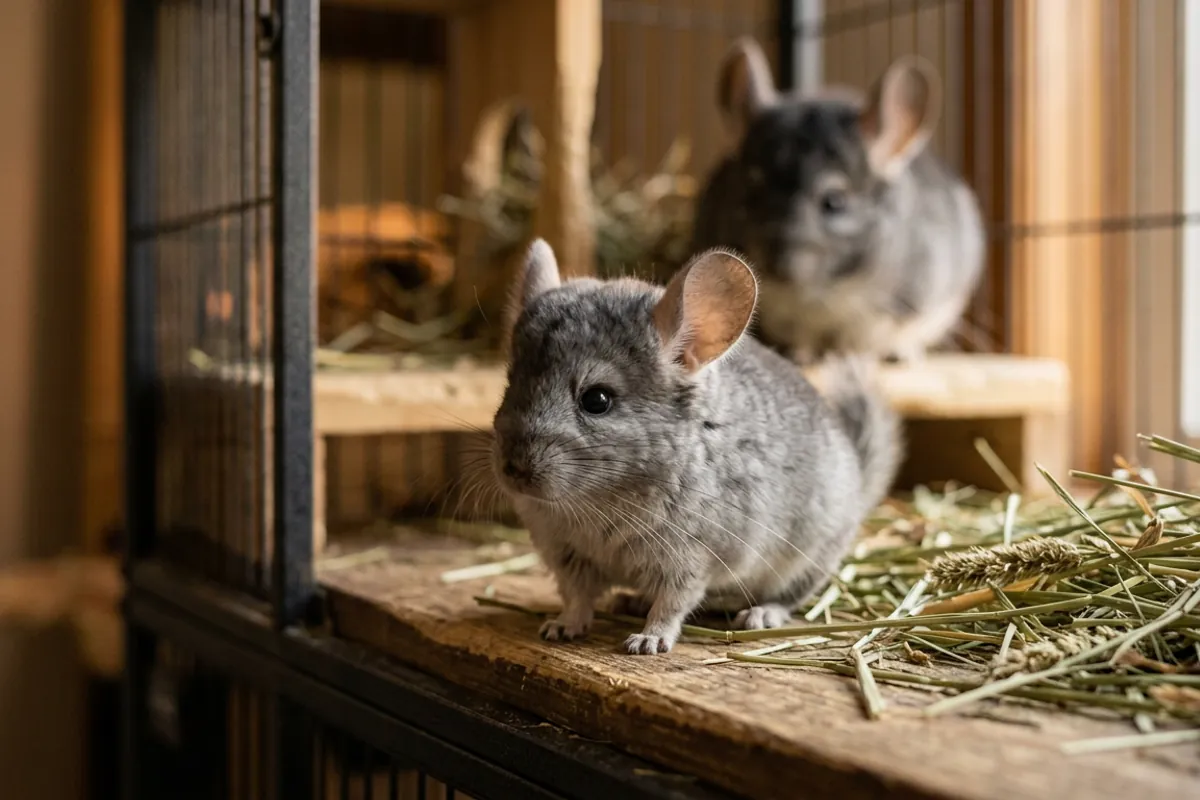
The single most important thing to understand about the day of birth: a female comes into estrus again within hours of delivering. If the male is in the cage, she will be pregnant again almost immediately, and back to back pregnancies with no recovery are how females get run into the ground. Separate the male before the due date, not after the birth. Housing him in a cage alongside hers, where they can see and smell each other, is the usual compromise, because chinchillas are social and an abruptly isolated male is a miserable one.
Weigh kits daily on a gram scale for the first few weeks. A kit that is not gaining is the earliest and often the only warning you get, well before it looks weak. Kits competing for a limited milk supply will squabble, and a mother who is short on milk or in pain can reject or injure a kit. Rotating kits in pairs, so each gets uninterrupted access, is the standard fix for a big litter, and hand feeding is a round the clock commitment for weeks if it comes to that.
Kits nibble hay and pellets within their first week or two while still nursing, and weaning lands at roughly six to eight weeks. Sex them at weaning and separate the males, from their mother and from their sisters both. Sexing chinchillas is easy to get wrong because males have no scrotum; you are judging the distance between the anus and the genital opening, which is short in females and clearly longer in males. If you are not certain, get someone experienced to check, because getting it wrong means an accidental litter out of an eight month old sibling pair.
A cage that will not kill kits
Standard adult chinchilla cages are not newborn safe. Bar spacing that comfortably contains an adult, commonly around an inch, lets a newborn kit walk straight out and fall. Line the lower section with hardware cloth, or set the mother up in a dedicated nursery cage before the due date. Everything else in my cage buying guide still applies: tall, metal and wood, wooden ledges, no plastic anywhere a chinchilla can reach it.
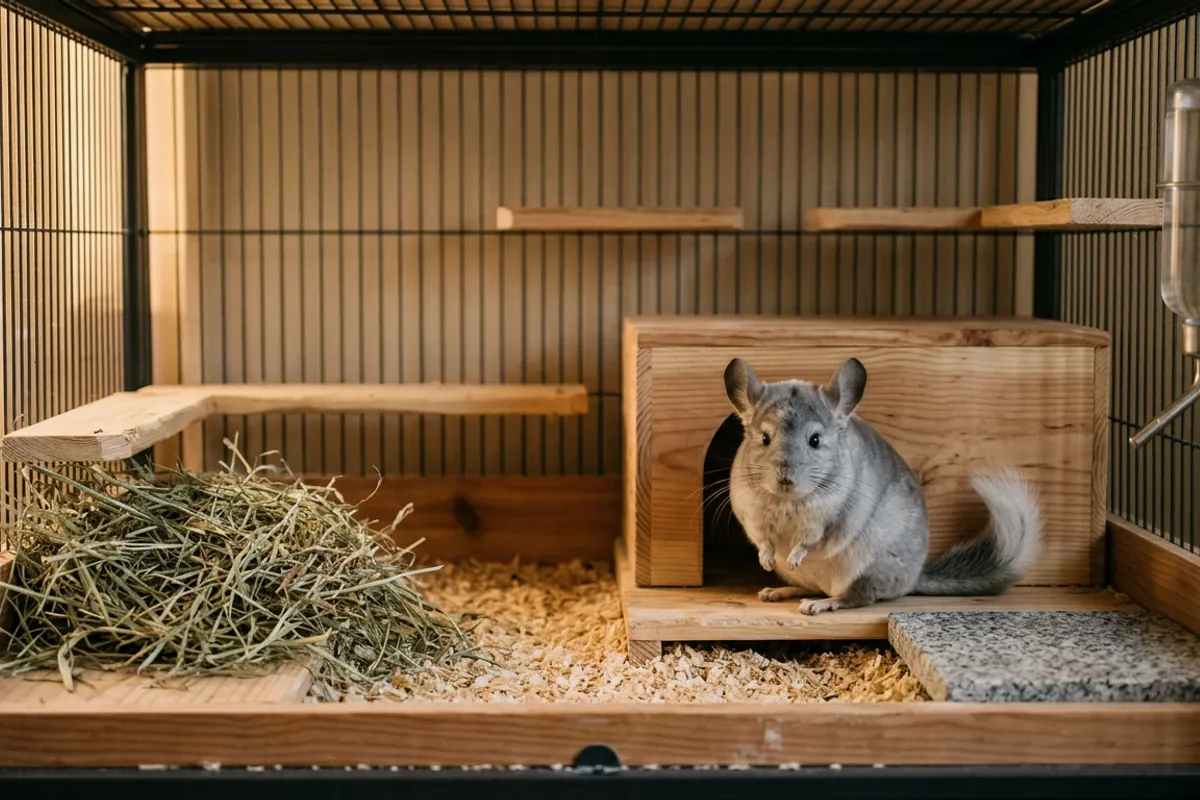
Critter Nation double unit small animal cage As an Amazon Associate I earn from qualifying purchases.
Take the wheel out entirely while kits are small. A wheel is a limb trap for an animal that cannot yet judge speed, and a nursing mother running hard is burning calories she needs. Put it back once the kits are weaned and steady. And to be blunt about equipment generally: a wire runged wheel has no place in any chinchilla cage at any stage of life, because it catches toes and breaks legs. A solid running surface is the only kind worth owning.
15 inch Chin Spin solid surface chinchilla wheel As an Amazon Associate I earn from qualifying purchases.
Drop the ledges. Kits climb long before they can judge a fall, and a fall from the top of a tall cage onto a hard pan is exactly the injury you would expect. Rearrange the interior so there is no drop of more than a foot or so until they are coordinated.
Most keepers pull the dust bath for a few days before the birth and for about a week afterwards, on the reasoning that fine dust in a birth canal that is still open invites infection. I want to be straight with you: I have not found real studies behind that practice, only long standing breeder convention, and I follow the cautious version because the cost of being wrong is asymmetric. After that the bath goes back to the normal schedule, and kits will start copying their mother in it within a few weeks. If you want the full picture on dust, the dust bath guide covers frequency and what to use, and note that chinchillas never bathe in water at any age.
Lixit Blue Beauty chinchilla dust, 3 lb As an Amazon Associate I earn from qualifying purchases.
Chews matter from the moment those kits start eating solids. Chinchilla teeth grow continuously for life, and my Juniper, a rescue whose dental disease I manage every single day, is the reason I will not shut up about hay and a genuine variety of safe wood.
emours apple wood chew sticks, 40 count As an Amazon Associate I earn from qualifying purchases.
Genetics, the founder bottleneck, and the pairings breeders avoid
Nearly every pet chinchilla alive descends from a very small founder group taken out of Chile in the 1920s, on the order of a dozen animals in a single shipment, with only a handful of later additions. That is an extraordinarily narrow base for a global population, and it means the pet chinchilla gene pool is already inbred before you do anything to it.
The practical consequence is that heritable problems are common and casual pairings concentrate them. Malocclusion, where the continuously growing teeth stop meeting and wearing correctly, has a strong hereditary component, and it is a slow, expensive, miserable way for a chinchilla to decline. I watch it up close. If you cannot name both parents of both animals and account for their dental history, you are gambling with kits who will pay the bill years later, and their new owners will pay it too. Spotting dental trouble early is worth reading either way. Fur chewing and a tendency to seizures are also widely suspected to run in lines, though the evidence there is weaker and I would not state it as fact.
Color genetics carry a specific hazard. Breeders avoid pairing white to white, and velvet to velvet, because the double dose of those genes is widely held to be lethal in utero. I have not seen this rigorously published, but it is consistent enough across serious breeders that I would not be the one to test it. The related point on color: violet is a real recessive mutation and "purple" is just a description of it, not a separate exotic type worth paying a premium for.
None of this can be assessed for an animal bought from a pet shop or a random classified ad, where the parents are unknown and the sexing is frequently wrong. My guide to buying without getting hurt or ripped off goes through what to ask.
Breeding chinchillas for profit is a math problem that does not close
Let me do the arithmetic that people asking about breeding chinchillas for profit usually have not done.
Gestation is 111 days. Average litter is two. Breed a female responsibly and you get perhaps one or two litters a year, so call it two to four kits annually per female. Each weaned kit needs its own cage or a compatible same sex companion, hay, pellets, dust, chews and space, for six to eight weeks minimum and often much longer if it does not sell. Read what a chinchilla costs and then multiply.
Against that, pet chinchillas sell cheaply, the market in most places is small and slow, rescues are full of surrendered animals, and one emergency cesarean can cost more than every kit in that litter would ever sell for combined. The only business model where the volume math has ever worked is fur, which is a different industry with different animals and different ethics, and it is not what anyone reading this is proposing.
Chinchilla breeding for profit is, in practice, a way to convert money and sleep into more chinchillas. The people who do it well and for decades do it because they care about the animals and the lines, and they subsidise it out of pocket. It is the same conclusion I reach in my account of keeping chinchillas as pets.
If you are going to do it anyway
Then do it properly, and have all of this in place before the two animals ever share a cage.
Have an exotics vet who has treated chinchillas, confirmed by phone, plus their out of hours plan written on the fridge. Know the pedigrees and dental history of both animals, and pass on the pairing if you do not. Quarantine and health check both before introduction. Own a gram scale and use it weekly on the female and daily on the kits. Have the nursery cage, the hardware cloth, the separate male housing and the temperature control ready in advance, not ordered in a panic. Line up homes for the kits before pairing, not after they are born, and commit in writing to taking any of them back for life if a home falls through. Keep records: dates, weights, outcomes, problems. That is what separates a breeder from someone who let two chinchillas share a cage.
And keep the room at 60 to 70°F through all of it. Everything else on this list is about doing it well. That one is about whether she survives.
Males bring one extra job, and hair rings are worth understanding before you ever find one.